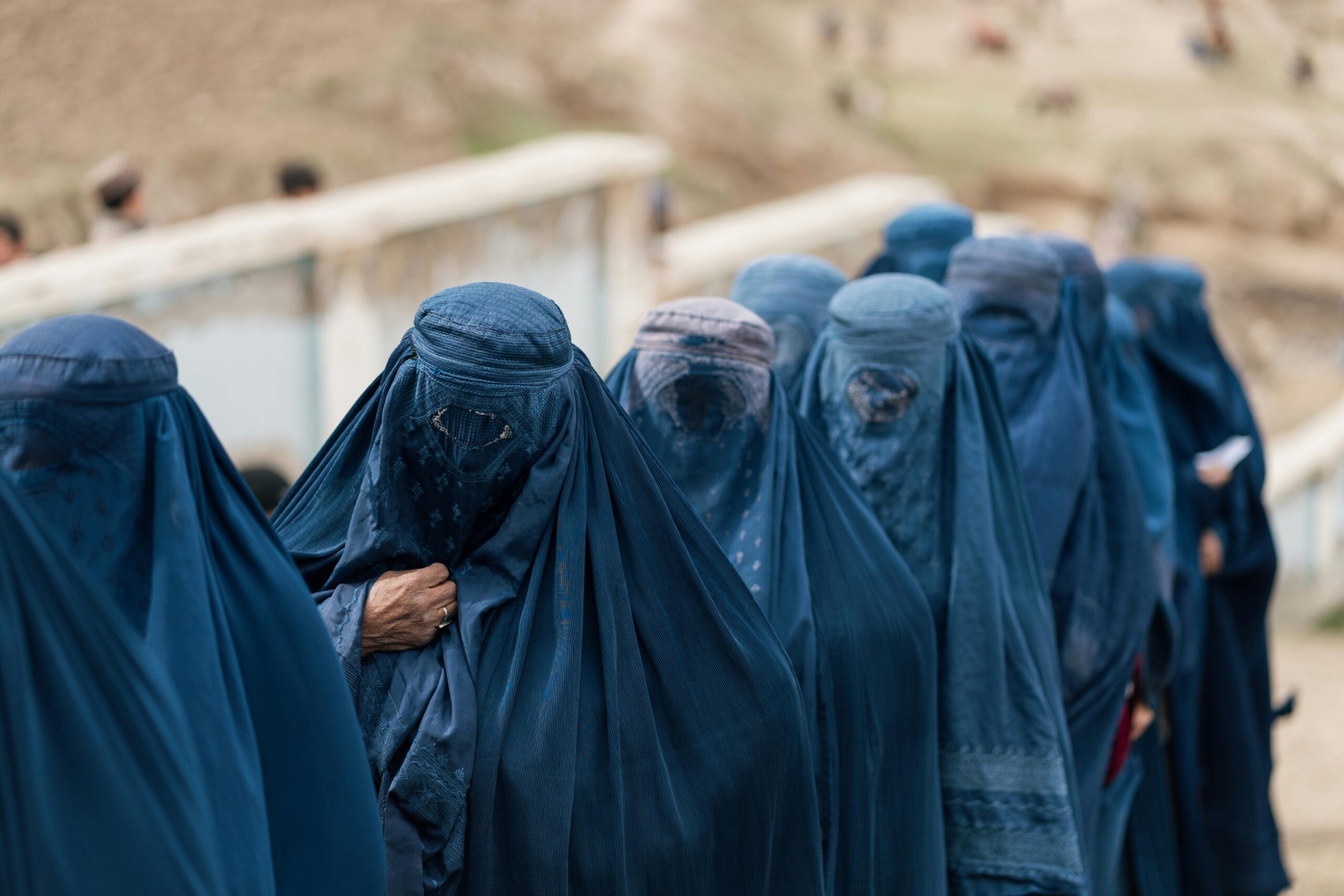
In Herat Province of Afghanistan, protests have occured over the ongoing arrests and beating of women until they fainted, for not wearing “proper hijab, Chadari or burqa”, by Taliban Morality Police.Taliban members shot some of the protesters in Herat.
Women wearing Burqa in Afghanistan.
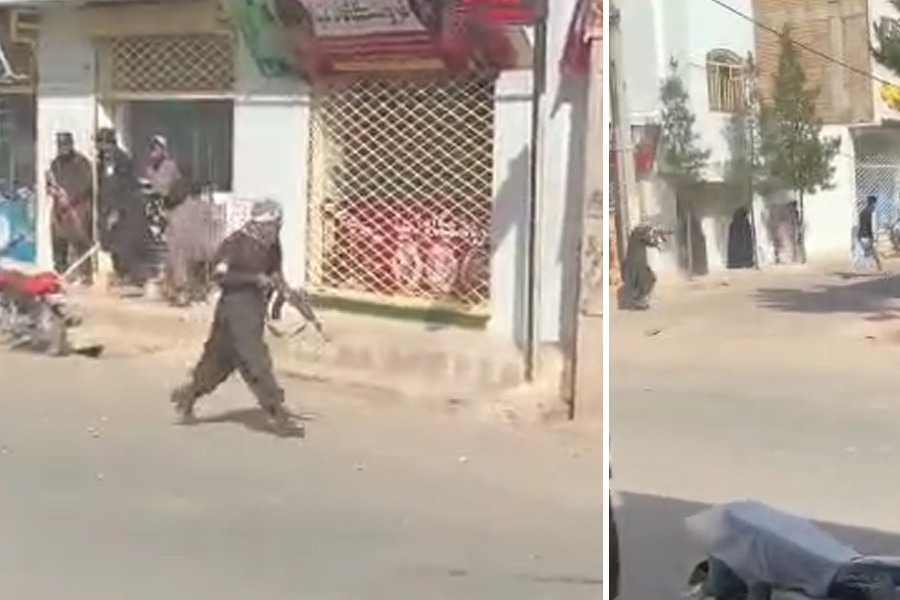
In Afghanistan, some residents from the Jibrail area of Herat Province held a protest rally this morning to protest the detention of women by the Taliban. Sources reported that residents chanting “Education, Work, Freedom” were met with gunfire from Taliban forces.
Afghanistan Women’s News Agency (AWNA) shared that the protest rally was suppressed by Taliban forces, who opened fire on the demonstrators.
The protests have raised over the ongoing arrests and harsh treatment of women by the Taliban’s Morality Police. This treatment of Taliban began on Saturday in various parts of Herat to forcefully make women to wear Chadari or burqa and warning that those who do not wear will be imprisoned.
The Taliban’s supreme leader, Hibatullah Akhundzada, formally endorsed a sweeping 119-article criminal regulation framework. Crucially, this regulation decentralized enforcement, effectively legalizing vigilante violence by stating that any citizen who witnesses a perceived “sin” (including improper dress) has a duty to stop it on the spot.
Photo: 8AM Media
According to 8AM Media, Taliban members have been detaining and beating women until they fainted, for wearing manteau coats. Women in Herat are saying that after these events of Taliban members beating women on the streets, the presence of women in public has dropped sharply, since women are afraid of going out even for the groceries.
ترس از بازداشت؛ حضور کمرنگ زنان در بازارهای هرات
همزمان با افزایش نگرانیها از بازداشت زنان بهدلیل رعایتنکردن حجاب مورد نظر طالبان، حضور زنان در جادهی لیلامی هرات در روزهای اخیر بهگونهی چشمگیری کاهش یافته است.
— Afghanistan Women News Agency (@AWNANEWS) June 9, 2026
Taliban shot protesters
Today (June 9th) local sources told 8AM Media reporters that Taliban members fired shots to disperse and suppress the protesters. They also reported that they can continuously hear the sound of ambulances and Taliban ranger vehicles throughout the area. The exact number of casualties remains unclear. In a video on social media, residents carrying wounded individuals away as gunfire is ongoing.
Herat Protests Continue Amid Reports of Taliban Gunfire
Sources in Herat told Aamaj News that several protesters were wounded after Taliban forces resorted to ‘live fire’ to break up the demonstrations.
At least four sources told the Afghanistan Women’s News Agency today, Taliban forces checked women’s attire and hijabs at the entrances to these halls before allowing people to enter in several places of Herat.
“’Improper Hijab’ is neither consistent with Islamic values”
Zarifa Ghafari Bashir who is a former female mayor of Maidan Shahr of Afghanistan, told on her X account:
“The Taliban violently cracked down on a peaceful demonstration of residents in Herat’s Jibril area who were protesting the detention of women and girls since last few days in Herat. Videos circulating online show Taliban forces firing shots to disperse the crowd and physically assaulting several protesters. This latest incident reflects the regime’s continued use of violence to silence dissent and suppress those who stand in solidarity with Afghan women.”
Nasir Ahmad Faiq, Afghanistan’s representative at the United Nations, told on his X account that the detention of women by the Taliban’s morality police carried under the pretext of “improper Hijab” is neither consistent with Islamic principles and values nor with the culture and traditions of the Afghan people. “How do Taliban enforcers consider themselves entitled to forcibly detain and transport women in public when they are not even their mahram (stranger/legal guardian)?” he asked, and continued “This comes amid credible and well-documented reports of violence, sexual abuse and rape in Taliban prisons, as well as forced marriages involving Taliban members – cases that have never been transparently investigated nor those responsible held accountable.”
Amnesty: “Every woman has the right to choose what to wear”
Regional Office of Amnesty International South Asia called on the Taliban to immediately disclose the whereabouts of the detained women, ensure their safe return, and end measures that target women because of their clothing:
“Reports of multiple women being arrested by the Taliban in Herat province for not adhering to their restrictive dress code are deeply alarming. It is a stark reminder of the continued crackdown on the rights of women and girls in Afghanistan. Every woman has the right to choose what to wear, move freely, participate in public life, and live without fear or intimidation.”
“These arrests are part of Taliban’s gender persecution”
Afghan Women Activist’s Coordinating Body which is a global protection network and diasphora advocacy group, told on their X account that “According to eyewitnesses, photos and video footage received from Herat, Taliban forces arrested women in public spaces simply because their faces were not fully covered. These arrests are not isolated incidents. They are part of the Taliban’s systematic campaign of gender persecution, fear and total control over Afghan women’s bodies, movement and existence.”
Statement by the Afghan Women Activists Coordinating Body on the Arrest of Women in Herat
The Afghan Women Activists Coordinating Body strongly condemns the reported arrest of dozens of women and girls by the Taliban in Herat under the pretext of “bad hijab”.
— Afghan Women Activist´s Coordinating Body (AWACB) (@AWACB_DE) June 7, 2026
Tahera Nasiri, The founder and head of the “Women’s Movement Towards Freedom” stated that “The Taliban are attempting to erase women from public life, making them increasingly vulnerable whenever they leave their homes”. To Nasiri, through systematic restrictions and oppression, Taliban seek to exclude women entirely from society and deny them their fundamental rights and freedoms.
“Shame on those who lobby for this regime or portray the current situation as normal. The reality is that women in Afghanistan continue to face severe discrimination, exclusion, and repression every day” she said.
The Taliban are attempting to erase women from public life, making them increasingly vulnerable whenever they leave their homes. Through systematic restrictions and oppression, they seek to exclude women entirely from society and deny them their fundamental rights and freedoms.… pic.twitter.com/RlizxHBiKn
— Tahera Nasiri ~ طاهره ناصری (@nasiri_tahera) June 8, 2026
According to data released by CİSST, as of June 2026, among the 421,583 inmates in prisons, at least 200 are LGBT+, 476 are disabled, and 14,276 are foreign nationals.
The Civil Society Association for the Penitentiary System (CİSST) released prison statistics for June 2026. According to these statistics, as of June, the 402 prisons in Turkey are housing 421,583 people, exceeding their designed capacity by 138.5%.
Data shared by CİSST indicates that 64,705 of these inmates are pretrial detainees, while 4,673 are children under the age of 18. The statistics also highlight that among these inmates, there are at least 200 LGBT+ inmates, 476 inmates with disabilities, and 14,276 foreign nationals.
There are 891 infants in prisons
According to CİSST, which notes that 4.8% of the inmates in prisons are women, there are also 891 infants and children under the age of six in prisons. The statistics compiled by CİSST reveal that prisons are not merely places of incarceration but also spaces where the elderly, children, people with disabilities, and infants living with their mothers are housed.
Report · CİSST
Overview
421,583
Total prison population
402
Number of prisons
304,390
Total official capacity
38.5% over capacity
Distribution by Detention Type
In closed prisons303,922
In open prisons117,661
Legal Status and Special Groups
356,878
Convicted prisoners
64,705
Pre-trial detainees (awaiting trial)
14,276
Foreign national prisoners
200+
LGBTI+ prisoners
Children and Women
4,673
Children aged 12–18 in prison
226 of them are girls
20,360
Women prisoners
891
Children aged 0–6 living with their incarcerated mothers
Age, Education and Work
6,680
Prisoners aged 65 and over
77,014
Prisoners continuing their education
58,500
Prisoners in insured employment
Prisoners with Disabilities (Total: 476)
Type of Disability
Number of People
Orthopedic disability
252
Visual impairment
96
Hearing impairment
68
Speech and language disability
34
Combined hearing and speech disability
26
Daily Food Allowance (2025)
₺144
Adult convicted prisoners, detainees and on-duty staff
₺275
Juvenile convicted prisoners and detainees
₺275
Children held with mothers, breastfeeding and pregnant inmates
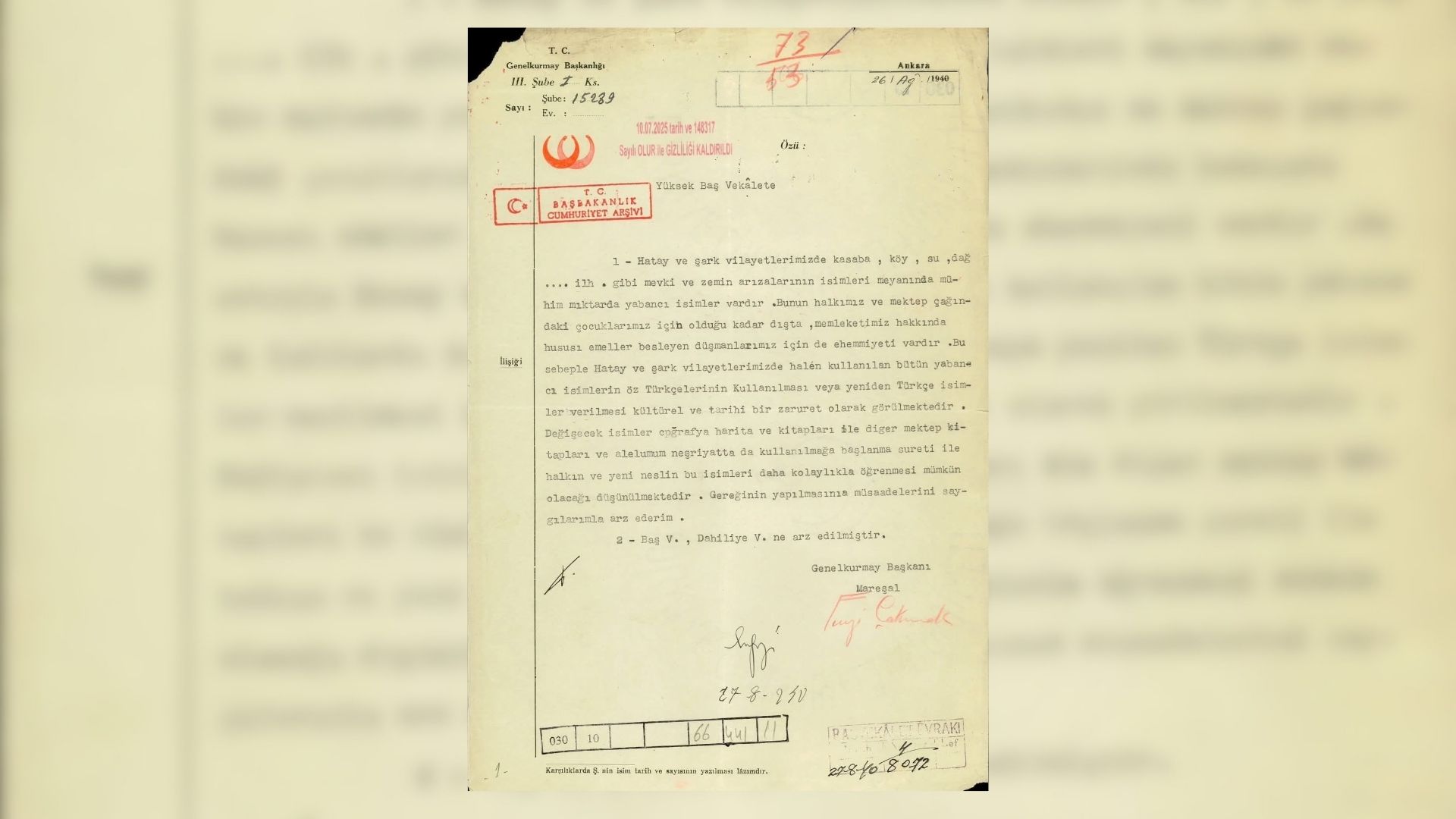
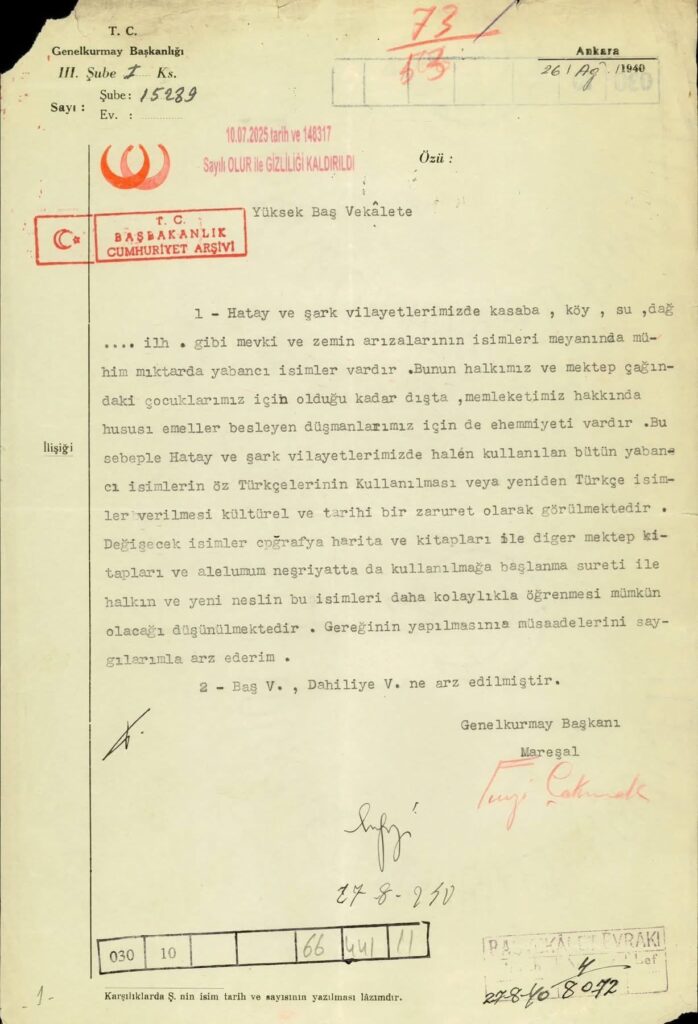
A Turkish General Staff document dated 1940 and declassified in 2025 proposes the Turkification of place names in Hatay and the eastern provinces, and the inclusion of these names in maps and educational materials.
A Turkish General Staff document from 1940, declassified in 2025, brings the Turkification of place names in Hatay and the eastern provinces to the agenda. The document suggests including the new names in maps and educational materials.
It is understood that the document, shared by researcher M. Saleh Ghaderi on his personal X account, has been newly declassified. Bearing the stamp “DECLASSIFIED with the APPROVAL dated 10.07.2025 and numbered 148317,” the document argues that changing the aforementioned names is a “cultural and historical necessity” and states the following:
“It is deemed a cultural and historical necessity to use the pure Turkish equivalents of all foreign names currently used in Hatay and our eastern provinces, or to assign them new Turkish names.”
The Education system is also part of the process
Another striking element in the document is that the name changes are not limited solely to administrative decisions. By proposing the use of the changed place names in geography books, maps, and other publications, the Turkish General Staff aims for the new generations to learn these names.
The text states that the new names should be included in educational materials so that “the public and the new generation can learn these names more easily.”
Enver Pasha’s directive is the starting point
The 1940 document also shows that the changing of place names was not a practice belonging to a single period alone.
In his recent interview published on Niha+, historian Namık Kemal Dinç states that the first comprehensive initiative regarding the changing of place names began with a directive sent to the provinces by Enver Pasha on January 5, 1916. The directive demanded the Turkification of Armenian, Greek, and Bulgarian place names.
Dinç notes that this approach continued during the Republican period, specifically targeting place names of Kurdish, Armenian, Syriac, Greek, Laz, and Georgian origin.
Institutional transformation
According to Dinç’s research, the practice acquired a systematic nature with the “Specialized Commission for Name Changing” (Ad Değiştirme İhtisas Kurulu) established in 1957. The commission, which included representatives from the Turkish General Staff, the Ministry of Interior, the Ministry of National Defense, the Ministry of National Education, the Turkish Language Association, and Ankara University, operated until 1978.
According to research, approximately 75,000 settlements were examined; official name change decisions were made for roughly 28,000 of them.
The “Politics of Memory” debate
Dinç evaluates the changing of place names not merely as an administrative regulation, but as the reconstruction of historical memory.
According to Dinç, the aim was to erase the traces of Anatolia’s multilingual and multicultural past and to create a new national memory.
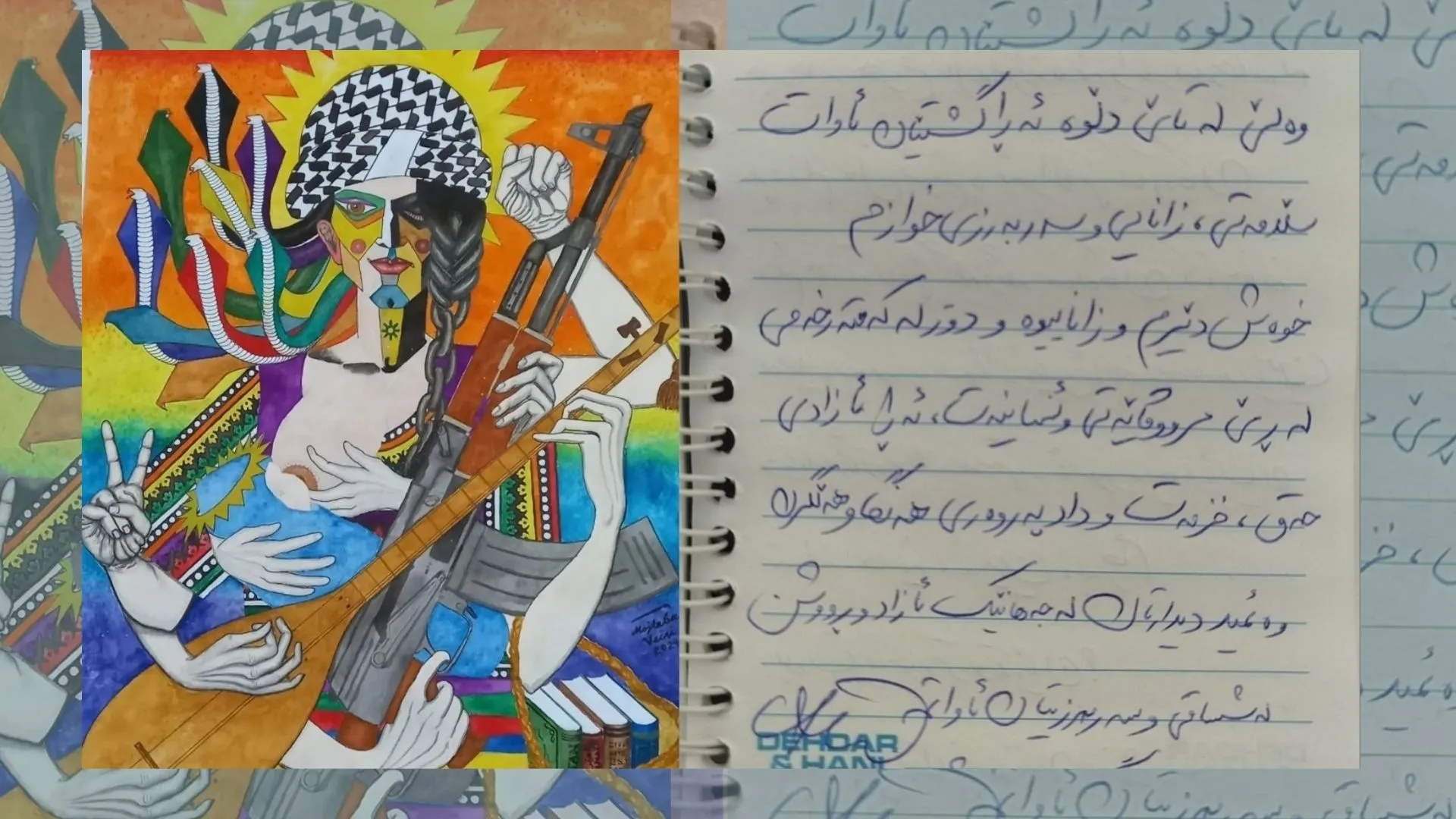
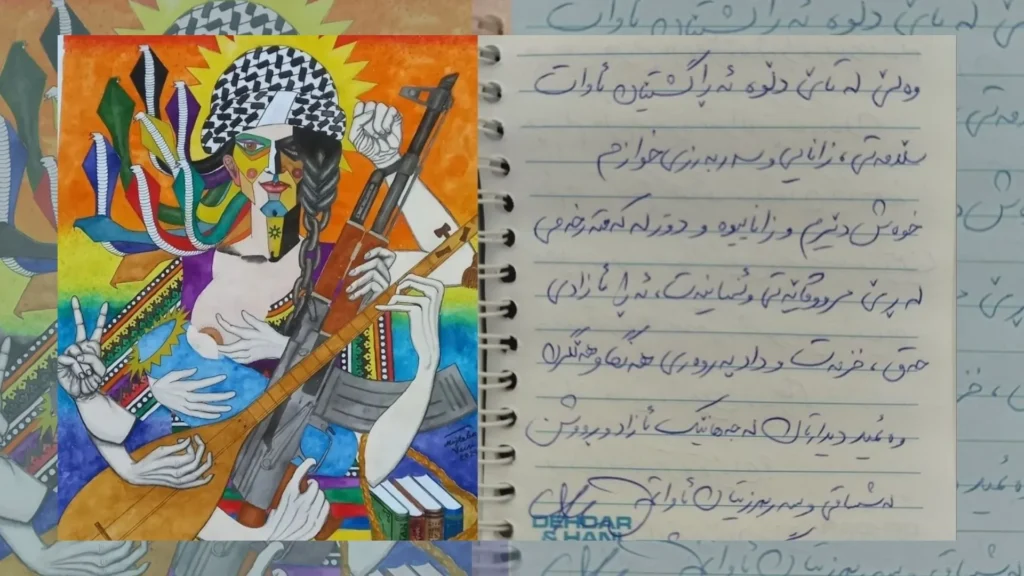
Since the ceasefire signed between Iran and the U.S. on April 7, dozens of Kurds have been executed and many others killed. The letter and watercolor paintings addressing children, created by Kurdish activist Mojtaba Waisi, who was most recently killed by the Revolutionary Guards, have been widely shared in the media.
The ceasefire, which began on the 40th day of the Iran-U.S. war (April 7) and was initially set to last two weeks, continues to be in effect officially under Pakistani mediation. While Iran continues its negotiations with the U.S., it has maintained its repressive policies within the country during this period and executed many Kurdish prisoners facing political and “security” charges.
Mojtaba Waisi: “Power must be used to serve humanity”
On May 28, Mojtaba and Maysam Waisi were shot and killed in their family home in the Mehdiye neighborhood (Dare Daraz or Dîrij) of Kermanshah by the Islamic Revolutionary Guard Corps. Following this incident, a letter written by Mojtaba Waisi to the children attending the library he founded, along with his artworks, came to light.
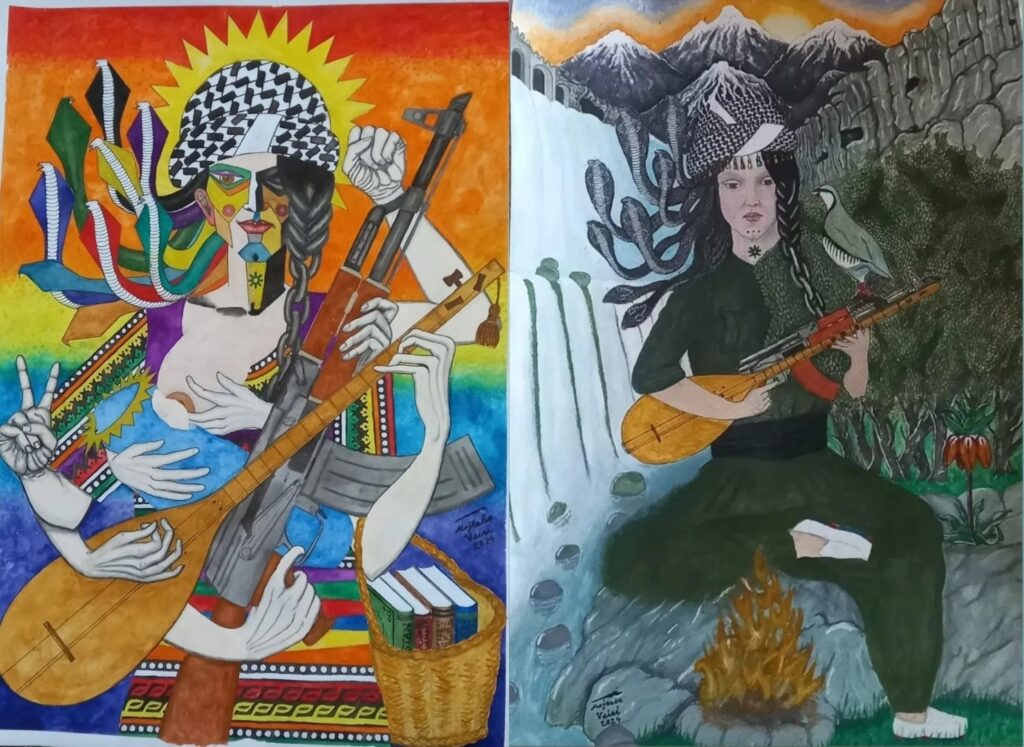
Signed artworks of Mojtaba Waisi.
It was learned that two of Mojtaba Waisi’s signed works depicting a Kurdish woman were created using watercolor.
Here is the translation from Sorani Kurdish to English of the two-page letter written by Mojtaba Waisi:
“Sometimes my feelings take flight toward that library where my soul flutters its wings for books. I miss every single child in that library: Mehiya, Mahbub, Sena, Aylin, Servinaz, Hena, Mübin, Diana, Atusa, Hesti, Alov, Negar, Ayda, Terane, Haniye, Aydın, Berhem…
I wonder if I’ll ever get to see them grow up and witness their futures? I don’t know if I’ll be able to bear witness to their futures and their adulthood. But from the depths of my heart, I wish each of them health, wisdom, and a life of honor. I love them; I wish for them knowledge and wisdom, to stay away from people’s tricks and deceptions, to be filled with humanity and reflect it, to have freedom, to seek justice, to serve the people, and to stand firm like ancient, noble oak trees. With the hope of seeing you in a free and enlightened world… The prosperity of the homeland and your greatness are my greatest wishes. May justice be with you; may justice be your supporter and refuge.
Under all circumstances, I am filled with despair and mental turmoil. Despair regarding an uncertain future… A despair stemming from not knowing what will happen, from being unable to foresee how events will unfold. How long will this situation continue? Will this tyrant’s reign come to an end—will this era of oppression finally cease? Or will another tyrant rise in his place? Will this vicious cycle repeat itself once more? How will the dictator’s power be overthrown and shattered?
Should the brave pay the price of freedom with their lives and all they possess, while the dishonorable and cowardly seize power and arrogance and ascend to the throne of rule and governance? Should those noble people who fought and lost their lives leave behind nothing but their photographs, now confined to prisons? Will the result of my comrades’ efforts and deaths be that the power over the nation’s future falls into the hands of those who seek it solely for their own interests? Yet power must be used to serve people and humanity. Before long, the bonds and chains of this captivity will be forged anew…
But the sorrow of rising up to fight against the oppressors is not a source of despair for me; on the contrary, it is the very essence of the flow of life and the meaning of existence. In this empty and meaningless world where I have found my own meaning, merely surviving and bowing to oppression out of fear of death is nothing but shame and humiliation.
Yours faithfully,
Your supporter and defender.”
According to the Kurdistan Human Rights Network (KHRN), the two brothers had previously been subjected to repeated pressure, threats, and detention by security forces due to their cultural activities and participation in anti-government protests.
It was reported that approximately one year ago, the two brothers, along with other cultural and literary activists, contributed to the establishment of the Darreh Drezh Kurdish library and organized cultural and artistic events to foster a sense of social solidarity among children and youth in the impoverished region. It is also known that the two brothers participated in the organization of many Newroz celebrations in the city and carried out various artistic projects in Kermanshah.
Deaths continue after the ceasefire
Since the ceasefire declared between Iran and the U.S. on April 7, 2026, the Iranian regime’s arrests, political executions, capital punishments, and attacks on Kurdish regions have continued. Human rights organizations have reported that this repression and the massacres have continued even after the ceasefire.
Individuals killed and executed by the Iranian regime following the April 7 ceasefire
April 7, 2026
Mohsen Eslamkhah
Hana Human Rights Organization reported that Mohsen Eslamkhah, a detained individual from Bukan, has been sentenced to death by the judiciary of the Islamic Republic of Iran.
April 14, 2026
Ghazal Mawlan
Ghazal Mawlan, an 18-year-old Komala member who was severely injured during Iran’s drone strike targeting opposition groups in the Kurdistan Region of Iraq, has passed away. Human rights organizations reported that some hospitals refused to provide treatment due to fear of political pressure.
April 17, 2026
3 killed in attack on PDKI camp
Following the ceasefire, three people lost their lives in an attack carried out by Iranian unmanned aerial vehicles on a PDKI camp in Iraqi Kurdistan. Two women were among the deceased.
April 25, 2026
Nasser Bakerzadeh
The Supreme Court of Iran upheld the death sentence of Nasser Bakerzadeh, a 26-year-old Kurdish prisoner detained in Orumiyeh Central Prison.
May 2, 2026
Nasser Bakerzadeh and Yaghoub Karimpour
In the early hours of May 2, Nasser Bakerzadeh, a Kurdish Sunni, and Yaghoub Karimpour, a disabled Azerbaijani Turk Yarsani citizen, were secretly executed in Orumiyeh Central Prison without prior notification to their lawyers or families. It was noted that prison authorities have since prevented the handover of their bodies. KHRN learned that both individuals had been transferred from the general ward to a security unit in the city on April 30, where they were pressured to record forced video confessions.
May 4, 2026
Mehrab Abdollahzadeh
Kurdish political prisoner Mehrab Abdollahzadeh was secretly executed in Orumiyeh Central Prison without any prior notification given to his family or defense lawyers. Security forces refused to hand over his body to his family.
May 21, 2026
Ramin Zaleh and Karim Maroufpour
Two Kurdish political prisoners, Ramin Zaleh and Karim Maroufpour, who were sentenced to death on charges of “armed rebellion,” were secretly executed in Naqadeh Prison in the early hours of May 21. No prior notice was given to their families or lawyers.
May 23, 2026
Ghazi Kawani
According to reports received by the Hana Human Rights Organization, Ghazi Kawani, a Kurdish shopkeeper from Doletu village in Sardasht County, passed away on May 23 due to severe injuries. Kawani had been critically wounded a few days earlier by direct fire from the armed forces of the Islamic Republic of Iran along the Jasousan border corridor.
May 28, 2026
Waisi brothers
Mojtaba Veysi and Meysam Veysi, two Kurdish Yarsani brothers and cultural activists from Kermanshah, were killed by the Islamic Revolutionary Guard Corps (IRGC) forces on May 28 in Ghaleh-Kouhesh village, located in the Dalahu county of Kermanshah province.
May 28, 2026
Ramazanpour and Marefati
Esmaeil Ramazanpour, 38, residing in Yazd, and Arman Marefati, a 30-year-old Kurdish civilian from Saqqez in Kurdistan Province, were sentenced to death on charges of “enmity against God” in connection with the December 2025–January 2026 protests.
May 30, 2026
Raouf Sheikh-Maroufi and Mohammad Faraji
Hana Human Rights Organization learned that the Supreme Court upheld the death sentences of two Kurdish political prisoners, Raouf Sheikh-Maroufi and Mohammad Faraji. The cases of these two individuals, who reside in Bukan and were detained during the “Woman, Life, Freedom” uprising, have been referred to the Sentence Enforcement Branch.
767
The number of reported detentions during the period from the ceasefire to April 21.
36
The total number of executions reported by KHRN during the war and ceasefire process.
Sources: Kurdistan Human Rights Network (KHRN), Iran Human Rights (IHRNGO), Center for Human Rights in Iran (CHRI). Chronological data only covers deaths, executions, and attacks reported after the April 7, 2026 ceasefire.
*This infographic was created with AI tools, utilizing data from the specified sources.
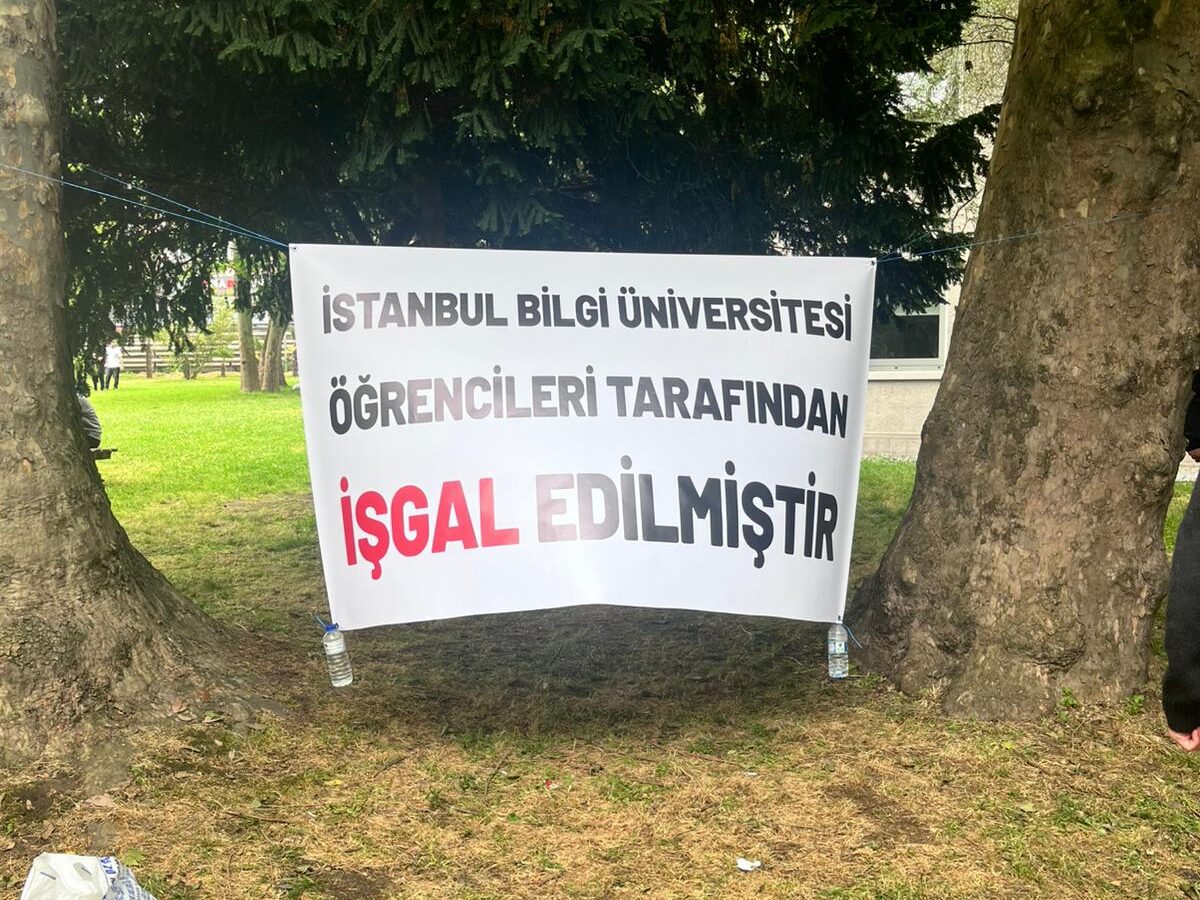
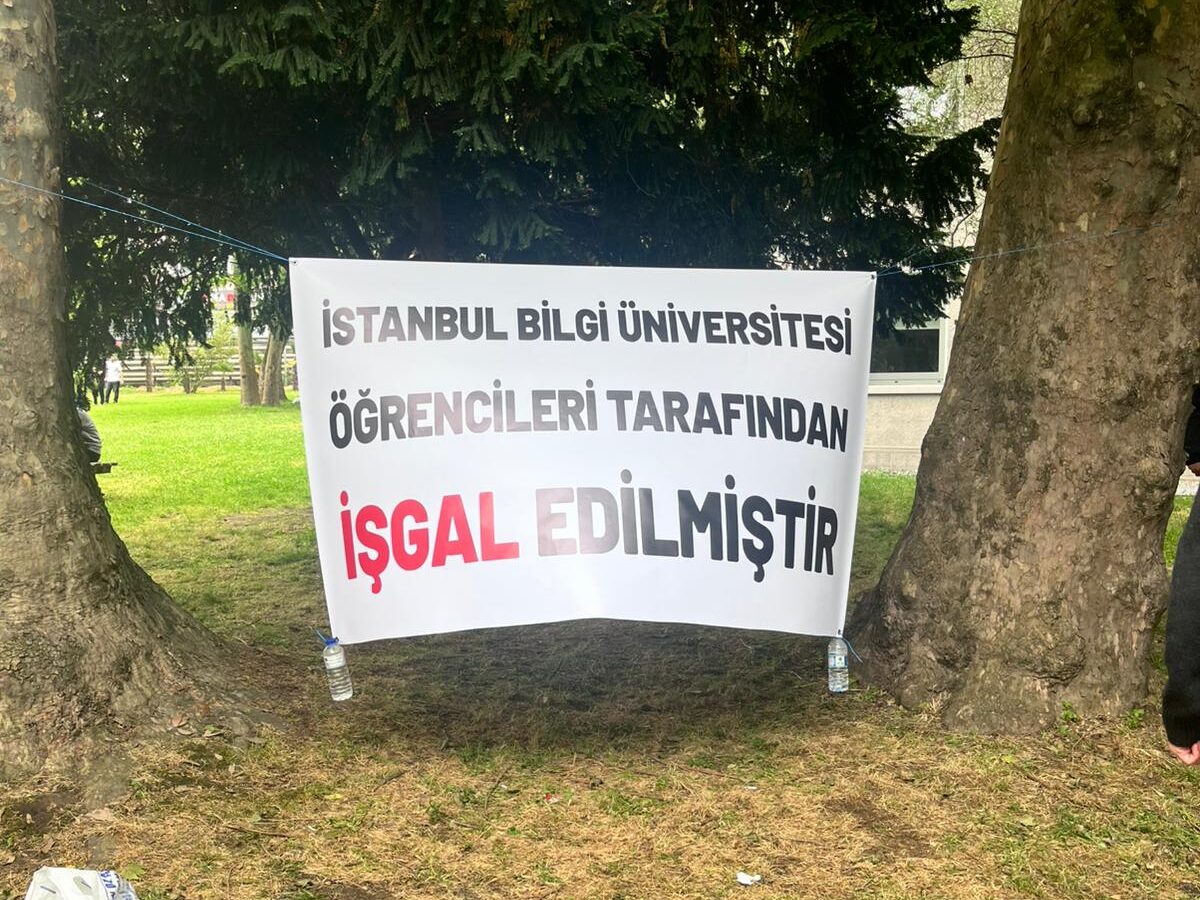
Following the closure of Istanbul Bilgi University by a presidential decree issued on May 22, students, faculty, and staff protested the decision for three days. On the night of May 24, it was announced that the closure order had been revoked by another presidential decree.
Istanbul Bilgi University, Santral Campus. Photo: Sosin Aslan
Following the closure of Istanbul Bilgi University, announced in a decision by President Recep Tayyip Erdoğan published in the Official Gazette on the night of May 22 without any prior notification to students, faculty or staff, protests broke out on the university campus. Three days after the closure, another presidential decree announced that the university had reopened. What happened during those three days?
Day one (May 22)
On the night of May 22, the decision to close Istanbul Bilgi University was published in the Resmi Gazete. Issued under Article 11 of the Additional Provisions of Law No. 2547 on Higher Education, this decision allows the Council of Higher Education (YÖK) to suspend the operations of higher education institutions established by foundations if YÖK determines deficiencies in their educational standards and these are not rectified despite warnings.
YÖK and the university administration issued a statement early this morning assuring that no one would be left in a difficult situation. Shortly after the statement, the Bilgi University Student Solidarity group reported that employees’ meal cards and private health insurance had been canceled.
Students, faculty members, and staff gathered at the Santral Campus at 2:00 p.m. to protest the decision. Entrances were blocked by riot police with barricades, and the historic gate of the university was locked. Security units allowed students onto the campus but initially did not allow graduates to enter. Later, through negotiations led by graduates and union members, many people were able to enter the campus. Several unions, including the Private Sector Teachers’ Union (Özel Sektör Öğretmenleri Sendikası) and Eğitim-SEN, were present on campus.
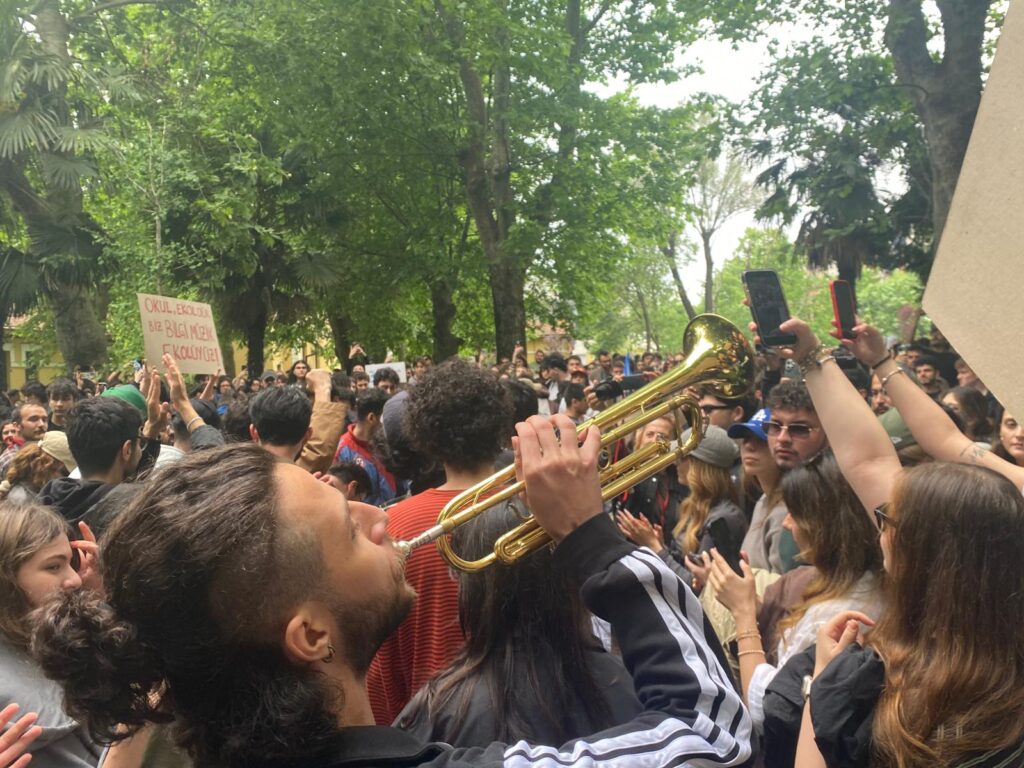
A march was held to the Rector’s Office, where press statements were made in front of the building, followed by the launch of an indefinite sit-in on the campus lawns. After speeches and chants, the Music Department of Istanbul Bilgi University also arrived at the sit-in site with their instruments.
Photo: Doğa Tekneci / Niha+
Students organized a forum in the evening. After the forum, everyone on campus spent the night inside the university. As a result of negotiations with the Rector’s Office, decisions were made to provide housing for students staying on campus, set up an event tent, allow access to food and water, prevent students inside from being removed, and resume in-person education after the holiday.
Day two (May 23)
At 2:00 PM, everyone gathered on campus. This time, graduates and union members were not permitted entry. A unionized faculty member had their foot trapped in the door by private security. Following negotiations, entry was finally permitted.
Students organized a press conference to demand that the university be nationalized and resume operations within three days. They chanted slogans such as “Knowledge belongs to us, and it will remain ours,” “Knowledge is here with its professors,” and “Long live student solidarity.” A march was held to the Rector’s Office building, where a sit-in and a forum were held. During the forum, some academics and Rector Ege Yazgan pledged that the rights of everyone at Istanbul Bilgi University would be protected.
Faculty and students from the Music Department at Istanbul Bilgi University gave a concert. The students spent the night at the university again.
As night fell, the number of riot police and detention vehicles in the university parking lot increased significantly. At midnight, Rector Ege Yazgan announced that the campus would be effectively closed. The decision was put into effect, with entry prohibited for students, faculty, and alumni, and it was stated that no food or water supplies would be allowed in from outside.
Day three (May 24)
Police and private security personnel did not allow students or staff to enter the campus from outside.
People outside threw food and snacks over the fences to the students inside.
Students inside the campus were forcibly removed through torture. Police used physical violence and pepper spray against the students. Many injured students reported instances of torture through journalists covering the news. It was noted that some students had blood on their faces, arms, and legs.
Following the police intervention against the students, around 5:00 p.m., students and staff held up a banner reading “Honk for Bilgi” and called out to passing cars on the street. After everyone was forcibly removed from the campus, the sit-in continued in front of the college.
According to information published in the Resmi Gazete late at night, the decision to close Bilgi University was withdrawn by a presidential decree.
YÖK President Erol Özvar stated in a post on his social media account this morning (May 25) regarding the matter: “The initial decision was a mandatory legal procedure that had to be carried out within the framework of current legislation. However, based on the reports submitted and the assessment of the current situation, our President, as always, has carefully considered the expectations of our students, their families, and university staff.”
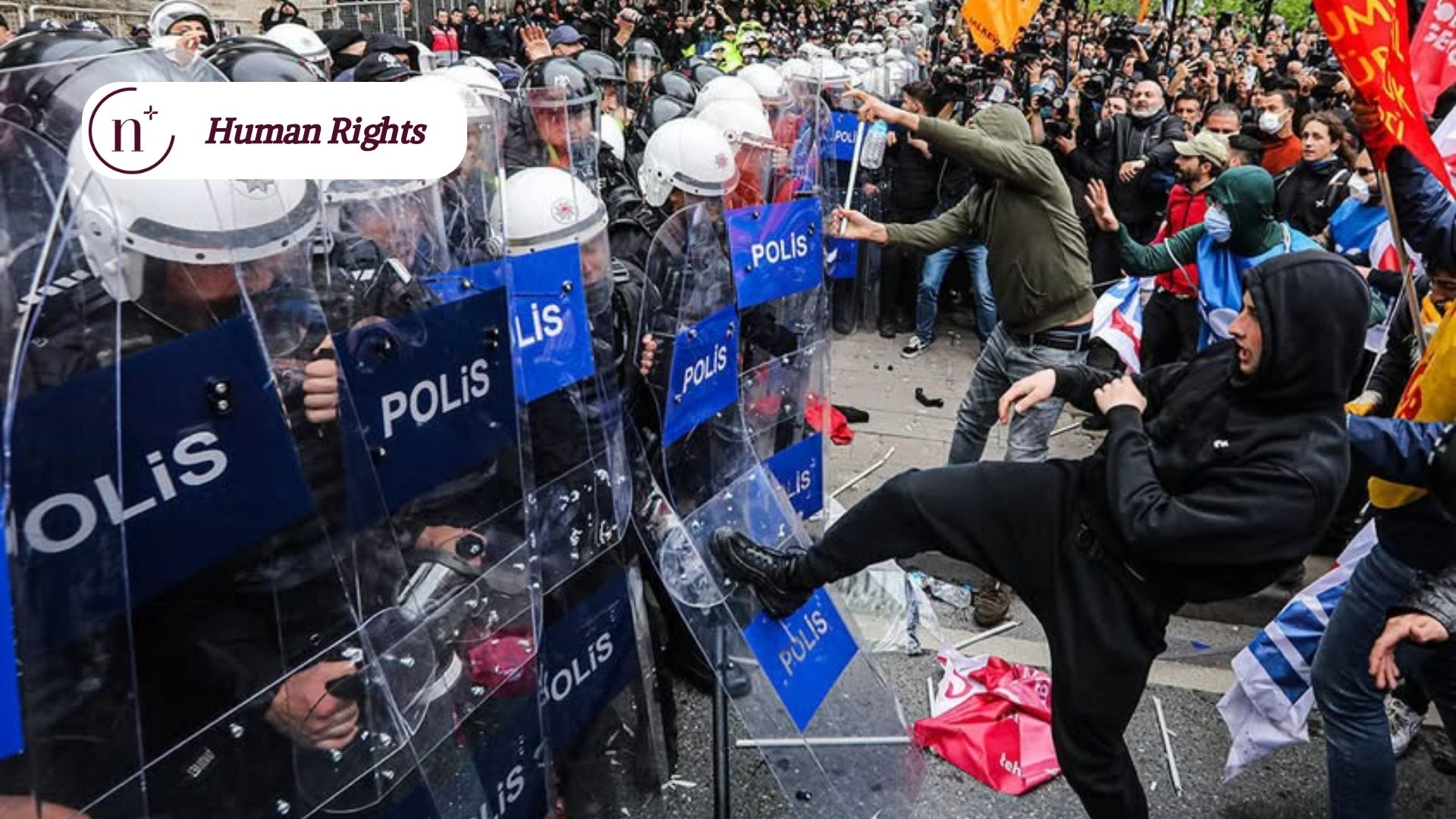
May 1st in Turkey, lastly celebrated in Taksim Square in 2012. We have compiled a chronicle of May 1st celebrations marked by police interventions and mass detentionsagainst the ban on Taksim.
Photo: Murat Bay
Since 1976, May 1st in Turkey has been defined by the persistence of workers to reach Taksim Square. Following the “1977 May Day Massacre,” the square became both a symbol of labor rights and the country’s most contested protest site. Despite long-standing bans, unions and leftist organizations continue to claim Taksim as the traditional heart of May Day celebrations.
Here is a summary of the events following the ban on Taksim Square over the last 13 years:
May Day in Istanbul from 2013 to 2025: The Taksim ban, police interventions, mass detentions, and the ongoing struggle.
1,000+
Total detentions (at least)
13 years
Ongoing Taksim ban
100+
Total number of arrests
2013
Following its reopening in 2010, Taksim was banned once again. The Governor’s Office cited the “pedestrianization project” as the reason. Extraordinary security measures were taken across the city; bridges were raised, and roads were closed. Hours-long police interventions occurred in many areas, particularly Beşiktaş and Şişli. Even hospitals and homes were affected by tear gas. It was reported that 30,000 police officers were deployed to Taksim that day. According to the Governor’s Office, 25 protesters (3 serious), 6 journalists, and 22 police officers (3 serious) were injured.
72 detentions
2014
Taksim Square was completely cordoned off. Intense tear gas and water cannons were used throughout the day in Şişli, Mecidiyeköy, and surrounding areas. Health institutions and journalists were also impacted by the interventions.
171 detentions • 12 journalists injured
2015
Entry to Taksim was prohibited. Only a limited number of unions were allowed to lay wreaths at the monument. Interventions targeted small groups across the city. Allegations surfaced regarding police entering political party buildings.
203 detentions, 13 arrested
2016
Celebrations were moved to Bakırköy. Despite this, interventions continued against groups attempting to reach Taksim. Various political and union groups were redirected to alternative areas. A citizen named Nail Mavuş lost his life after being crushed due to an uncontrolled maneuver by a water cannon vehicle (TOMA).
231 detentions, 5 arrested
2017
The Taksim ban remained in effect. Groups gathering at various points in Istanbul were detained, including individuals attempting to hold sit-in protests.
165 detentions
2018
The Governor’s Office rejected all applications. The rally site was moved to Maltepe. Taksim was sealed off with barriers starting from the early hours of the morning.
84 detentions
2019
Interventions were carried out against groups gathering in Şişli. Detentions of those attempting to march toward Taksim continued throughout the day.
119 detentions
2020
Curfews under pandemic conditions were cited as grounds for restrictions. Reports included allegations of ill-treatment, assault, and reverse-handcuffing during detentions.
48 detentions
2021
Despite the curfew, groups attempting to march to Taksim faced harsh intervention. Union representatives were among those detained.
212 detentions
2022
After a two-year hiatus, a mass rally was held in Maltepe. Groups heading toward Taksim were once again blocked, leading to further detentions.
100+ detentions
2023
Numerous groups attempting to march to Taksim from Şişli and Beşiktaş were detained. There were attempts to prevent members of the press from recording the events.
80+ detentions
2024
The Constitutional Court (AYM) ruled that Taksim is a legitimate May Day site and declared the Governor’s ban a “rights violation.” Thousands gathered in Saraçhane to march to Taksim, but police blocked the route with barricades. The confrontation lasted approximately 1.5 hours, followed by house raids. In 2025, the court found the ban to be unlawful.
268 detentions, 77 arrested
2025
Operations were conducted against organizations calling for a Taksim gathering. Throughout the day, barricades in Mecidiyeköy were challenged amidst ongoing interventions. According to the Progressive Lawyers Association (ÇHD), a total of 419 people, including 10 children and 11 lawyers, were detained in Şişli.
419 detentions, 13 arrested
Source: Human rights organizations and press compilations.
2013: The return of the ban
After allowing celebrations in 2010, the AKP government reimposed the ban in 2013. The Governor’s Office cited a “pedestrianization” project as the reason.
30,000 officers were deployed.
Bridges of Galata and Unkapanı were dismantled to block access.
Police used tear gas and water cannons against groups in Beşiktaş and Şişli. Tear gas was fired at ambulances and into the garden of Şişli Etfal Hospital.
At least 72 people were detained.
2014, May 1
Taksim was closed to everyone except police and accredited journalists.
While small pro-government unions were briefly allowed to lay wreaths, others faced heavy intervention in Tarlabaşı, Şişli, and Beşiktaş.
22 people were hospitalized with fractures, 12 journalists were injured by gas canisters and rubber bullets.
171 people were detained.
2015, May 1
Unions like DİSK and KESK insisted on Taksim, but were blocked.
Police fired tear gas into the CHP district building in Beşiktaş.
203 people were detained; 13 were officially arrested.
2016, May 1
Major unions (DİSK, KESK, TMMOB, TTB) decided to hold the main rally in Bakırköy for this year only. However, other leftist groups still marched toward Taksim.
231 detentions and 5 arrests near Beşiktaş and Şişli.
2017, May 1
The Interior Minister announced Taksim would remain closed. Main unions moved to Bakırköy again.
165 people attempting to reach Taksim were detained across various districts.
2018, May 1
Main unions moved to Maltepe, while socialist groups headed for Taksim.
The square was completely surrounded by barriers early in the morning; even journalists were barred.
84 people were taken into custody.
2019, May 1
Groups gathered at Şişli Cevahir Mall to march to Taksim but were met with police intervention.
119 people were detained.
2020, May 1
During the pandemic, 48 people were detained. Lawyers from ÇHD reported that detainees were subjected to “plastic handcuff torture,” beatings, and insults. One person’s arm was broken during the intervention.
2021, May 1
Despite a lockdown and rejected applications, unions tried to march from Dolmabahçe.
212 people were detained, many of whom were dragged on the ground. DİSK President Arzu Çerkezoğlu was among those detained.
2022, May 1
After a two-year pandemic break, mass celebrations returned.
At least 100 people were detained while trying to reach the square from multiple points. The official rally was held in Maltepe.
2023, May 1
Groups from various unions and socialist parties attempted to walk from Şişli and Beşiktaş.
At least 80 people were detained.
2024: The Saraçhane barricade
Unions and the CHP gathered at Saraçhane to march to Taksim, citing a Constitutional Court ruling that the ban was illegal.
Police formed a massive barricade under the historic Bozdoğan Aqueduct.
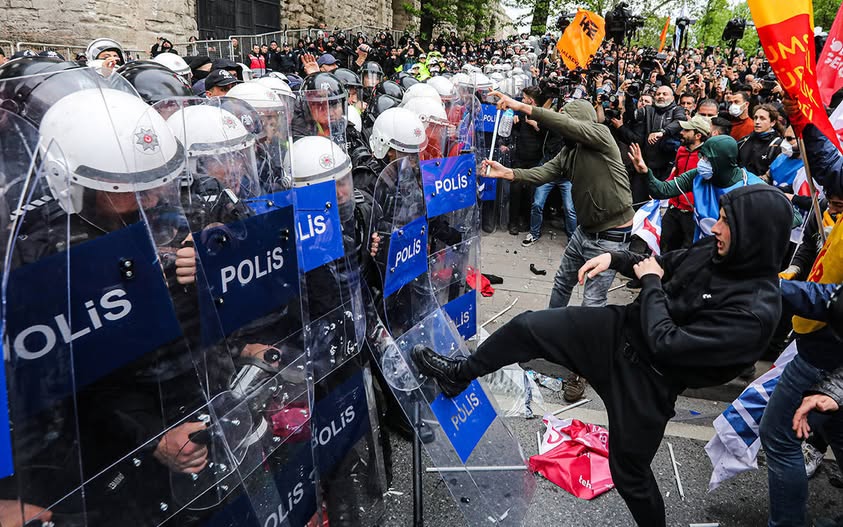
Police used water cannons, tear gas, and rubber bullets.
210 people were detained on the day, 47 more were taken in during house raids on May 3.
Governor Davut Gül stated, “The state may leave it for tomorrow, but it won’t let it go unpunished.”
2025, May 1
A new May 1st organizing committee declared “Taksim belongs to the people.”
Police operations targeted organizers on April 29 and 30, around 92 people were detained.
Protesters repeatedly challenged police barriers in Mecidiyeköy throughout the day.
407 people were detained, 7 were arrested. Reports of reverse-handcuffing and police brutality were documented in Mecidiyeköy.
Elevatorz NG, the Nigerian guests of the International Amed Theater Festival, surprised the audience by blending their modern performance with the Kurdish dance Cida: “Movement is a universal language; this warm welcome in Diyarbakır made us feel right at home.”
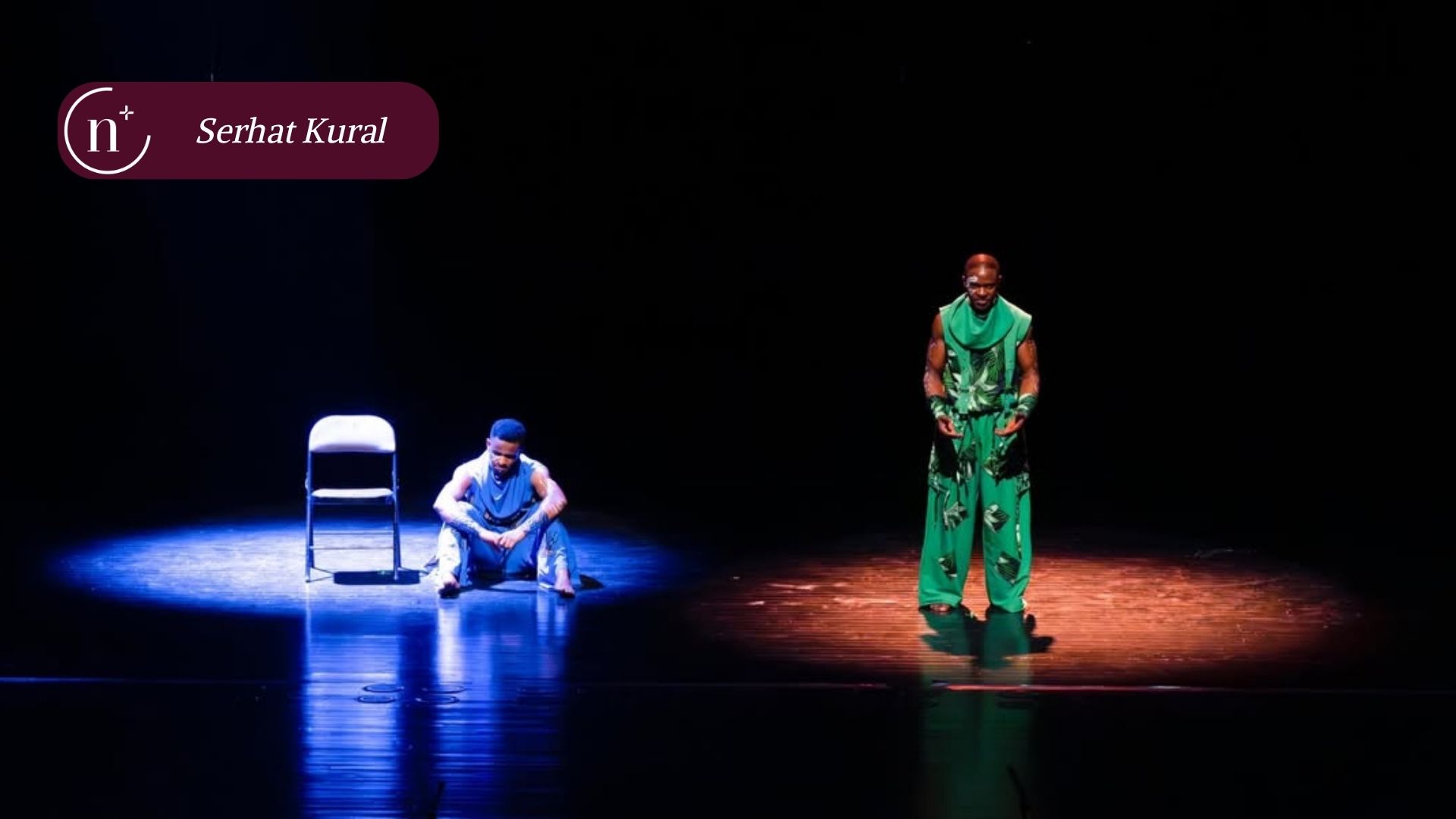
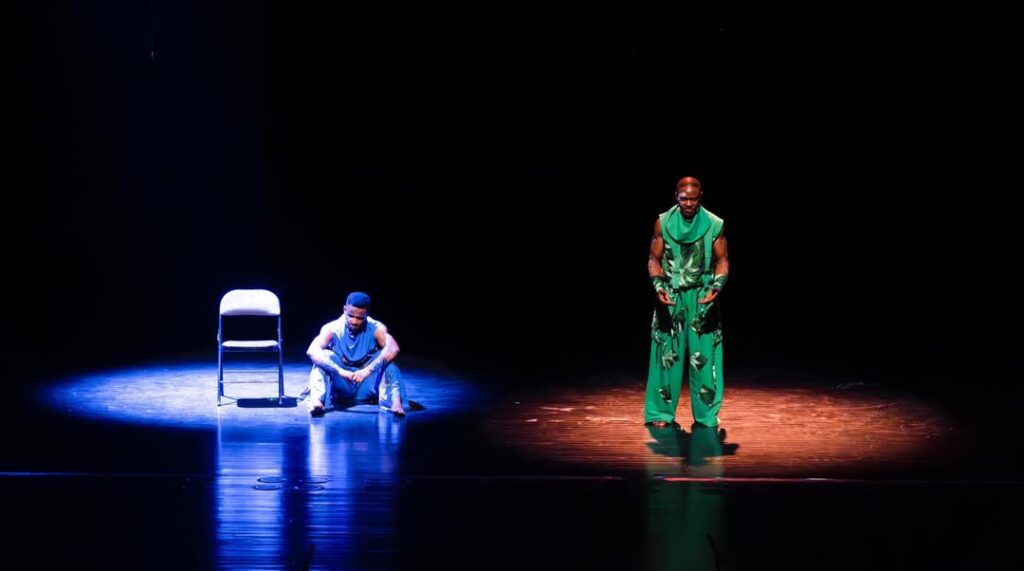
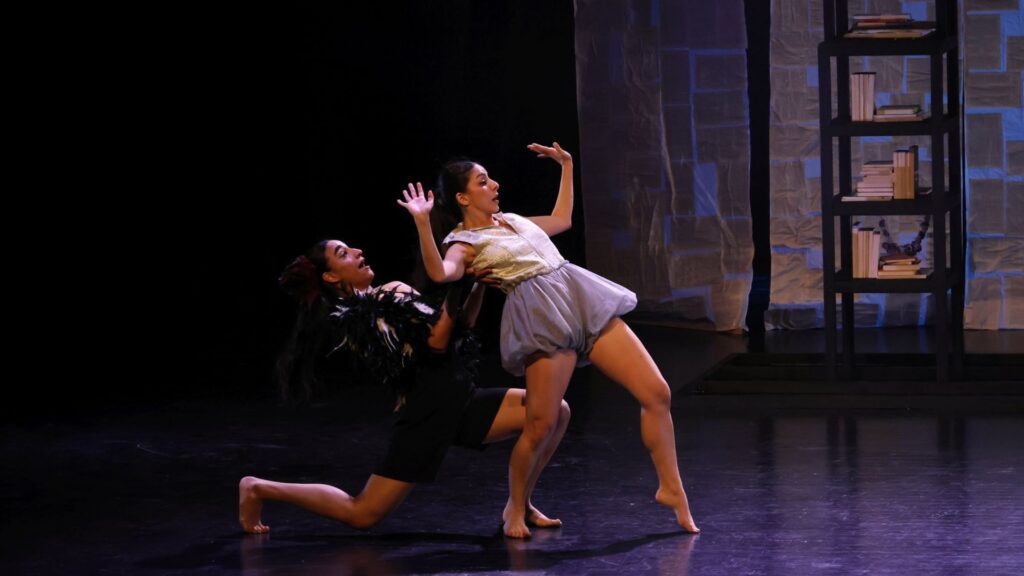
“A scene from the ‘Connecting Bridges’ dance performance. Photo: Elevatorz NG”
Elevatorz NG, participating from Nigeria in the 11th Amed International Theater Festival organized by the Diyarbakır Metropolitan Municipality, presented a dance performance titled ‘Connecting Bridges.’ Founded by two brothers, Michael and Samson Vatorz, the group aims to convey a message of ‘unity’ and ‘respect’ by bringing together Nigeria’s national dances with dances from various parts of the world.
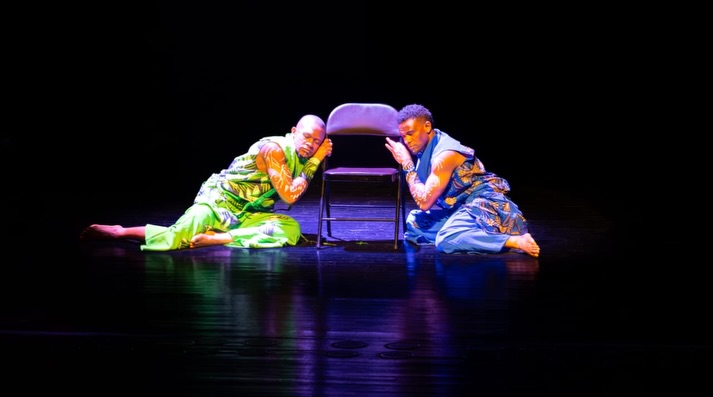
The staging approach adopts a minimalist and symbolic aesthetic that places the performer’s body, movement, and voice at the center of the theatrical experience. The stage is designed as an open, fluid space, allowing choreography and spatial relationships to define shifting emotional and narrative landscapes. Stage props are minimal, functioning as abstract representations of barriers and bridges that can be reconfigured to evoke division, negotiation, and connection. The aesthetic language emphasizes physical expression; lighting is used to isolate moments of conflict and gradually opens up to warmer, more inclusive states as dialogue emerges. The costumes are made of African fabrics in contemporary styles, allowing the performers to represent multiple identities rather than fixed characters. Overall, the staging prioritizes clarity, intimacy, and adaptability, supporting the work’s focus on themes of dialogue, empathy, and peace, while allowing the audience to engage imaginatively with the symbolic world of the performance.
The show met with the audience on April 27th at the Çand Amed Great Hall. Dance and music artist Serhat Kural spoke with Michael and Samson Vatorz for Niha+ about their dance performance, their dance work in Nigeria, and their impressions of Diyarbakır.
“There is nothing that dialogue cannot solve”
Serhat: First of all, I want to welcome you to Amed and this international theater festival. As a dancer, I am very happy to have watched your show; it was truly beautiful. Could you tell us a bit about who you are and your background?
Michael Vatorz: Hi, my name is Michael, also known as Michael Vatorz.
Samson Vatorz: My name is Samson, also known as Samson Vatorz, and together we are Elevatorz NG.
Michael: Elevatorz NG is a dance and theater company; beyond dance, we also act. We have a bit of a singing background as well, so we incorporate that into our work, but we are primarily active as actors, dancers, and creative directors. We have been established as Elevatorz NG since 2010. So far, we have competed in several competitions and are currently the winners of World of Dance Nigeria. We were the first K-pop ambassadors in Nigeria and represented our country in Seoul, South Korea. We have participated in several other festivals outside of Nigeria, and this is what we do full-time.
Serhat: And when did you start working together?
Samson: Well, we are brothers. We have been working together since birth.
Serhat: Could you tell us a bit about your piece? What message do you want to convey to the audience?
Michael: The piece, “Connecting Bridges,” is simply about “dialogue for peace,” much like the festival’s theme. We actually created this dance piece back in 2023. We performed a shorter version of it when we represented Nigeria at the ITI World Congress in Fujairah. That was where the organizers saw us and invited us here because the dance-theater piece matches the festival theme so well. We created an extended version specifically for this festival. The piece is designed to say that regardless of our ideologies, family backgrounds, or religious beliefs, we are humans first. There is nothing that dialogue cannot solve; we simply need to sit together and talk about it, and we will definitely find a way. We wanted to express these thoughts through our dancing and the dialogue within the piece.
“Peace means unity and respect.”
Serhat: If you had to use just one word to describe peace in your country, what would it be?
Samson: You mean the meaning of peace for our country?
Serhat: Yes.
Michael: If it is just one word, we will likely have different ones. He can say his word, and then I will say mine.
Samson For me, the word is respect . I say respect because if you respect another person’s culture, views, and traditions, you can live together. You do not necessarily have to adopt their culture or do what they do. You have your own culture; they respect yours, you respect theirs, and everyone can coexist.
Michael: To add to what he said, we went out today and witnessed something that represents why I chose the word unity. We visited a church and saw Muslims inside who were very welcoming. Then we went to a mosque, and they were so happy to see us; they hugged us regardless of where we came from or who we were. They just wanted us to be their friends. One man in particular was so happy, and it was quite emotional for me. We said to ourselves: if we can all act this way, there will be so much unity and peace.
Serhat: What was the journey like while creating this project? From the beginning to the end of the piece, you emphasized that we can live much more peacefully and beautifully. You also had great concentration on stage; could you tell us a bit about that?
Michael: Regarding the experience of creating the piece and maintaining the tempo and character throughout… I will start with the fact that we have been together all our lives because we are brothers. That is a major advantage. I know there are brothers who fight or do not even speak to each other, but we see ourselves as more than just brothers; we are one. That bond kept us together and made creating the piece much easier because we already have a shared mindset on how we flow. Secondly, maintaining the tempo in the performance was not something we just learned; we had to practice over and over again. Practice is what makes a dancer a professional. Anyone can dance, but not everyone can perform at a professional level. Repeated practice and engagement with the audience were key. We fed off the energy the audience gave us. When they gave us positive energy, it boosted our morale on stage and kept us going. We didn’t even notice when the piece came to an end.
Serhat: Your piece featured traditional costumes. Why did you choose traditional costumes for this mix of dance styles?
Samson: Because they are beautiful. We started a movement in 2017 that we called “Trado-HipHop” at the time. We see ourselves as cultural ambassadors. Nigeria has many languages, and while that can sometimes cause minor hiccups, it is also our unique strength that makes us dynamic. Nigeria is a beautiful country because, despite these many tongues, it remains one nation. To have stayed together for 66 years as one country despite this diversity is commendable. We feel a responsibility to promote this culture for the world to see. As for the hip-hop element, we started as hip-hop dancers and later added traditional dancing professionally. We decided we couldn’t throw hip-hop away because it is a culture, specifically a Black culture, and we love cultures from all around the world. We wanted to fuse our traditional dances with hip-hop without diluting either. We have now evolved the name to trado-pop as of 2026. The reason for the change is that “hip-hop” felt limiting. We love salsa, Afro-dance, Kizomba, Bachata, and many other styles. We wanted to fuse traditional dance with popular culture as a whole. The consistent element is the Nigerian traditional dance. If you watch closely, you will see parts where I did some funk and locking, and Michael did some locking as well. You will notice we have backgrounds in hip-hop, contemporary dance, and salsa. We tried to chip in various elements of popular culture and then added your culture as well.
“A scene from the ‘Connecting Bridges’ dance performance. Photo: Elevatorz NG”
Michael: And then we added the cida.
Samson: Yes, we brought the cida on stage. We wanted to express that the world is one and that movement is a universal language.
Serhat: Have you been to the here before, and how do you feel here?
Samson: It’s a new era in the Middle East… like the United Arab Emirates…
Michael: I’ll take this one. We haven’t been to this part of the world before—I’m not sure if UAE counts as the same experience—so this feels like our first time. We feel so welcome; the reception has been awesome. We love it. If you asked me to come back, I would come back again and again because it feels like Nigeria. Nigerians are warm people; we treat guests right and make them feel loved. The reception here feels just like that. It is so warm, and we honestly love it here.
Palestinian dance artist Shaden Abu Elasal, whose dance group, Shaden Dance Company, presented a performance titled “Feathers” at the 11th Amed International Theatre Festival, expressed that she was deeply moved by the Kurdish people’s commitment to their culture. Abu Elasal noted that in her works, she does not merely copy reality but generates something new from it.
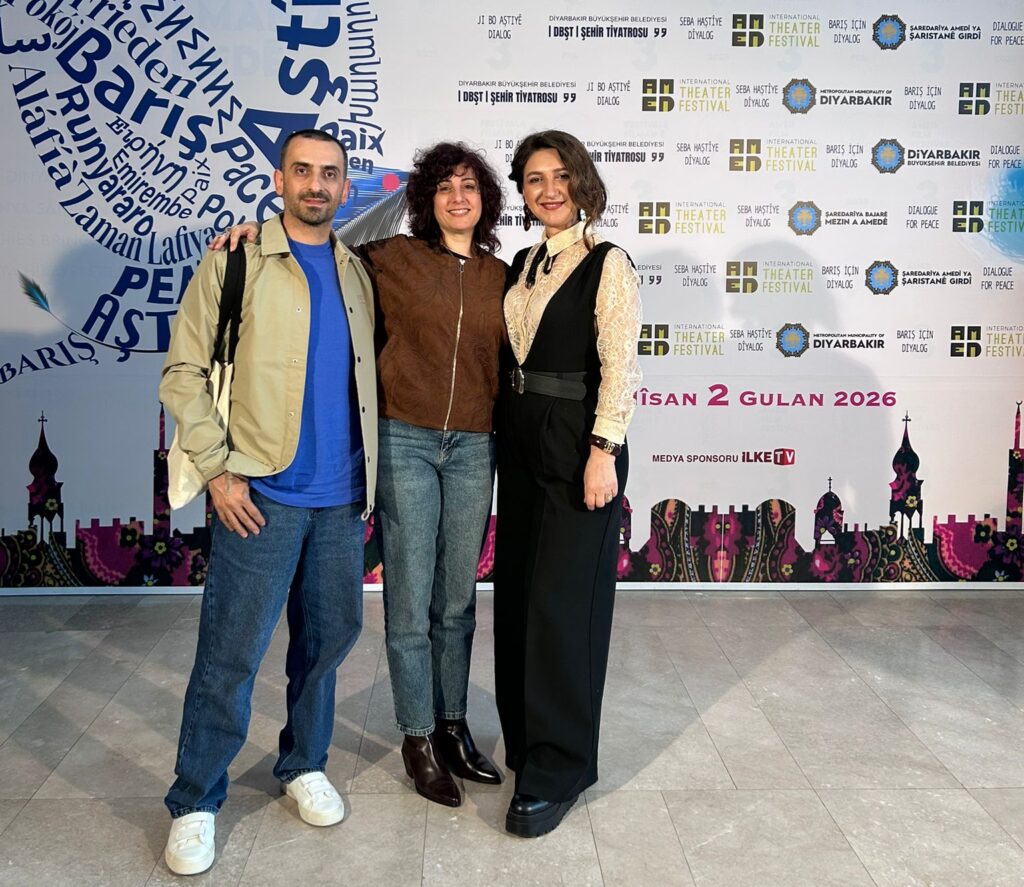
The theme of this year’s 11th Amed International Theatre Festival, held in Diyarbakır, was set as “Dialogue for Peace.” Led by the Metropolitan City Theatre, which continues its work under the auspices of the municipality, the festival opened with a reception on April 22nd.
During the ten-day festival, which runs until May 2nd, numerous plays and dance performances by theatre troupes from 19 countries will meet the audience. Various panels and workshops related to theatre will also be organized.
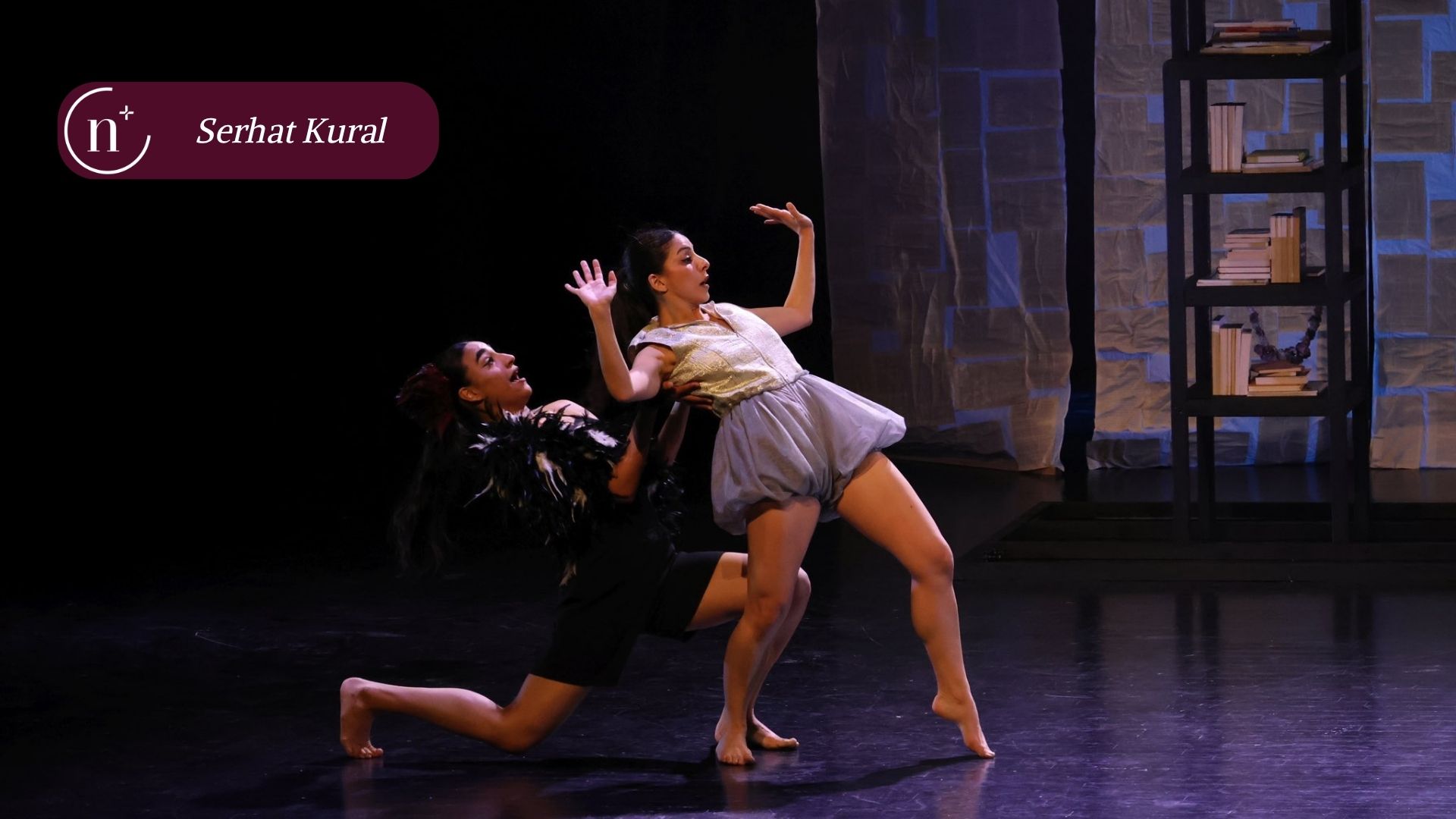
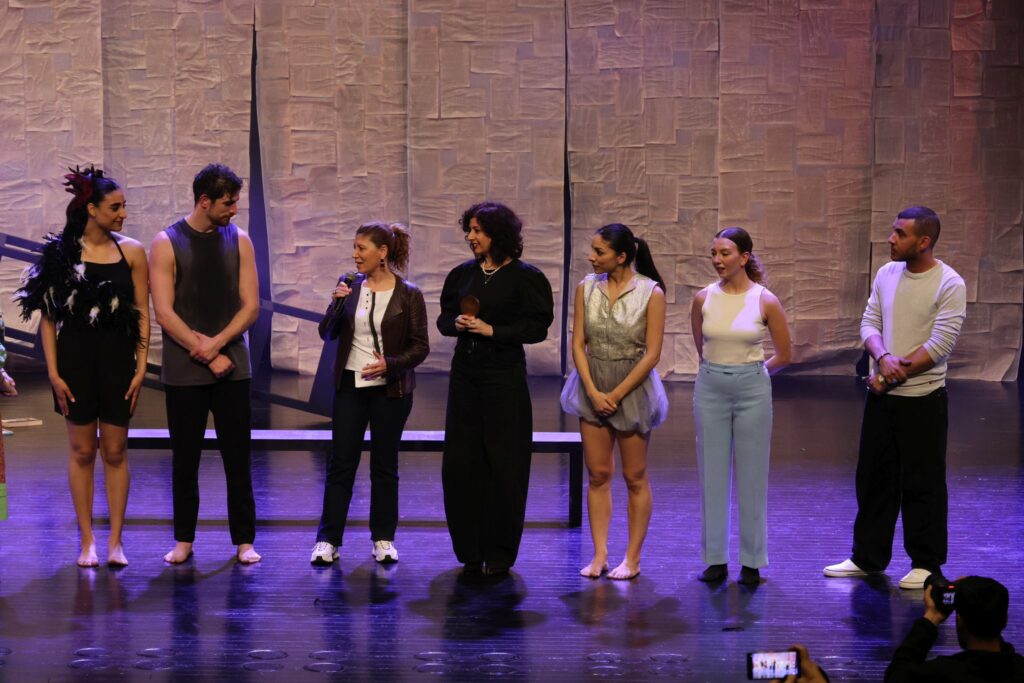
Alongside participants from countries such as Sudan, Ukraine, Syria, and the Kurdistan Region, the Shaden Dance Company from Palestine is among the groups and artists attending the festival. The team’s project, “Feathers,” met with the audience on April 25th at the Çand Amed Grand Hall.
The performance was introduced in the promotional bulletin with the following words: “When our consciousness forms, we realize that we do not know how free we truly are or whether we can ever escape the clutches of power. Feathers explores how power shapes our identity, influences our perception of beauty and goodness, and how it can drive a human being from love to hate. In Feathers, four beings come together and intertwine in scenes that reveal the complexity of human interaction and the forces of power shaping their lives. This is embodied in a love story between two beings—one dominant, the other submissive. The submissive being does not realize what they are.”
Dance and music artist Serhat Kural spoke with the founder of the ensemble, Shaden Abu Elasal, for Niha+ about this dance performance, the experience of being a female dancer in Palestine, and the festival itself.
Serhat Kural, Shaden Abu Elasal, Rugeş Kırıcı
Hello Ms. Shaden. Welcome to Amed. Welcome to our International Theatre Festival as a Palestinian choreographer and dancer. First of all, I want to ask: Who is Shaden Abu Al-Assal, and what is the Shaden Dance Company? Could you tell us a bit about yourself?
First, I’m happy to be here and thank you, Serhat, for this interview. I am Shaden Abu Al-Assal. I was born in Nazareth, in the north of Palestine. I finished my degree in Dance at the Academy of Music and Dance in Jerusalem. Then I came back to Nazareth and I started establishing projects and programs around dancing—educational programs. Besides that, I started doing my own creations as an independent choreographer. So, there was one path of education, focusing on dance, ballet, and contemporary dance, and the other line was developing myself as a choreographer. In 2016, I established a dance group for ballet and contemporary dance in Nazareth for ages 14 to 18, and we used dance as a tool for understanding ourselves and understanding the world and our complicated reality. So, besides the technique, we searched the body as a tool for education. In 2019, I established the Shaden Dance Company. After I did many projects as a dancer and created and performed my own dance works, I decided that I would now be only a choreographer and create not on stage, but behind it. I started this in 2019, and there are dancers from Palestine, Palestinian dancers, and also dancers from all over the world.
Could you explain your identity, as a dancer in Palestine and also as a woman? What kind of journey have you had regarding this?
In a society that has been under oppression for many years since the Nakba of 1948, as a third generation of the Nakba, as a Palestinian living in a very “hot” place… it’s a very hard, complicated, and difficult situation. It’s like everyday suffering. So I want to say that the values that I embrace as a woman and as a human being created who I am. I also came from a family that was very active politically and socially. So the meaning of justice, the meaning of equality, and the meaning of respect for humanity were really powerful parts of who I am. Since I was a child, I was asking myself many questions about the world that we are living in, about myself, about what I can do in this situation, and what my influence is. Can I make my voice louder than it is, seeing the suffering of the Palestinians through all these years?
I can understand this very well because our story is more or less the same as Kurdish dancers. When I met you and your group, and when I watched your performance, a part of me was really happy. Another part of me was so sensitive because even when I listened to your panel, you said you created choreography about how power can affect the body. A lot of pieces are also about this, because balance is really changeable and we don’t have to take our decisions for it to be more free. And that’s why I can understand you very, very much. I want to ask about your piece; what did you want to tell us about it? Can you tell us a bit about your project?
Yes, it’s a combination of who I am, how I was created in this reality as a person, and also how I am a revolutionary in my life. Usually, in anything, I look for something different, new, something that is unique. So, in my art, I don’t want to be a victim—not in reality and not in my art. I want to look for this combination of having a message for the world and being an artist that is looking for something new. I don’t want the authority to decide how my art is going to be. So I am very, very sensitive about not wanting to copy reality. I’m taking reality and digging and creating something new. My biggest happiness is when I enter the studio and start searching, and in one moment something is created—something different, something that I haven’t seen before. This astonishment that I have from art makes me feel powerful, and this power makes me survive in this place. I feel my power when I create. I feel my power when I create as I want to create, not as they want me to create. It’s a combination between who I am as a woman and a human being, and who I am as an artist. I hope that you understand me.
Exactly, I understand very much. Do you think you are giving courage to women who live in Palestine as an artist?
I don’t know. I know that I’m giving…
Sorry, I want to open this topic; maybe it can help you. I watched two videos about your pieces. They were so affecting. I saw many women dancers inside, and I think you have many women dancers. You create something and they find an opportunity to do something with you. I have to say you are like a choreographer, but at the same time, a leader as a woman. That’s why I ask this.
I find it hard to talk about it because it’s hard to talk about myself as a leader. I can say that I can affect people around me in a positive way so that they can do something that wasn’t done before. If they have the tools, if they insist, if they believe in themselves and if they work hard, I think that maybe I am an example of that. Because as an Arab woman, I was the first one to study in the Academy of Dance. At that time, the words “contemporary dance” were not common in our society. But I took this step because I wanted to do that. And coming back and creating things there… my performances are not “shows” shaped in a beautiful way. My performance is different; it’s not superficial. And I insist on that. I also succeeded in creating a very good school at a very high level, technically and artistically. So, I think that these students—women that I taught and who dance in this group—maybe, and I hope, see the world differently than how society wanted us to see it. I’m happy that some of them continued dancing and they are finding their own ways now as choreographers. I hope that I had a positive effect on them.
I’m pretty sure you’re going to be an example for these women. I want to talk about your experience in Amed. What do you feel about Amed and about your performance? How did the audience criticize your piece? Could you share a bit of this experience with us?
First of all, the idea of this festival is really powerful and important, both in its panels and performances. Because there is always an attention to shut our mouths. In this festival, they give people who are under oppression the power to stand and to express themselves with all the beauty that this place has. The people are so kind, so generous. I’ve been to many festivals, but being in a festival that a woman is directing… I should say that it’s different. It has its own spirit. I really admire this community, the Kurdish people, for their commitment to their culture and their insistence on expressing themselves through art. They don’t lose their culture. I saw the opening and I said, “Wow.” Yes, I see people here and how connected they are to each other. The position of the woman as mayor is something unique. I think it’s something that I can learn from.
My last question. Deeply, I want to say I have really high respect for the Palestinian community. We are always with you. I know there is a condition that is so difficult. But as I said to you, we are a bit similar. And I hope Palestine is going to be free soon. How do you relate to the audience in Palestine as a contemporary dancer?
I must say, as I said before, that it is new in Nazareth and in the north of Palestine, and also in the West Bank. But people are curious. People come to our performances and they ask questions. Even though sometimes they say, “we don’t understand,” what is good is that we talk to people. There’s a dialogue about it. I must say that the last work, Feathers, because it has a clearer drama and characters, the audience interacts with it more than my previous work, which was more abstract. So I think these kinds of works make the people closer to you. I think sometimes they are afraid of these kinds of performances because they don’t have the tools to analyze them. But when you come to them and you talk and explain, and you say it’s okay, you can take it however you want, people feel comfortable. When they feel comfortable, their imagination works. So I’m happy that we have an audience for this. It is not huge, but there’s an audience that is growing more and more.
Exactly. I understand very much because we are in the same process. We are doing the same way for us to be more understandable for the audience. But another part of us wants to be more abstract. I don’t want to say this is our destiny, but we need a balance to be closer to the audience.
Exactly. And I think it’s so important not to be “above” the audience. Because our work is going on stage, and without this audience, there is no meaning for us. This combination between being loyal to yourself as an artist and staying loyal to your audience… we have to find this balance without giving up our artistic vision.
128 years ago, Mîqdat Mîdhad Bedirxan lit the torch of Kurdish journalism by publishing the Kurdistan newspaper in Cairo, Egypt. Despite all hardships, torture, murders, and exiles, this tradition continues.
From its inception, Kurdish journalism has been more than just an information tool; it has served as a mirror of national identity, an arena for linguistic struggle, and a political platform for a stateless nation. In all four parts of Kurdistan, every publication has simultaneously represented the press, resistance, and cultural memory. The character of this journalism distinguishes it from many other forms of media and makes it a vital source for political and cultural research.
From Kurdistan to Rojî Kurd, Jiyan, Hawar, Ronahî, Rojname, Welat, Azadiya Welat, and many others, Kurdish journalism continues its journey despite hardships, torture, assassinations, and exiles.
History of Kurdish Journalism (1898–2026)
From its inception, Kurdish journalism has been more than just a tool for information; it has served as a mirror of national identity, a sphere of linguistic struggle, and a political platform for a stateless nation. Every publication in all four parts of Kurdistan has simultaneously represented the press, resistance, and cultural memory.
I. EARLY PERIOD: CAIRO and EXILE (1898–1908)
Kurdistan — The First Kurdish Newspaper
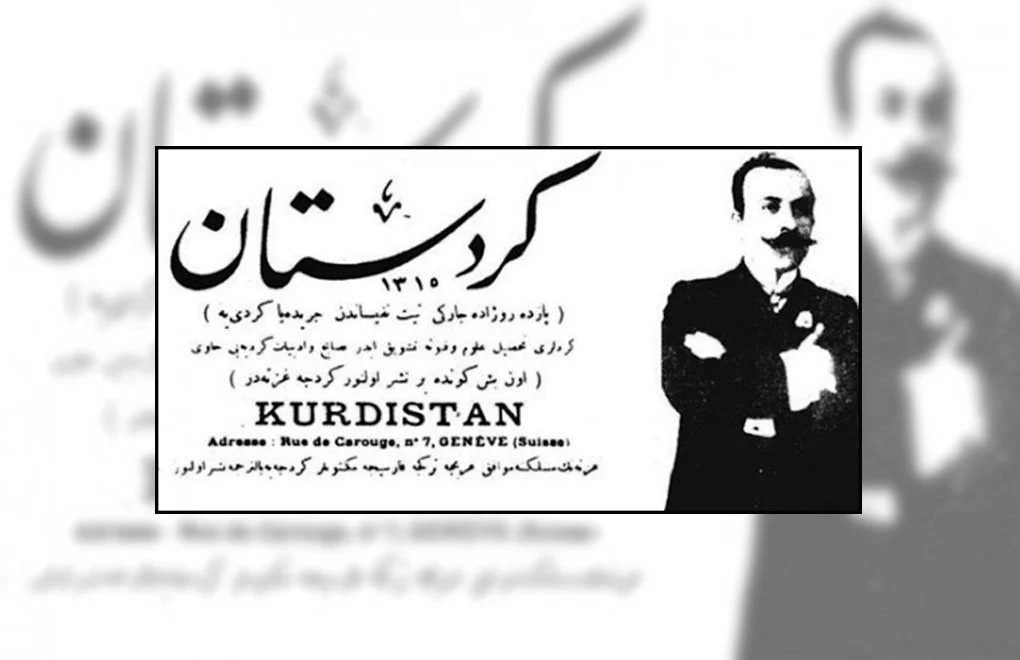
On April 22, 1898, Mîqdad Midhat Bedirxan published the first Kurdish newspaper, Kurdistan, in Cairo.
[Visual: First Issue of Kurdistan Newspaper, 1898]
“Each time, I will talk to the Kurds a little about the benefits of reading and science. Through reading and science, one understands everything. Our Kurds are not as educated as other nations. Therefore, they are unaware of the world’s situation.”
Printing locations: Cairo (1–5), Geneva (6–19), Cairo again (20–23), London (24), Southern England (25–29), Geneva (30–31).
II. THE ISTANBUL PERIOD (1908–1918)
Rojî Kurd and Hetawî Kurd (1913–1914)
On June 6, 1913, the Hêvî association published the magazine Rojî Kurd. Following its closure, it continued under the name Hetawî Kurd.
[Visual: Cover of Rojî Kurd Magazine]
Jîn and Kurdistan (1916–1918)
In 1916, Süreyya Bedirxan published the Turkish-language weekly Jîn (Life) in Istanbul, advocating for Kurdish independence. This publication is entirely distinct from Pîremêrd’s Jîn newspaper in Sulaymaniyah.
III. THE SOUTH AND THE SOVIETS (1919–1932)
Pêşkewtin and Sulaymaniyah
The first newspaper published within the Kurdistan region itself, Pêşkewtin (1920–1922), was released in Sulaymaniyah. Later, Jiyan (1926), edited by Pîremêrd, became the symbol of this era.
Riya Teze (1930–) — Voice of Soviet Kurdistan
It began publication in Yerevan on March 25, 1930, serving as the Kurdish organ of the Communist Party of Armenia.
[Visual: Masthead of Riya Teze Newspaper]
IV. THE HAWAR ERA (1932–1943)
Celadet Alî Bedirxan and Hawar Magazine
In May 15, 1932, Hawar was published in Damascus. Celadet implemented the Latin-based Kurdish alphabet through this magazine, which remains the standard today.
[Visual: Hawar Alphabet and Magazine Issue]
Principal Writers: Celadet and Kamûran Bedirxan, Rewşen Bedirxan, Cegerxwîn, Osman Sebrî.
V. THE REPUBLIC OF MAHABAD (1945–1946)
Kurdistan Newspaper
Established in Mahabad on January 11, 1946. Although the Republic of Mahabad lasted only 11 months, it held a special place in Kurdish media history as a period of institutional statehood.
VI. & VII. THE FREE PRESS TRADITION (1990–2016)
Özgür Gündem and Apê Musa
On May 30, 1992, Özgür Gündem began publication. The Kurdish intellectual Musa Anter (Apê Musa) was assassinated in Diyarbakır on September 20, 1992.
[Visual: Musa Anter – Apê Musa]
Bombing of Buildings (1994)
On the night of December 2-3, 1994, the headquarters of the Özgür Ülke newspaper were bombed. Ersin Yıldız lost his life.
Newspaper Name
Year
Status
Özgür Gündem
1992
Closed (1994)
Özgür Ülke
1994
Bombed
Azadiya Welat
2006
Closed (2016)
VIII. THE ROLE OF WOMEN
Gurbetelli Ersöz (1965–1997)
The first female editor-in-chief of a daily newspaper in Turkey (Özgür Gündem). October 8th is celebrated as Kurdish Women Journalists Day.
Modern Institutions: JINNEWS and JIN TV (The first all-female satellite channel, 2018).
IX. THE SATELLITE REVOLUTION: MED TV
MED TV (1995–1999)
The first Kurdish satellite channel. It began broadcasting in March 1995, representing a media revolution for Kurds and a turning point for language standardization.
X. CONCLUSION AND HISTORICAL CHRONOLOGY
Historical Milestones
Date
Event
1898
Kurdistan, Cairo (First Newspaper)
1932
Hawar, Damascus (Alphabet Revolution)
1946
Kurdistan, Mahabad
1995
MED TV, Europe (First Satellite TV)
2018
JIN TV
Kurdish journalism is a 128-year tradition of resistance, stretching from exile to the digital age.
Sources: Wikipedia, Encyclopaedia Iranica, KurdîLit, CPJ, RSF, Cambridge History of the Kurds.
I. Kurdistan, the first Kurdish hewspaper
On April 22, 1898, Mîqdad Midhat Bedirxan (1858–1915), son of Bedirxan Pasha of Botan, published the first Kurdish newspaper under the name Kurdistan in Cairo. Under the shadow of Ottoman censorship, it was printed abroad in Geneva, London, and Folkestone, with a total of 31 issues released. The final issue was published in 1902.
In the first issue, Mîqdad Midhat Bedirxan stated his purpose with these words:
“Each time, I will talk to the Kurds a little about the benefits of reading and science. Through reading and science, one understands everything. Our Kurds are not as educated as other nations. Therefore, they are unaware of the world’s situation.”
The printing locations were as follows: Cairo (1–5), Geneva (6–19), Cairo again (20–23), London (24), Southern England (25–29), and Geneva (30–31). His brother, Abdurrahman Bey, took over the responsibility of publication in the later periods.
Kurdistan was not merely a source of information but an ideological platform. By establishing Kurdish as a medium for intellectual expression and resistance, it laid the foundation for the century to come.
II. The Istanbul period (1908–1918)
Rojî Kurd and Hetawî Kurd (1913–1914)
On July 27, 1912, the Kurdish Student Association Hêvî (Hope) was founded in Istanbul. On June 6, 1913, the association published the magazine Rojî Kurd (Kurdish Day). It was shut down by the government after four issues. During the same period, Yekbûn (1913, 3 issues) was published. On October 24, 1913, the magazine changed its name to Hetawî Kurd. It was essentially the same publication, continuing under a different name. The etymology of the names is interesting: Roj in Kurmanji and Hetaw in Sorani both mean “Sun.”
Jîn and Kurdistan (1916–1918)
In 1916, Süreyya Bedirxan published the Turkish-language weekly Jîn (Life) in Istanbul, which demanded Kurdish independence. Between 1917 and 1918, he published the weekly Kurdistan. It is important to clarify: this Istanbul-based Jîn was in Turkish and was entirely different from the Jîn newspaper published by Pîremêrd in Sulaymaniyah.
III. The South and the Soviets (1919–1932)
Pêşkewtin and Sulaymaniyah
The first Kurdish newspaper published within the geography of Kurdistan itself, Pêşkewtin (Progress), was released in Sulaymaniyah between 1920 and 1922 under British administration. 118 issues were printed. This was followed by a series of publications:
Bangê Kurdistan (1922, 14 issues)
Rojî Kurdistan (1922–1923, 15 issues)
Jiyanewe (1924–1926, 56 issues)
Jiyan (1926–1938, 556+ issues, under the editorship of Pîremêrd)
Zarî Kurmancî (1926–1932, Rawanduz, 30 issues)
Pîremêrd and Jiyan-Jîn: Born in Sulaymaniyah, Tewfîq Mehmûd Hemze, known by his pen name Pîremêrd (1867 – June 19, 1950), became the editor-in-chief of Jiyan in 1926 and its manager in 1932. In 1938, he changed the name of Jiyan to Jîn and continued publishing it until his death on June 19, 1950. He also founded the first private Kurdish school, Qutabxaney Zanistî.
Riya Teze (1930–) – The Voice of Soviet Kurdistan
On March 25, 1930, it began publication in Yerevan using the Marogulov and Shamilov alphabet. It was the Kurdish organ of the Communist Party of Armenia. Initially managed by three Armenian Kurdologists (Kevork Paris, Hrachya Kochar, and Harutyun Mkrtchyan), the Kurdish Kurmanji scholar Cerdoy Gênco became the editor-in-chief in 1934. It was suspended during the Stalin era but resumed in 1955 with a Cyrillic alphabet. Mîroyê Esed (1919–2008) managed the newspaper until 1989.
IV. The Hawar era (1932–1943)
Celadet Alî Bedirxan and Hawar Magazine
After being exiled from Turkey, Celadet Alî Bedirxan published Hawar in Damascus on May 15, 1932. A total of 57 issues were released between 1932-1935 and 1941-1943.
Hawar holds special significance as the first media outlet published in Kurmanji Kurdish. For this reason, May 15 has been celebrated as Kurdish Language Day since 2006.
Celadet created a Latin-based alphabet for Northern Kurmanji, known as the “Hawar Alphabet” or “Bedirxan Alphabet,” which remains the standard today. Its purpose was: “Hawar is the voice of science. Science is for a person to know themselves; knowing oneself opens the path to freedom and happiness.”
Key writers: Celadet and Kamûran Bedirxan, Rewşen Bedirxan, Qedrî Can, Cegerxwîn, Osman Sebrî, Nûredîn Zaza, Ekrem Cemîl Paşa, Ahmed Namî.
Roja Nû and Stêr were published in Beirut by Kamûran Bedirxan. Nûdem (1992–2001, Stockholm, 40 issues, edited by Firat Cewerî) was referred to as the “Second Hawar.”
Rewşen Bedirxan
In a field largely dominated by men, Rewşen Bedirxan took her place as an active writer among the contributors of Hawar. She stands as a pioneering example.
V. The Kurdish Republic of Mahabad (1945–1946)
On January 11, 1946, during the brief existence of the Republic of Mahabad, the newspaper Kurdistan was established as the first Kurdish newspaper of the region, releasing a total of 113 issues. Alongside it, the literary magazine Kurdistan (16 issues) was also published.
When the Iranian army entered Mahabad on December 15, 1946, the Kurdish printing press was closed, Kurdish education was banned, and all Kurdish books, including school textbooks, were burned. Qazi Muhammad was executed on March 31, 1947. The Republic of Mahabad lived for only 11 months but secured a unique place in Kurdish media history.
VI. The South (1950–1990)
South Kurdistan
Between 1950 and 1963, numerous publications emerged in Baghdad and Sulaymaniyah:
Hîwa (1957–1963, Baghdad, 36 issues)
Xebat (1959–1961, Baghdad, 462 issues)
Ray Gel (1959–1962, Kirkuk, 34 issues)
Azadî (1959–1961, Rawanduz, 56 issues)
After 1968 and the Baathist occupation, the Kurdish press came under intense pressure. The Enfal and Halabja chemical attacks in 1988 signaled a period of extreme suppression for Kurdish media.
Diaspora
From the 1970s onwards, Kurdish media shifted its center to Europe (Germany, Sweden, France, Belgium). These publications were mostly party-affiliated and primarily political in content.
“Rojname” Newspaper (May 8, 1991)
In the early 90s, when the ban on the Kurdish language was slightly relaxed, Kurdish intellectuals and journalists sought to step into daily news reporting. This newspaper is recognized as the first trial of a daily newspaper based on “Kurdish Reality” in the history of Northern Kurdistan and Turkey after a long silence. Rojname was only able to print one issue. On the very day it was released, it was confiscated and banned by the State Security Court (DGM).
VII. The northern free press (1992–2016)
Özgür Gündem (1992–1994)
On May 30, 1992, under the leadership of Ragıp Duran, Özgür Gündem began publication, reaching a circulation of 60,000. During Ocak Işık Yurtçu’s tenure, circulation reached 100,000.
Systematic Murders (1990–1995):
Between 1990 and 1995, dozens of journalists, mostly from the Kurdish free press, were killed. Within this historical context, 76 victims are remembered as “martyrs of the free press.”
The Assassination of Apê Musa, September 20, 1992
Musa Anter (1920 – September 20, 1992) was born in the village of Zivinge, Nusaybin, Mardin. Known as “Apê Musa,” he was a prominent Kurdish writer and intellectual; he wrote for Özgür Gündem, Yeni Ülke, and Welat. He had been prosecuted in the “Trial of the 49s” for Kurdish propaganda. On September 20, 1992, he was murdered in an ambush in Diyarbakır. His murder remained a “perpetrator unknown” case. In 2008, the European Court of Human Rights convicted Turkey.
The Bombing of Buildings, December 2–3, 1994
Özgür Gündem was closed on April 14, 1994. Two weeks later, Özgür Ülke was launched. On the night of December 2–3, 1994, the technical center in Kadırga, Istanbul, the Çağaloğlu bureau, and the Ankara bureau were bombed simultaneously. Transport coordinator Ersin Yıldız lost his life, and more than 20 employees were injured.
Chronology (1992–2016):
Name
Start
Outcome
Özgür Gündem
1992
Closed on April 14, 1994
Özgür Ülke
1994
Bombed on Dec 2–3, 1994
Gündem
1995
Closed
Ülke
1996
Closed
Özgür Gündem (New)
2011
Closed in August 2016
Welat and Azadiya Welat
Launched as a weekly in Istanbul on February 22, 1992, it was the first Kurdish-language newspaper in Turkey after the 1991 ban was lifted. In 1996, it became Azadiya Welat. In 2003, it moved its headquarters to Diyarbakır, and in 2006, it became a daily newspaper. It was closed on August 8, 2018, by a statutory decree (KHK) under the State of Emergency.
VIII. The role of women
Rewşen Bedirxan
She was an active writer in the Hawar ekol and served as a pioneering example in the early periods of the Kurdish press.
Gurbetelli Ersöz (1965–1997)
A chemist born in Elazığ/Palu. She was arrested in 1990 for political activities and spent two years in prison. On April 23, 1993, she began working at Özgür Gündem and became the editor-in-chief, making her the first female editor-in-chief of a daily newspaper in Turkey, not just in Kurdish media. On December 10, 1993, the newspaper building was besieged; Ersöz was detained along with 17 colleagues. After being held for 13 days, she was sent to Sağmalcılar Prison. At the trial, the prosecutor sought 15 years; Harold Pinter, Noam Chomsky, and the CPJ supported her. She was sentenced to 3 years and 9 months and released in June 1994. Since she was not allowed to work as a journalist, she joined the PKK in 1995. She lost her life in a clash on October 8, 1997. October 8 is celebrated as Kurdish Women Journalists Day.
Jinha, Jinnews, and Jin TV
JINHA began its operations as the Women’s News Agency. It was closed by the Turkish state in 2016 and subsequently continued as JINNEWS. On March 8, 2018, on International Women’s Day, JIN TV began broadcasting as the first satellite channel with an all-female staff.
IX. The Satellite revolution: MED TV and beyond (1995–2010)
MED TV (1995–1999)
In 1994, it received a license from the UK Independent Television Commission (ITC) and began test broadcasts in March 1995. It was the first Kurdish satellite channel and represented a media revolution for Kurds during a period of extreme state pressure. In the West, satellite dishes were in every Kurdish home, and dozens of families would gather in the evenings to listen to the news in their own language. At the request of the Turkish state, MED TV‘s license was revoked on April 23, 1999. Following this:
Medya TV was launched but closed by French authorities.
Roj TV (2003, Denmark) was closed.
Nûçe TV, Stêrk TV, and others were launched in succession.
European News Agencies
The first Kurdish news agency, Dam, was founded in Germany in 2000, later becoming the Mesopotamia News Agency (MHA) in Frankfurt. After MHA was closed by German police, the Firat News Agency (ANF) was founded in Belgium in 2005.
X. Rojava (2011–2019)
On January 21, 2014, the Democratic Autonomous Administration was announced in Qamishlo on the anniversary of the Mahabad Republic. That same year, when ISIS attacked Sinjar, Kurdish journalism played a key role in bringing the voice of the Yazidi community to the world. During the siege of Kobanê, the Dengê Kobanî radio became the voice of the resistance.
XI. Principal figures
The Bedirxan Family
Name
Life
Contribution
Mîqdad Midhat Bedirxan
1858–1915
Kurdistan (1898) — Founder
Süreyya Bedirxan
1883–1938
Jîn (1916), Kurdistan (1918)
Jeladet Alî Bedirxan
1893–1951
Hawar (1932–1943), Alphabet
Kamûran Bedirxan
1895–1978
Roja Nû, Stêr (Beirut)
Rewşen Bedirxan
—
Writer of the Hawar ekol
Pîremêrd (1867–1950)
Real name: Tewfîq b. Mehmûd Hemze. Born in the Gwêje neighborhood of Sulaymaniyah. He was a poet, writer, and journalist. He became the editor-in-chief of Jiyan in 1926 and its manager in 1932. In 1938, he renamed Jiyan to Jîn. He founded the first private Kurdish school, Qutabxaney Zanistî. He passed away in Sulaymaniyah on June 19, 1950.
Musa Anter — Apê Musa (1920–1992)
Born in the village of Zivinge, Nusaybin, Mardin. He was convicted in the “Trial of the 49s.” He wrote for Özgür Gündem and Yeni Ülke. He was killed by JÎTEM in Diyarbakır on September 20, 1992.
XII. Hardships and obstacles
Systematic Bans
In Turkey, publishing in Kurdish was explicitly banned from 1924 to 1991. Subsequently, Kurdish journalists were prosecuted under Article 8 of the Anti-Terror Law and later Article 314.
The 2016 Mass Shutdowns
During the State of Emergency (2016–2018), via Decree Laws (KHK):
Azadiya Welat was closed (August 2016)
JINHA was closed (2016)
IMC TV was closed (2016)Dozens of journalists were arrested and sentenced.
XIII. The digital age (2010–2026)
Digital media brought three major changes:
Proliferated: Social media, websites, and Kurdish podcasts increased.
Weakened: The financial model of print media collapsed; many newspapers closed.
Renewed:ANHA, ANF, Rudaw, Kurdistan 24 developed a global Kurdish digital media model, though most remain affiliated with political parties or governments.
Conclusion
Date
Event
April 22, 1898
Kurdistan, Cairo — Mîqdad Midhat Bedirxan
June 6, 1913
Rojî Kurd, Istanbul
March 25, 1930
Riya Teze, Yerevan
May 15, 1932
Hawar, Damascus — Jeladet Alî Bedirxan
January 11, 1946
Kurdistan, Mahabad — Republic of Mahabad
May 30, 1992
Özgür Gündem, Istanbul
February 22, 1992
Welat, Istanbul
September 20, 1992
Assassination of Apê Musa
Dec 2–3, 1994
Bombing of Özgür Ülke
March 1995
MED TV — First Satellite TV
October 8, 1997
Assassination of Gurbetelli Ersöz
March 8, 2018
JIN TV
2026
The journey continues
Kurdish journalism has faced oppression and obstacles for over 128 years. From Cairo to digital platforms, from exile to war, and from the Bedirxan family to the generation of Jinnews and Jin TV, this tradition endures.
Amnesty International’s report exposes the lawlessness, discrimination, and rights violations perpetrated by nations -most notably the US, Russia, China, the UK, and Israel- while asserting that a new history of humanity is being written by the people resisting these injustices.
The 406-page report, titled The State of the World’s Human Rights 2025/26, evaluates 144 countries. It emphasizes that the international legal framework was significantly undermined in 2025, largely driven by the actions of the USA, Israel, and Russia. The report highlights that despite ceasefires, Israel continued its genocidal actions through illegal settlements and the obstruction of aid, while expanding its military offensive into countries such as Lebanon and Iran.
As the world endures one of its darkest periods of institutional impunity and state violence, the report notes that resistance has spread in equal measure. Port workers across several European countries formed a global solidarity network, putting their bodies on the line to block arms shipments to Israel. Meanwhile, youth movements from Indonesia to Peru targeted systemic injustice, transforming the streets into “spaces of transformation” throughout 2025.
“Time to write the history of human rights”
In the report’s foreword, Agnés Callamard, Secretary General of Amnesty International, stated:
“As Amnesty International has long warned, a global environment where primitive ferocity could flourish has been long in the making. But in 2025, accelerants were recklessly poured over dry kindling, as sharp U-turns were taken away from the international order that had been imagined out of the ashes of the Holocaust and the utter destruction of world wars, and constructed slowly and painfully, albeit insufficiently, over these past 80 years.”
Callamard emphasized that resistance is also about clarifying what needs to be transformed, urging people to find the courage to change as the very structures built over the last 80 years face destruction:
“We must imagine a transformed and transformative human rights vision for the world that we are becoming, not merely defend human rights in terms of the world we once were. Together, we must then lead that transformation into existence, with all our creativity, determination and resilience. History is not just something that is done to us. It is also ours to make. And for the sake of humanity, it’s time to make human rights history.”
The report documented protester deaths resulting from the unlawful use of force in countries including Turkey, Angola, Cameroon, Ecuador, Indonesia, Kenya, Madagascar, Pakistan, and Peru. In nations such as Afghanistan, Belarus, Burkina Faso, China, Cuba, Mali, Myanmar, Nicaragua, North Korea, Russia, Uganda, and Venezuela, authorities reportedly used enforced disappearances of human rights defenders, activists, and journalists to spread fear. Many other countries, including Iran and Saudi Arabia, continued to resort to the death penalty.
Turkey: Rise in baseless investigations and convictions
The report brings to light allegations of torture and rights violations by law enforcement against protesters in Turkey, alongside a culture of impunity. It further highlights an increase in baseless investigations and convictions targeting human rights defenders, noting that executive interference in the judiciary has deepened. Key findings include:
The report notes legislative proposals aimed at criminalizing LGBTI+ and their advocates. Similar to Hungary, Turkey banned Pride Marches, where law enforcement used unlawful force. The report also recorded bans placed on LGBTI+ associations.
The report recorded the detention of hundreds of peaceful protesters following the detention of Ekrem İmamoğlu, Mayor of Istanbul and CHP presidential candidate. Unlawful force was documented during the March 19-26, 2025, protests sparked by operations against the CHP and İmamoğlu’s detention.
Despite European Court of Human Rights (ECHR) rulings and the Council of Europe’s 2022 infringement proceedings, figures such as Osman Kavala, Selahattin Demirtaş, and Figen Yüksekdağ remain imprisoned.
The report identified unlawful force by both the judiciary and law enforcement during protests following the prison sentence handed to Abdullah Zeydan, the elected mayor of Van Metropolitan Municipality.
Rights violations during May Day protests and subsequent house raids were highlighted. In 2025, 294 femicides were committed by men, while 297 women were found dead under suspicious circumstances.
Escalating violence in the Middle East and North Africa
The report underscores a surge in attacks by various actors across the Middle East. Notable findings include:
Israeli attacks in Gaza continued through 2025, killing approximately 27,000 Palestinians (60% of whom were women and children). Systematic destruction of housing and infrastructure decimated living conditions. An 18-year blockade was tightened, leaving half a million people facing famine and banning medical evacuations.
Israel conducted military strikes against Lebanon, Iran, Qatar, Syria, and Yemen. Targeting civilian sites in Iran (such as Evin Prison) was classified as a war crime. While a new era began in Syria with the fall of the Assad regime, sectarian massacres continued. In Yemen, the humanitarian crisis deepened following a cut in US aid.
Non-independent judiciaries in Egypt, Tunisia, Saudi Arabia, and Iraq handed down politically motivated prison sentences. Peaceful protests were crushed in Iran, Algeria, and Tunisia. Racial attacks and collective expulsions of Black refugees increased in Tunisia and Algeria, while Libya remained a spot for the torture and arbitrary detention of migrants.
Global impunity and the reluctance of states
By early 2026, the unlawful use of force by the US and Israel against Iran -violating the UN Charter- triggered retaliatory strikes against Israel and Gulf Cooperation Council countries. The US, Israel, and Russia further weakened international accountability mechanisms, specifically the International Criminal Court (ICC).
The Trump administration imposed sanctions on ICC staff and the UN Special Rapporteur on the Occupied Palestinian Territory, while Russian courts issued arrest warrants for ICC officials. Most states remained reluctant to activate mechanisms to block the aggressive actions of the US, Russia, Israel, or China.
In Brazil, police operations in impoverished neighborhoods of Rio de Janeiro resulted in over 120 deaths, mostly among Black residents. In Afghanistan, the Taliban escalated its oppressive policies, banning women from education, work, and travel.
Floods in Pakistan displaced millions, while New Delhi recorded the world’s most polluted air. Pacific islands face an existential threat from rising sea levels.
Activism against the flow of weapons to Israel expanded globally. Port workers in France, Greece, Italy, Morocco, Spain, and Sweden blocked shipment routes. An increasing number of states acknowledged that Israel is committing genocide, with many joining the “Hague Group” or contributing to South Africa’s case at the International Court of Justice (ICJ).
In 2026, the Spanish government maintained a principled stance against these violations.