
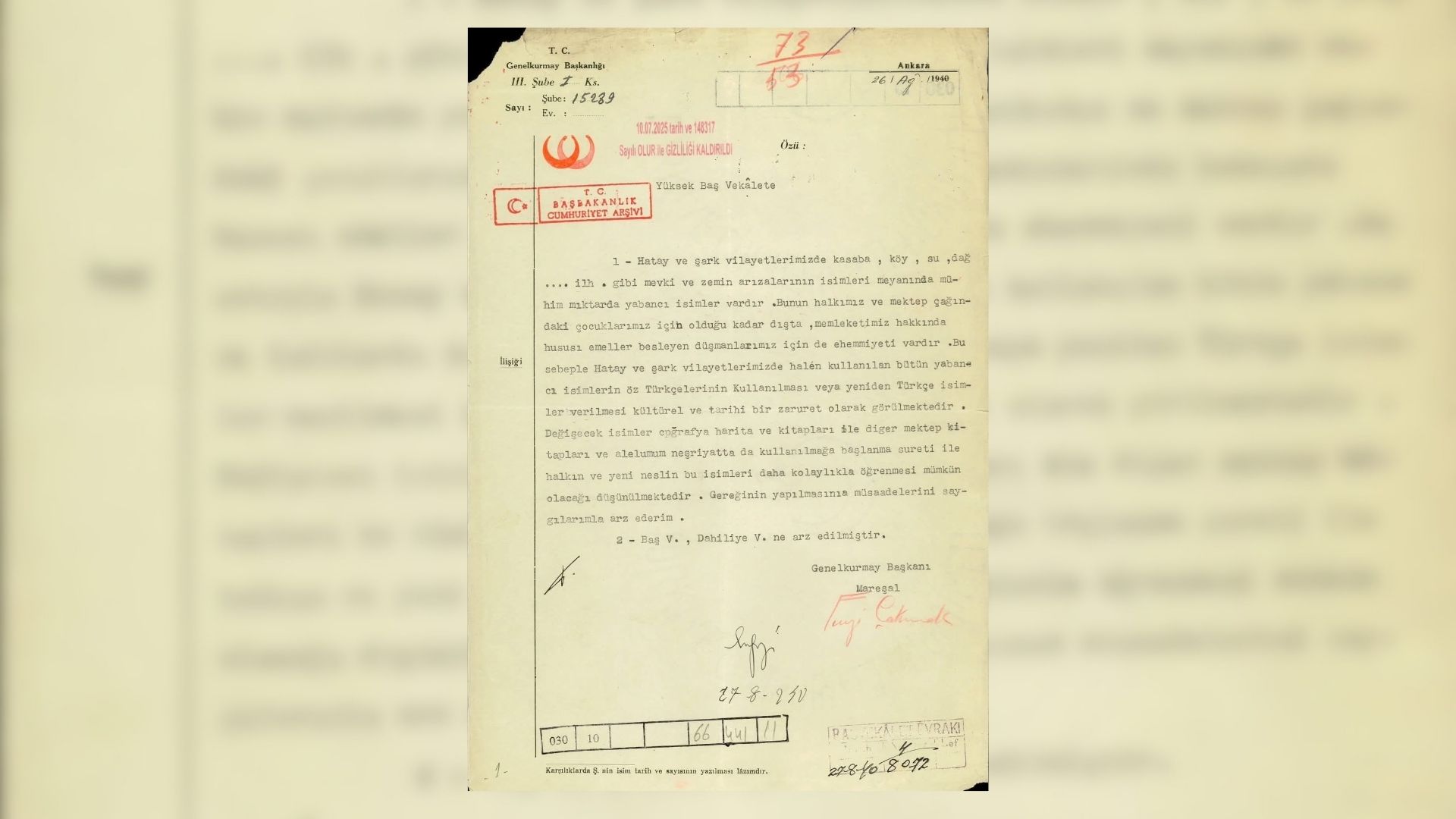
A Turkish General Staff document dated 1940 and declassified in 2025 proposes the Turkification of place names in Hatay and the eastern provinces, and the inclusion of these names in maps and educational materials.
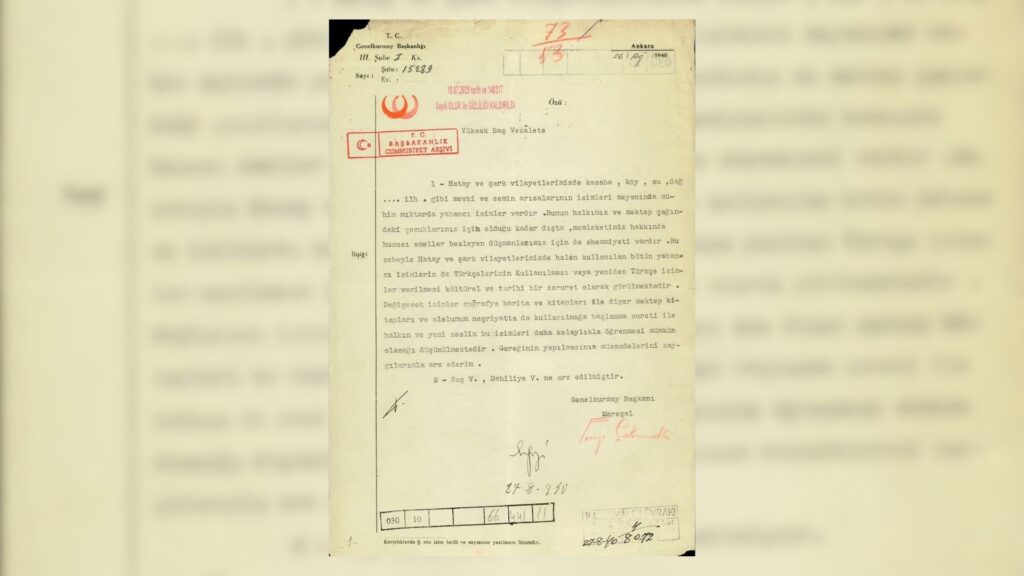
A Turkish General Staff document from 1940, declassified in 2025, brings the Turkification of place names in Hatay and the eastern provinces to the agenda. The document suggests including the new names in maps and educational materials.
It is understood that the document, shared by researcher M. Saleh Ghaderi on his personal X account, has been newly declassified. Bearing the stamp “DECLASSIFIED with the APPROVAL dated 10.07.2025 and numbered 148317,” the document argues that changing the aforementioned names is a “cultural and historical necessity” and states the following:
“It is deemed a cultural and historical necessity to use the pure Turkish equivalents of all foreign names currently used in Hatay and our eastern provinces, or to assign them new Turkish names.”
The Education system is also part of the process
Another striking element in the document is that the name changes are not limited solely to administrative decisions. By proposing the use of the changed place names in geography books, maps, and other publications, the Turkish General Staff aims for the new generations to learn these names.
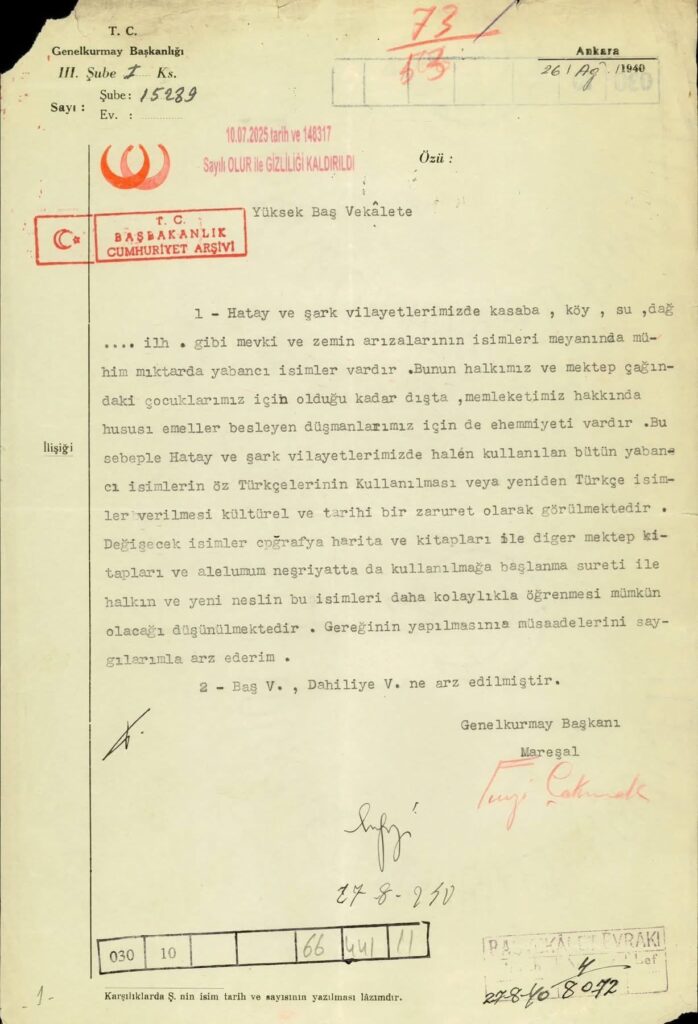
The text states that the new names should be included in educational materials so that “the public and the new generation can learn these names more easily.”
Enver Pasha’s directive is the starting point
The 1940 document also shows that the changing of place names was not a practice belonging to a single period alone.
In his recent interview published on Niha+, historian Namık Kemal Dinç states that the first comprehensive initiative regarding the changing of place names began with a directive sent to the provinces by Enver Pasha on January 5, 1916. The directive demanded the Turkification of Armenian, Greek, and Bulgarian place names.
Dinç notes that this approach continued during the Republican period, specifically targeting place names of Kurdish, Armenian, Syriac, Greek, Laz, and Georgian origin.
Institutional transformation
According to Dinç’s research, the practice acquired a systematic nature with the “Specialized Commission for Name Changing” (Ad Değiştirme İhtisas Kurulu) established in 1957. The commission, which included representatives from the Turkish General Staff, the Ministry of Interior, the Ministry of National Defense, the Ministry of National Education, the Turkish Language Association, and Ankara University, operated until 1978.
According to research, approximately 75,000 settlements were examined; official name change decisions were made for roughly 28,000 of them.
The “Politics of Memory” debate
Dinç evaluates the changing of place names not merely as an administrative regulation, but as the reconstruction of historical memory.
According to Dinç, the aim was to erase the traces of Anatolia’s multilingual and multicultural past and to create a new national memory.