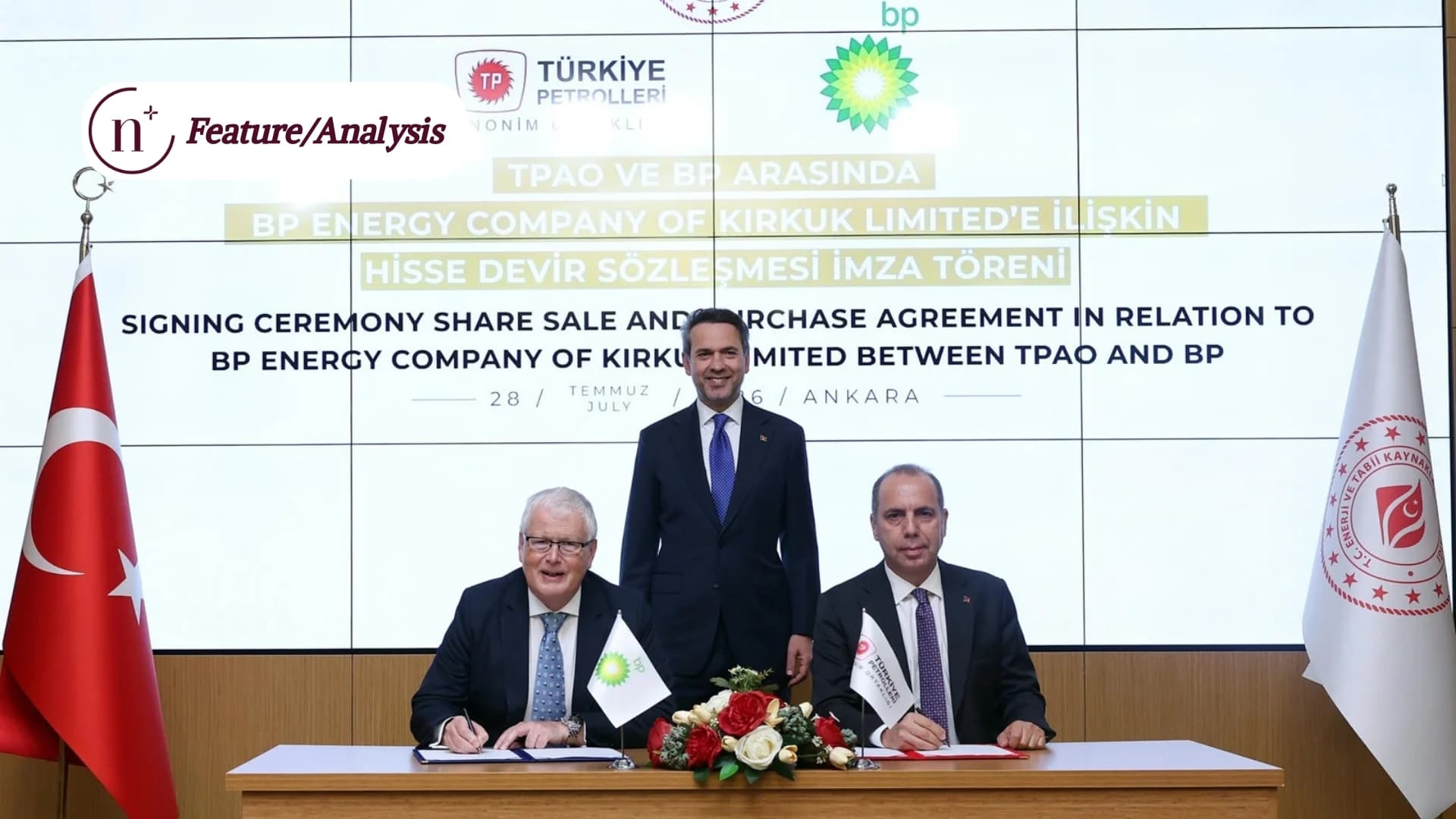
TPAO has taken a 15% stake in the BP vehicle redeveloping Kirkuk. According to The National Context, it marks Turkey’s return to a geography where a century ago it held only a royalty right; yet the share structure keeps Ankara’s seat well short of a steering wheel.
Photo: The National Context
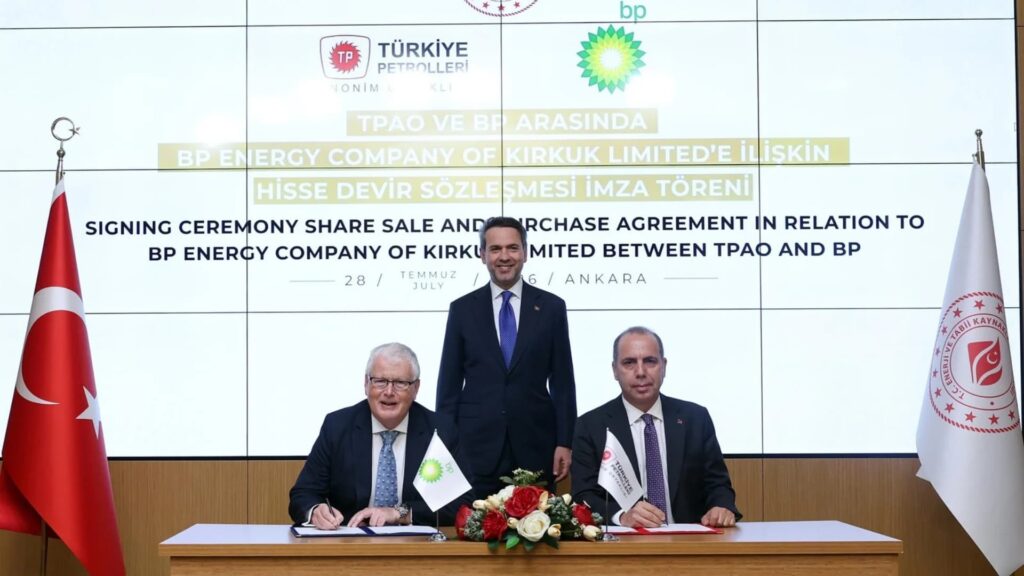
Turkey’s state oil company TPAO has acquired a 15% stake in BP Energy Company of Kirkuk Limited, the contractor vehicle for the redevelopment of the Kirkuk oil complex. An analysis published by The National Context describes this as the clearest commercial sign yet of Ankara’s return to a geography where it last held a formal economic interest a century ago.
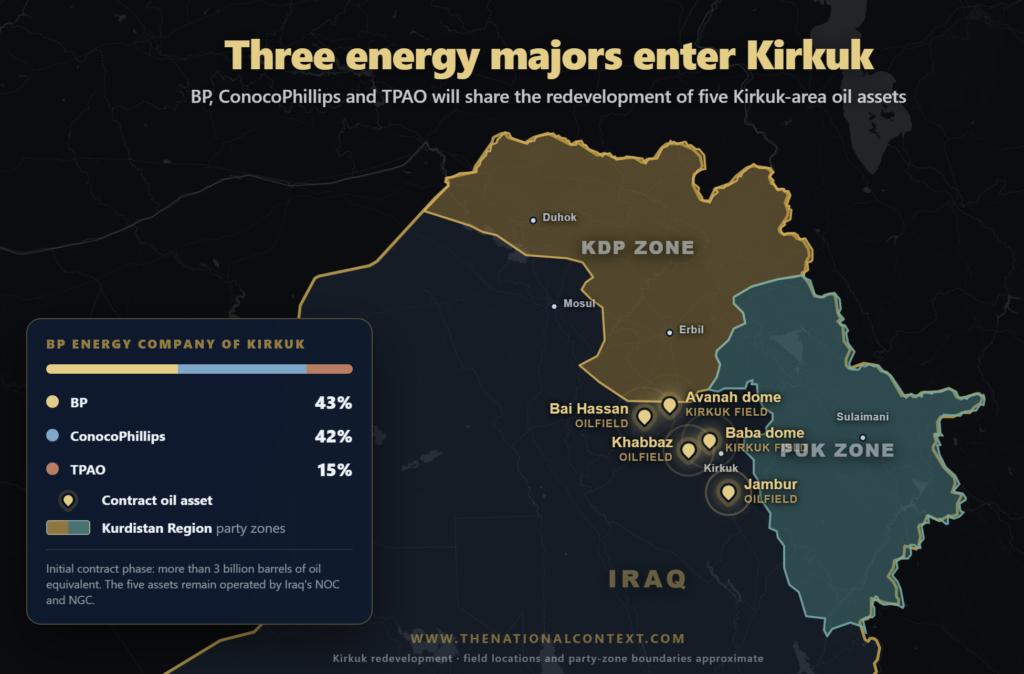
The agreement was signed in Ankara by TPAO general manager Cem Erdem and BP upstream business development vice president Andrew McAuslan, in the presence of energy minister Alparslan Bayraktar, ahead of talks between President Recep Tayyip Erdoğan and Iraqi Prime Minister Ali al-Zaidi. It follows ConocoPhillips’s agreement earlier in the month to take a 42% interest in the same vehicle, concluded during al-Zaidi’s visit to Washington, and leaves BP with the remaining 43% and majority control.
The National Context states that the contract area covers the Baba and Avanah domes of the Kirkuk field together with Bai Hassan, Jambur and Khabbaz, with an initial gross recoverable resource above three billion barrels of oil equivalent. The transaction does not alter the contract framework: the fields remain Iraqi state property, North Oil Company and North Gas Company retain their operating roles, and the partners will book production and reserves according to the terms of the development and production contract. The signing came a day after the Iraq–Turkey crude oil pipeline agreement expired, with both governments stating that they now want a comprehensive energy cooperation agreement in its place.
Back to 1926
To measure the return, The National Context reaches back to the one earlier moment Turkey had money riding on this ground. Back then, the analysis notes, it wasn’t a business stake at all but a consolation prize for territory it had given up. The 1926 Ankara Treaty had Turkey accept the Brussels Line, which placed the old Mosul vilayet on the Iraqi side of the border. In exchange, Ankara was promised 10% of the oil royalties owed to the Iraqi government over a 25-year window, with a fallback option to trade the whole stream for a single £500,000 cheque. Crucially, that 10% bit only into royalties (not production, not exports, not profits) and it bought Turkey no piece of the Turkish Petroleum Company, an outfit the analysis describes as Turkish in name and nothing else.
The cash didn’t even start moving until Baba Gurgur was discovered. The first payment landed in 1931: Iraq collected somewhere around £400,000 in royalties and passed roughly £40,000 up to Ankara, a figure that had climbed to about £223,000 by 1939. Turkish budget records show the 10% payments still running through 1952, with one last, smaller sum in 1954, which makes the frequently repeated claim that Turkey just cashed out for £500,000 either wrong or only half the tale. The math also limits how much the entitlement was ever worth: 10% of royalties, themselves only a sliver of gross sales, left Ankara with something nearer 1% of what the oil was really worth. Lord Curzon’s instinct that the territory mattered was vindicated within a year of the settlement, when Kirkuk turned out to hold one of the largest fields in the world.
Zoom out, the analysis suggests, and the real backdrop is the regional economy that the post-1918 lines carved up. It leans on Sarah Shields’s work on nineteenth-century Mosul, which shows a city whose merchant class looked outward along old, dense regional ties (toward Aleppo, Baghdad, Damascus and the Anatolian interior) rather than toward Europe or Istanbul, with only a small share of trade by value ever leaving that orbit. Aleppo connected the interior to Mediterranean shipping through Alexandretta, and the Baghdad Railway was an unfinished attempt to bind Anatolia, northern Syria and Mesopotamia through modern infrastructure. Kirkuk didn’t enter its oil age until 1927 so, the piece argues, today’s petroleum arrangements are being draped over a map that trade, caravans and railways had already knitted together long before.
The Fulcrum Doctrine
The National Context files the TPAO stake under what it calls the Fulcrum Doctrine: a setup in which Washington calls the strategic shots across Iraq, Syria and Turkey but hands the actual work to regional players, using energy and infrastructure as the levers.
Source: The National Context
The diplomatic architecture, it argues, tells the same story. Tom Barrack serves simultaneously as US ambassador in Ankara and as special envoy for Syria and for Iraq, and he described the three countries on taking the expanded role as the strategic fulcrum on which regional stability rests, requiring a single consistent American point of contact. Syria and Iraq were bolted onto the portfolio of the ambassador resident in Turkey, not the other way round, which makes Ankara the administrative hub of Washington’s northern Middle East. The economic side lines up with the diplomacy. June’s US–Iraq joint statement backed reviving the Kirkuk–Baniyas line out to the Mediterranean, and the Iraq–Syria pipeline deal inked in Washington this month puts a US-led consortium in charge of the engineering and the financing. The point of both the northern and western corridors, the piece says, is the same: to loosen Iraq’s reliance on the Strait of Hormuz.
Inside that frame, the analysis reads the Kirkuk line-up as a neatly parcelled set of jobs. Washington holds the strategic umbrella; the American and British firms bring the capital and the corporate machinery; Turkey brings the ground, the pipes and the regional access; and Iraq keeps the sovereignty and owns the oil. The 85% that BP and ConocoPhillips split between them also sets the hard ceiling on how far Turkey can go. TPAO gets a seat, the piece argues, because Turkish soil, ports and pipelines make Ankara the northern gateway nobody can route around. Yet, the share math is built so that a seat never becomes a steering wheel. That fits its longer-running case that Turkish leverage in the region runs through corridors, host geography and rights of approval, not through owning the outcome.
1926 against 2026
The analysis suggests that the comparison with 1926 should be handled with the same precision. A royalty cut and a block of company equity are different legal instruments, so reading “10% to 15%” as a straight upgrade misses the point. The jump means nothing in pure financial terms. According to The National Context, what actually repeats is the structure: In 1926, a bargain drawn up in London turned a Turkish land claim into a short-lived royalty trickle from outside the operating company, while later American pressure bought US firms a permanent 23.75% inside it.
In 2026, the same three ingredients (a Turkish state interest, British oil capital and Kirkuk crude) are stirred back into one vehicle, with BP presents the project as a return to the field its predecessor helped discover at Baba Gurgur. The one thing that’s genuinely moved, the piece concludes, is where Turkey stands in relation to the consortium: in 1926 it took a slice of Baghdad’s royalties from the outside, in 2026 it holds shares inside the contractor within an arrangement that remains Anglo-American in design and Iraqi in sovereignty. The borders drawn after 1918 are unchanged, while the energy, security and commercial systems that cross them increasingly operate as one connected space, with Turkey positioned as its northern hub.
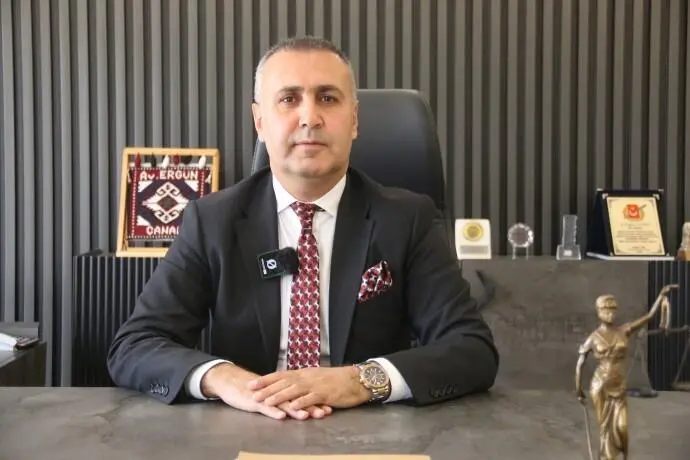
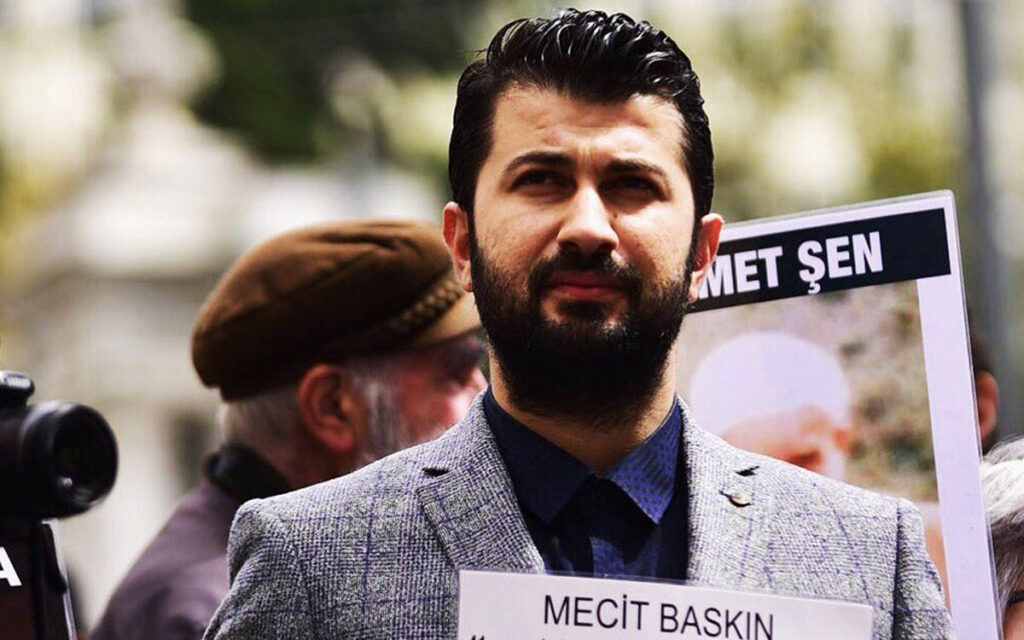
Eren Baskın of the Hakkari branch of the Human Rights Association (İHD) and Ergün Canan, head of the Hakkari Bar Association, say decades of deaths caused by landmines, unexploded ordnance and armored vehicles in Turkey’s Kurdish-majority provinces stem from a pattern of rights violations and unresolved trauma. “Responsibility does not lie with the citizen — it lies with the state,” Canan said.
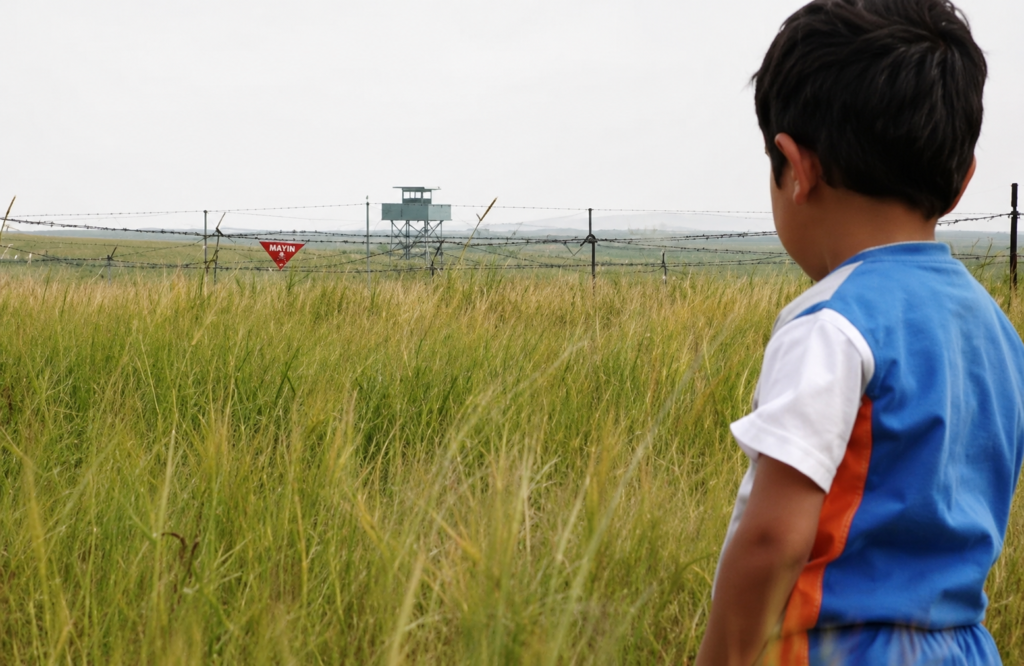
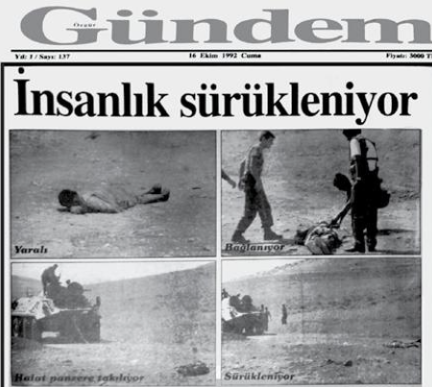
This year, on May 9, 2026, 17-year-old Muhammed Aykut was wounded when he stepped on a landmine while herding animals in Hakkari; several of his animals were killed. Two years earlier, on July 24, shepherd Bedrettin Düzen, also in Hakkari, was killed in a landmine explosion while grazing his sheep. These incidents have renewed scrutiny of deaths and injuries from mines and explosives across Kurdish provinces — and of how investigations into such cases have been handled.
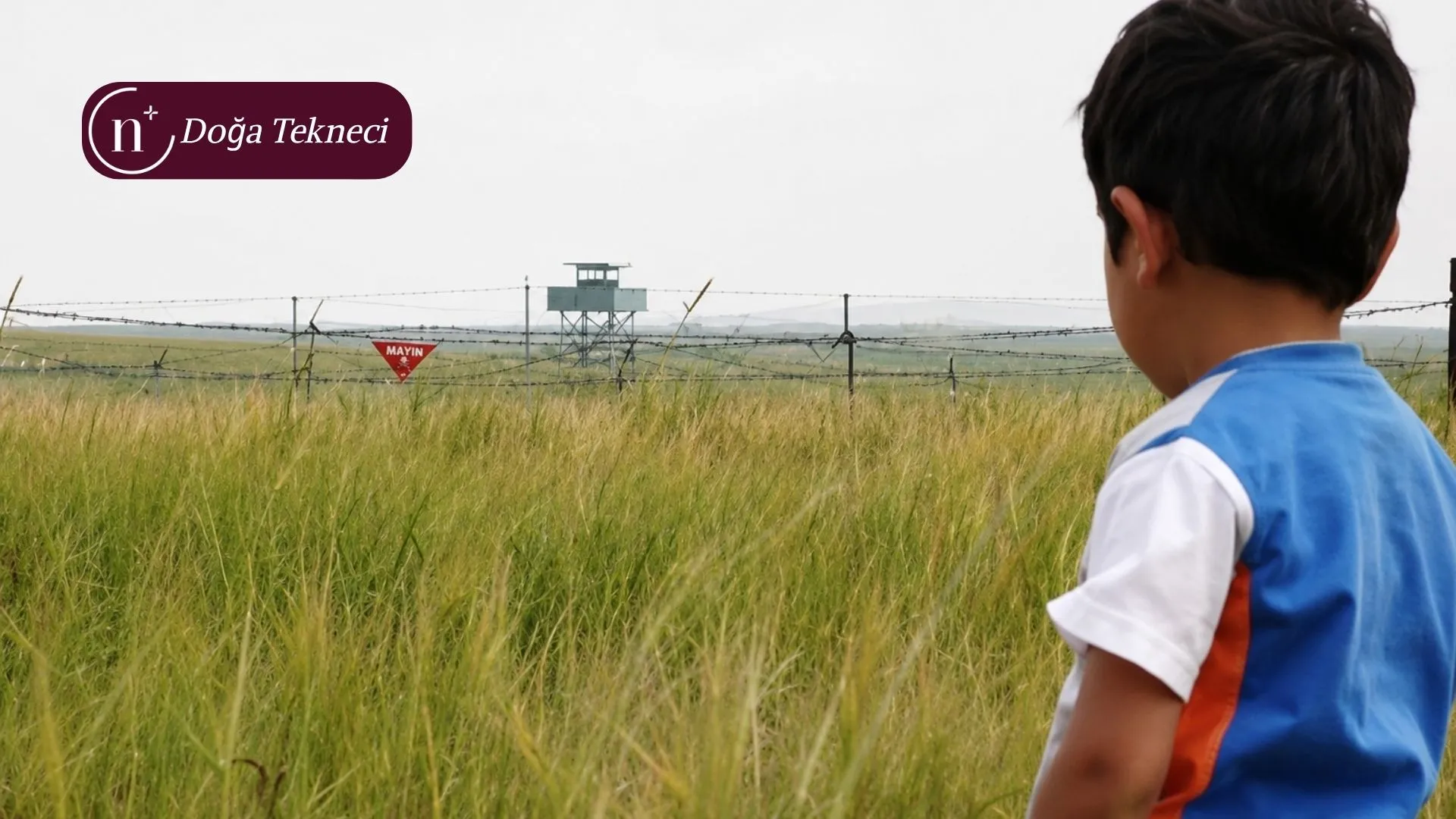
Thousands of landmines and pieces of unexploded ordnance remain buried in areas used by civilians across most Kurdish provinces in Turkey. According to the Turkey Without Mines Initiative, roughly one million mines remain underground nationwide; the Ministry of National Defense’s 2021 figures put the number at closer to 850,000, spread across nearly 3,800 mined areas.
A report by the Diyarbakır Bar Association covering 2011–2021, titled “Child Rights Violations Caused by Armored Vehicles, Landmines and War/Conflict Remnants,” found that children bear the brunt of these hazards. Over that ten-year period, 45 children were killed and 135 injured by war ordnance or landmine explosions. A further 22 children were killed and 27 injured by armored vehicles. İHD’s annual human rights violation reports show the pattern persisting: between 2020 and 2024, at least 23 people — including eight children — were injured, and eight people, including three children, were killed in ordnance and landmine explosions. Diyarbakır, Şırnak, Hakkari and Mardin recorded the highest concentrations of deaths and injuries.
Mayın ve Mühimmat Patlamaları İnfografik
Mine and Ammunition Explosions in Kurdish Cities
Based on data from the Human Rights Association’s annual Human Rights Violations Reports (2020–2024)
8
Lost their lives
3 of them are children
23
Injured
8 of them are children
Total HRA data between 2020–2024
Number of dead and injured by year
Caused by mines and abandoned explosives/munitions
2020
Death
1
Injured
4
1 death and 2 injured children
2021
Death
4
Injured
6
2 deaths and 2 injured children
2022
Death
0
Injured
8
3 injured children
2023
Death
0
Injured
1
No children data
2024
Death
3
Injured
4
1 death and 1 injured children
Death
Injured
Deaths and injuries from armored vehicles, war ordnance and landmines have declined compared with the 2000s, following an end to mass mine-laying and large-scale clearance along the border. But the underlying problem has persisted for decades in Kurdish provinces, largely because that clearance work has focused on the borders with Armenia and Iran. According to the European External Action Service, a total of 50,000 landmines were cleared from Turkey’s borders with Armenia and Iran between 2021 and 2023. The greater risk lies inland: the pastures of villages emptied in the 1990s and later reopened to returning residents, along with the areas around former military outposts and bases, remain uncleared. Under the Ottawa Convention, which Turkey joined in 2003, the deadline for mine clearance has been repeatedly postponed — the most recent extension request was valid through the end of 2025. Throughout this period, those responsible for deaths and injuries have largely gone unpunished, with no effective investigations carried out. Head of Hakkari Bar Association Ergün Canan and İHD Hakkari’s Eren Baskın assessed the legal and political landscape behind these deaths.
The Ottawa Convention
The Anti-Personnel Mine Ban Convention (the Ottawa Convention) is an international treaty banning the use, production, stockpiling and transfer of anti-personnel mines and requiring their destruction. Turkey joined the treaty in 2003, and it entered into force for Turkey on March 1, 2004. Anti-personnel mines were originally laid by Turkey along its borders with Armenia, Iran and Iraq, as well as along the Syrian border between 1956 and 1959, to prevent illegal border crossings. Mine-laying later expanded into Turkey’s interior with the outbreak of conflict in 1984. In July 2006, the Kurdistan Workers’ Party (PKK) signed the Geneva Call deed of commitment, declaring an end to its own use of landmines.
In 2013, Turkey’s National Defense Minister announced a request to extend the Ottawa Convention deadline for clearing landmines — originally set for March 1, 2014 — to 2022. At the Mine Ban Treaty’s intersessional meetings held June 22–24, Turkey requested a further extension of three years and nine months, covering March 1, 2022, through December 31, 2025, and indicated it would likely need yet another extension after that period.
According to the International Campaign to Ban Landmines’ (ICBL) “Landmine Monitor 2023,” Ottawa Convention states parties Bosnia and Herzegovina, Cambodia, Croatia, Ethiopia, Iraq, Turkey and Ukraine are among the countries with the largest numbers of landmines still in the ground.
“Responsibility cannot be placed on the citizen”
Ergün Canan, Photo: Yeni Yaşam Newspaper
Head of Hakkari Bar Association Ergün Canan recalled that Bedrettin Düzen, who died in Hakkari, and Muhammed Aykut, who was severely wounded, both stepped on mines while grazing sheep. Noting that unexploded ordnance left over from past conflict is present throughout the region, Canan said: “Responsibility here cannot be placed on the citizen. Legally, primary responsibility here belongs, of course, to the state.”
Canan said that in a province that has endured the heavy toll of decades of conflict, it is the state’s obligation to protect civilian life, clear high-risk areas, secure them, and carry out effective investigations. He stressed that the state fulfilling these obligations is a matter of life and death:
“It is simply unacceptable for children or adults to encounter mines or ordnance in pastures, on village roads, in rural areas, or near residential zones. These areas need to be cleared as soon as possible. Otherwise, we may well see similar incidents again. Agriculture and animal husbandry are people’s only source of livelihood here. They have to take their animals out to graze on those pastures. When there are no safe areas, people are forced to use those areas anyway. There is a security failure here as well. Unfortunately, the state has not carried out any real work on this to date — at least not in the Hakkari region.”
“A truth and reconciliation commission should be established”
Canan said that during past peace processes, truth-seeking, giving voice to victims, and the prospect of resolution were discussed more openly, whereas during periods of conflict a security-first approach has tended to dominate, pushing families’ pursuit of justice to the sidelines. He said that for the current peace process to succeed, confronting the truth must come first:
“A truth and reconciliation commission needs to be established as soon as possible. These investigations — or at least these incidents — need a process for more effective investigation to be carried out. There is a social peace process under way that all of us support. In particular, these mined areas absolutely need to be cleared as soon as possible.”
Cases involving ordnance and mine explosions, or deaths under armored vehicles, generally end in impunity. Canan said reversing this requires ending the practice of impunity, transparently mapping mined and high-risk areas, clearing those areas while informing affected families, and conducting independent, effective investigations. Absent these steps, Canan warned, “We will keep losing our children — in the mountains, in rural areas, or within city limits.”
Canan noted that under the Ottawa Convention, the Turkish state is obligated to clear mined areas, that this obligation has been extended to 2025, and that the repeated postponement of this obligation shows that sufficient, concrete progress has not been made on the ground. He said that while Turkey’s Constitutional Court and the European Court of Human Rights have issued rulings on the matter, Turkish courts have failed to comply with them despite the treaty. “We believe that once this process finally concludes, concrete steps will follow within the Turkish state, and particularly within the Grand National Assembly of Turkey,” Canan said.
“These files are treated as unsolved”
Canan said Muhammed Aykut’s case remains ongoing and that they continue to follow it, noting that the case is still effectively being treated as an unsolved matter with an unidentified perpetrator:
“The court has conducted no investigation into who placed that ordnance there. Unfortunately, no effective investigation or prosecution is being carried out. When that doesn’t happen, these cases either remain permanently under search status or are recorded as having an unidentified perpetrator. The emotional toll on families is enormous as well, victims may be left disabled for life. What families want from the state and from the Turkish judiciary is this: for the truth to come out, for those responsible to be identified, and for them to be tried before the courts.”
Canan said that mined or unexploded-ordnance-contaminated areas must be cleared before they can be reopened to civilian use, and that as long as they remain uncleared, similar incidents will continue to occur.
Child Rights Violations Caused by Landmines and Armored Vehicles
Child Rights Violations Caused by Landmines and Armored Vehicles
Diyarbakır Bar Association, “Child Rights Violations Caused by Armored Vehicles, Landmines and War/Conflict Remnants” report (2011–2021)
Landmine / War Remnant
Children killed45
Children injured135
2011–2021
Armored Vehicle
Children killed22
Children injured27
2011–2021
Child deaths and injuries, 2011–2021
Landmine / War Remnant
Killed
45
Injured
135
Armored Vehicle
Killed
22
Injured
27
Killed
Injured
Sharp rise during the state of emergency
A significant rise in deaths and injuries caused by landmines and war remnants was observed between 2015 and 2018, coinciding with the state-of-emergency period and its aftermath.
Over half of armored vehicle incidents occurred within three years
Over the 11-year period, at least 49 deaths and injuries were caused by armored vehicles. 52% of these incidents occurred between 2016 and 2018, when security-focused state policies intensified.
Most affected provinces (2011–2021)
1Landmine / war remnantDiyarbakır, Şırnak, Hakkari, Mardin
2Armored vehicleŞırnak, Diyarbakır, Hakkari, Mardin
Source: Diyarbakır Bar Association Children’s Rights Center, “Child Rights Violations Caused by Armored Vehicles, Landmines and War/Conflict Remnants” report, 2011–2021 period. Graphic prepared for niha özel haber.
“If ordnance exploded, it is administrative negligence”
Eren Baskın, Photo: bianet
For Eren Baskın of İHD’s Hakkari branch, ordnance explosions in Hakkari, Diyarbakır, Şırnak and Mardin are not merely a legal term or a line of data in a report. Baskın put it this way:
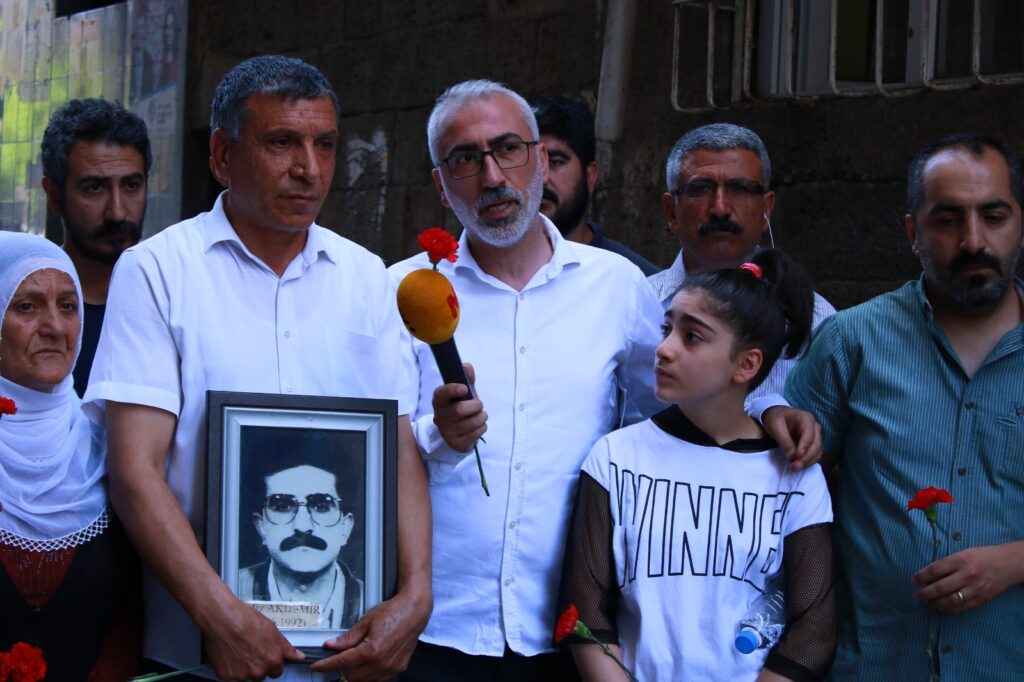
“For us, this issue means children losing their hands, their feet, their lives — while grazing sheep on pastures, while playing on paths just outside their villages. It is Ceylan Önkol. It is Nihat Kazanhan. It is our children who died crushed under an armored vehicle that brought down the wall of their home.”
Baskın said that when they arrive at the scene after receiving news of an explosion, the first thing they encounter is the gulf between the theory of the law and the state’s practice on the ground:
“Under international treaties and Article 125 of the Constitution, the state is obligated to protect the right to life of every citizen within its sovereign territory. If ordnance has exploded, that means there has been administrative negligence — a ‘service fault.’ The administration failed to close off the area, failed to post warning signs, left the ordnance unattended.”
Baskın said that in practice in Hakkari, administrative courts and prosecutors’ offices tend to shift responsibility onto the victim. He said children are effectively declared at fault on grounds such as “they entered a restricted military zone,” “there was fault on their own part,” or “parental supervision was neglected,” adding: “A child cannot be expected to know the boundary of a restricted military zone — but the state is obligated not to leave that ordnance there, and to seal off that area so that a child cannot enter it.”
“The right to life is not equal”
Describing landmine- and explosive-related death and injury case files not as files with an “unidentified perpetrator” but as files whose perpetrator is being protected, Baskın said impunity is experienced in Kurdish cities as an instrument of injustice, one that has produced widespread rights violations and trauma across the region:
“When a perpetrator is not punished, the violation does not end for the family — it continues, and grows. No effective investigation is carried out after an explosion. The crime-scene examination is either delayed or the evidence is tainted. When prosecutors want to open an investigation into suspect security personnel, the local administrative authorities [the governor’s or district governor’s office] refuse to grant permission. Files sit on court shelves for years until they run out the statute of limitations. Asking a mother who has lost her child, in the courtroom, ‘What was the child doing there?’ inflicts psychological violence on that family as severe as the explosion itself. Impunity sends an implicit message to the people living on this land: ‘Your right to life is not protected equally with that of a citizen in the west.’ This is the gravest violation, one that severs the bond of social peace.”
“There is pressure to drop the case”
Baskın said İHD has repeatedly documented how the justice mechanism shifts direction according to the political winds in Ankara. He recalled that during periods of escalating security policy, the judiciary falls entirely into a reflex of protecting security forces, and that cases are moved, on “security” grounds, hundreds of kilometers away from victims’ families — to places such as Ankara, İzmir or Karabük. “It is physically and financially impossible for a poor villager in Hakkari to travel to a western province every month to follow their child’s case. This is a deliberate strategy to let the case go unpursued,” he said.
“During periods without active conflict, the doors of the courts open somewhat more for us,” Baskın said, noting that in those periods prosecutors can operate more freely and that civil society organizations are able to visit the scene and prepare independent investigation reports. He added: “But unfortunately, even during these periods, no fundamental or lasting structural steps have been taken toward confronting the perpetrators of the past — peace processes have never gone beyond a temporary breathing space.”
Recalling the Ottawa Convention, to which Turkey is a signatory, Baskın said that reviewing the data and visiting border villages made clear that Turkey remains far behind its commitments. According to Baskın, some concrete steps — funded internationally through EU- and UNDP-backed projects — have been taken along the Iran and Armenia border lines, and a significant number of mines have been cleared. But that is precisely where the real problem begins:
“In the interior of Hakkari and Şırnak — in the pastures of villages emptied in the 1990s and now reopened to return, and around former military outposts and base areas — no clearance is being carried out. Maps are not being shared with civilian institutions. Obligations keep being postponed through repeated extension requests.”
“Risk education should be given in the mother tongue”
Baskın laid out İHD’s demands for preventing further deaths and injuries:
“The National Mine Action Center (MAFAM) must cease to be a military structure and must be opened to civilian, transparent oversight that includes us — human rights organizations — as well as local bar associations and medical chambers. Leaving ordnance in ways that lead to the death or maiming of children must be treated as a grave violation of the right to life, and the statute of limitations must be abolished entirely in these cases. If mine-risk education is to be given to children in the villages of Hakkari, Yüksekova and Çukurca, it absolutely must be given in the language in which those children feel safest — their mother tongue. A child fully understanding the warning means that child staying alive.”
The government crisis, which has been ongoing for more than 20 months, is dragging the Kurdistan Region not only into a political impasse but also into administrative and military division. The search for balance between Erbil and Sulaymaniyah has transcended local politics and turned into a critical breaking point that threatens regional security.
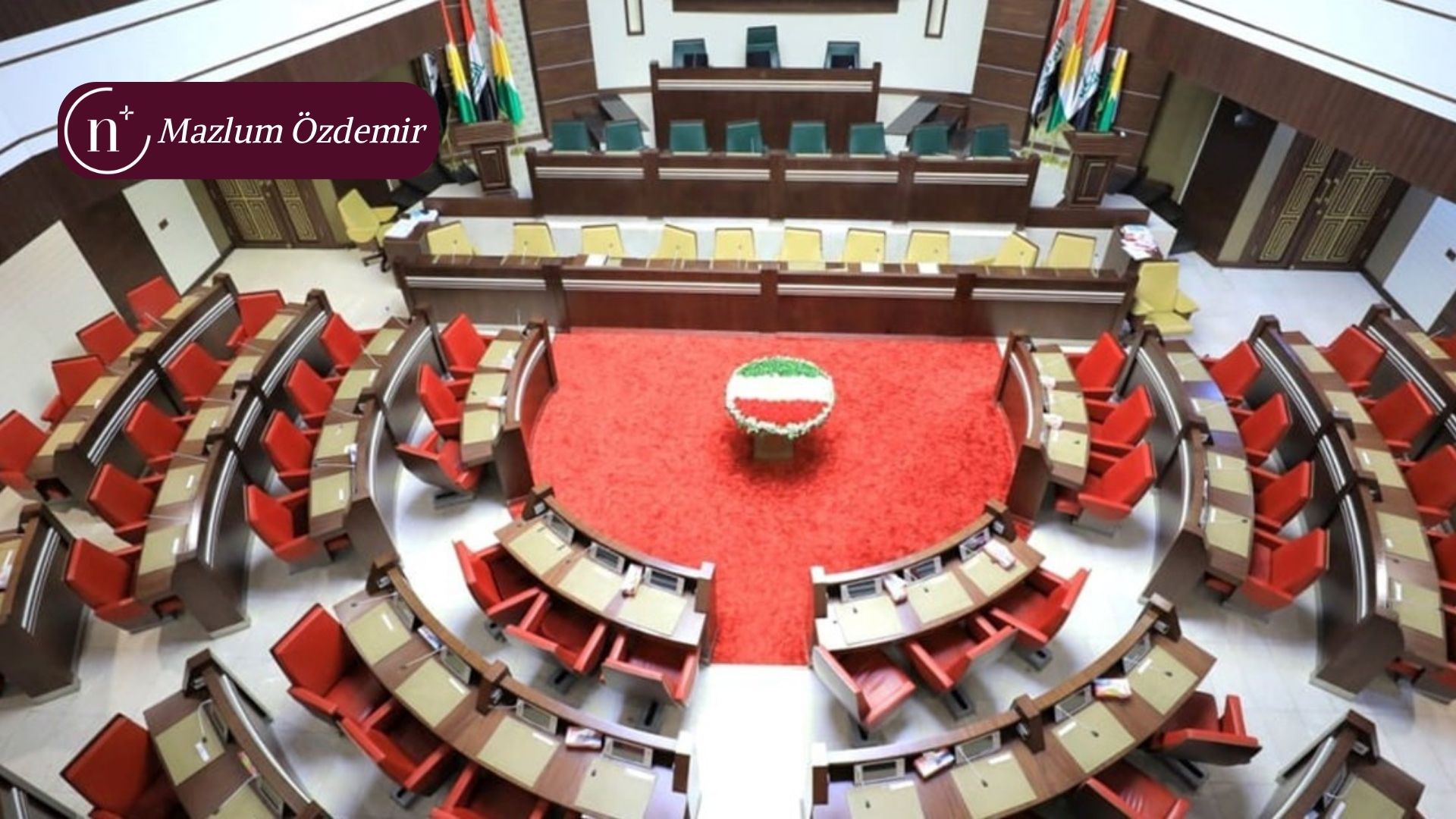
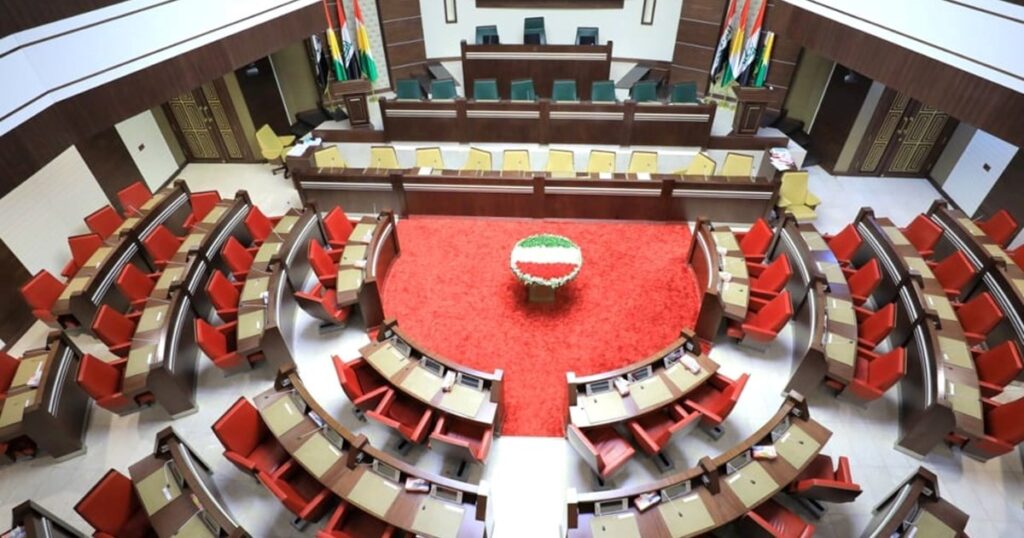
KRG Parliament
Although more than 20 months have passed since the elections held on October 20, 2024, in the Iraqi Kurdistan Region, a government has yet to be formed. The political crisis in the region is deepening because no coalition has been formed in the 105-seat parliament that can secure a 50+1 majority.
In the elections held on October 20, 2024, the KDP won 40 seats, the PUK 23, New Generation 16, the Kurdistan Islamic Union (Yekgirtî) 7, Helwest 3, the People’s Front (Berey Gel) 2, and Goran and Komal 3 seats each.
Following the elections, more than 30 rounds of talks between the KDP and the PUK—covering issues such as the redistribution of ministerial portfolios and the election of the president—failed to yield results. Since a new government has not been formed, the government established after the previous election has been operating as an interim government for approximately 20 months. This disagreement between the KDP and the PUK was reflected not only in the Kurdistan Regional Government election but also in the Iraqi presidential election, and due to the Kurds’ divided stance, the Iraqi presidential election has also been prolonged.
KRI Politic and Administrative Activity Map
Yellow Zone: Kurdistan Democratic Party (KDP)
The core power and absolute dominance area of the KDP covers the provinces of Erbil (Hewlêr) and Duhok. Since Erbil is the capital of the KRI, the weight of the KDP is also strongly felt at the center of the official administrative structure. At the same time, Zakho and its surroundings, which border Turkey, are under the full control of the KDP.
Green Zone: Patriotic Union of Kurdistan (PUK)
The traditional base and political, administrative, and military control point of the PUK consists of the Sulaymaniyah and Halabja provinces. This region runs parallel to the Iranian border, and the PUK administration ensures the security and local governance of these provinces through its own military (70th Brigade) and administrative cadres.
Activity Areas of the Opposition and Other Parties
Gorran (Movement for Change): Its birthplace and strongest base is the Sulaymaniyah province. Emerging from within the PUK, this movement remains a factor in Sulaymaniyah politics.
New Generation Movement (Naway Nwe): Its headquarters and main base are predominantly in Sulaymaniyah, but it is the current main opposition that resonates across the region, having also successfully appealed to a certain protest vote in Erbil.
Islamic Parties: While the Kurdistan Islamic Union (Yekgirtû) maintains a significant presence in the Duhok region, the Kurdistan Justice Group (Komal) is primarily influential around Sulaymaniyah and Halabja.
According to the Iraqi Constitution, which was ratified in 2005, the President is traditionally selected from among the Kurds. Under the agreement between the KDP and the PUK, however, the President of the Kurdistan Region has been selected from the KDP, while the President of Iraq has been selected from the PUK ever since. As the two parties could not reach an agreement on the presidential election, they entered the race with different candidates; the election held on April 11 was won by the PUK’s candidate, Nizar Amedi. The KDP, however, boycotted the election and announced that it did not recognize Nizar Amedi as the representative of Kurdistan.
In a statement issued by the KDP Politburo, it was stated: “The candidate nominated for the office of President has been excluded from Kurdish mechanisms. Yet this office belongs not to a party, but to the people of Kurdistan. However, the candidate in question for this office was designated by a party and endorsed by certain parties affiliated with other components of Iraq. For this reason, we reject this election method and will not recognize a person selected in this manner as the representative of the Kurdish majority, nor will we engage with him.”
Government talks ended in a stalemate
While the Iraqi presidential election was resolved in this manner, the formation of the regional government remained unresolved despite dozens of rounds of talks. According to political conventions in the Kurdistan Region, the office of Prime Minister of the Kurdistan Region has traditionally been shared between the two parties on a two-year rotating basis for each electoral cycle. However, the KDP has not adhered to this convention for some time. The KDP wants to retain the presidencies of the Kurdistan Region and the Prime Minister’s Office. In contrast, the PUK wants more ministerial posts and authority within the government. Until 2023, the KDP was able to form a government by securing a 50 percent majority, including its 11-seat quota. However, in 2023, following a ruling by the Iraqi Federal Court, the number of seats in the Kurdistan Regional Parliament was reduced from 111 to 100, and the number of quota seats was reduced from 11 to 5.
The PUK, which seeks full partnership in the administration of the Kurdistan Region, argues that the KDP has become the decisive factor in decision-making processes and that this has disrupted the political balance.
Along with the disagreement between the parties over control of the Ministry of the Interior and security agencies, the KDP ultimately wants to retain its dominant position in the administration, while the PUK is demanding equal partnership.
This dispute between the KDP and the PUK has brought about numerous negative consequences in the Kurdistan Region. While political, economic, and social crises—including the non-payment of salaries—are being experienced due to the failure to form a government, the resolution of issues between Baghdad and the Kurdistan Region is constantly being postponed due to the fragmented state of relations with the central government.
Influential Figures of KRI Politics
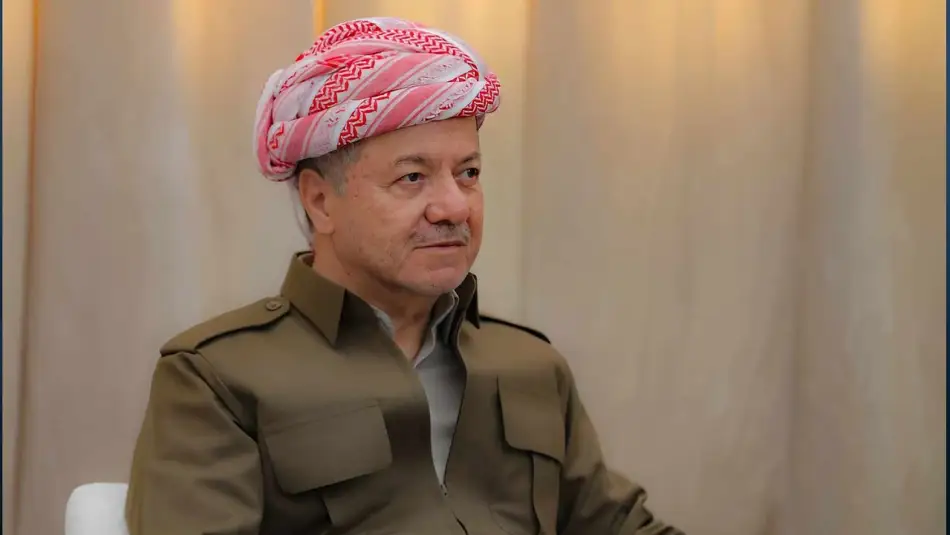
Masoud Barzani
President of the Kurdistan Democratic Party (KDP)
The former president of the Kurdistan Region and the historical leader of the KDP. Although he holds no official government post, he remains the most powerful political figure who makes the ultimate decisions in the Yellow Zone (Erbil-Duhok) and across regional politics.
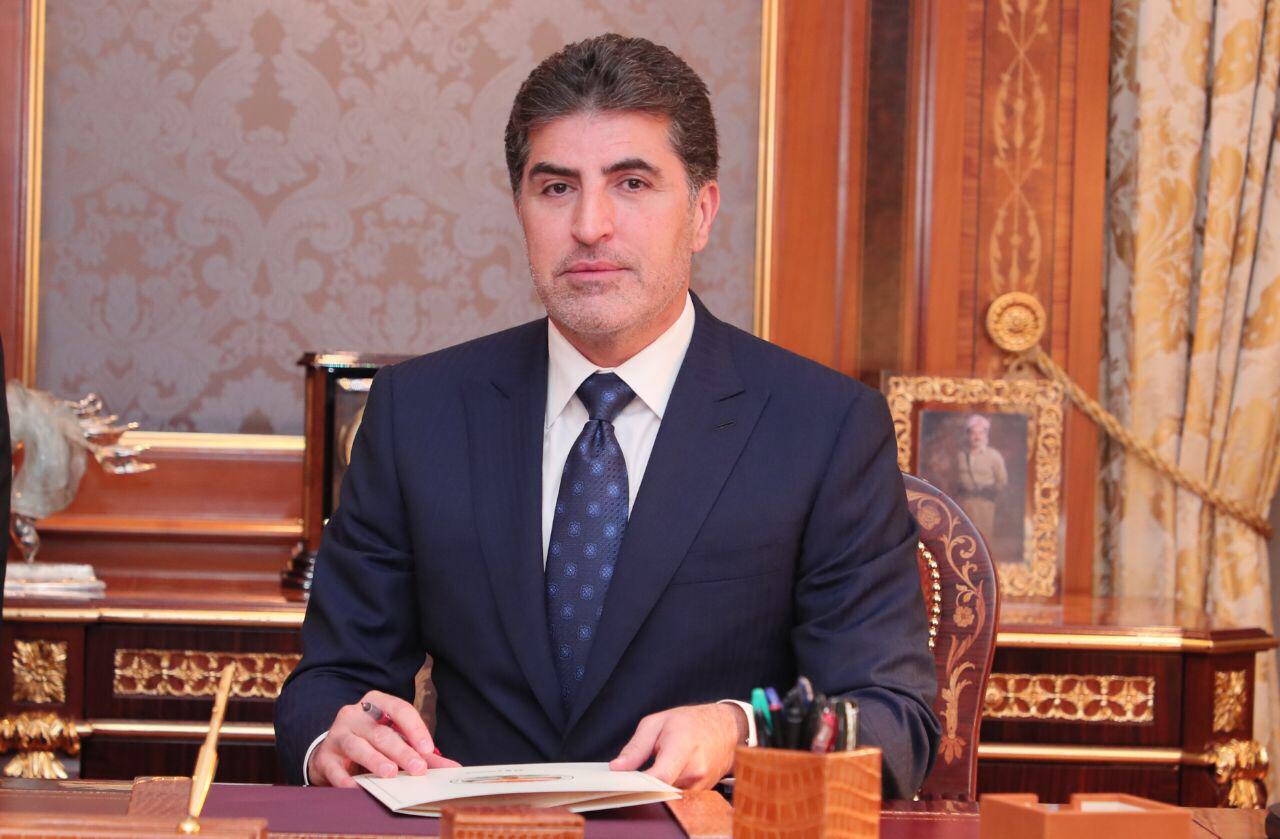
Nechirvan Barzani
President of KRI & Vice President of KDP
The current president of the region. He plays a key role particularly in Erbil-centered diplomacy, managing relations with Baghdad and Ankara, and balancing regional crises between the KDP and PUK.
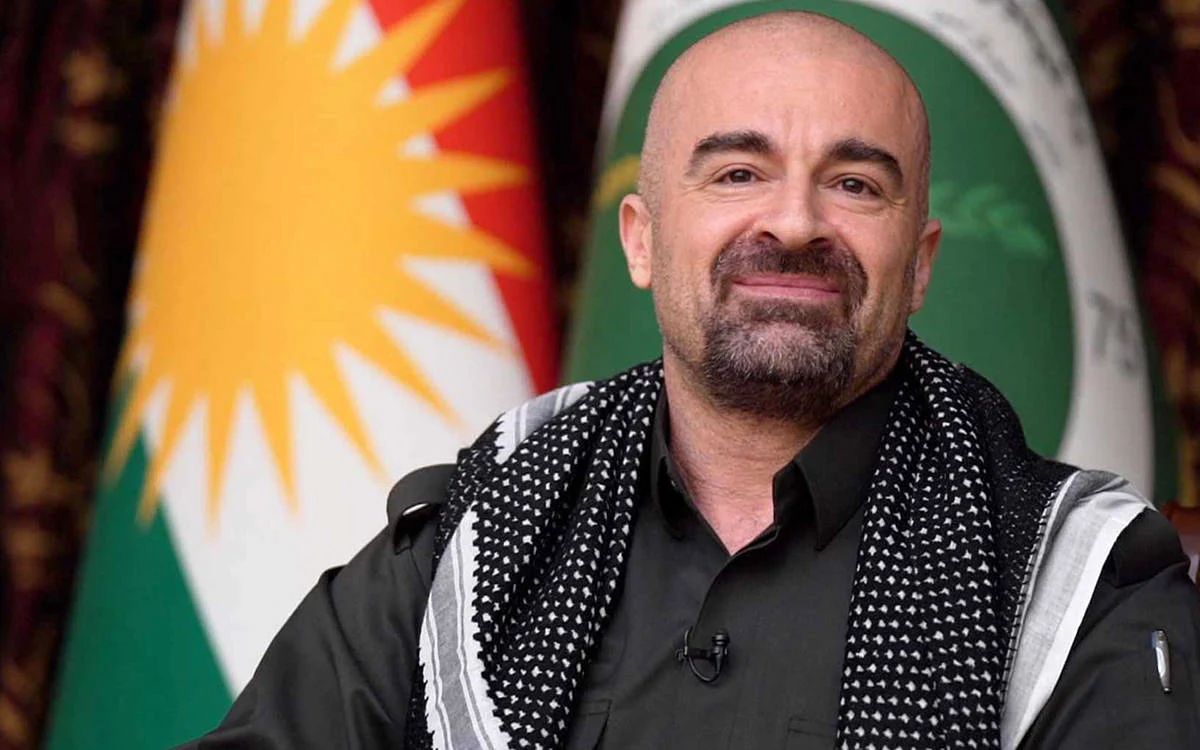
Bafel Talabani
President of the Patriotic Union of Kurdistan (PUK)
The de facto leader of the Green Zone (Sulaymaniyah-Halabja). By putting an end to internal party rivalries, he consolidated the PUK’s military (70th Brigade) and intelligence power into a single hand, becoming the main actor defending the autonomy of Sulaymaniyah against Erbil’s policies.
Shaswar Abdulwahid
Leader of the New Generation Movement (Naway Nwe)
A media mogul and politician based in Sulaymaniyah. By directing harsh criticisms against the traditional duopoly of the KDP and PUK, he forms the current center for anti-establishment and protest votes in both regions.
The alliance between the PUK and the new generation movement
Following prolonged and fruitless negotiations between the KDP and the PUK, the PUK and the New Generation Movement decided in recent months to work together in parliament. Although this alliance—which, with a total of 38 seats, brought the number of seats close to that of the KDP in the Kurdistan Regional Parliament and partially shifted the balance of power—did not reach the number needed to form a government, the merger of these two Sulaymaniyah-based movements against the KDP has created a new balance of power. Indeed, it appears that the two parties have secured significant influence by also deciding to work together in the Iraqi Parliament.
Following the agreement reached between the PUK and the New Generation Movement, PUK Chairman Bafıl Talabani stated that they wished to reach an agreement with the KDP and form a government as soon as possible, while New Generation Movement Leader Şaswar Abdulvahid conveyed that the premiership should go to someone outside the KDP, signaling that they were aligned with the PUK. The KDP, however, despite leaving all alliance proposals in limbo, is citing the PUK as the reason for the failure to form a government. KDP Spokesperson Mahmud Muhammed, in a statement made a few days ago, accused the PUK of obstructing the process, saying, “It is the PUK itself that is disregarding the people’s vote and will, imposing itself on the election results through coercion, and failing to take into account the number of votes and seats won by the parties.”
KDP: We are the true representatives
Noting that the KDP received more votes than the PUK in both the Kurdistan Parliament and the Iraqi Council of Representatives elections, Muhammad stated that the KDP is the true representative of the people, while the PUK, with only 23 seats, represents only its own voters.
Military crisis: The failure to unify the Peshmerga
In addition to this political crisis between the KDP and the PUK, there is also the issue of unifying the Peshmerga, which can be viewed as a military crisis. Both parties have their own separate armed forces, namely the Peshmerga. The process of unifying the Peshmerga forces affiliated with both parties, which began in 2010, resulted in the formation of 14 brigades by 2013 through the unification of 42,000 Peshmerga fighters; however, the unification process subsequently stalled. In 2018, with the support and pressure of the international coalition formed against ISIS, this process resumed but has yet to reach a conclusion. Tom Barrack, the U.S.’s new representative for Iraq and Syria, announced a new U.S. regional policy—the “one army, one central structure” doctrine—and has been attempting to implement it. There has been discussion that the Peshmerga would be integrated into the Iraqi army under this doctrine, but this claim was denied by the Ministry of Peshmerga Affairs and the KDP.
Mela Bahtiyar: “The consequences will be severe”
Mela Bahtiyar, a prominent Kurdish politician in the politics of Federal Kurdistan and Iraq, warned in a recent statement to Rudaw that the political consequences of failing to form a government would be severe. Noting that the current situation has weakened the position of the Federal Kurdistan Region, Bahtiyar said that there are effectively two separate areas in the region. Recalling that the Peshmerga forces, the police force, and various public institutions have not been fully integrated for years, Bahtiyar said, “Our government cannot appoint even a single civil servant from Koye to Xaneqîn without consulting the PUK, nor can the PUK deploy a single soldier from Koye to Zaxo without consulting the KDP.”
“The U.S. Determines the Representative”
Bahtiyar noted that the U.S. supports a strong and unified state structure in Iraq, and that the Washington administration wants to see a unified army, a unified financial system, and strong central institutions, adding that resolving the issues between the Kurdistan Region and Baghdad is therefore crucial. Noting that if the KDP and the PUK fail to overcome their current disagreements, external actors could become more involved in the process, Bahtiyar added: “It would be better if they resolved it, but if they don’t, I believe the U.S. will ultimately decide for itself who the Kurds’ representative will be. It would be best for them to resolve it before the situation reaches that point.”
The regional government, which has not been formed for over 20 months due to the two parties’ inability to reach an agreement, is causing serious economic and political problems in the Kurdistan Region while also leaving the region vulnerable to interference by neighboring states.
KRI Political System: Chronology and Structural Analysis
Emergence and Chronology of the Political System
1946:The Kurdistan Democratic Party (KDP) was founded in Mahabad by Mustafa Barzani.
1970:The “March 11 Autonomy Accord” was signed between Kurdish leaders and the Iraqi government.
1975:The Patriotic Union of Kurdistan (PUK) was established under the leadership of Jalal Talabani.
1991:Following the First Gulf War, the Raperin (uprising) took place. A de facto autonomy was created as the UN declared the area north of the 36th parallel a “No-Fly Zone.”
1992:The first parliamentary elections were held in the region. The KDP and PUK shared a 50-50 power balance in parliament, and the Kurdistan Regional Government (KRG) was de facto established.
1994 – 1998:As a result of the civil war (Brakujî) between the KDP and PUK, the region was administratively split into two (Erbil and Sulaymaniyah).
2003:The Ba’ath regime was overthrown by the US invasion of Iraq; Peshmerga forces acted in coordination with the coalition.
2005:With the new Iraqi Constitution, the Kurdistan Region gained official legal (de jure) status as a “federal region.”
2006:The KDP and PUK administrations merged to form a unified government.
2009:The Gorran (Change) Movement was founded, breaking the two-party hegemony.
2014 – 2017:During the war against ISIS, the Peshmerga secured control over disputed territories, including Kirkuk.
2017:An Independence Referendum was held, after which the Iraqi army reclaimed Kirkuk and other disputed territories.
2024:The postponed Kurdistan Parliamentary elections were carried out in October.
Active Political Forces and Dominance Zones
Kurdistan Democratic Party (KDP):Dominant in Erbil and Duhok provinces (“Yellow Zone”). Its military backbone is the 80th Brigade.
Patriotic Union of Kurdistan (PUK):Dominant in Sulaymaniyah and Halabja provinces (“Green Zone”). Its military backbone is the 70th Brigade.
New Generation Movement (Naway Nwe):The region’s main current opposition party, challenging the KDP-PUK duopoly.
Gorran:The Sulaymaniyah-based former primary opposition movement.
Islamic Parties:The Kurdistan Islamic Union (Yekgirtû) and the Kurdistan Justice Group (Komal) are the conservative forces represented in parliament.
Regional and International Relations Equation
Iraqi Central Government (Baghdad):Relations revolve around the federal budget share, public servant salaries, energy exports, and the status of disputed territories under “Article 140.”
Turkey:Maintains strong commercial, political, and energy (Ceyhan pipeline) ties primarily with Erbil. Military operations against the PKK form a core part of the relationship dynamics.
Iran:Exerts high historical and political influence in the PUK-controlled area along its border. It intervenes in regional developments through military pressure directed at its own dissident Iranian-Kurdish parties.
US and International Coalition:Maintains security-focused relations. They provide funding and training aimed at unifying the Peshmerga forces into a non-partisan, institutional army.
What Do They Want? (Core Political Demands)
Implementation of Article 140:Holding referendums in Kirkuk and other disputed areas to finalize whether these zones will officially attach to Erbil or Baghdad.
Financial Guarantees:Ensuring uninterrupted payments of public servant and Peshmerga salaries by Baghdad.
Energy Independence:Securing recognized authority to manage regional oil and gas resources, or receiving a fair share of the generated national revenues.
What Are They Doing? (Current Activities)
Conducting intra-party and inter-party negotiations aimed at forming a new coalition government following the October 2024 elections.
Advancing reform initiatives to unify party-controlled military units under a single Ministry of Peshmerga Affairs.
Engaging in technical talks with Baghdad to coordinate the payment of civil servant salaries through banking systems (Tawtin/MyAccount projects).
Executing coordinated operations with the Iraqi army against ISIS sleeper cells in disputed territories experiencing security gaps.
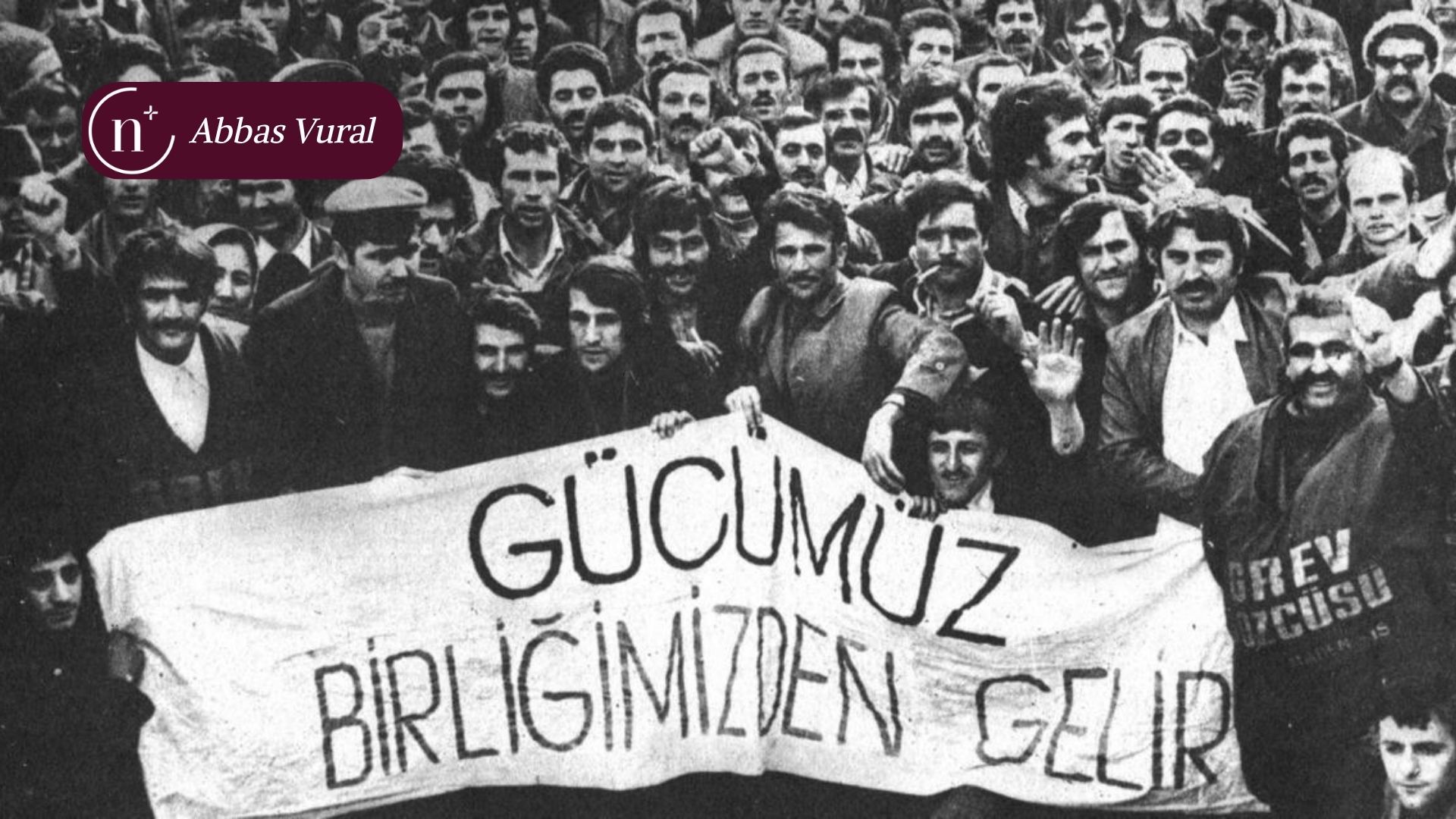
On June 15-16, 1970, nearly a hundred thousand workers took to the streets against regulations targeting union rights. Despite 56 years having passed, we have compiled a day-by-day account of the events, which remain one of the greatest resistance movements in Turkish working-class history.
Photo: DISK Archive
Today marks the 56th anniversary of the June 15-16 resistance, one of the largest worker actions in Turkish history.
The June 15-16 resistance, the subject of numerous books, films, documentaries, and research, has maintained its status as one of the greatest actions of the Turkish working class for over half a century. The memory of these actions, in which nearly one hundred thousand workers from companies such as Türk Demir Döküm, Sungurlar, Derby, Elektrometal, Rabak, Auer, Çelik Endüstrisi, Mutlu Akü, Vinileks, Otosan, Arçelik, and Vita took to the streets, still needs to be preserved 56 years later.
On the 56th anniversary of the June 15-16 resistance, which began as a protest against the Justice Party government’s planned changes to the trade union law but transformed into a much more radical and widespread movement, we discussed the state of labor struggles and trade union rights in Turkey with Prof. Dr. Aziz Çelik, Assoc. Dr. Hakan Koçak, Özkan Atar, General President of the United Metal Workers Union, and labor historian Zafer Aydın.
The June 15–16 Resistance: A Day-by-Day Account of Events and Legal Proceedings
In June 1970, close to a hundred thousand workers took to the streets in protest against regulations targeting trade union rights. Remembered to this day as one of the greatest acts of resistance in the history of Turkey’s working class, we have compiled the course of the events and the massive legal struggle that followed — day by day.
June 11, 1970
A bill proposing amendments to Trade Unions Act No. 274 and Collective Bargaining, Strike and Lockout Act No. 275 was passed in the Grand National Assembly with the votes of all parties except the Turkish Workers’ Party (TİP) — including the Justice Party and the CHP. The bill’s primary aim was to halt the flow of workers from Türk-İş to DİSK. It introduced a requirement that a union must have enrolled as members at least one-third (1/3) of the insured workers employed in the sector in which it operates in order to function nationwide. A similar one-third representation threshold was also set for confederations.
June 13, 1970
Under the legislation, which had completed its parliamentary process, salaried state personnel such as orderlies, janitors, and cleaning workers would be classified as workers and permitted to form unions; a minimum of three years’ employment in the sector would be required to establish a union; withdrawal from union membership would be processed through a notary; union general assemblies would convene every three years rather than two; and unions’ investment permissions for funds would be subject to confederation approval.
June 14, 1970
On the grounds that the bill would eliminate freedom of union choice, workplace representatives of unions affiliated with the Confederation of Revolutionary Trade Unions (DİSK) in Ankara, İzmir, Kocaeli, and Sakarya convened a joint meeting and resolved to take action until the bill was withdrawn.
June 15, 1970
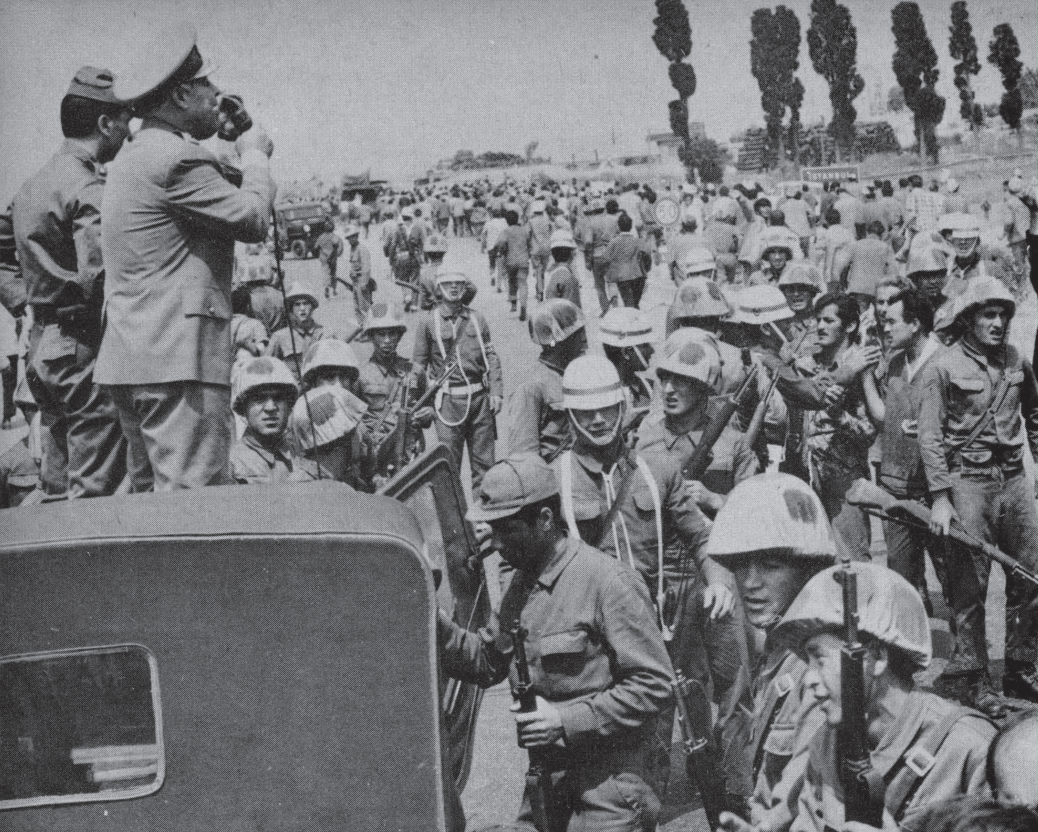
Tensions that had been building on factory floors for years spilled into the streets as between 75,000 and 100,000 workers marched toward various points across Istanbul. Although the protests were led by DİSK, large numbers of Türk-İş members also joined the marches in class solidarity, rejecting the stance taken by the parties they had previously supported. By the evening of the first day, the Council of Ministers declared 60 days of martial law.
Asian Side: A march column departing from Kartal advanced along the Ankara Highway (E-5). With workers from Otosan and DMO in Göztepe joining, along with groups from Beykoz and Paşabahçe, an enormous crowd formed and moved toward Üsküdar and Kadıköy.
European Side: Marches were held along the Bakırköy–Topkapı–Sağmalcılar route. The Istanbul–Ankara highway was closed to traffic.
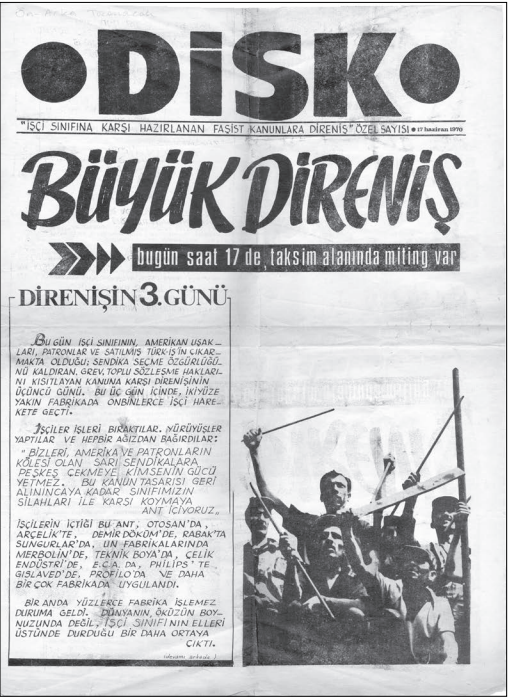
A newspaper front page published by DİSK under the headline “The Great Resistance,” highlighting the June protests and the participation of tens of thousands of workers.
Security measures taken by military units during the demonstrations and the moment of an announcement made through a loudspeaker.
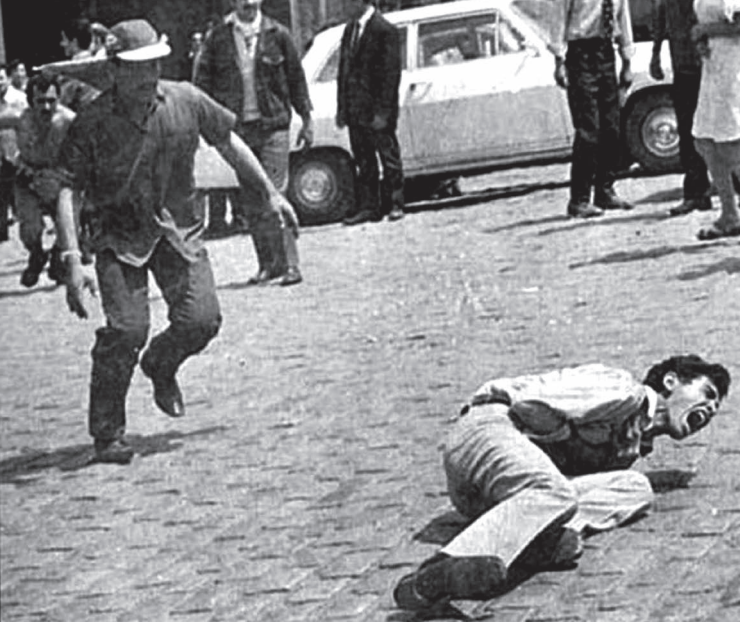
Violent clashes in the streets during the June 15–16 protests, and workers injured in the unrest.
June 16, 1970
The workers’ protests continued in full force. A march that began in Gebze merged with workers from Kartal and reached Kadıköy Ferry Square along Bağdat Avenue. On the European side, columns advancing from outside Topkapı descended via Aksaray to Sultanahmet, Cağaloğlu, and the front of the Governor’s Office, and from there to Eminönü. Actions also took place in Ankara, Adana, Bursa, and İzmir.
Opening of the Bridges: The Istanbul Governorship opened the Galata and Unkapanı bridges to traffic in order to prevent the Asian and European columns of the movement (or passage to the Beyoğlu side) from converging.
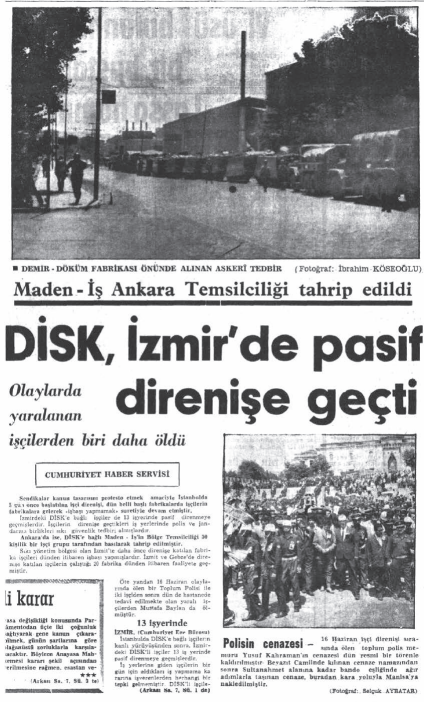
Casualties: As a result of police fire and clashes in Kadıköy, workers Yaşar Yıldırım (Mutlu Akü), Mustafa Bayram (Vinleks), and Mehmet Gıdak (Cevizli Tekel), along with shopkeeper Doğukan Dere and police officer Yusuf Kahraman, lost their lives.
Martial Law and DİSK’s Stance: Martial law was declared in Istanbul and in the Merkez and Gebze districts of Kocaeli. DİSK General President Kemal Türkler, in a message read on the radio, warned workers against provocations and called on them not to step outside the constitutional framework.
A Cumhuriyet newspaper clipping: military measures in front of the Demir-Döküm factory and news reports on those who lost their lives in the events.
June 17, 1970
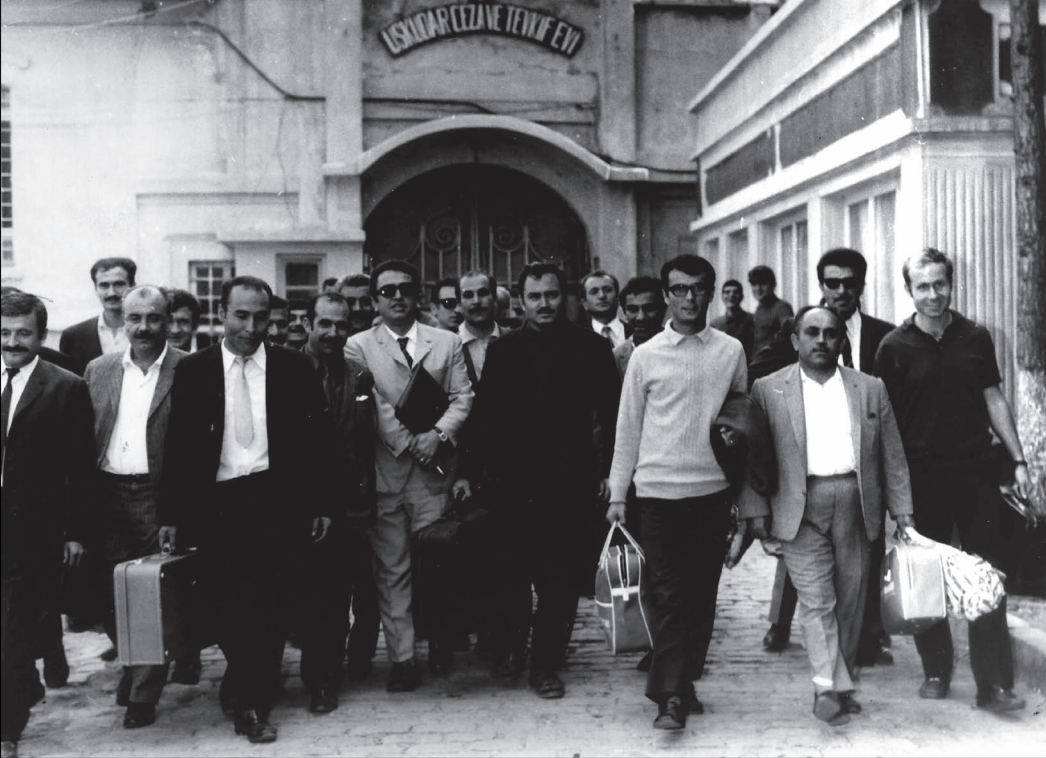
The Martial Law Command detained 23 union officials — including DİSK General President Kemal Türkler and Secretary General Kemal Sülker — on charges of instigating and inciting the events. These individuals were tried by the Martial Law Military Court on the grave charge of “attempting to alter, transform, and abolish the Constitution.” In addition, close to a hundred workers were taken into custody during the events, and a curfew was imposed from 21:00 onward.
Union officials, including DİSK General President Kemal Türkler and Secretary General Kemal Sülker, in front of Üsküdar Prison.
June 18, 1970
In İzmir, where martial law had not been declared, workers at certain workplaces affiliated with Lastik-İş, Maden-İş, and Gıda-İş also walked off the job in solidarity with the resistance.
June 19, 1970
Through Communiqué No. 13 of the Martial Law Command, the exercise of the right to strike was banned; a separate communiqué made collective bargaining negotiations subject to official authorization.
June 20, 1970
The printing and distribution of Maden-İş Gazetesi, the publication of the Maden-İş Union affiliated with DİSK, was banned.
June 22, 1970
Military units entered the İzsal strike zone, where a strike had begun prior to the events and was still ongoing. Martial law officials issued an order to open fire on anyone approaching within 25 metres of the military units.
Post-Resistance Mass Dismissals (July 1970)
In the aftermath of the June 15–16 events, 5,090 workers who had participated in the protests were dismissed and blacklisted. The targeted dismissal of workers silenced the labor movement in the Marmara region for a long time to come. Meanwhile, the bill amending Act No. 274 — following the suppression of the protests — received its final parliamentary approval on July 29, 1970, as Law No. 1317.
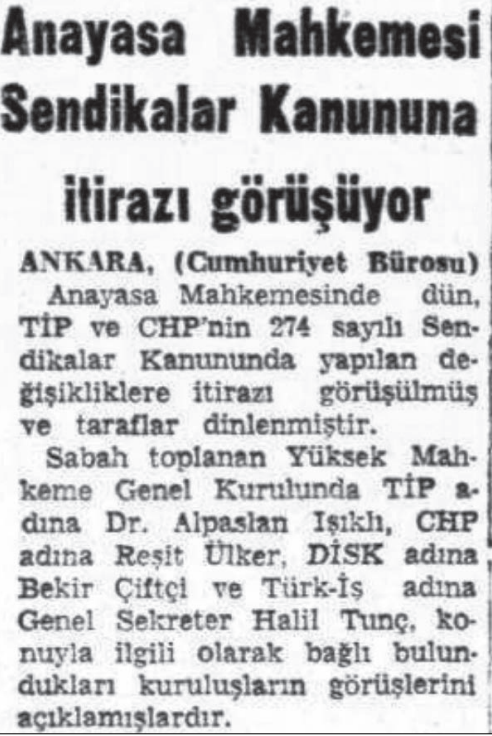
A hearing report on the annulment case filed at the Constitutional Court challenging the amendments to Trade Unions Act No. 274.
August 12, 1970
Law No. 1317 was published in the Official Gazette and entered into force. On the same day, a petition prepared on behalf of the Turkish Workers’ Party (TİP) by Prof. Dr. Alpaslan Işıklı was formally submitted to the Constitutional Court (AYM) to have the law annulled.
August 18, 1970
Shortly after TİP’s application, the Republican People’s Party — under the leadership of Secretary General Bülent Ecevit and party leader İsmet İnönü — filed a separate application with the Constitutional Court seeking the annulment of the law. (The Court later consolidated these cases and examined them under case number 1970/47.)
March 12, 1971
The Turkish Armed Forces issued a memorandum citing street conflicts and economic instability, forcing the incumbent government to resign and effectively seizing control of the administration.
October 19, 1972
The Constitutional Court’s ruling of February 9, 1972 was published in the Official Gazette and entered into force. The Court annulled the majority of the amendments in their entirety, on the grounds that they were “contrary to the constitutional principles of the right to form trade unions and the right to strike.”
The May 2026 United Kingdom elections were a serious warning for the Labour government, a sign of pressure for the Conservative Party to rebuild itself, a big opportunity for Reform UK, and a sign of a new period in domestic politics. These elections show that UK politics is becoming more fragmented, more competitive and more unpredictable.
The elections held in the United Kingdom last month were not general elections, but they were still an important turning point because they showed the political direction of the country. Local elections were held in many parts of England, while parliamentary elections were held in Scotland and Senedd elections were held in Wales. These elections gave a serious warning to the Labour government. Labour came to power with a large majority in the 2024 general election, but only two years later, the party lost a lot of support in all three countries.
Perhaps the most important result of the elections was the rise of political fragmentation. For a long time, politics in the United Kingdom was mainly shaped by the competition between Labour and the Conservative Party. However, the 2026 election results showed that the two-party system is becoming weaker. Reform UK gained strength as a right-wing populist alternative, while the Green Party, the Liberal Democrats, Plaid Cymru and the SNP increased their support in different regions. This shows that voters are no longer automatically loyal to traditional parties.
It would not be wrong to say that the May local elections were especially disappointing for Labour in England. In the elections held on 7 May, Labour either lost in many areas that could be described as its strongholds or saw a serious fall in its vote share. Reform UK achieved successful results, especially in areas where support for Brexit was high. Reform UK, which has been criticised for its anti-immigration position but has also increased its support recently, won more than 1,400 council seats in England. This has already put pressure on its rivals before the 2029 general election. Reform UK’s success shows that issues such as immigration, economic insecurity and public services still have a strong influence on voters.
The Green Party also achieved an important success in these elections, winning more than 500 council seats and two mayoralties in London. The Liberal Democrats also increased their number of council seats compared with the previous election.
May 2026 United Kingdom Elections
Political fragmentation, warning signs, and a roadmap analysis for 2029
Regional seat allocations and radical shift
Wales Senedd elections
Plaid Cymru
43
Reform UK
34
Labour
9
Scotland Holyrood elections
SNP (Scottish National Party)
57
Reform UK
17
Scottish Labour Party
17
England local elections & alternative powers
In council seats across England, voters looking for alternatives to the traditional two-party system drove radical shifts across both the right and left wings:
1,400+
Reform UK Council Seats
Achieved massive success particularly in high Brexit-support areas, creating a huge pressure element for 2029.
500+
Green Party Council Seats
Won two mayoralties in London and more than 500 seats, becoming the new focal point for left-wing/progressive voters.
Key dynamics shifting voter behavior
Chronic issues lie behind the end of “automatic” loyalty toward traditional parties:
Economic Instability & Cost of Living: Voters feel that the change of government in 2024 has not reflected onto their daily lives.
Healthcare (NHS) and Public Crisis: The decline in public services is being blamed on the traditional parties.
Immigration and Security Debates: This became the main fuel powering the rise of the right-wing populist Reform UK.
Political projection towards the 2029 general election
Although Prime Minister Keir Starmer, who is under heavy pressure, announced following the election results that he would not resign and would not drag the country into instability, the government’s room for maneuver has narrowed. In this new era where politics has turned into a much more fragmented, competitive, and unpredictable structure, the May 2026 results serve as a stark warning to all parties on the path leading to the 2029 general elections.
Exclusive HTML Infographic Module | Created using AI tools based on the article text.
Labour won only 9 seats in Wales
On 7 May, people in Scotland and Wales also voted to choose representatives for their national parliaments, and Reform UK achieved successful results in both countries. In Wales, the Welsh nationalist party Plaid Cymru won the highest number of seats, with 43 seats, and became the largest party in the Senedd. Reform UK became the second-largest party with 34 seats. Labour won only 9 seats in Wales.
In the elections for the Scottish Parliament, also known as Holyrood, the Scottish National Party, or SNP, won the election for the fifth time, but lost its majority. The SNP won 57 seats, while Reform UK and Scottish Labour shared second place with 17 seats each. The elections in Scotland showed that the question of independence is still very important for many voters. However, issues such as the cost of living, the NHS and public services were also important factors in how people voted.
The most important message of the 7 May elections for Labour is that its big victory in the 2024 general election was not a permanent vote of confidence. Keir Starmer’s government had promised economic stability, better public services and the rebuilding of political trust. However, the 2026 elections showed that many voters have not yet felt this change in their daily lives. After the election results, Starmer said that he would not resign and would not leave the country in “chaos”. This clearly showed that his government is under pressure.
Housing crisis, debates on migration
The wider meaning of the 2026 elections is that voter behaviour in the United Kingdom is now more affected by current problems. Economic difficulties, debates about immigration, the condition of public services, the housing crisis and political distrust are changing traditional voting habits. For this reason, the May 2026 elections were not only local or regional elections. They also gave serious warnings to political parties on the road to the 2029 general election.
The May 2026 United Kingdom elections were a serious warning for the Labour government, a sign of pressure for the Conservative Party to rebuild itself, a big opportunity for Reform UK, and a sign of a new period in domestic politics. These elections show that UK politics is becoming more fragmented, more competitive and more unpredictable.
The Kurdish question, discussed under the heading of the PKK and leaving its mark on the last 48 years of Turkey, has outlasted numerous presidents, dozens of prime ministers, governments, ministers of interior and foreign affairs, and chiefs of general staff. Throughout this period, spanning from 1978 to February 27, 2025, Abdullah Öcalan has remained the unchanging actor on the other side of this issue.
Photo: Niha+
Despite having a history of over a century, the Kurdish question—debated alongside the PKK’s prominence in the last fifty years of Turkish history—is not merely a chronology of conflict; it serves as a mirror reflecting how the state’s institutional structure and mode of governance have transformed.
Consequently, the recent political history of Turkey, covering this 48-year span, is on one hand the history of the transformation of the Kurdish question—oscillating between “denial,” “annihilation,” “dialogue,” and the “securitarian status quo”—and on the other, a history of statistics showing the turnover of countless governments, presidents, prime ministers, and ministers.
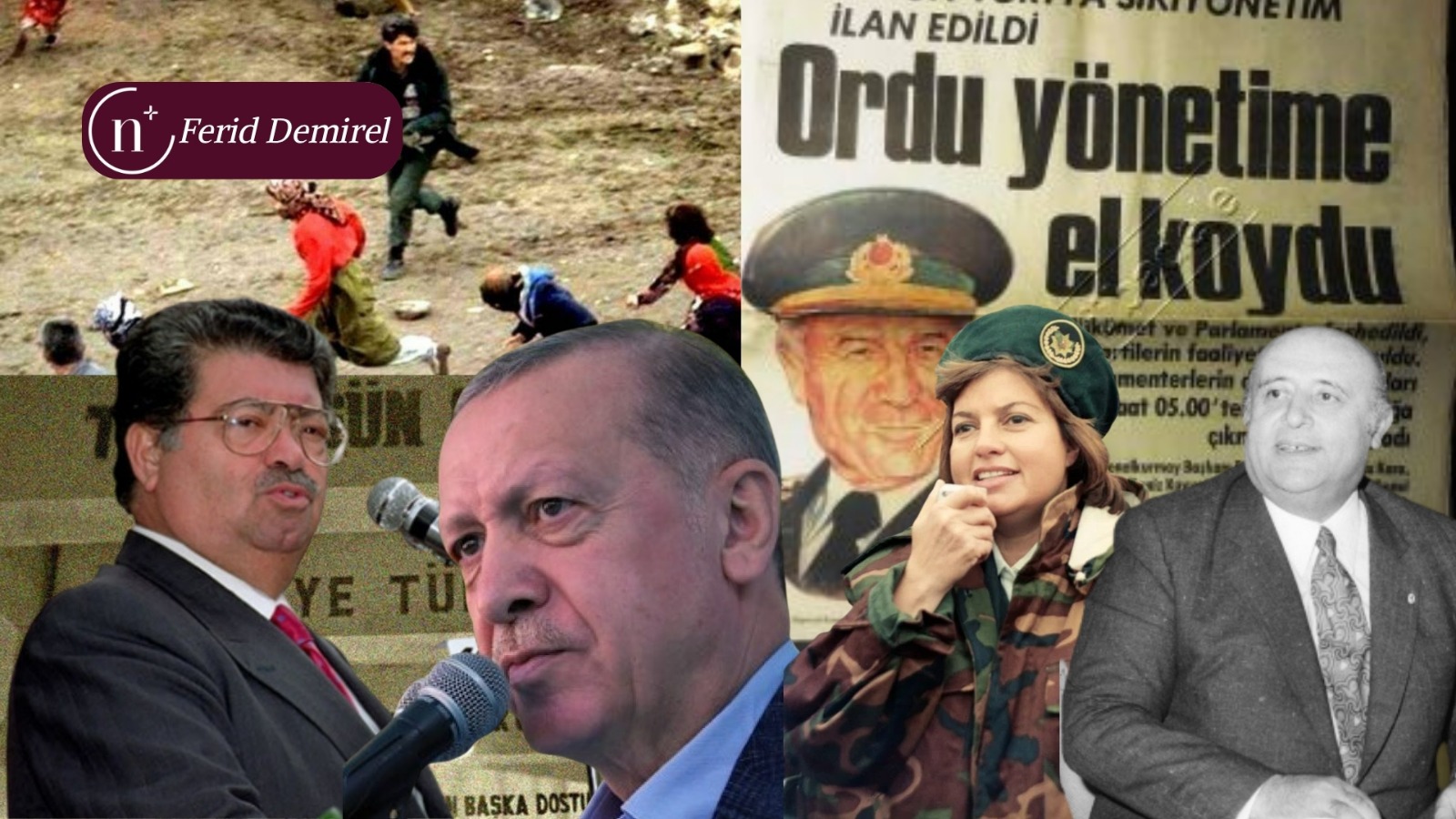
Throughout these 48 years, which the state has characterized in official discourse primarily through the rhetoric of “terrorism” rather than as the Kurdish question, the common point of almost all ministers from various parties has been the emphasis on “fighting until the last terrorist.” From the day the PKK was founded—an event Süleyman Demirel described as the “29th Kurdish Rebellion” and widely viewed as a result of the Kurdish question—until the day it announced its dissolution, the issue was portrayed by the state as “terrorism.” From the military boots of September 12 to today’s cross-border doctrine utilizing UCAVs (SİHAs), there has been a consistent effort to squeeze the Kurdish issue into a parenthesis of “annihilation and public order.”
THE ANKARA RECORD & MEMORY ARCHIVE: 1978 – 2026
Focal & Process Actors
1978 – PresentAbdullah Öcalan
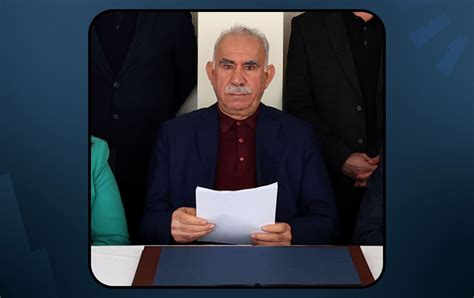
The focal point of the process from Fis to İmralı. In 2025, he issued the historic call for the organization’s dissolution.
1997 – PresentDevlet Bahçeli
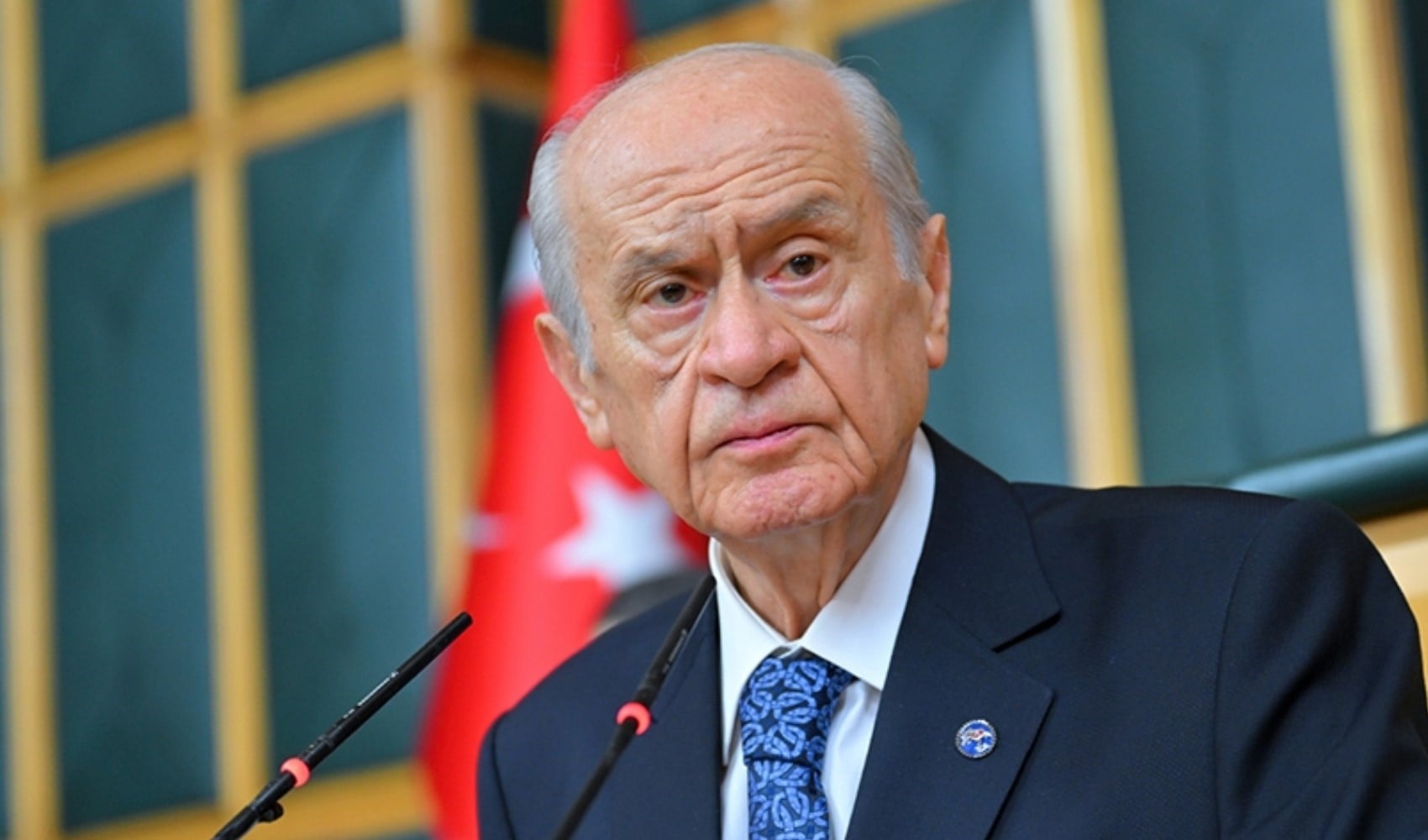
Untied the 48-year-old knot in late 2024 with his move: “Let İmralı address the Parliament.”
Presidency and Leadership
2003 – 2026Recep Tayyip Erdoğan
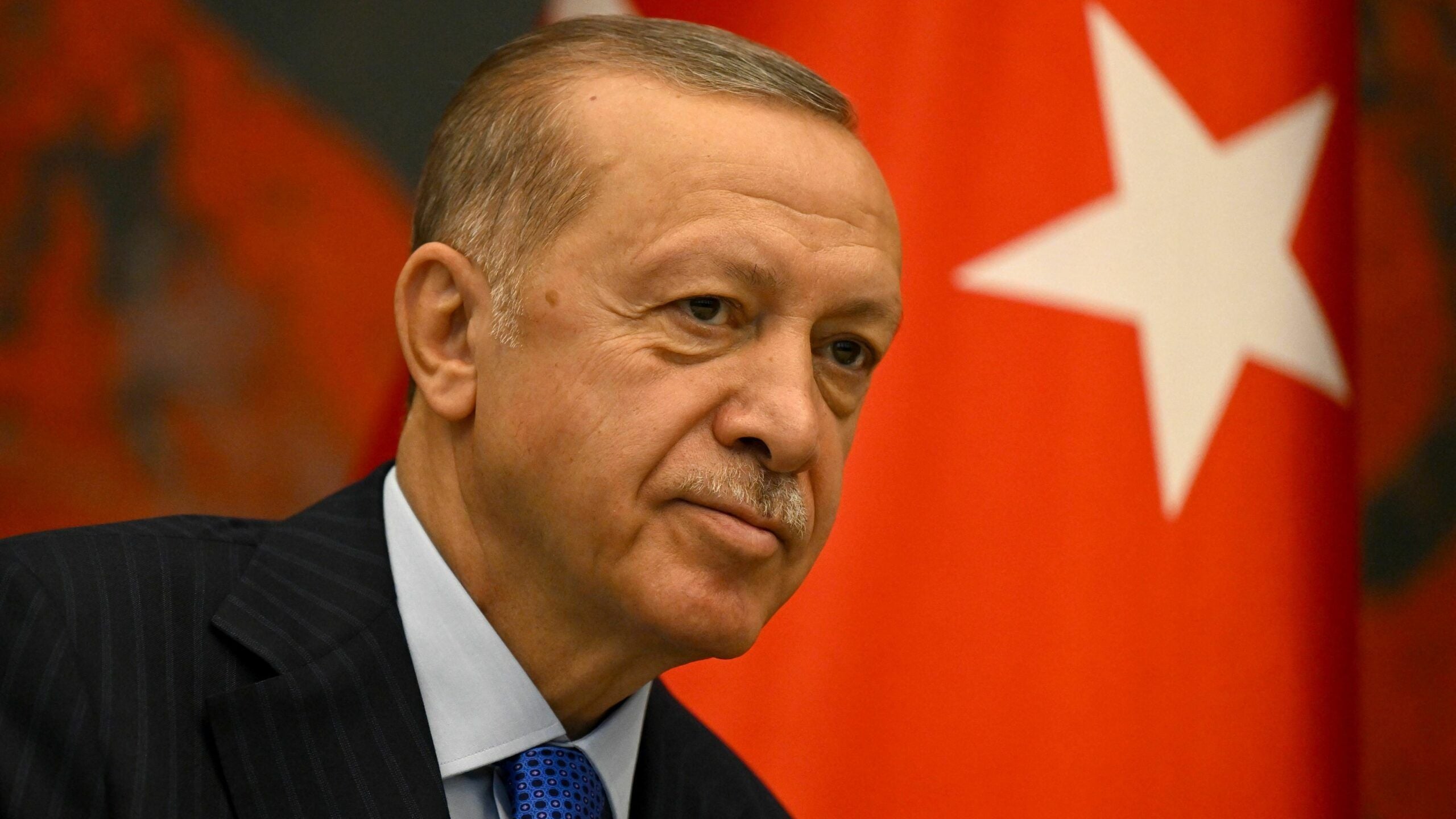
The primary executive who steered the issue from “The Kurdish problem is my problem” to a “Survival issue,” leading to the 2025 finale.
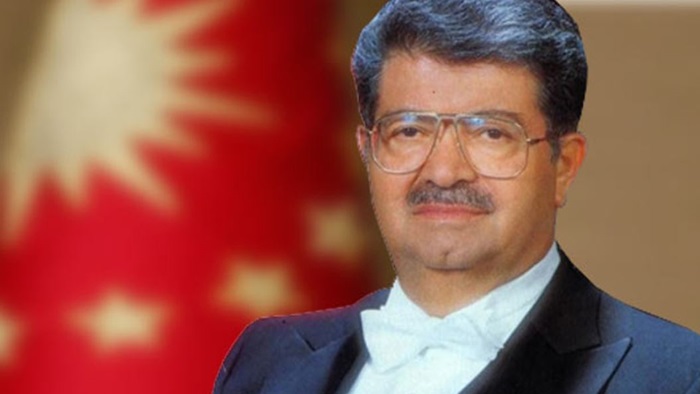
1989 – 1993Turgut Özal
The first civilian move to break the taboo. The first leader to discuss the possibility of dialogue with the PKK at the state level.
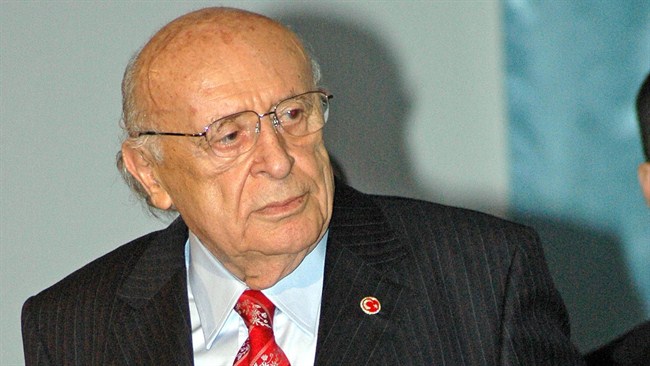
1991 – 2000Süleyman Demirel
The state mind who acknowledged the “Kurdish Reality” yet became the architect of OHAL and rigid security-oriented policies.
Security & Responsibility Milestones
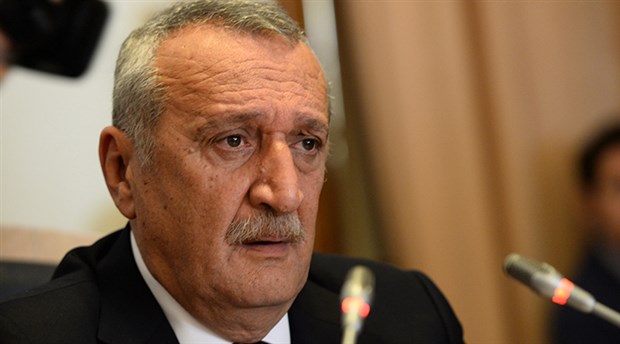
1996Mehmet Ağar
The era of “a thousand operations.” Central figure in dark networks and the famous “If I pull one brick, the wall collapses” metaphor.
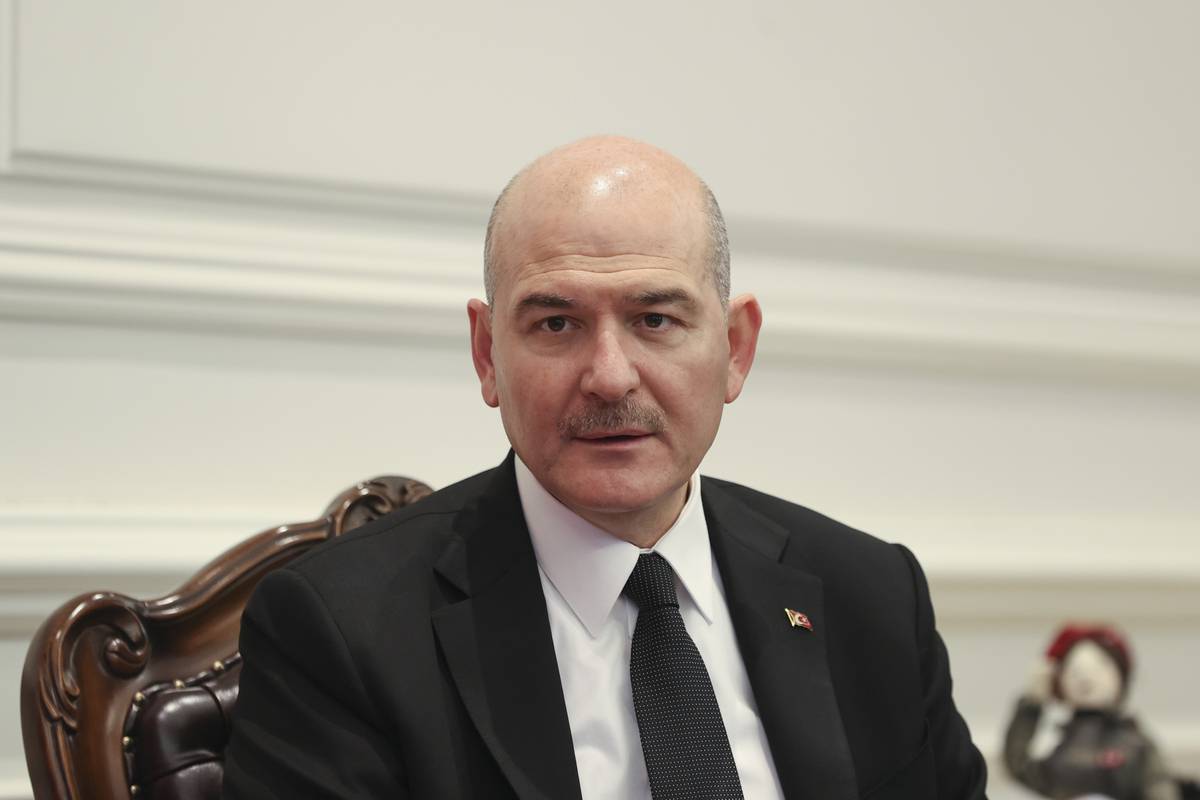
2016 – 2023Süleyman Soylu
The figure who prioritized security over the ballot box through the trustee regime and the “neutralization beyond borders” doctrine.
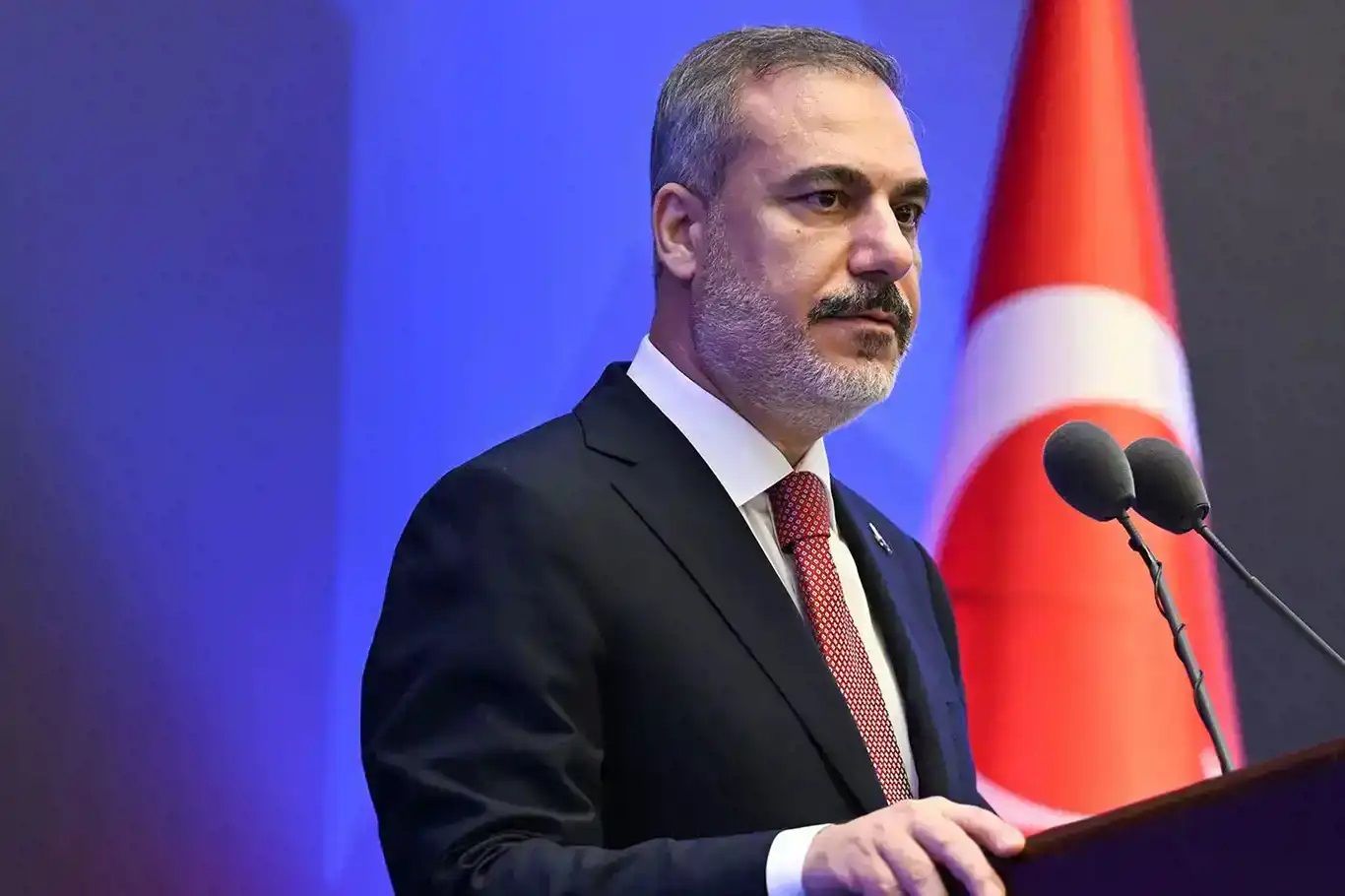
2010 – 2026Hakan Fidan
The most critical political mind in back-door diplomacy, overseeing both the peace attempts and operations from Oslo to the present.
* This chart is a summary of political records compiled from NihaPlus’s official archives.
From Fis to September 12: Ankara’s ‘Public Order’ parenthesis
The foundation of one of the most significant periods of the Kurdish issue in modern history was laid on November 27, 1978, with the establishment of the PKK in the village of Fis in Diyarbakır’s Lice district. Abdullah Öcalan and 21 founding members from the structure known as the “Apocular” (Apoists) before 1978 attended this meeting, which is considered the PKK’s first congress. The ideological roots of the PKK are based on the political line Öcalan shaped at Ankara University in the 1970s. Öcalan’s organizational background began in 1974 with the Ankara Democratic Higher Education Association, a Marxist structure.
During this period, Turkey was debating an agenda dominated by economic crises and clashes between right-wing groups and a strong revolutionary structure led by students. At that time, Ankara was in a climate of crisis under the supervision of President Fahri Korutürk, where political will was constantly shaken. The 42nd government led by Bülent Ecevit, followed by the 43rd led by Süleyman Demirel, treated the Kurdish issue as a technical file within the scope of “separatist activities” during their short-lived administrations, just as their predecessors had. Interior Ministers İrfan Özaydınlı and Hasan Fehmi Güneş (Ecevit era) handled the Kurdish people’s search for rights and increasing pressure in the region within the framework of “separatist activity” and “public order issues.” It was not accepted in the “official” agenda of the state or the government that these events were a result of the Kurdish question.
In 1979, when activity on the Urfa-Siverek line caught the attention of the security bureaucracy, the Interior Ministry in Demirel’s cabinet was held by Mustafa Gülcügil, while the Foreign Ministry was held by Gündüz Ökçün and later Hayrettin Erkmen. During this period, an intense conflict broke out between the PKK and certain tribes in the region associated with political powers in Ankara. The “Apocular,” as they were known then, began to appear in newspaper headlines daily and became the primary agenda item for civil and military administrators.
The political spectrum was alternating between Ecevit and Demirel governments. At the very center of this political circulation, every moment civilian politics failed to produce solutions, the space for military tutelage—represented by Chief of General Staff Kenan Evren—expanded further. While Ankara’s actors presented the matter as “marginal groups associated with the dissolution of feudalism,” democratic channels were rapidly closing, and Turkey was drifting toward the darkness of September 12—a period that would be etched into memory with grave rights violations like those at Diyarbakır Prison No. 5. As this half-century parenthesis opened and actors in Ankara changed, the dimensions of the problem and the official approach deepened.
The 1980s: Coup, denial, and the Atrocity of Diyarbakır No. 5
The military coup of September 12, 1980, represents more than a breaking point in Turkey’s political history; it is a dark milestone where the Kurdish question was completely severed from the ground of democratic solutions. The administration of General Kenan Evren, who took over the junta leadership, positioned Kurdish identity not just as a “public order” issue, but as a direct “political threat” to the survival of the state. This period turned into a systematic process of oppression where the most fundamental human rights of Kurds were suspended, the mother tongue was banned, and identity demands were put through severe torture racks.
During these years when democratic politics were liquidated, Prime Minister Bülend Ulusu and Interior Minister Selahattin Demircioğlu took their places in history as the executive figures of this oppressive regime built by military tutelage. In this phase, where Kurds were redefined as “Mountain Turks” in the state’s core memory, the bureaucracy under Ulusu and Demircioğlu attempted to justify rights violations on the ground as “state discipline.” However, every repressive practice implemented by these administrations only deepened the problem.
The real center of tragedy during this period was the Diyarbakır No. 5 Military Prison, which functioned not just as a prison but as a “radicalization laboratory.” While the inhuman tortures carried out under the orders of Kenan Evren and the junta administration left indelible marks on the memory of the Kurdish political movement, Ankara’s actors reported this brutality under the heading of “discipline.” İlter Türkmen held the Foreign Ministry seat, and the coup administration sought “understanding for the coup” from the international community. The efforts of the coup administration, both inside and outside Turkey, served to transform denial into a constitutional text (the 1982 Constitution) rather than solving the problem.
Throughout the 1980s, the names passing through these seats signed off on decisions banning Kurdish identity, thereby preparing not for a solution, but for the most violent phase of the conflict (the 1984 Eruh-Şemdinli attacks). The wreckage handed over from Bülend Ulusu to Turgut Özal was not just a public order file, but a reality of a Turkey where millions were uprooted and the sense of democratic belonging was severely damaged. While these “temporary” cadres of Ankara tried to negate identity under the boots of September 12, they took their places in the dusty pages of history as the primary architects of that massive parenthesis that remains unresolved today.
The 1990s: Peak of conflict, OHAL, and evacuated villages
The 1990s constituted the bloodiest period of the Turkey-PKK conflict. This decade was marked by the premierships of Süleyman Demirel and Tansu Çiller, and the term of Doğan Güreş as Chief of General Staff. Within the framework of the State of Emergency (OHAL) applications covering the Kurdish geography, the state resorted to large-scale security operations. During this period, many names passed through the Ministry of Interior, from İsmet Sezgin to Mehmet Ağar and Meral Akşener.
This decade witnessed politicians developing a new concept alongside “security bosses.” The interior ministry seat, handed from İsmet Sezgin to Mehmet Ağar, was now the headquarters for “extra-routine” operations. The evacuation of 3,428 villages and “unsolved” extrajudicial murders showed that Ankara approached the matter with a policy of “annihilation.” Ağar’s famous later words, “If I pull one brick, the wall will collapse,” summarized the state memory of that era.
According to a report prepared by the TBMM (Grand National Assembly of Turkey) in 1998, it was documented that 3,428 villages and hamlets were evacuated and approximately 500,000 people were forcibly displaced. According to some political parties and NGOs, these figures are higher: 4,000 settlements evacuated and nearly 3.5 million citizens forced into internal migration. The Human Rights Association (İHD), in a report submitted to a commission established in the TBMM in 2025, documented that a total of 36,409 people, including 9,454 civilians, lost their lives in the conflict process covering the 1991-2024 period.
One of the most important political ruptures of this picture occurred in 1993. Turgut Özal was in the presidency. On one hand, Özal represented a pragmatic dilemma: he activated traditional public order language and securitarian instruments like village guards by labeling the group as “a handful of bandits,” while on the other, he pushed taboo dialogue channels with an emphasis on “Kurdish reality.” Özal went down in history as one of the rare leaders who did not publicly exclude the possibility of dialogue with the PKK. The PKK declared a ceasefire in March. However, this window closed with Özal’s sudden death in April. Immediately after Özal’s death, on May 24, 1993, 33 unarmed soldiers in civilian clothes were killed on the Bingöl-Elazığ highway. The incident effectively meant the end of the unilateral PKK ceasefire declared up to that date. With Tansu Çiller (50th Government) taking the Prime Ministry, security policy shifted to a harsher line. The wave of “unsolved” murders that began after Çiller’s statement, “We have a list of Kurdish businessmen who help the PKK,” became the dark legacy of the 1990s.
The 2000s: EU Process, “Democratic Opening“ and Oslo Talks
The year 1999 became a multi-layered turning point where the Kurdish issue evolved on both legal and political levels. During the 56th and 57th governments led by Bülent Ecevit, the bringing of Abdullah Öcalan to Turkey slowed the pace of conflicts on the ground but left Ankara’s democratic solution capacity facing a new test. When the trial system established on İmralı Island combined with the pressure created by the EU membership process, Turkey undertook a radical legal transformation, such as the abolition of the death penalty. While Interior Ministers Sadettin Tantan and Rüştü Kazım Yücelen, along with Foreign Minister İsmail Cem, tried to bring the legal framework of the issue closer to international standards, the lifespan of their politics was not yet enough to turn these reforms into a social peace project.
The AKP coming to power in 2002 created a pragmatic curve in the state’s traditional securitarian language. Following President Ahmet Necdet Sezer, Abdullah Gül’s ascent to the Çankaya Mansion initiated a new climate where the term “Kurdish issue” was articulated at the highest level in Ankara. The “Democratic Opening,” which materialized with Gül’s March 2009 statement that “Good things will happen,” was presented as a comprehensive policy package under the coordination of Interior Minister Beşir Atalay. However, this civilian search could not avoid colliding with the ancient tension between the status quo in the state’s core structure and the demands for democratic reform.
During the same period, behind the scenes, a secret diplomatic traffic with KCK executives—which included MIT Undersecretary Hakan Fidan and reached the public as the “Oslo Talks”—documented Ankara’s search for an interlocutor for a solution. While the entry of 34 PKK members through the Habur Border Gate on October 19, 2009, welcomed by tens of thousands of people, revived hopes for social peace, the failure of political actors to ground this process on a constitutional basis deepened the crisis. While the echoes of Habur were still ongoing, the Constitutional Court’s closure of the Democratic Society Party (DTP) in December 2009 meant the blocking of democratic political channels through judicial intervention.
In this ten-year process, names like Hüseyin Kıvrıkoğlu, Hilmi Özkök, Yaşar Büyükanıt, and İlker Başbuğ, who changed in the seat of the Chief of General Staff, along with the interior ministry seat handed from Abdülkadir Aksu to Beşir Atalay, left their places to new ones as “temporary actors” at the end of their terms. Although Ankara tried to expand the field of rights with European Union harmonization laws, every reform step, to the extent it was not crowned with a democratic constitution, was abandoned once again to securitarian reflexes and judicial obstacles.
2013–2015: “Solution Process“ and the Dolmabahçe Agreement
At the beginning of 2013, a new link in state-PKK negotiations began. This time, the process was conducted more transparently: HDP’s İmralı delegation held meetings with Öcalan. On March 21, 2013, Öcalan’s letter was read at the Diyarbakır Newroz. The most concrete output of the process featured Deputy Prime Minister Yalçın Akdoğan and Interior Minister Efkan Ala at the center of the dialogue traffic with the HDP delegation. The Dolmabahçe Agreement, announced on February 28, 2015, was the most concrete threshold in these actors’ search for a solution. However, President Erdoğan’s announcement that he did not recognize the agreement and the shifting political balances after the June 2015 elections brought an end to the policies carried out by these names. As Efkan Ala and Yalçın Akdoğan were gradually moved away from decision-making mechanisms with the end of the solution process, Prime Minister Ahmet Davutoğlu also became part of this circulation by handing his seat to Binali Yıldırım.
Post-2016: Anatomy of the trustee (Kayyım) policy
The State of Emergency (OHAL) declared after 2016 and the change in the system initiated a period where Ankara reinforced its “securitarian” doctrine with new names. Süleyman Soylu, who took the Interior Ministry seat, operated the regulation added to the Municipality Law via Decree-Law (KHK) No. 674, continuing the policy of appointing trustees (kayyım) in place of elected mayors for seven years. During the Soylu era, the tension between the right to democratic representation and the security bureaucracy was managed through judicial and operational processes. After Soylu handed over the duty to Ali Yerlikaya in 2023, Ankara continued cross-border operations with military strategies under the management of Minister of National Defense Hulusi Akar and Chief of General Staff Yaşar Güler.
The registration of the local will in the region in favor of the DEM Party as a result of the 2024 local elections showed that despite the dozens of prime ministers, interior, and foreign ministers who changed over this 48-year process, the issue maintained its ground of social legitimacy. Today, the process under the management of Foreign Minister Hakan Fidan and Interior Minister Ali Yerlikaya constitutes the most current link of that historical parenthesis where actors have changed rapidly since 1978, but solution methods have failed to achieve constitutional status.
2025 and beyond: The “Dissolution” call and the question remaining uncertain
The autumn of 2024 was a turning point where a new political language, diverging from the state’s traditional security policies, was established in Ankara. The move by MHP Chairman Devlet Bahçeli from the parliament podium went down in record as an initiative that moved the ground of interlocution for the decades-long conflict directly to İmralı. Following this declaration of political will, on February 27, 2025, Abdullah Öcalan made an open call to the PKK to end the armed struggle and dissolve the organizational structure. Responding to this call at its 12th Congress held on May 5–7, 2025, the organization announced the decision to terminate activities carried out under the name “PKK” since November 27, 1978.
With the announcement of dissolution, although the matter was moved back to the parliamentary floor, the tension between political will and the state’s institutional memory persisted. The text prepared by the commission established within the Parliament and tasked with reporting the process could not step outside the traditional state language regarding the naming of the solution. The fact that the definition “Kurdish issue” was not included in the report was evaluated by human rights defenders and political subjects as an institutional obstacle to meeting the issue on constitutional grounds. Abdullah Öcalan, in a message published on the first anniversary of the dissolution decision (February 2026), emphasized that the February 27, 2025 call was a declaration that the choice was clearly made in favor of politics.
In this 48-year process stretching from 1978 to 2026, Turkey outlasted many prime ministers and dozens of interior ministers before reaching the final stage under the administration of President Recep Tayyip Erdoğan, Interior Minister Ali Yerlikaya, and Foreign Minister Hakan Fidan. This half-century record, where political actors changed rapidly and various discourses—from the promise of “fighting until the last terrorist” to the “call for dissolution in parliament”—were tried, has once again confirmed the transience of names. Today, in the new picture formed after the dissolution of the PKK, Ankara continues to face the reality that the solution lies not just in the change of names and offices, but in that democratic and constitutional transformation of mindset that dozens of governments have postponed.
Written but unimplemented reports
The recent political history of Turkey is also a history of “written but unimplemented” reports. Historian Mehmet Bayrak describes the Kurdish question from the state’s perspective as: “The state mind is a denier and refuser on the official plane, but a confessor and acceptor on the secret plane.” From the public order bulletins of the Ministry of Interior since 1978 to the thousands of pages of minutes from Parliamentary Research Commissions, every document actually offers an anatomy of a non-solution. These reports, prepared by the state’s own institutions, also reveal what has been sacrificed under the heading of “combating terrorism.”
The 1990s were years when the state took to the field not only with weapons but with “extra-routine” structures. The Parliamentary Commission for the Investigation of Unsolved Murders established in 1993 reflected only the tip of the iceberg. The data reached by the commission documented the field equivalent of Mehmet Ağar’s “thousand operations” remark. However, the true symbol of the Ağar era was that famous metaphor describing the web of dark relations within the state: “If I pull one brick, the wall will collapse.” The Ministry of Interior shelved the files investigating structures like JİTEM behind this wall by placing them under the scope of “state secrets.”
According to the report, a large portion of the murders in the region, especially between 1992 and 1994, were committed by “uncontrolled forces within the state.” However, instead of taking action on these reports, the Ministry of Interior shelved the files targeting structures like JİTEM by classifying them as “state secrets.” These reports today still demonstrate the significance of the Saturday Mothers’ search for justice at Galatasaray Square.
Reports prepared in the second half of the 1990s revealed the social cost of the Ministry of Interior’s “secured zone” strategy. Village evacuations, which gained momentum after Turgut Özal’s death, resulted in more than 3,000 settlements being wiped off the map by 1997. According to the TBMM Migration Commission Report (1998), approximately 1 million people were displaced. While the Interior Ministers of the period tried to present this wave of migration as “voluntary,” the reports of NGOs (İHD, MAZLUMDER) recorded for history the burned crops, the shot livestock, and the imposition of “either become a village guard or leave.”
Work carried out under the coordination of Beşir Atalay during the AKP era’s “Democratic Opening” process acknowledged that the problem was not just a public order issue, yet it did not turn into a concrete result. Concepts like “integration,” “cultural rights in the mother tongue,” and “strengthening local governments” appeared in these studies. However, when these concepts collided with the state’s traditional red lines (concerns over the unitary structure), they were replaced by “operational” reports again starting from 2011. The “Wise People Delegation Reports” prepared during the 2013-2015 Solution Process showed that a large part of society was ready for peace, but the “trust” issue could not be overcome.
Post-2016, the content of reports was entirely built upon “justifying the appointment of trustees.” During the Süleyman Soylu era, attempts were made to legalize the trustee regime by defining elected mayors as “logistics support units.” While these studies formed the basis for thousands of pages of indictments, international institutions such as the Council of Europe Congress of Local and Regional Authorities stated in their reports that this situation was a “usurpation of the right to elect and be elected.”
The Foreign Ministry’s defense line
The Ministry of Foreign Affairs was managed by 26 different names during this process. International reports show that 70% of Turkey’s conviction files at the ECtHR consist of “Kurdish issue-oriented rights violations” (right to life, freedom of expression, property rights). In the Hakan Fidan era, diplomacy reports are now built on the “export of the problem beyond borders.” Operation reports regarding northern Iraq and Syria signal a strategic shift that moves the problem from the streets of Ankara to the mountains of Erbil and Sulaymaniyah.
The Statistical memory of the Interior Ministry
In these 48 years, more than 30 different names occupied the interior ministry seat. Statistics show that changes in ministers did not lead to a change in “method.” The 15-year continuous State of Emergency (OHAL) regime from 1987 to 2002 is the most concrete and darkest data of this statistic.
THE ANKARA RECORD: COMPLETE 48-YEAR LIST (1978 – 2026)
Veysi Polat, Öznur Değer, Murat Bayram ve Faruk Balıkçı, the journalists worked in Diyarbakır for years facing various pressures, assessed limitations and challenges of being a journalist in Diyarbakır.
140journos’ documentary “Şeytantepe,” about the Narin Güran murder, has reignited an old debate about what it means to practice journalism in Diyarbakır.
The Narin Güran murder case refers to the killing of 8-year-old Narin Güran, who lived in the rural Tavşantepe neighborhood of the Bağlar district in Diyarbakır province. Narin’s family reported her missing on August 21, 2024, and her body was found on September 8, 2024, inside a sack in the Eğertutmaz stream near the village. Many television channels and newspapers presented claims such as “forbidden relationship,” “the sister was also killed,” “brother was a drug user,” and “Hezbollah connection” as definitive information to the public without concrete evidence, but many of these were refuted in the judicial process, leading to the perpetrator’s identity remaining unknown.
Throughout the 1990s, journalists in Diyarbakır and the surrounding region were victims of “unsolved” murders, detained, tortured, and imprisoned; and the distribution of newspapers was banned. While “unsolved” murders were no longer as common in the 2000s, the judiciary and law enforcement agencies made it difficult for journalists to report from the field. Arrests, forced exile, and house arrests kept journalists away from their profession; newspapers, TV channels, radio stations and websites were shut down, leaving hundreds of journalists unemployed. Journalists who have been reporting from this region for years recounted the hardships they faced and the price of being present in the field.
Veysi Polat: The reality in field is harsh
Veysi Polat started journalism on 1991 in Diyarbakır. He and his uncle, who was a reporter at Özgür Gündem newspaper, were together attacked with a gun. He had to go to İstanbul continue his profession there. Polat who worked for many years in press organizations that came from the Özgür Gündem tradition, returned to Diyarbakır after 21 years and built a local news platform called Aborî.
Journalist Veysi Polat at Hafız Akdemir commemoration. Source: Aborî
Polat, stating security politics, judgement processes, social sensitivities and local dinamics in Diyarbakır severely restricts the journalist’s freedom of movement, told that the reality in the field was harsh and that the space to convey that reality was limited. stated that practicing journalism in a city directly affected by the Kurdish issue, requires every news to be thought for at least few times, every sentences to be regulated, and said “Not only what you write, but also what you do not write is becomes a responsibility.”
Polat explaining the difference between doing journalism in Diyarbakır and in Western cities through the lens of “the weight of the profession,” stated that when he returned to Diyarbakır from Istanbul after 21 years, he realized that the meaning, risks, and burden of journalism had changed when the geography changed.
How is a local new is altered to another?
Polat stated that he believes information transferred from the local to the central level is often either diminished or transformed, emphasizing that this transformation often passes through political, institutional, and ideological filters:
“Especially in central media, the reflex of not harming the relationship between the institutions and government can prevent the news from being reported as it is. This leads either to overt censorship or a more sophisticated form of ‘cover-up’. As a result, the news may reflect not the event itself, but the version that the center wants to see.”
Polat reminding an example happened on 90s, “When the news of a citizen, a shepherd in the rural area of Cizre, being killed in a security forces operation reached the center, it was transformed into a completely different identity and presented as ‘a PKK member neutralized in the operation.’ However, information and photographs from the field show that the truth is much more stark and shocking. The image of a person being dragged behind an armored vehicle, tied by their feet, is a document of the truth. But that image is ignored because it doesn’t fit the narrative constructed by the center. Our decision to publish it with the headline ‘Humanity is being dragged’ at that time was actually to show the truth as it was,” he said.
Hacı Lokman Birlik was killed during a conflict between him and the Turkish army on October 3, 2015 in Cizre, Şırnak. His dead body was tied to an armoured police vehicle and he was dragged to death behind the vehicle. One of the pro-AKP newspaper Sabah claimed the dragging of a body was a universally acceptable procedure to verify whether a bomb was attached to the body.
News about dragging and killing of Hacı Lokman Birlik on Özgür Gündem, with the headline “Humanity is being dragged”. Source: X/@Code644
The reality in local is experienced more rawly and more directly, while the mainstream media often softens this harshness, and sometimes makes it completely invisible.
The Narin Güran case: Being the one who reports correctively, not just first
Polat states that how cases like Narin Güran are reported directly affects the geography, language, and framing of the news. “If a similar incident had occurred in Istanbul, the news flow would likely have proceeded in a more institutional, distant, and controlled manner,” he said. Noting that media headquarters in major cities have stronger editorial oversight mechanisms, better access to diverse sources, and faster fact-checking processes, Polat explained that in a place like Diyarbakır—where political and social sensitivities are intense—the process works differently:
“We saw reports that began as a simple missing child case in the early days evolve into a different dimension within a short time through various allegations, dark connections, and leaked information. Specifically, the leaking of certain information and documents from law enforcement and judicial sources to specific media outlets revealed a picture where relationship networks, rather than journalistic reflexes, were the determining factor.”
Polat highlighted two fundamental issues at this point: “First, the lack of a healthy distance in the relationship between the journalist and the news source strengthens a practice based on transmission rather than interrogation. This can turn the journalist into a producer of information rather than just its carrier. Second is information pollution and manipulation. Especially in sensitive cases, information served piece-by-piece can serve to direct public opinion rather than enlighten it. This creates serious perceptual confusion in society.”
Stating that both the political atmosphere and the source structure in Diyarbakır can create a ground more open to such interventions, Polat emphasized that the issue boils down to the core principle of journalism: Being the one who reports correctly, not just the one who reports first.
“Journalism was a struggle for survival”
Comparing today’s conditions with those of the 1990s and early 2000s, journalist Polat noted that Diyarbakır existed within an extraordinary atmosphere during the periods when the Kurdish issue was most intense. Describing a process in the early 90s where human rights were suspended and life was devalued, Polat explained that journalism then was not just a profession but a struggle for survival:
“People were being shot in the back of the head in broad daylight, villages were being burned, forced migrations were occurring, and enforced disappearances and torture were becoming part of daily life. Practicing journalism in such an environment was truly like wearing a ‘shirt of fire.’ The fact that on June 8, 1992, while walking from home to the newspaper office with my uncle, journalist Hafız Akdemir, we were attacked and he lost his life, is enough to explain the darkness of that era.”
Polat noted that while journalists could be massacred in the middle of the street in those years, the primary difference today is that such an overt and large-scale practice of physical elimination no longer exists. Pointing out that things are possible today that were not in the 90s, Polat said, “Thanks to digital media, news can spread much faster, and opportunities arise to make one’s voice heard through alternative channels. It is not as easy as it once was to completely blackout a story.”
Journalism is now a more heavily monitored profession
However, he explained that this situation has not eliminated pressure; rather, the methods have changed, and journalism is restricted today through different tools:
“Obstructions while following news in the field, detentions, lawsuits, long judicial processes, digital access bans, and pressures exerted through social media have come to the forefront. Direct violence has been replaced by a monitoring mechanism that appears more ‘legal’ and ‘administrative’ but has an undeniable impact. Today, while journalism is faster and more accessible on one hand, it is a profession that is more closely watched and more easily targeted on the other.”
Öznur Değer: Diyarbakır, a city that turns written fate into struggle
Öznur Değer began her career as a female journalist six years ago in Diyarbakır. For her, practicing journalism in Diyarbakır means extracting a new story from every inch of a city that has been the center of special warfare policies and state pressure since the 90s.
Journalist Öznur Değer. Source: Yeni Yaşam Newspaper
Değer states that Diyarbakır is a place where there is an attempt to alter the city’s sociology—politically, socially, economically, and culturally—ranging from drugs and prostitution to assimilation and moral decay. She also notes that it is a place where the consequences of the Kurdish issue manifest in their severest form:
“From children collecting scrap paper on the streets to the Peace Mothers crying out for peace; from families waiting for their loved ones in front of prisons to mothers searching for the bones of their children; from mothers keeping watch over their children’s graves so they won’t be desecrated to women arrested for shouting ‘Jin, jiyan, azadî’ (Woman, Life, Freedom) in the field—Amed is a deeply political place.”
“The journalists most obstructed by police are women journalists”
For Değer, being a female journalist in Diyarbakır means overcoming walls of fear with courageous pens:
“While many of our colleagues were massacred in the 90s just for reporting the truth, and more recently, while Nagihan Akarsel in Sulaymaniyah and Cihan Bilgin in Rojava were murdered for their persistence in the truth, we are practically shuttling between the police headquarters, the courthouse, and the prison. On one hand, we reveal the dimensions of ‘special warfare’ through our reports on the women most affected by it; on the other, we are investigated and prosecuted because of those very reports.”
Emphasizing that many female journalists, herself included, have been tried and arrested due to the stories they uncovered, Değer noted that they are also subjected to numerous restrictions:
“Our agency, JINNEWS, which serves as an example to the world as a women’s news agency, has been blocked by the BTK (Information and Communication Technologies Authority) numerous times, and its digital media accounts have been shut down.”
Attack on journalists in 2024, Diyarbakır. Source: MLSA
Değer also stated that as female journalists, they are engaged in a tough struggle against other journalists to counter the increasingly masculinized language of the press, noting that the journalists most obstructed by police in the field are, once again, women. Having worked as a journalist in Ankara for a period, Değer explained that Ankara is the place where the policies implemented in Diyarbakır are decided:
“I saw both the memory, the legacy, and the values of a people in Amed -along with the struggle to protect them- and I saw Ankara as the place where the decisions for the policies produced there are made. For me, one was a city writing a fate (giving the orders), while the other was a place turning that written fate into a struggle.”
“MKG makes the labor of women journalists visible”
In Diyarbakır, a city with a dense population of Kurdish and politically active people, Değer says the greatest solidarity network for female journalists is the Mesopotamia Women Journalists Association (MKG):
“MKG not only puts a spotlight on the difficulties, pressures, and problems faced by women journalists and prepares monthly reports on them, but it also works to establish a female language in the press and make the labor of women journalists -who are often marginalized- visible. In this sense, it transforms their experiences into solidarity by giving presence to women’s voices and colors, weaving together the organized struggle of women journalists.”
Değer notes that the Narin Güran case has turned into a sensationalist soap opera—a result of the sociological decay bred by “special warfare.” She states, “Rather than uncovering how and by whom Narin was murdered, many journalists, especially those coming from outside, focused on allegations of a ‘forbidden affair’ between Narin’s mother and uncle, evolving the incident into a dimension that veils the truth.”
Değer argues that if the same situation had occurred in Istanbul, the identity of a child’s killer would not remain in mystery, and the judiciary would display a different, more analytical stance:
“The fact that this happened in Kurdistan and has a political background has significant impacts. Indeed, Galip Ensarioğlu’s words in the early days of the incident, which exonerated the event and potential perpetrators, remain fresh in our memory. In Istanbul, the media—which in Amed pursued tabloid sensationalism day and night—would have focused on the perpetrators. Here, many facts were distorted by prioritizing historical, cultural, and tribal factors. Instead, the incident should have been handled as a social problem from the very beginning, pursuing the truth and all the power dynamics and elements in the background.”
Stating that journalists carry historical responsibility and conscientious obligations, Değer said the only way forward is to shout the truth fearlessly.
Murat Bayram: There is a special police group in Diyarbakır that only deals with journalists
Murat Bayram began his journalism career in 2010. After years of working for both international media and outlets broadcasting from the Kurdistan Region, Bayram now manages Botan International, which provides training for journalists and produces news in Diyarbakır. According to Bayram, practicing this profession in Diyarbakır inevitably means acquiring a political identity:
Journalist Murat Bayram
“It starts with the assumption among social, religious, and other groups that you are directly a propaganda tool. Both Kurds and the government perceive you as highly partisan. They may perceive you as a potential propaganda tool or a terrorist.”
As he worked in Istanbul for a time, Bayram noted that one can blend into the crowd while following news there. In Diyarbakır, however, he noted that there is a specific police group that only deals with journalists, who are attending every press conference, photographing journalists, knowing them by name, knowing where they work, and knowing which stories they cover, and that the pressure is more intense:
“When I first started in 2010, we would go to a story with 40-50 people. With so many journalists, you didn’t stand out much. Now, when we go to a press briefing, only 3-5 cameras show up. Everyone handles their work by gathering news from social media and agencies. This causes the existing pressure to be felt more clearly.”
“The Press Advertising Agency does not support the Kurdish language”
Bayram, who also prepares reports on the structure and problems of Kurdish media in Turkey, stated that while there are over 20 million Kurds in Turkey, there is only one news agency and only four websites broadcasting daily in Kurdish. He noted that before the end of the resolution process in 2015-2016, there were 9 television channels in Diyarbakır producing Kurdish programs, with at least 4 broadcasting exclusively in Kurdish. Currently, only Zarok TV and one local newspaper broadcast in Kurdish in Diyarbakır. Pointing out that TRT has the largest presence in Diyarbakır with over 40 media representatives, Bayram said, “It is understandable that TRT exists; what is not understandable is that only TRT exists. The only television making Kurdish news programs is the state’s television.”
Bayram mentioned that the Press Advertising Agency is the biggest sponsor of local media, yet all local newspapers are exclusively in Turkish. He explained that this is because Kurdish is not among the languages supported by the agency for publishing.
“For a Kurdish media institution to survive, it needs an economic resource,” says Bayram. According to his accounts, Google Ads does not support Kurdish in Turkey, and Kurdish media cannot receive payments from the Press Advertising Agency:
“When it’s in Kurdish, you cannot receive the advertisements that the state publishes using our own taxes. Kurdish podcasts were listed among Turkish podcasts. Kurdish music is still evaluated in the Turkish music category.”
Bayram expressed that producing Kurdish content is devalued as if it were mere volunteer work: “Reporters for Kurdish media are not exempt from rent, food costs, or vehicle costs. But while they are putting in the labor, they are exempted from receiving the wages for that labor.”
Faruk Balıkçı: In local media, you are in the ‘kitchen’ of the work
Faruk Balıkçı, who began his career at Anadolu Agency, has served as the Diyarbakır representative for outlets such as Milliyet and Hürriyet newspapers, IMC TV, and Doğan News Agency. Having worked for both national and local media for many years, Balıkçı stated that Diyarbakır is the regional center for journalism. He noted that due to the impact of wars in Iraq and Syria and the long-standing environment of conflict, Diyarbakır journalists have, in a sense, become ‘war correspondents’:
“Because of its central location and being a place where news prioritized by Turkey occurs, journalists do not just do local journalism. They simultaneously do international journalism. This makes the journalists here more effective.”
Journalist Faruk Balıkçı. Source: bianet
Balıkçı, who previously worked in mainstream media, explained that the readership and sphere of influence change between national and local newspapers:
“When you voice a local problem or negativity, officials take it into account and correct it the next day. This is important for the local area and makes one happy from a journalistic perspective. In a national newspaper, because you report on more general news, you have to access more restricted information. But if you are a local journalist, you have to exert more effort to voice the many problems experienced in the locality or region.”
Balıkçı stated that a local journalist reporting on local issues also serves a supervisory role by pointing out shortcomings.
Explaining that a journalist working for media that appeals to the general public only produces the news, while centers like Istanbul shape it, Balıkçı said: “It’s not like that in local media. In local media, you are in the kitchen of the work. You can write and present what you see in the format you want. Nothing else touches your story.”
“In this regard, local media provides more alternatives. You are freer in local media because you are in the kitchen of the work.”
Deniz Xelat Büyükkaya discusses how Rojhelat has once again become the frontline of Iran’s war against its Kurdish population, amid nationwide protests and economic collapse.
Photo of protests in Iran.
by Deniz Xelat Büyükkaya
Rojhelat (Eastern Kurdistan) or the Kurdish regions of western Iran, have once again become a key site of political tension, state repression and regional security concern. Over the past few years, Rojhelat has faced intensified government repression, increased protest activity, and rising geopolitical pressure related to regional conflicts. Latest developments show that Rojhelat remains one of the most politically sensitive regions inside Iran.
Iran has been facing nationwide protests since late 2025 because of economic collapse, rising inflation, and shortages of basic goods, fueling growing anger toward the government. The government has responded to protests with extreme repression: mass arrests, shootings of protesters, internet shutdowns, executions and death sentences.
Rojhelat: A Centre of Protest Movements
Rojhelat—especially the provinces of Kurdistan, Kermansah, West Azerbaijan, and Ilam—has long been considered by Tehran a politically sensitive border region. As a result, the Iranian state has often approached Kurdish activism through a security-focused framework shaped by fears of separatism and cross-border insurgency. Also, the region was already the centre of the nationwide “Jin, Jiyan Azadi (Woman, Life, Freedom)” movement that erupted in late 2022 after the death of Kurdish woman Jina (Mahsa) Amini in police custody.
By late 2025, Kurdish monitoring organisations reported that Iranian security forces had intensified surveillance and arrest campaigns across Rojhelat, targeting activists, journalists, and ordinary citizens. The Washington Kurdish Institute’s 2025 Annual Report notes that in November 2025 alone, 51 Kurds were detained in Iran, representing 45 percent of all recorded arrests nationwide that month.
According to Kurdistan Tribune, Kurdish regions have long been centres of anti-government protest, and state responses have often been violent. During the recent demonstrations, Rojhelat was among the most heavily affected, with security forces responding aggressively.
Many people were arrested without clear charges or proper legal procedures. This has drawn concern from international human rights organisations about fairness and legal rights in Iran’s response to political opposition. Kurdish cities often show strong political mobilisation. This is partly because of ethnic marginalisation, economic difficulties, and long-standing political grievances. In addition, Rojhelat is considered one of the less economically developed parts of Iran.
Cross-Border tension
The situation in Rojhelat cannot be completely understood without considering cross-border dynamics between Iran and Başur (Iraqi Kurdistan). While repression in Rojhelat increased, developments across the border in Başur also made the situation more tense. In March 2026, Iranian forces carried out drone strikes targeting Kurdish opposition positions in Iraqi Kurdistan, including an attack on an opposition headquarters in the town of Dekala that wounded members and damaged facilities.
These attacks were part of a broader campaign against Kurdish groups that Iran accuses of operating across the border. According to regional media reports, several Kurdish opposition sites in Erbil and Sulaymaniyah provinces, including the Koya district and nearby mountain areas, were targeted during the escalation.
Iranian officials justified these operations as necessary responses to “separatist groups” threatening national security.
Human rights concerns
Human rights organisations report that Iran has significantly increased its use of the death penalty in recent years. According to Iran Human Rights (IHR), in 2024, at least 975 executions were recorded. The number reportedly increased to around 1,500 executions in 2025, the highest level in decades.
Ethnic minorities seem to be affected more by these policies. According to a report by Hengaw around 150 Kurdish prisoners were executed in 2025. In early 2026, Hengaw also reported that at least 257 Kurdish civilians were killed during a crackdown linked to protests, including 20 children and 19 women. Many of them were accused of security-related crimes, but human rights groups often criticise the lack of fair trials and transparency in Iran’s judicial system.
Because of these numbers, many Kurds believe that the Iranian government treats Kurdish regions mainly as a security issue instead of solving political and social problems.
Image: Fazel Hawramy/Rudaw
Economic marginalisation and the Kolbar
In addition to political repression, economic conditions in Kurdish border areas are also very difficult. Rojhelat has some of the highest unemployment rates in Iran, especially among young people. Because of this, many residents work as kolbars. Kolbars are Kurdish porters who carry goods across mountain borders between Iran and neighbouring countries. The work is very dangerous and often illegal, but many people rely on it to earn living.
According to the Kurdistan Human Rights Network (KHRN) dozens of kolbars are killed each year by Iranian border forces, while many others are injured or arrested. Kurdish activists say that kolbar work continues because there are not enough stable job opportunities in the region. For many Kurdish families in border cities, kolbar work has become a symbol of the broader economic marginalisation faced by Rojhelat.
An unresolved political question
Despite decades of political tension, the Kurdish question in Iran remains unresolved. Kurdish activists continue to demand cultural rights, Kurdish language education, economic development, and greater political representation. However, Iranian authorities have continued to restrict Kurdish cultural and linguistic rights. In 2025, expressions of Kurdish identity were often treated as security offences. The Kurdish language is still largely excluded from formal education, and cultural activists promoting Kurdish language or traditions have faced arrests and intimidation.
At the same time, the Iranian government continues to view Rojhelat mainly through a security perspective because of concerns about territorial integrity and armed opposition. As Iran faces both internal dissent and regional pressure, Rojhelat is likely to remain an important indicator of the country’s political stability. For now, the Kurdish regions of Iran remain caught between protest movements, state repression, economic hardship, and regional geopolitical tensions.
A quantitative analysis of international media coverage of Iranian Kurds between February 28 and March 22, 2026, reveals a pattern that speaks less to increased visibility and more to the nature of that visibility: Kurds were covered more — but largely through the voices of others.
Foto: Rudaw
Following the February 28 launch of US-Israeli strikes on Iran, Kurdish political actors entered the international media agenda. The period was further amplified when, on March 5, President Donald Trump told Axios: “If the Kurds want to attack Iran, I think that’s wonderful. I’m totally in favor of it.” That statement turned global attention toward Iranian Kurdish organizations.
Yet Kurdish groups had already reached an agreement among themselves weeks earlier. The Coalition of Political Forces of Iranian Kurdistan — bringing together PJAK, IKDP, PAK, Komala and Xebat — was formed on February 22, thirteen days before Trump’s remarks. The coalition’s founding drew almost no attention from international mainstream media until Trump spoke. In March, the Komala Party joined, bringing the number of member organizations to six.
Once Trump’s statement focused international attention on the Kurds, coverage surged. Of more than fifty records analyzed, approximately seventy percent were published between March 1 and 8 — the first eight days of the war. Between March 9 and 22, independent Kurdish-focused coverage fell to single digits, with Foreign Policy’s March 17 analysis standing as a near-solitary exception.
The peak came between March 3 and 7. On March 3, CNN was the first to report — citing multiple anonymous sources — that the CIA was working to arm Kurdish forces. That same day, the Wall Street Journal noted that Trump was open to supporting armed militias, with Kurdish forces along the Iran-Iraq border described as holding significant military capacity. Reuters reported, citing three sources, that Iranian Kurdish militias were in discussions with the US about how and where to strike Iranian security forces. On March 5, Bloomberg reported that Israel was working to open the way for Kurdish forces to take positions in northwest Iran, citing a senior Israeli military official. Al Jazeera published a detailed explainer: “Which Kurdish groups is the US rallying to fight Iran?” On March 7, Chatham House published its analysis: “Kurdish groups in Iran face a risky dilemma amid an unclear US endgame.” The Kurdish-focused content published across those five days exceeded the combined total of the two preceding weeks and the two that followed.
Daily news intensity — Iranian Kurds
Feb 28 – Mar 22, 2026 · Estimated distribution based on dataset
Feb 28Mar 8Mar 15Mar 22
High (3+ reports)
Medium (1–2 reports)
Sparse / none
Then, on March 7–8, Trump reversed course. Asked about the possibility of Kurds establishing a new autonomous region in Iran and whether they would join the war, he said: “We’re very friendly with the Kurds, but we don’t want to make the war any more complex than it already is. I’ve decided I don’t want the Kurds going in.”
The conditions Kurdish groups themselves had put forward were central to this outcome. According to Axios, one Kurdish opposition official stated: “We cannot move until the skies above us are clear” — a demand for an arrangement comparable to the no-fly zone that enabled Kurdish autonomy in Iraq after 1991. CNN reported that Kurdish groups also sought political guarantees from the Trump administration before committing to action. Komala Secretary-General Abdullah Mohtadi summarized these conditions to Die Zeit: “We will not send our forces to the slaughterhouse.”
On March 4, Kurdish groups issued a joint denial directly contradicting media reports of a ground offensive. PAK stated: “Claims that our forces have crossed into Rojhilat are baseless. We categorically deny these reports — no such movement took place.” PJAK, PDKI and Komala issued similar statements the same day. The coalition’s first joint communiqué, released on March 2, was not a declaration of military action but a political appeal to Iranian armed forces in Kurdish regions: “Separate yourselves from the remnants of the Islamic Republic.” PDKI President Hijri had stated on March 1: “We will continue our struggle until free and democratic elections are held.” The Kurdistan Regional Government’s Interior Ministry also announced that its territory would not be used as a base for operations against neighboring countries. Trump’s reversal on March 7–8 confirmed that the conditions Kurdish groups had set would not be met.
Independence referendum and Rojava: a comparative frame
Two earlier turning points offer context for understanding Kurdish visibility in international media.
Three periods compared
How Kurds appeared in international media — 2017, January 2026, February–March 2026
Criterion
2017 Referendum
Jan 2026 Rojava
Feb–Mar 2026
Visibility level
High
Low
Very high
Trigger
Kurdish political demand
Kurdish civilian tragedy
Inclusion in great-power plans
Dominant frame
Great-power opposition
Humanitarian crisis
Strategic instrument
Subject position
Political actor (shadowed)
Victim
Object / instrument
Kurdish voice weight
Limited
Very limited
Limited but increased
Civilian dimension
Partly present
Relatively present
Almost absent
2017Political actor — but in the shadow of international opposition
Jan 2026Humanitarian crisis — but with limited attention
Feb–Mar 2026Strategic instrument — and with great intensity
In 2017, the Kurdistan independence referendum drew extensive international coverage — but structured around the near-unanimous opposition of major powers (the US, Russia, the UK, Turkey, Iran) rather than around Kurdish political demands. An academic study published in the British Journal of Middle Eastern Studies documented that in Egyptian online media, the referendum was framed as “a Zionist plan directed by the US and Israel to redraw the region.” That framing was the dominant pattern across regional Arab media in 2017. By 2026, the dynamic had inverted: Israeli support was no longer presented as a threat but as an operational reality — yet Kurds remained objects of great-power planning rather than subjects of their own story.
In January 2026, the Syrian Transitional Government’s attacks on Kurdish neighborhoods in Aleppo — dozens killed, hospitals struck, tens of thousands displaced — drew comparatively limited international coverage. The gap in intensity and framing between that period and February–March 2026 is stark. What it reveals is a pattern: international media interest is triggered not by violence against Kurds, but by Kurdish inclusion in great-power plans.
The comparative picture across three periods: In 2017, Kurds were covered as political actors — but in the shadow of international opposition. In January 2026, as a humanitarian crisis — but with limited attention. In February–March 2026, as a strategic instrument — and with great intensity. Visibility and subject position took different forms in each period.
Coverage by outlet
US media formed the dominant block. CNN produced at least seven separate Kurdish-focused pieces, five of them concentrated between March 3 and 5. Axios published four reports. Reuters and AP each produced one critical exclusive. US media’s Kurdish coverage intensity outpaced the combined output of all other countries.
Israeli media — Haaretz, Times of Israel, Channel 12, i24NEWS, Ynet — formed the second largest block in both volume and substance, though with a markedly different editorial frame.
Coverage by outlet
Estimated Kurdish-focused report count and dominant editorial frame · Feb 28 – Mar 22, 2026
FT, Economist, Guardian, Le Monde, NHK, Dawn, SCMP, etc.
—
No access
In European media, BBC Persian’s Jiyar Gol interview with PJAK leadership — conducted inside tunnels near the border — and BBC World Service’s interview with a PAK fighter were the standout pieces. Die Zeit published an interview with Komala Secretary-General Abdullah Mohtadi; the piece’s reach came largely through citations in Chatham House and Al Arabiya. InsideOver conducted the most direct leader interview on the European continent, speaking with PDKI President Hijri on March 8.
Arabic-language media in this analysis was represented only by Al Jazeera English and Al Arabiya English. The Arabic-language services of both outlets, along with Asharq Al-Awsat, Al-Quds Al-Arabi, Al-Araby Al-Jadeed, BBC Arabic, Sky News Arabia, and Gulf media, fell outside the scope of this study.
Who spoke, who was silenced
When all records in the dataset are coded by source type, approximately fifty percent relied on anonymous US or Israeli officials. CNN’s March 3 report cited “multiple people familiar with the plan”; Axios’s March 5 piece cited two separate US-Israeli officials; Reuters’s March 6 exclusive cited three anonymous sources.
Direct interviews with Kurdish leaders totaled nine over 22 days: Abdullah Mohtadi (CNN, IranWire, Die Zeit, Al Arabiya, Atlantico, Newsweek), PJAK Co-Chair Amir Karimi (CNN, Axios, AFP, Al Arabiya), PJAK Co-Chair Peyman Viyan (Channel 12), Khabat Secretary-General Babasheikh Hosseini (Al Jazeera), IKDP official Muhammed Azizi (Fox News), Komala Central Committee member Koosar Fattahi (CBS), PDKI President Mustafa Hijri (InsideOver, CSM). The distribution is telling: Mohtadi received the most direct coverage, while PJAK generated the most reporting — yet PJAK was most often reported through anonymous sources or US officials rather than its own leadership.
Iranian state media’s terminology passed into mainstream international coverage with almost no critical framing: “separatist terrorist forces.” In Al Jazeera’s March 5 report, Press TV’s characterization — “anti-Iran separatist forces” — and the IRGC statement carried by IRNA were presented side by side, directly and without contextual challenge.
Source breakdown: who spoke in the coverage?
Estimated distribution across all records · Feb 28 – Mar 22, 2026
Anonymous US/Israeli official50%
Kurdish leader written statement25%
Direct Kurdish leader interview15%
Iranian state/official sources10%
Thematic focus
Five themes emerge from the dataset.
The US-Israel-Kurdish strategic relationship was the dominant theme, accounting for approximately forty percent of all records. This framing positioned Kurds as objects of the story: coverage focused not on what they were doing, but on what great powers intended to do with them.
Military capacity and ground offensive speculation formed the second major theme — fighter numbers, arms levels, border crossing preparations. The retracted March 4 ground offensive story was this theme’s most concrete and most problematic example.
Historical betrayal and distrust was the third theme, structuring Haaretz’s March 7 analysis, the Chatham House report, the Atlantic Council assessment and France 24’s “pawn” piece.
The predicament of Iraqi Kurds was the fourth theme — the tension between the KRG’s declared neutrality and Iran’s actual strikes.
Kurdish civilian experience and human rights was the most conspicuous absence. Hengaw’s warnings about civilian casualties, strikes in Kurdish cities, women’s organizing — the presence of HPJ received a line or two. HPJ Commander Roken Nereda had not spoken on record to any international outlet before AFP’s March 8 field report.
Disinformation: one story, five outlets
March 4 disinformation chain
The origin, spread and retraction of the “ground offensive launched” story
1
Initial claim
i24NEWS reported — without footage, citing an unnamed CPFIK official — that PJAK fighters were taking positions in the mountains south of Marivan.
i24NEWS · March 4, 2026
2
Rapid amplification
Axios and Fox News ran the same story almost simultaneously. Jerusalem Post also reported similar claims citing an unnamed source.
Axios · Fox News · Jerusalem Post · March 4, 2026
3
Contradictory confirmation
Channel 12 correspondent Barak Ravid first confirmed the report citing a US official, then walked it back the same day: “There are conflicting reports.”
Channel 12 / Barak Ravid · March 4, 2026
4
Joint denial
PAK, PJAK, PDKI and Komala issued a joint denial the same day. KRG official Aziz Ahmed stated: “Not a single Iraqi Kurd has crossed the border.”
PAK · PJAK · PDKI · Komala · KRG · March 4, 2026
5
Retraction
Axios and Fox News removed the stories. The retraction did not reach the speed or scale of the original report.
Axios · Fox News · March 4–5, 2026
Five outlets published or amplified the same unverified claim. Reliance on anonymous sources, the absence of direct verification from Kurdish political actors, and the lack of real-time fact-checking mechanisms were the structural causes of this chain.
March 4 stands as this period’s best-documented media failure. i24NEWS reported — without footage and citing an unnamed CPFIK official — that PJAK fighters were taking positions in the mountains south of Marivan. Axios and Fox News ran the same story almost simultaneously. Channel 12 correspondent Barak Ravid first confirmed it citing a US official, then walked it back the same day: “There are conflicting reports.” All Kurdish parties denied it. Five outlets published or amplified the same unverified claim; the retraction did not reach the speed or scale of the original.
Notes

This study was compiled and organized using data gathered by the Claude AI model.

The analysis focused on English-language content and English-language media outlets. This methodological limitation creates several important gaps.

Non-English-language media fell outside the scope of the study. How outlets such as Le Monde, Libération, Le Figaro, Corriere della Sera, El País, NHK, Dawn, South China Morning Post and The Hindu covered — or did not cover — Kurds during this period was not examined.

Arabic-language media was represented in this study only through Al Jazeera English and Al Arabiya English. The Arabic-language services of both outlets, along with Asharq Al-Awsat, Al-Quds Al-Arabi, Al-Araby Al-Jadeed, BBC Arabic, Sky News Arabia and Gulf media, fell outside the scope of this study.

English-language outlets behind paywalls — the Financial Times, The Economist, and certain Haaretz content — could not be fully accessed. For these outlets, the accurate description is "could not be reached," not "did not publish."