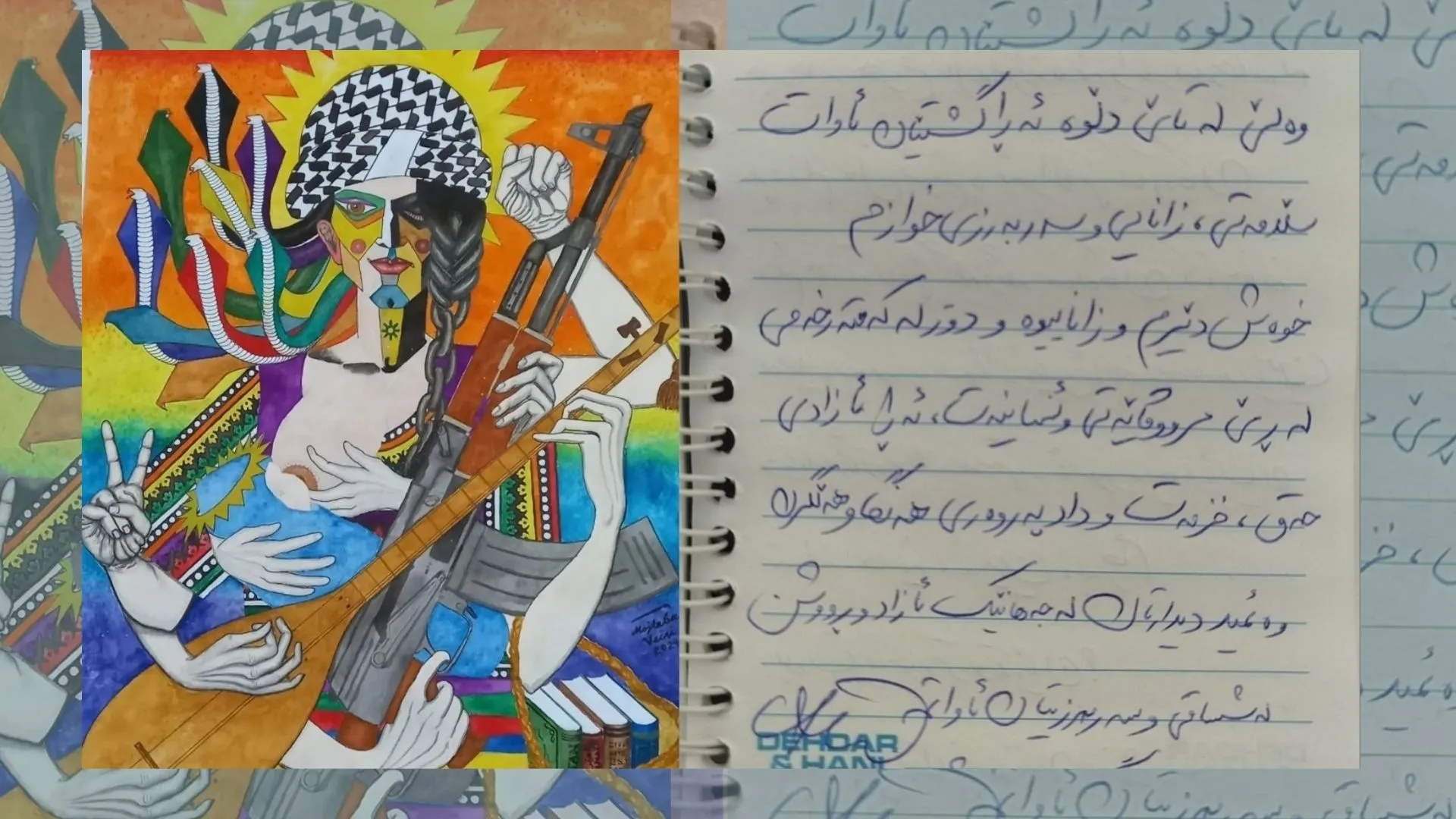
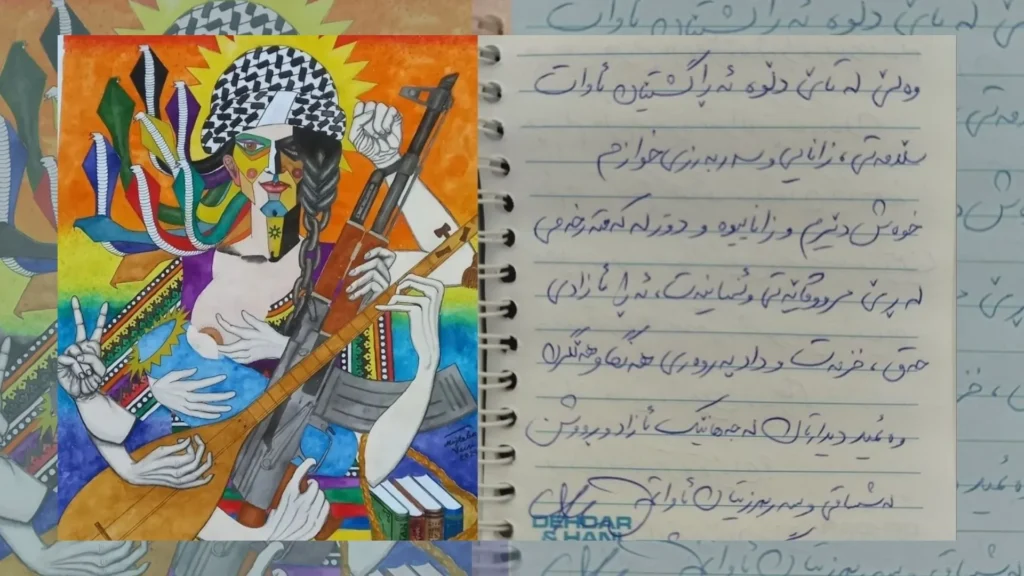
Since the ceasefire signed between Iran and the U.S. on April 7, dozens of Kurds have been executed and many others killed. The letter and watercolor paintings addressing children, created by Kurdish activist Mojtaba Waisi, who was most recently killed by the Revolutionary Guards, have been widely shared in the media.
The ceasefire, which began on the 40th day of the Iran-U.S. war (April 7) and was initially set to last two weeks, continues to be in effect officially under Pakistani mediation. While Iran continues its negotiations with the U.S., it has maintained its repressive policies within the country during this period and executed many Kurdish prisoners facing political and “security” charges.
Mojtaba Waisi: “Power must be used to serve humanity”
On May 28, Mojtaba and Maysam Waisi were shot and killed in their family home in the Mehdiye neighborhood (Dare Daraz or Dîrij) of Kermanshah by the Islamic Revolutionary Guard Corps. Following this incident, a letter written by Mojtaba Waisi to the children attending the library he founded, along with his artworks, came to light.
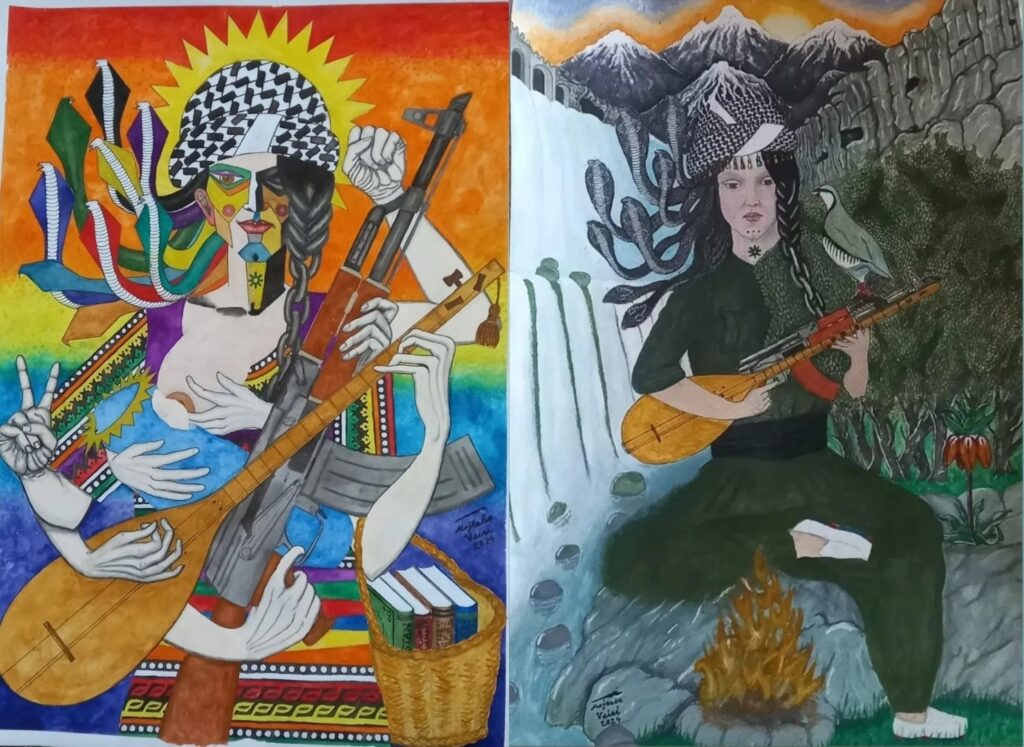
It was learned that two of Mojtaba Waisi’s signed works depicting a Kurdish woman were created using watercolor.
Here is the translation from Sorani Kurdish to English of the two-page letter written by Mojtaba Waisi:
“Sometimes my feelings take flight toward that library where my soul flutters its wings for books. I miss every single child in that library: Mehiya, Mahbub, Sena, Aylin, Servinaz, Hena, Mübin, Diana, Atusa, Hesti, Alov, Negar, Ayda, Terane, Haniye, Aydın, Berhem…
I wonder if I’ll ever get to see them grow up and witness their futures? I don’t know if I’ll be able to bear witness to their futures and their adulthood. But from the depths of my heart, I wish each of them health, wisdom, and a life of honor. I love them; I wish for them knowledge and wisdom, to stay away from people’s tricks and deceptions, to be filled with humanity and reflect it, to have freedom, to seek justice, to serve the people, and to stand firm like ancient, noble oak trees. With the hope of seeing you in a free and enlightened world… The prosperity of the homeland and your greatness are my greatest wishes. May justice be with you; may justice be your supporter and refuge.
Under all circumstances, I am filled with despair and mental turmoil. Despair regarding an uncertain future… A despair stemming from not knowing what will happen, from being unable to foresee how events will unfold. How long will this situation continue? Will this tyrant’s reign come to an end—will this era of oppression finally cease? Or will another tyrant rise in his place? Will this vicious cycle repeat itself once more? How will the dictator’s power be overthrown and shattered?
Should the brave pay the price of freedom with their lives and all they possess, while the dishonorable and cowardly seize power and arrogance and ascend to the throne of rule and governance? Should those noble people who fought and lost their lives leave behind nothing but their photographs, now confined to prisons? Will the result of my comrades’ efforts and deaths be that the power over the nation’s future falls into the hands of those who seek it solely for their own interests? Yet power must be used to serve people and humanity. Before long, the bonds and chains of this captivity will be forged anew…
But the sorrow of rising up to fight against the oppressors is not a source of despair for me; on the contrary, it is the very essence of the flow of life and the meaning of existence. In this empty and meaningless world where I have found my own meaning, merely surviving and bowing to oppression out of fear of death is nothing but shame and humiliation.
Yours faithfully,
Your supporter and defender.”
According to the Kurdistan Human Rights Network (KHRN), the two brothers had previously been subjected to repeated pressure, threats, and detention by security forces due to their cultural activities and participation in anti-government protests.
It was reported that approximately one year ago, the two brothers, along with other cultural and literary activists, contributed to the establishment of the Darreh Drezh Kurdish library and organized cultural and artistic events to foster a sense of social solidarity among children and youth in the impoverished region. It is also known that the two brothers participated in the organization of many Newroz celebrations in the city and carried out various artistic projects in Kermanshah.
Deaths continue after the ceasefire
Since the ceasefire declared between Iran and the U.S. on April 7, 2026, the Iranian regime’s arrests, political executions, capital punishments, and attacks on Kurdish regions have continued. Human rights organizations have reported that this repression and the massacres have continued even after the ceasefire.
Individuals killed and executed by the Iranian regime following the April 7 ceasefire
Mohsen Eslamkhah
Hana Human Rights Organization reported that Mohsen Eslamkhah, a detained individual from Bukan, has been sentenced to death by the judiciary of the Islamic Republic of Iran.
Ghazal Mawlan
Ghazal Mawlan, an 18-year-old Komala member who was severely injured during Iran’s drone strike targeting opposition groups in the Kurdistan Region of Iraq, has passed away. Human rights organizations reported that some hospitals refused to provide treatment due to fear of political pressure.
3 killed in attack on PDKI camp
Following the ceasefire, three people lost their lives in an attack carried out by Iranian unmanned aerial vehicles on a PDKI camp in Iraqi Kurdistan. Two women were among the deceased.
Nasser Bakerzadeh
The Supreme Court of Iran upheld the death sentence of Nasser Bakerzadeh, a 26-year-old Kurdish prisoner detained in Orumiyeh Central Prison.
Nasser Bakerzadeh and Yaghoub Karimpour
In the early hours of May 2, Nasser Bakerzadeh, a Kurdish Sunni, and Yaghoub Karimpour, a disabled Azerbaijani Turk Yarsani citizen, were secretly executed in Orumiyeh Central Prison without prior notification to their lawyers or families. It was noted that prison authorities have since prevented the handover of their bodies. KHRN learned that both individuals had been transferred from the general ward to a security unit in the city on April 30, where they were pressured to record forced video confessions.
Mehrab Abdollahzadeh
Kurdish political prisoner Mehrab Abdollahzadeh was secretly executed in Orumiyeh Central Prison without any prior notification given to his family or defense lawyers. Security forces refused to hand over his body to his family.
Ramin Zaleh and Karim Maroufpour
Two Kurdish political prisoners, Ramin Zaleh and Karim Maroufpour, who were sentenced to death on charges of “armed rebellion,” were secretly executed in Naqadeh Prison in the early hours of May 21. No prior notice was given to their families or lawyers.
Ghazi Kawani
According to reports received by the Hana Human Rights Organization, Ghazi Kawani, a Kurdish shopkeeper from Doletu village in Sardasht County, passed away on May 23 due to severe injuries. Kawani had been critically wounded a few days earlier by direct fire from the armed forces of the Islamic Republic of Iran along the Jasousan border corridor.
Waisi brothers
Mojtaba Veysi and Meysam Veysi, two Kurdish Yarsani brothers and cultural activists from Kermanshah, were killed by the Islamic Revolutionary Guard Corps (IRGC) forces on May 28 in Ghaleh-Kouhesh village, located in the Dalahu county of Kermanshah province.
Ramazanpour and Marefati
Esmaeil Ramazanpour, 38, residing in Yazd, and Arman Marefati, a 30-year-old Kurdish civilian from Saqqez in Kurdistan Province, were sentenced to death on charges of “enmity against God” in connection with the December 2025–January 2026 protests.
Raouf Sheikh-Maroufi and Mohammad Faraji
Hana Human Rights Organization learned that the Supreme Court upheld the death sentences of two Kurdish political prisoners, Raouf Sheikh-Maroufi and Mohammad Faraji. The cases of these two individuals, who reside in Bukan and were detained during the “Woman, Life, Freedom” uprising, have been referred to the Sentence Enforcement Branch.
*This infographic was created with AI tools, utilizing data from the specified sources.