Former HDP Co-Chairs Selahattin Demirtaş and Figen Yüksekdağ have been held in prison for 10 years. While 15 bar associations and the lawyers representing them in the case are calling for the implementation of European Court of Human Rights rulings, DEM Party Co-Chairs Hatimoğulları and Bakırhan made statements in front of the prisons where the former co-chairs are being held.
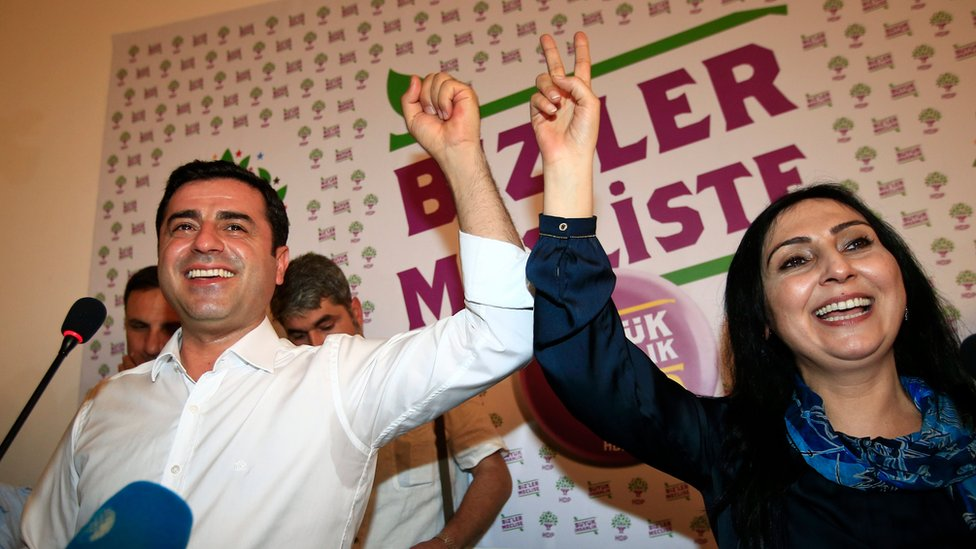
Photo: AP
Former Co-Chairs of the Peoples’ Democratic Party (HDP), Selahattin Demirtaş and Figen Yüksekdağ, have been held in prison for 10 years.
Marking the 10th anniversary of their imprisonment, 15 bar associations and lawyers representing the defendants have requested the release of 13 HDP politicians, including Selahattin Demirtaş and Figen Yüksekdağ. The appeal filed in Ankara calls for implementation of the European Court of Human Rights (ECHR) final rulings on rights violations.
The 15 regional bar associations and the lawyers for the “Kobani case” submitted the release request to the 22nd Criminal Chamber of the Ankara Regional Court of Justice.
The core arguments for this request rest on final ECHR rulings on rights violations, a decision by the Committee of Ministers of the Council of Europe dated September 16, 2026, and Articles 19 and 90 of the Constitution.
Bakırhan: “For ten years, we have been making statements at the gates of prisons.”
On the 10th anniversary of their arrests, DEM Party Co-Chairs Tülay Hatimoğulları and Tuncer Bakırhan visited the prisons where the politicians are being held. Hatimoğulları visited Edirne Prison, where Selahattin Demirtaş is incarcerated, and Bakırhan visited Kandıra Prison in Kocaeli, where Figen Yüksekdağ is held, and delivered statements outside the facilities.
Hatimoğulları reported that, during their meeting, Demirtaş conveyed his greetings to the peoples of Turkey and affirmed that he would continue to support the “Peace and Democratic Society Process” despite his imprisonment, emphasizing that the detained politicians have not abandoned their efforts for peace. She stated that they would continue their struggle until all political prisoners are released.
Bakırhan remarked, “For ten years, we have been making statements at the gates of these prisons. Isn’t that enough by now? We do not want to come here to make statements in the eleventh year. By the eleventh year, our friends should be engaging in democratic politics alongside us. Figen Yüksekdağ should be able to demonstrate her commitment to peace outside these walls. Selahattin Demirtaş should be able to engage in politics together with his own people and his comrades.”
What happened during Demirtaş and Yüksekdağ’s leadership of the HDP?
Demirtaş and Yüksekdağ, who have been imprisoned since November 4, 2016, led a pro-Kurdish party in Turkey to surpass the electoral threshold for the first time; the HDP (Peoples’ Democratic Party) secured 13.22% of the vote in the June 7, 2015, general elections. Although no party reached the 276 seats required to govern alone, the HDP won 80 seats in parliament. The AKP, in power since 2002, lost its parliamentary majority after these elections.
In the lead-up to the June 7 elections, Demirtaş made a statement from the podium of the Grand National Assembly of Turkey on March 17, 2015, directed at Erdoğan: “We will not let you become president”, a remark that became a major topic of public discussion.
Two days before the elections, on June 5, ISIS carried out a bomb attack on an HDP rally held at the Istasyon Square in Diyarbakır, resulting in the deaths of five people.
The peace process that had been underway between the PKK and the state was effectively shelved on August 11, 2015, when President Recep Tayyip Erdoğan declared, “The ‘solution process’ is in the deep freeze.”
The period spanning the June 7 elections and the subsequent snap election on November 1 went down in history as one of the bloodiest and darkest eras in Turkey.
On July 20, 2015, an ISIS suicide attack targeted students from the SGDF (Federation of Socialist Youth Associations) in Suruç, Urfa, who were planning to deliver toys to children from Kobanê; 33 people lost their lives.
On July 22, 2015, two police officers were killed in their home in Ceylanpınar, and this event marked the de facto end of the “solution process.” However, it remains unknown who killed the police officers.
On October 10, 2015, 103 people lost their lives and more than 500 were injured in an ISIS-perpetrated bombing targeting a peace rally in front of the Ankara Train Station.
Although the blockades that followed the declaration of self-governance in Kurdish cities began and intensified primarily after November 1, they occurred between June and November.
The European Court of Human Rights demanded the release of Demirtaş and Yüksekdağ
Authorities launched an investigation into Selahattin Demirtaş after he called for a march toward the Sur district, where a curfew was in effect at the time.
Demirtaş, who faces accusations of engaging in PKK propaganda on 93 separate occasions, was the subject of an indictment seeking a 5-year prison sentence for “propagandizing for a terrorist organization.” This charge stems from a speech he delivered during a Newroz celebration in Istanbul in 2013, in which he allegedly “praised the PKK and its leader, Abdullah Öcalan.”
On September 7, 2018, Selahattin Demirtaş was sentenced to 4 years and 8 months in prison for “propagandizing for a terrorist organization.” However, the Office of the Chief Public Prosecutor at the Court of Cassation requested that this conviction be overturned. On December 22, 2020, the European Court of Human Rights ruled that Demirtaş’s rights to freedom of expression and to stand for election had been violated.
On May 16, 2024, a verdict was reached in the “Kobani Case,” in which Selahattin Demirtaş, who has been in detention since 2016, was a defendant. The court ordered his continued detention and sentenced him to 28 years in prison.
When combined with his other legal cases, Demirtaş has been sentenced to a total of 42 years in prison.
Figen Yüksekdağ was taken into custody at her home in Ankara on November 4, 2016, as part of a “terrorism investigation” conducted by the Diyarbakır Chief Public Prosecutor’s Office, and was subsequently sent to Diyarbakır. There, the 2nd Criminal Peace Judgeship heard her case and ordered her arrest that same day; she was later transferred to the Kocaeli F-Type Prison. On February 21, 2017, her parliamentary membership was revoked; subsequently, on March 9, 2017, the Office of the Chief Public Prosecutor at the Court of Cassation terminated her political party membership, in accordance with a provision in the Law on Political Parties stating that individuals convicted of “terrorist acts” cannot be members of political parties.
On May 16, 2024, in the “Kobani Case,” Yüksekdağ was sentenced to 30 years in prison.
On November 8, 2022, the ECHR ruled that the rights of former HDP members of parliament, including Yüksekdağ, to freedom of expression, liberty and security, and free elections had been violated. The Court called for necessary measures to secure the release of those applicants who remained in detention. The ruling became final on April 3, 2023.