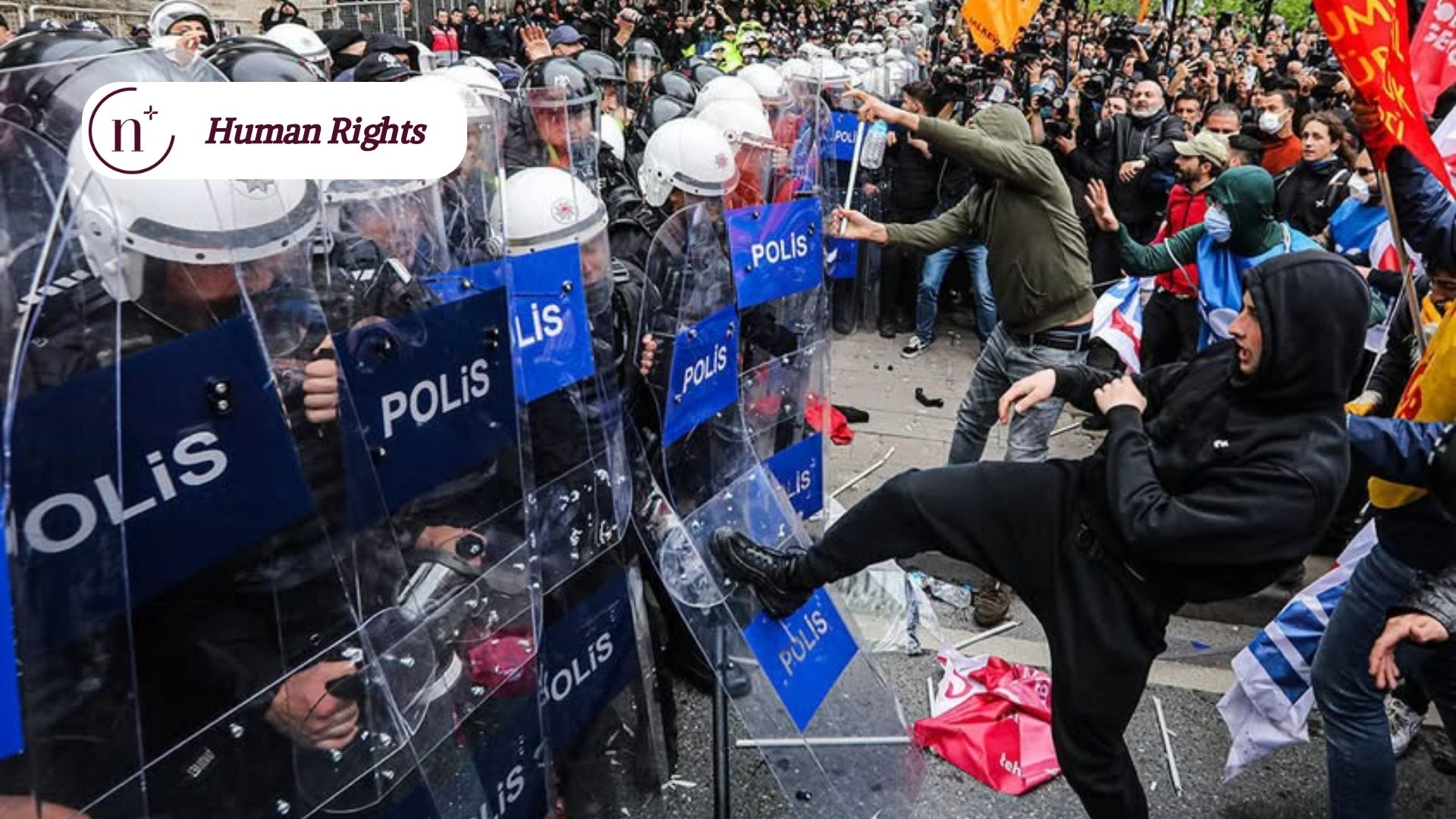
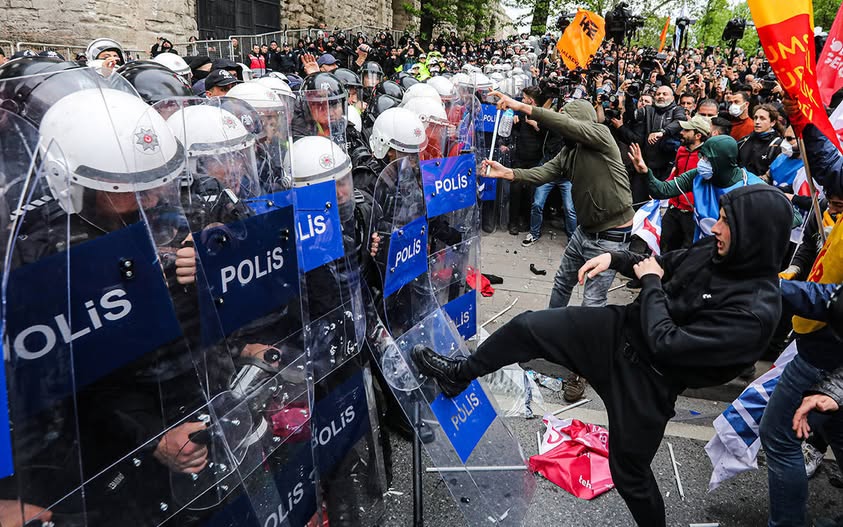
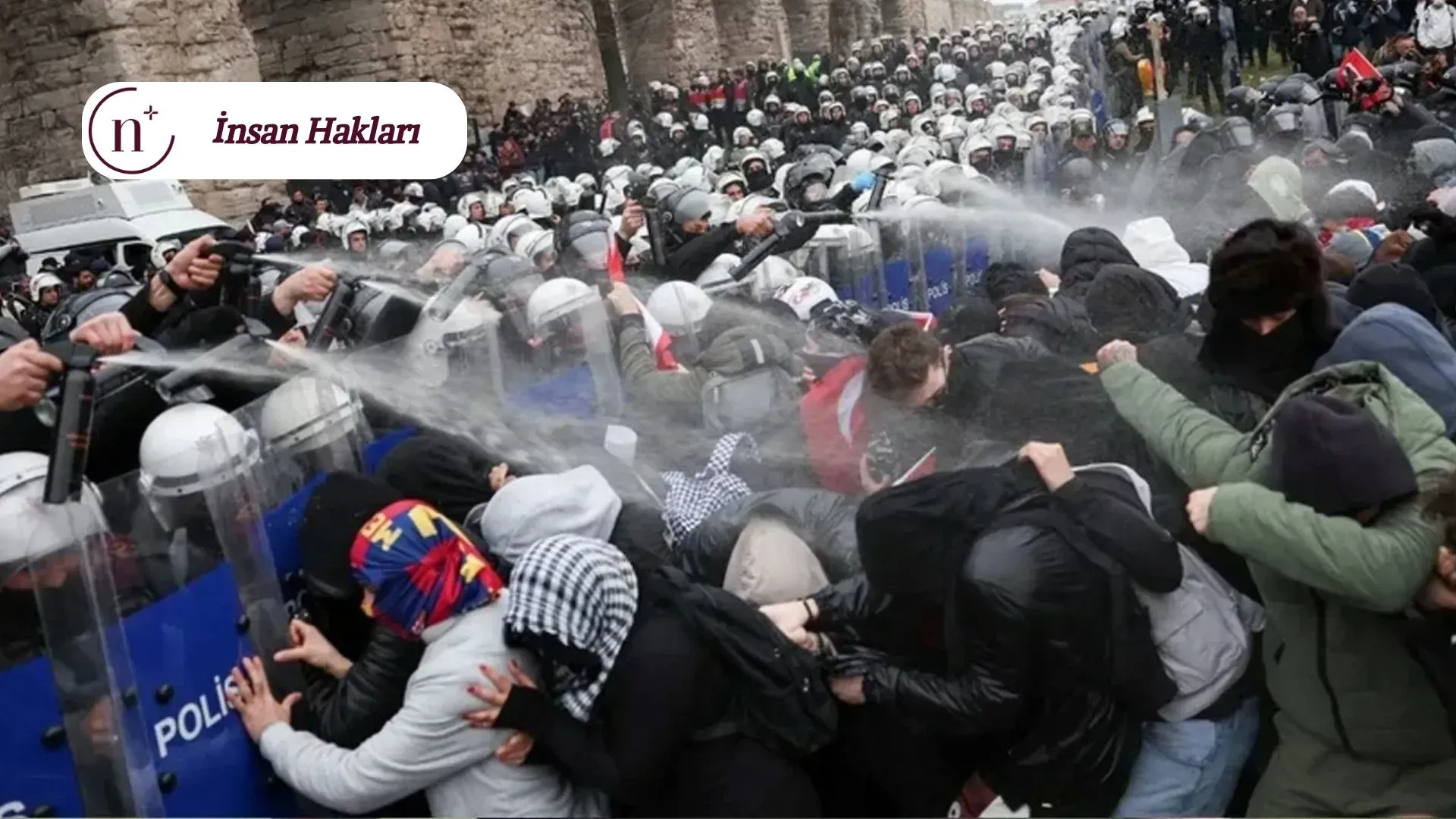
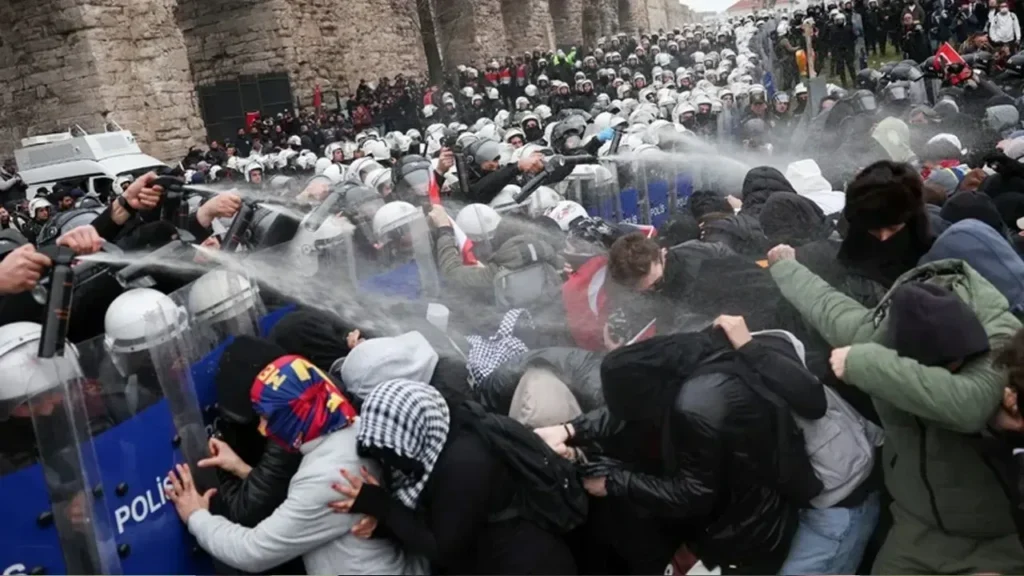
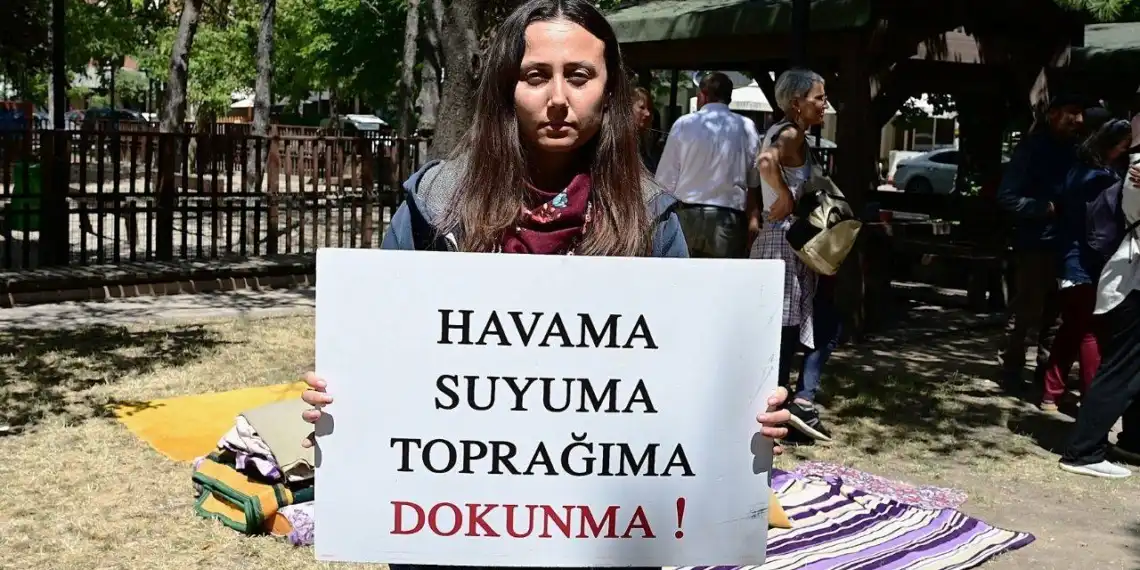
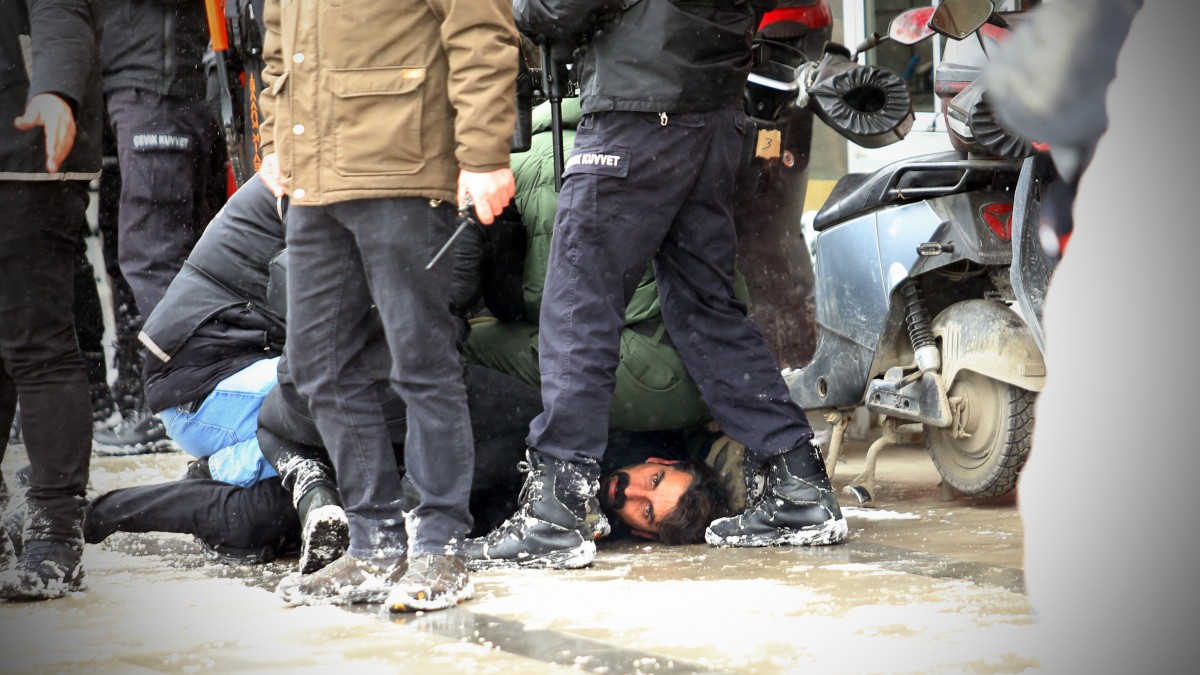
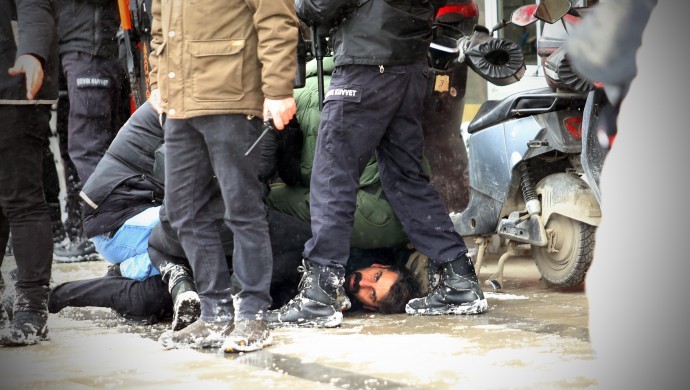
May 1st in Turkey, lastly celebrated in Taksim Square in 2012. We have compiled a chronicle of May 1st celebrations marked by police interventions and mass detentionsagainst the ban on Taksim.
Photo: Murat Bay
Since 1976, May 1st in Turkey has been defined by the persistence of workers to reach Taksim Square. Following the “1977 May Day Massacre,” the square became both a symbol of labor rights and the country’s most contested protest site. Despite long-standing bans, unions and leftist organizations continue to claim Taksim as the traditional heart of May Day celebrations.
Here is a summary of the events following the ban on Taksim Square over the last 13 years:
May Day in Istanbul from 2013 to 2025: The Taksim ban, police interventions, mass detentions, and the ongoing struggle.
1,000+
Total detentions (at least)
13 years
Ongoing Taksim ban
100+
Total number of arrests
2013
Following its reopening in 2010, Taksim was banned once again. The Governor’s Office cited the “pedestrianization project” as the reason. Extraordinary security measures were taken across the city; bridges were raised, and roads were closed. Hours-long police interventions occurred in many areas, particularly Beşiktaş and Şişli. Even hospitals and homes were affected by tear gas. It was reported that 30,000 police officers were deployed to Taksim that day. According to the Governor’s Office, 25 protesters (3 serious), 6 journalists, and 22 police officers (3 serious) were injured.
72 detentions
2014
Taksim Square was completely cordoned off. Intense tear gas and water cannons were used throughout the day in Şişli, Mecidiyeköy, and surrounding areas. Health institutions and journalists were also impacted by the interventions.
171 detentions • 12 journalists injured
2015
Entry to Taksim was prohibited. Only a limited number of unions were allowed to lay wreaths at the monument. Interventions targeted small groups across the city. Allegations surfaced regarding police entering political party buildings.
203 detentions, 13 arrested
2016
Celebrations were moved to Bakırköy. Despite this, interventions continued against groups attempting to reach Taksim. Various political and union groups were redirected to alternative areas. A citizen named Nail Mavuş lost his life after being crushed due to an uncontrolled maneuver by a water cannon vehicle (TOMA).
231 detentions, 5 arrested
2017
The Taksim ban remained in effect. Groups gathering at various points in Istanbul were detained, including individuals attempting to hold sit-in protests.
165 detentions
2018
The Governor’s Office rejected all applications. The rally site was moved to Maltepe. Taksim was sealed off with barriers starting from the early hours of the morning.
84 detentions
2019
Interventions were carried out against groups gathering in Şişli. Detentions of those attempting to march toward Taksim continued throughout the day.
119 detentions
2020
Curfews under pandemic conditions were cited as grounds for restrictions. Reports included allegations of ill-treatment, assault, and reverse-handcuffing during detentions.
48 detentions
2021
Despite the curfew, groups attempting to march to Taksim faced harsh intervention. Union representatives were among those detained.
212 detentions
2022
After a two-year hiatus, a mass rally was held in Maltepe. Groups heading toward Taksim were once again blocked, leading to further detentions.
100+ detentions
2023
Numerous groups attempting to march to Taksim from Şişli and Beşiktaş were detained. There were attempts to prevent members of the press from recording the events.
80+ detentions
2024
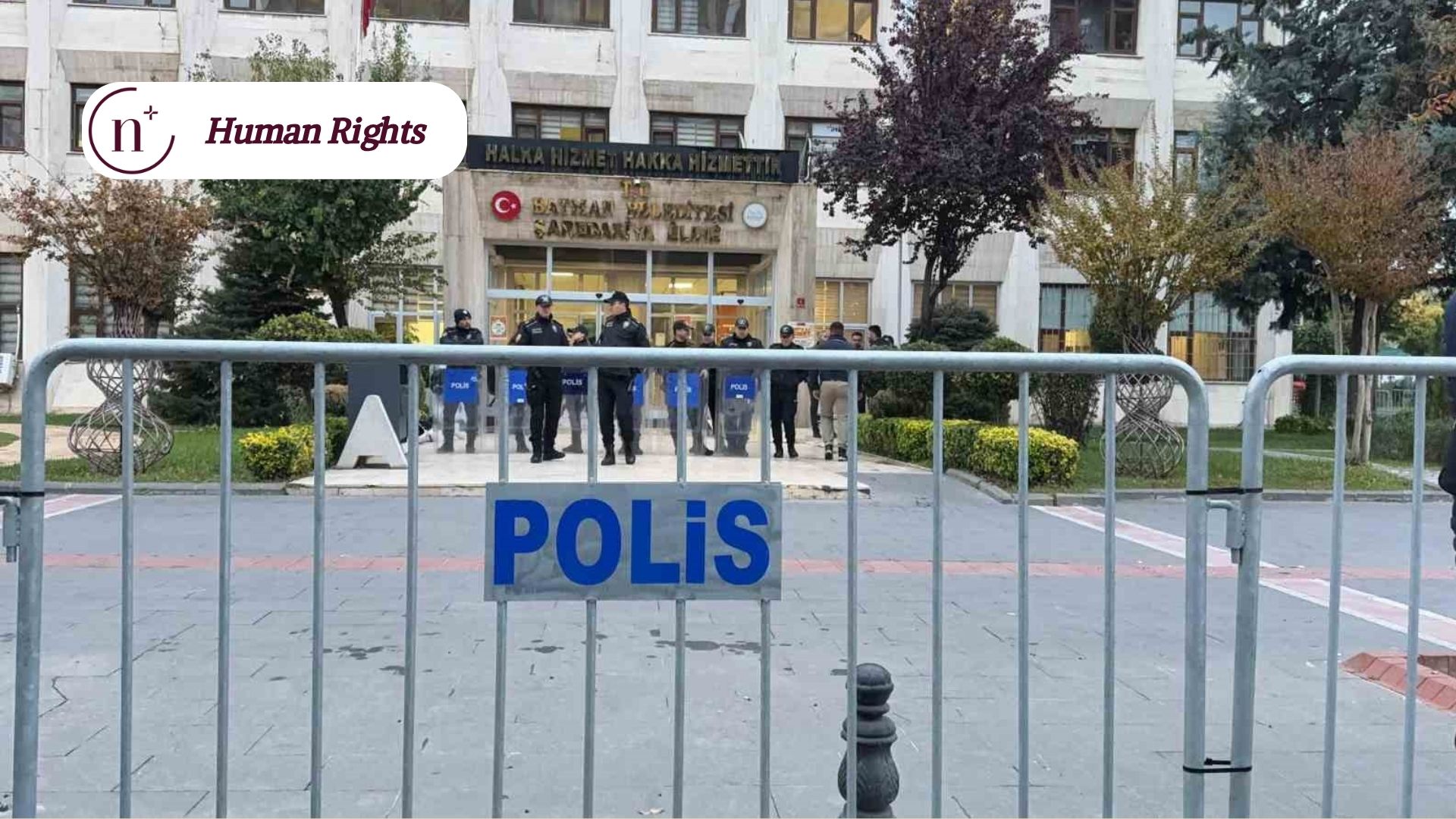
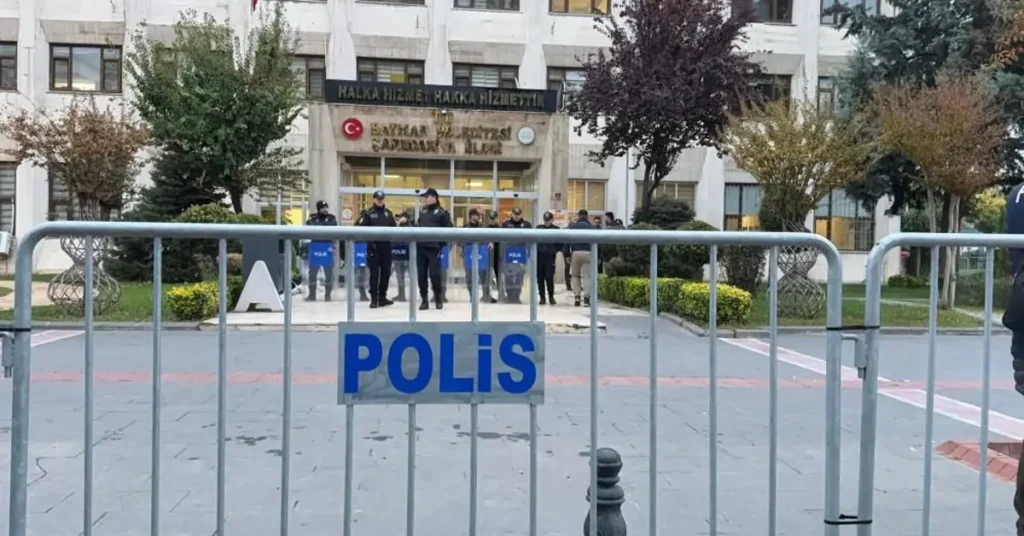
The Constitutional Court (AYM) ruled that Taksim is a legitimate May Day site and declared the Governor’s ban a “rights violation.” Thousands gathered in Saraçhane to march to Taksim, but police blocked the route with barricades. The confrontation lasted approximately 1.5 hours, followed by house raids. In 2025, the court found the ban to be unlawful.
268 detentions, 77 arrested
2025
Operations were conducted against organizations calling for a Taksim gathering. Throughout the day, barricades in Mecidiyeköy were challenged amidst ongoing interventions. According to the Progressive Lawyers Association (ÇHD), a total of 419 people, including 10 children and 11 lawyers, were detained in Şişli.
419 detentions, 13 arrested
Source: Human rights organizations and press compilations.
2013: The return of the ban
After allowing celebrations in 2010, the AKP government reimposed the ban in 2013. The Governor’s Office cited a “pedestrianization” project as the reason.
30,000 officers were deployed.
Bridges of Galata and Unkapanı were dismantled to block access.
Police used tear gas and water cannons against groups in Beşiktaş and Şişli. Tear gas was fired at ambulances and into the garden of Şişli Etfal Hospital.
At least 72 people were detained.
2014, May 1
Taksim was closed to everyone except police and accredited journalists.
While small pro-government unions were briefly allowed to lay wreaths, others faced heavy intervention in Tarlabaşı, Şişli, and Beşiktaş.
22 people were hospitalized with fractures, 12 journalists were injured by gas canisters and rubber bullets.
171 people were detained.
2015, May 1
Unions like DİSK and KESK insisted on Taksim, but were blocked.
Police fired tear gas into the CHP district building in Beşiktaş.
203 people were detained; 13 were officially arrested.
2016, May 1
Major unions (DİSK, KESK, TMMOB, TTB) decided to hold the main rally in Bakırköy for this year only. However, other leftist groups still marched toward Taksim.
231 detentions and 5 arrests near Beşiktaş and Şişli.
2017, May 1
The Interior Minister announced Taksim would remain closed. Main unions moved to Bakırköy again.
165 people attempting to reach Taksim were detained across various districts.
2018, May 1
Main unions moved to Maltepe, while socialist groups headed for Taksim.
The square was completely surrounded by barriers early in the morning; even journalists were barred.
84 people were taken into custody.
2019, May 1
Groups gathered at Şişli Cevahir Mall to march to Taksim but were met with police intervention.
119 people were detained.
2020, May 1
During the pandemic, 48 people were detained. Lawyers from ÇHD reported that detainees were subjected to “plastic handcuff torture,” beatings, and insults. One person’s arm was broken during the intervention.
2021, May 1
Despite a lockdown and rejected applications, unions tried to march from Dolmabahçe.
212 people were detained, many of whom were dragged on the ground. DİSK President Arzu Çerkezoğlu was among those detained.
2022, May 1
After a two-year pandemic break, mass celebrations returned.
At least 100 people were detained while trying to reach the square from multiple points. The official rally was held in Maltepe.
2023, May 1
Groups from various unions and socialist parties attempted to walk from Şişli and Beşiktaş.
At least 80 people were detained.
2024: The Saraçhane barricade
Unions and the CHP gathered at Saraçhane to march to Taksim, citing a Constitutional Court ruling that the ban was illegal.
Police formed a massive barricade under the historic Bozdoğan Aqueduct.
Police used water cannons, tear gas, and rubber bullets.
210 people were detained on the day, 47 more were taken in during house raids on May 3.
Governor Davut Gül stated, “The state may leave it for tomorrow, but it won’t let it go unpunished.”
2025, May 1
A new May 1st organizing committee declared “Taksim belongs to the people.”
Police operations targeted organizers on April 29 and 30, around 92 people were detained.
Protesters repeatedly challenged police barriers in Mecidiyeköy throughout the day.
407 people were detained, 7 were arrested. Reports of reverse-handcuffing and police brutality were documented in Mecidiyeköy.
Hogir Alay and Gökhan Kumak were found hanging from a tree in refugee camps in Germany. Alay and Kumak are just two of the Kurdish refugees who have reportedly committed suicide in German camps in recent years. These two suicides, which occurred in 2023 and 2024, raise questions about the safety of the refugee camps. The families are awaiting justice.
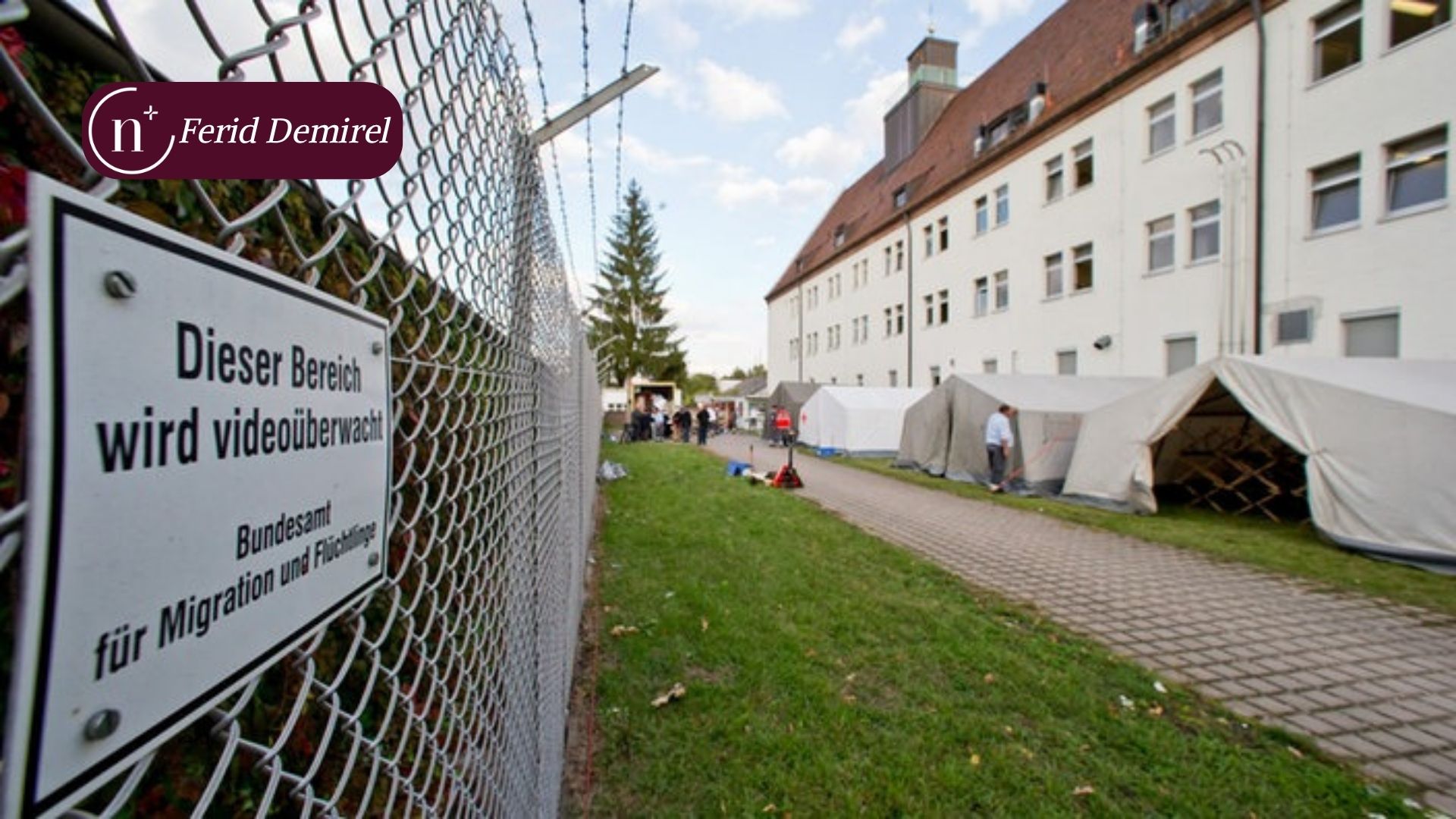
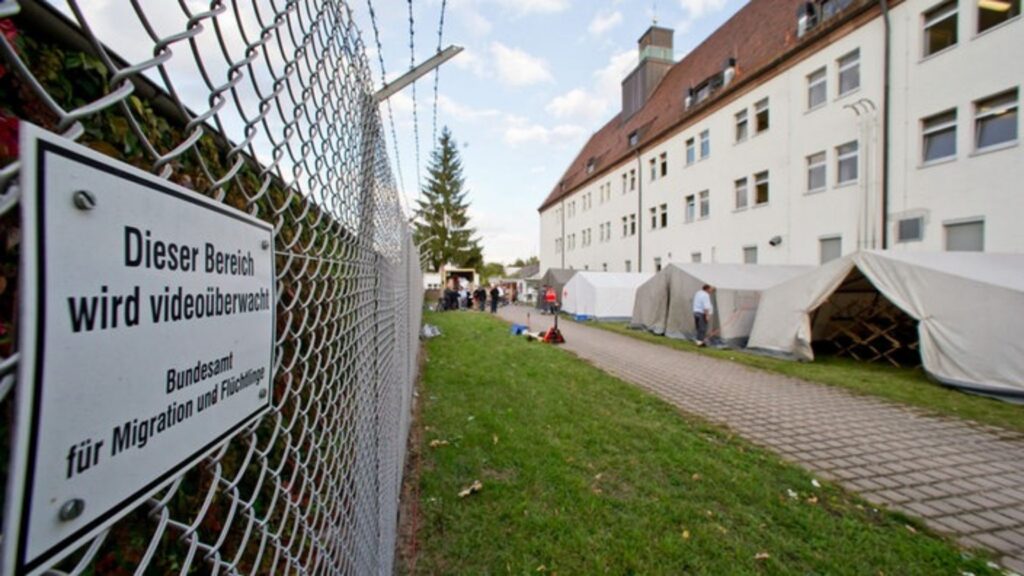
A refugee camp in Germany, Photo: planet-wissen.de
Hogir Alay and Gökhan Kumak are only two of the Kurdish refugees who have lost their lives in refugee camps in Germany in recent years. Hogir went from Mardin to Germany in 2022, and Gökhan went from Şırnak in 2023 to seek asylum. On this journey, which they embarked upon due to political pressure or the goal of building a better life, they spent a long time trying to reach Germany illegally. At the end of this period, they experienced difficult days in the camps they arrived at. After a while, their bodies were found hanging from trees inside the refugee camps. Alay’s body was found 24 days later in a wooded area within the garden of the camp where he stayed.
German authorities announced that both Alay and Kumak had committed suicide. However, according to their families, there was no reason for their children to take their own lives. Despite the time that has passed, they want the causes of their children’s deaths to be investigated. They claim there was negligence on the part of relevant institutions and individuals in Germany.
Why are refugees committing suicide in Germany?
According to data reflected in the press and public opinion, dozens of Kurdish refugees have ended their lives in Germany since 2023. 17-year-old Mustafa Baki from Kobanî, Mehvan Muhammed Süleyman from Duhok, 28-year-old Fethullah Aslan in a psychiatric institution in Berlin, and Mustafa Polat in Erfurt are just a few names on this list.
According to data from the refugee counseling center Pena-Ger, 32 suicide attempts occurred in the state of Saxony in 2024 alone. However, according to Pena-Ger, the real figures are much higher, as ethnic origin records are not kept and many cases go ‘undocumented.’
Between 1993 and 2018, 288 suicide cases were documented in refugee camps in Germany. Today, it is recorded that there are approximately 30 suicides and 400 attempts per year.
Hanging, jumping from heights, or overdosing
Refugees most often commit suicide in or around the camps where they stay, while their asylum process is ongoing or under the threat of deportation. This most frequently occurs in the form of hanging oneself from a tree, jumping from a height, or overdosing. It was announced that Gökhan Kumak and Hogir Alay also committed suicide by hanging themselves.
Hogir Alay’s body was found 24 days later
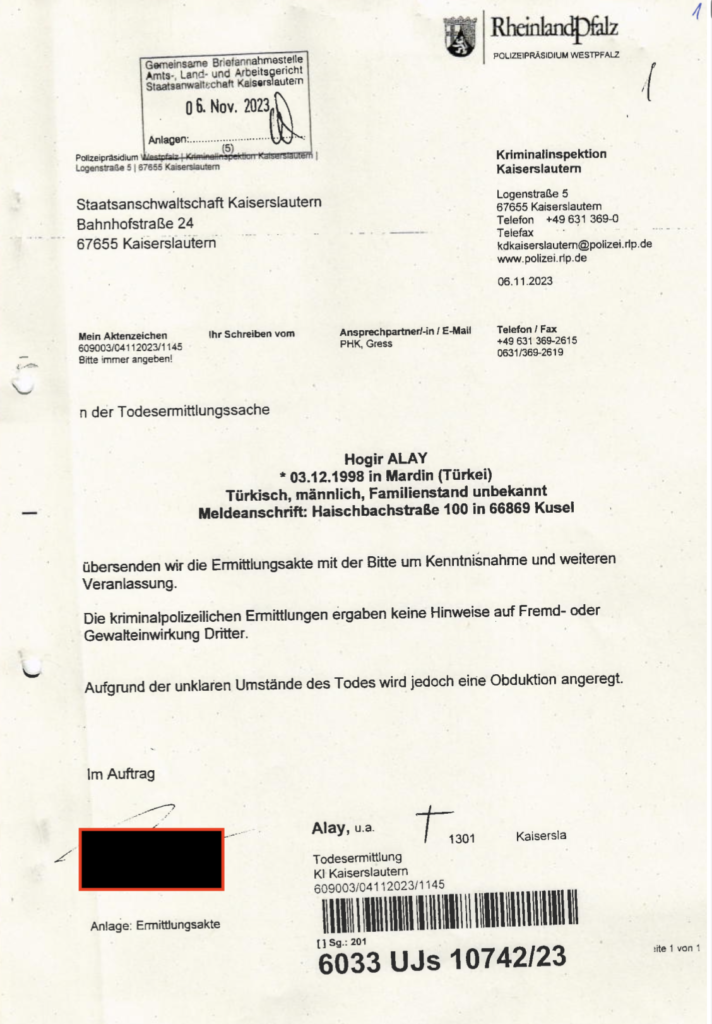
Hogir Alay lost his life on October 11, 2023. His body was found on November 4 by someone else staying at the AfA-Kusel refugee camp where he resided. In other words, Alay’s body emerged 24 days later. As stated in the investigation file, the location where the body was found was the wooded area right behind the gym inside the camp.
On October 11, Alay called his father several times, as well as his brother and his brother’s wife, but could not reach them. After this attempt, which took place around 18:00 on the same day, his family could never reach Hogir’s phone again.
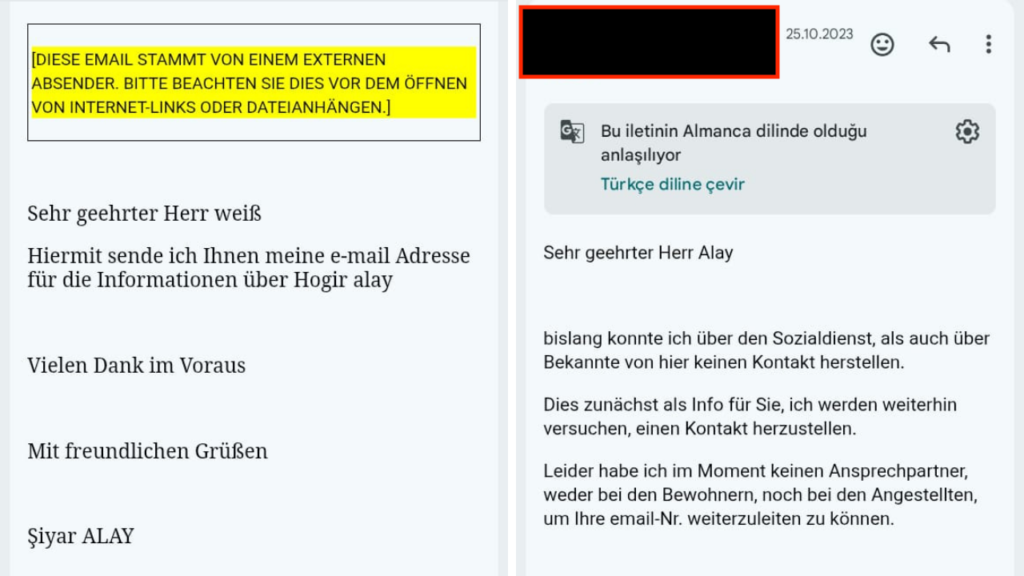
Screen recordings showing Şiyar Alay’s correspondence with authorities via email
According to the family’s claim, during the following days when they could not hear from their child, they wrote an email to the refugee camp where Hogir stayed through their other child, Şiyar Alay, who is a refugee in Austria. In the official email written in response to Şiyar Alay dated October 25, it was explicitly stated that the police could not establish any contact with Hogir and that attempts made through Social Services (Sozialdienst) had been inconclusive.
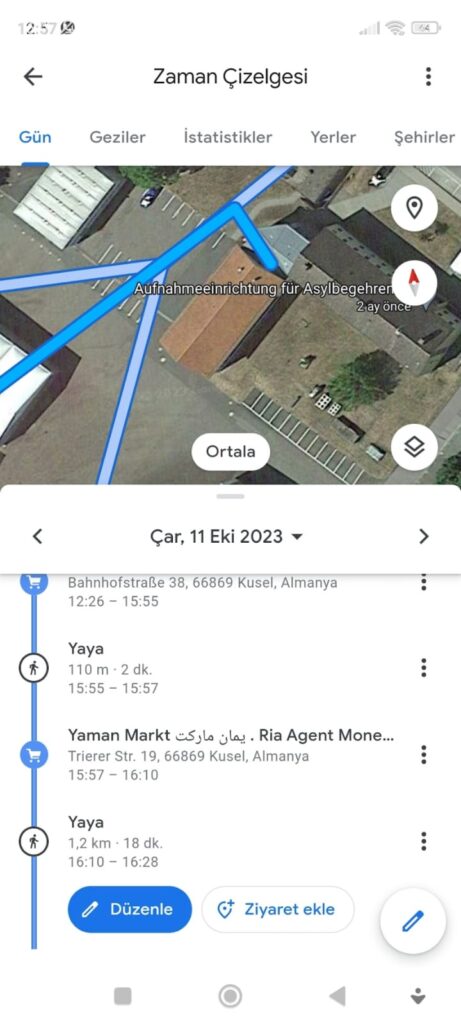
In the file prepared regarding Alay’s death, according to the security guards of the camp, Alay’s last entry-exit record via ID card scan was made on October 11, 2023, at 16:27. It is stated that he entered the facility at that hour. It is noted that on October 17, 2023, he was reported missing because he could not be found in the accommodation facility during patrols.
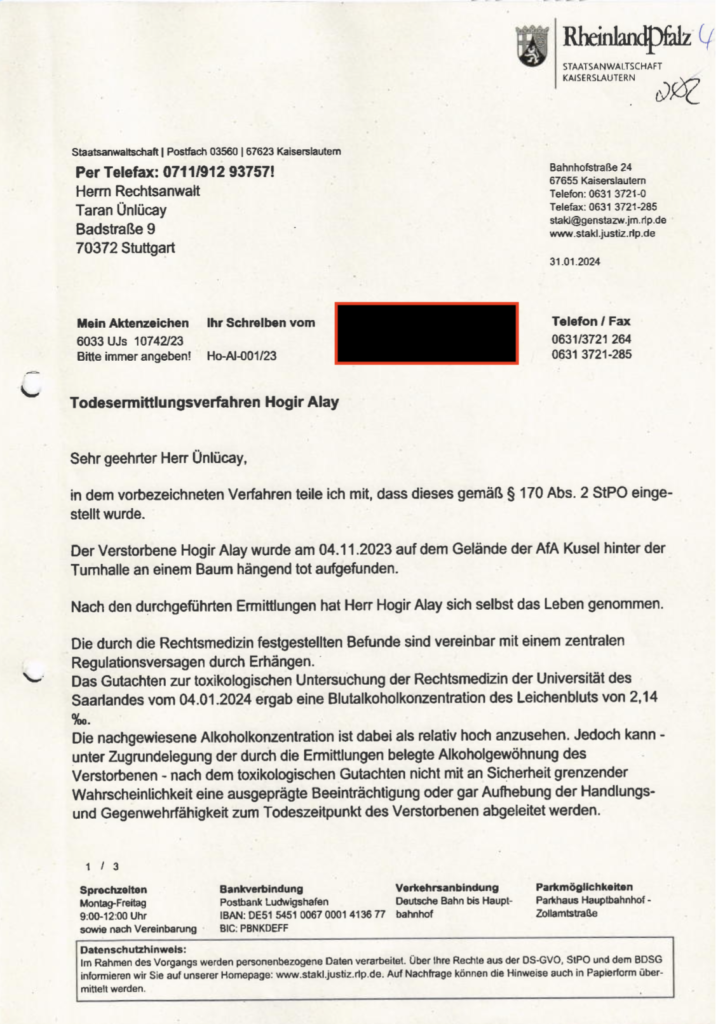
Official Investigation Document of the Kaiserslautern Police Department
Alay’s brother Rêber Alay told Niha+: “On November 4, news came to us from the camp. They saw him and said he had lost his life. They realized it was him because he had an AK-47 tattoo on his chest. He had a tattoo on his chest.” In the investigation and autopsy reports, it is stated that because the body had remained outside for a long time, it had become unrecognizable, his identity could not be determined, and identification was only possible with the tattoo on his chest. The news of Hogir Alay’s death was officially conveyed to Turkey’s Consulate General in Mainz by the police on November 6, 2023, at 11:52.
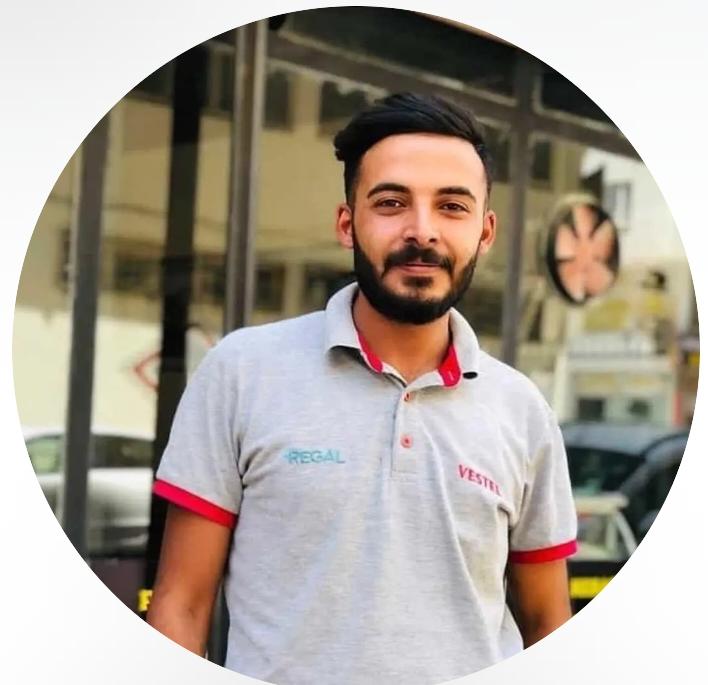
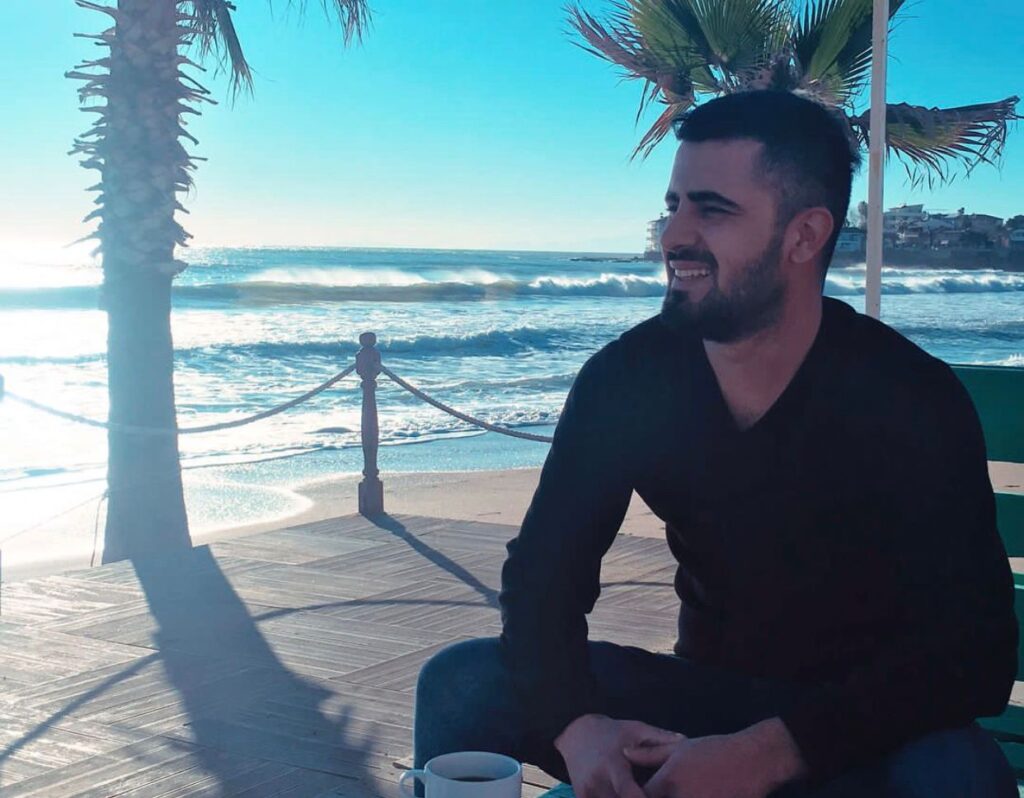
Hogir Alay before going to Germany as a refugee
Rêber Alay rebels against this situation: “His feet are touching the ground. There are photos. Also, his body is very battered. Decayed. He must have been hanging for 24 days. If he is in the camp and in a visible place, how could this child have been hanging for 24 days? Thousands of people stay in 그 camp. During this time, camp authorities did not ask if this child was missing. They notified the police after it became clear he was dead. Something striking is that they say everyone who died hanged themselves. Don’t people who commit suicide try another method? This is a question mark. They are all diagnosed as dying from heart failure. It was said that Hogir died the same way. It was written that Hogir drank a lot, and there was two per mille alcohol in his blood. It is claimed that Hogir actually fainted before hanging himself, and died not from suffocation but from heart failure.”
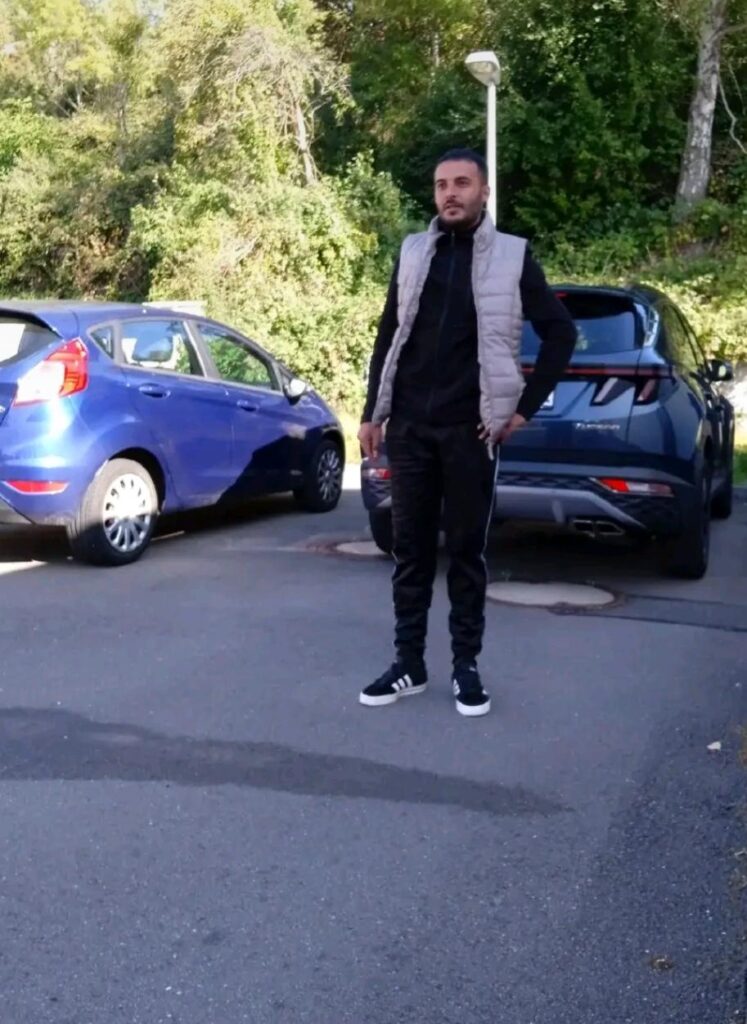
Hogir Alay while at the refugee camp in Germany
He went through illegal routes
Hogir Alay went from Mardin to Germany through illegal routes a year and a half before he died, in 2022. According to his family’s account, while Hogir was in Mardin, he participated in protests for Kobanî and was investigated for this. In the face of both this investigation and the difficulties he experienced due to refusing mandatory military service, he decided to go to Germany with his wife. It is claimed that before his death, Hogir repeatedly complained about poor living conditions, discrimination, and violence perpetrated by security personnel and social workers, but these complaints were not forwarded to the relevant authorities.
Investigation document showing Hogir Alay’s official date of death
His brother Rêber Alay confirmed that his brother had problems with camp authorities: “One day, in front of everyone, Hogir says, ‘if I am killed here, either they killed me or I will kill the security guard.’ They couldn’t get along.” In the report prepared by the Hogir Alay Initiative, which was established to continue the search for justice after Hogir Alay’s death, it is stated that Alay complained about constant room changes and psychological pressure during his stay at the camp. It is alleged that security personnel subjected him to systematic harassment and physical attacks.
Last location information taken from Hogir Alay’s phone
Complaints were not forwarded on the grounds of “protecting the institution’s reputation”
The claim that Alay wanted to convey these complaints to the management unit, but the translators at the camp refused to translate these statements on the grounds of “protecting the reputation of the institution,” is included in the file. In the investigation file, criminal records regarding Hogir Alay’s past and turmoils in his private life have been added by the authorities as ‘psychological factors triggering suicide.’ However, according to refugee rights defenders and the family, the personal crises an individual is in do not alleviate the camp management’s responsibility to ‘protect the right to life’; on the contrary, it increases the obligation of supervision and protection toward an individual at risk.
The case is closed quickly in Germany
It is understood from the information reflected in the investigation file that an autopsy of Hogir Alay was performed in Germany. The autopsy was conducted on November 9, 2023, at the Institute of Forensic Medicine at Saarland University in Homburg. Regarding the family’s claims that an autopsy was not performed, the Kaiserslautern Chief Public Prosecutor stated in a 2025 letter that this claim does not reflect the truth, emphasizing that comprehensive autopsy and toxicology reports are available in the file.
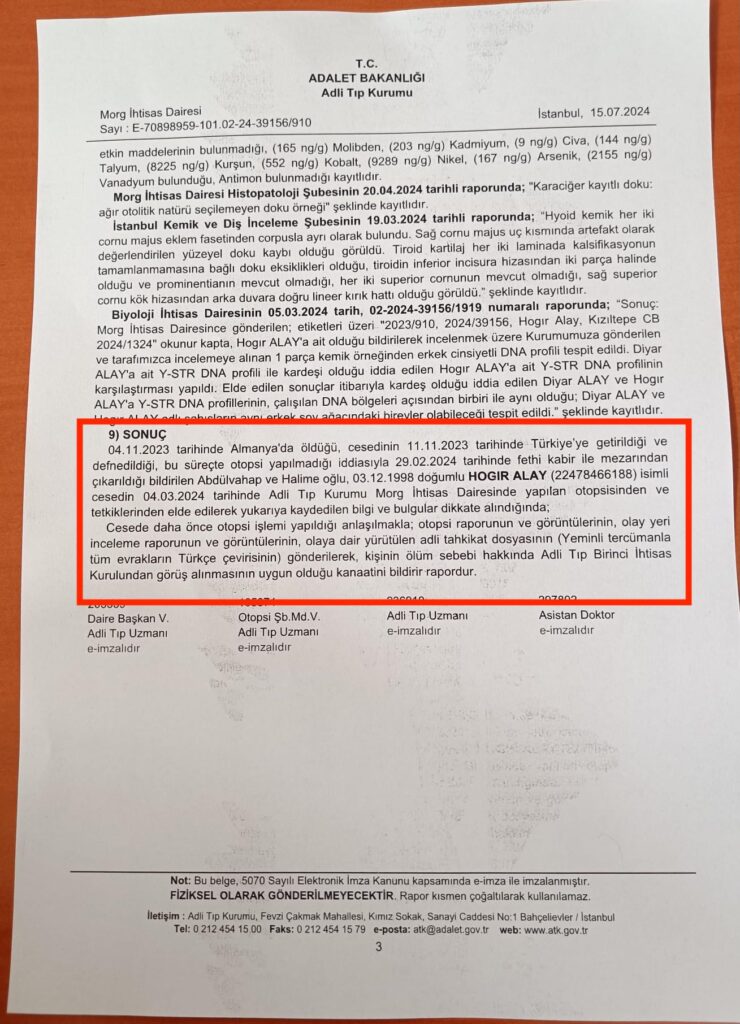
Despite this, the family demands an autopsy in Turkey as well: “After he came to Turkey, we didn’t think of anything at first. Then after thinking a bit, we took him out of the ground. We had an autopsy done. According to the autopsy, it is said his front teeth had fallen out. One of his bones was broken, his heart and some of his organs were decomposed, some were missing. It is said the higher board of the Forensic Medicine Institute in Turkey will give the final result. A year and a half later, after the autopsy, Germany sent its own autopsy to the prosecutor here. What do the authorities here say now? We will put Germany’s and our own autopsy side by side. Let’s see what comes out. In the end, they also made their own autopsy reports like the one in Germany. Now they also say Hogir hanged himself,” says Rêber Alay.
From the preliminary autopsy report of the Istanbul Forensic Medicine Institute regarding Hogir Alay
His father Abdülvahap Alay filed a criminal complaint with German institutions through the Kızıltepe Chief Public Prosecutor’s Office. In the complaint, he claims that there was no possibility of their child committing suicide and that he might have been a victim of murder. Despite this application, the Zweibrücken Chief Public Prosecutor’s Office stated that Hogir took his own life, claiming that he did not commit suicide under the influence of someone else, but due to his internal problems. Furthermore, it noted that there was no information or findings regarding the possibility of him being killed by others and closed the investigation it conducted on the grounds that no criminal situation was detected.
In the investigation file in question, it is stated that no direct connection could be established between Alay’s past frictions with security personnel and the death event. The German prosecutor’s office points to the fact that Hogir Alay personally declared in his statement dated August 4, 2023, that he had “made peace with the security personnel” as evidence that conflicts within the camp had no link to the suicide decision. According to the information provided by Rêber Alay, some of his brother’s personal belongings and phone have not yet been delivered to them. The investigation opened in Turkey continues.
Kumak: They will kill me
Gökhan Kumak, like Hogir Alay, committed suicide in the camp where he lived in Germany. Kumak went to Germany through illegal routes in January 2023. He was 34 years old. He was a long-haul truck driver. He used to carry cargo to and from Iran and Iraq. According to his family’s account, he decided to go to Germany saying, “I don’t have a profession, I can’t see a future, let me go to Germany, maybe I’ll get residency and build a good life for myself.” After staying in the first camp where refugees are accepted for the first 8 months, Kumak was sent to a camp called a heim where he would stay permanently. Kumak, who stayed here for 6 months, constantly called his family during this time, claiming that he would be killed. The family states that their child’s psychology deteriorated greatly due to this situation. His brother Eser Kumak told Niha+: “Before he died, he called my father. He says, ‘I’m afraid the German police will bring trouble upon me. They will kill me, they will burn me.’ Something happened to him in the heim, I don’t know that. He suffered a lot in the camp. He said the German police set Afghans upon him.”
Before losing his life, Gökhan calls his father and says that they have ruined his psychology, that it is a very serious matter, and asks them to save him.
Gökhan lost his life on April 2, 2024.
However, his family was informed on April 9: “One day we couldn’t get news. He had a friend. I called him, I told him we couldn’t reach my brother. I said, don’t you see Gökhan? He said, ‘don’t call me,’ he said, ‘I don’t know where Gökhan is.’ There was someone else next to him. He said, his voice came to me, ‘tell them the police came and took Gökhan and Gökhan died.’ The other kid said, ‘don’t involve me, don’t involve me, don’t call me,’ and after day he blocked me. He was an Afghan boy. But he was using a number from Turkey.”
Gökhan Kumak
Eser Kumak stated that official authorities from Germany did not reach them. Gökhan Kumak’s body, like Hogir Alay’s body, was seen hanging from a tree in the forest. It was sent to Turkey on April 14, 2024. In the autopsy performed, it was written that he had a heart attack. However, the family does not believe this finding. Eser Kumak states that due to the heavy situation they experienced, they could not think to request an autopsy in Turkey as well. The family provided the information that no investigation has been opened in Turkey regarding Gökhan Kumak.
Someone from Germany calls the family: Don’t go to the ECHR On April 18, 2026, someone who identified herself as Ute Classen and stated she was a social service official in the city of Bad Wildungen sent voice messages to the family via WhatsApp from Germany. In the voice recording sent in German, the person states that Gökhan had psychological problems, that everyone tried to help him, but he committed suicide nonetheless. The voice recording also says, “I would not recommend you to apply to the European Court, because here in Bad Wildungen, nothing happened to justify this.”
Gökhan Kumak
Pena-Ger: Suicide attempts of refugees are not being recorded
Pena-Ger is a non-profit non-governmental organization providing online counseling services for refugees throughout Germany. Dealing with the files of Gökhan Kumak and Hogir Alay, the organization is preparing to restart the legal process for both files. According to Pena-Ger, a series of death cases occurring among Kurdish refugees in Germany in recent years, which are mostly evaluated as suicides, are known. However, according to the organization, there is no precise statistical record specific to this group, and they argue that this lack of data points to a more fundamental problem: that suicides or suicide attempts among refugees in general are not systematically recorded in Germany.
According to DRK Rheinland-Pfalz, which operates as part of the Red Cross in the German state of Rhineland-Palatinate, a large portion of these cases remain invisible because they are not recognized or documented as a result of structural problems. This invisibility leads political decision-makers to not take the need for adequate psychosocial support for refugees seriously enough, and this situation leads to serious consequences. The organization states that despite this, structural patterns are identified through individual cases and media and civil society reports.
“Problems of Kurdish refugees remain invisible”
Pena-Ger draws attention to another point: neither the German Federal Statistical Office nor the Federal Office for Migration and Refugees makes a distinction based on ethnic origin. Therefore, the specific problems experienced by Kurdish refugees in particular remain statistically invisible. Especially collective accommodation centers, deportation detention, and similar restrictive conditions negatively affect psychological health. Isolation, lack of privacy, and constant fear of deportation deepen existing crises and increase suicidal thoughts. At the same time, the psychological problems of refugees are frequently distorted in the public eye through a security perspective.
Pena-Ger believes the causes of the suicide cases and attempts are structural. In addition to inadequate psychological support, the failure to forward complaints, insufficient protection mechanisms, and staff shortages, it is stated that living conditions within the acceptance system lead to re-traumatization. Long asylum processes, collective housing, lack of privacy, and constant uncertainty deepen existing traumas. The legal situation regarding access to health services is also thought to be a critical factor. It is stated that the Asylbewerberleistungsgesetz (AsylbLG) seriously restricts access to psychotherapy in particular. In the first 36 months, only acute illnesses are treated. This leads to many refugees being unable to access the necessary treatment.
Beybûn Şeker from Pena-Ger states that as an institution, they try to offer active support: “Every day we encounter people who experience suicidal thoughts or live in deep despair without support. In Germany, the mental health of refugees usually comes to the agenda for a short time only after sensational events. Millions of refugees are portrayed as threats by being generalized, but this is not the solution.”
Amnesty International’s report exposes the lawlessness, discrimination, and rights violations perpetrated by nations -most notably the US, Russia, China, the UK, and Israel- while asserting that a new history of humanity is being written by the people resisting these injustices.
The 406-page report, titled The State of the World’s Human Rights 2025/26, evaluates 144 countries. It emphasizes that the international legal framework was significantly undermined in 2025, largely driven by the actions of the USA, Israel, and Russia. The report highlights that despite ceasefires, Israel continued its genocidal actions through illegal settlements and the obstruction of aid, while expanding its military offensive into countries such as Lebanon and Iran.
As the world endures one of its darkest periods of institutional impunity and state violence, the report notes that resistance has spread in equal measure. Port workers across several European countries formed a global solidarity network, putting their bodies on the line to block arms shipments to Israel. Meanwhile, youth movements from Indonesia to Peru targeted systemic injustice, transforming the streets into “spaces of transformation” throughout 2025.
“Time to write the history of human rights”
In the report’s foreword, Agnés Callamard, Secretary General of Amnesty International, stated:
“As Amnesty International has long warned, a global environment where primitive ferocity could flourish has been long in the making. But in 2025, accelerants were recklessly poured over dry kindling, as sharp U-turns were taken away from the international order that had been imagined out of the ashes of the Holocaust and the utter destruction of world wars, and constructed slowly and painfully, albeit insufficiently, over these past 80 years.”
Callamard emphasized that resistance is also about clarifying what needs to be transformed, urging people to find the courage to change as the very structures built over the last 80 years face destruction:
“We must imagine a transformed and transformative human rights vision for the world that we are becoming, not merely defend human rights in terms of the world we once were. Together, we must then lead that transformation into existence, with all our creativity, determination and resilience. History is not just something that is done to us. It is also ours to make. And for the sake of humanity, it’s time to make human rights history.”
The report documented protester deaths resulting from the unlawful use of force in countries including Turkey, Angola, Cameroon, Ecuador, Indonesia, Kenya, Madagascar, Pakistan, and Peru. In nations such as Afghanistan, Belarus, Burkina Faso, China, Cuba, Mali, Myanmar, Nicaragua, North Korea, Russia, Uganda, and Venezuela, authorities reportedly used enforced disappearances of human rights defenders, activists, and journalists to spread fear. Many other countries, including Iran and Saudi Arabia, continued to resort to the death penalty.
Turkey: Rise in baseless investigations and convictions
The report brings to light allegations of torture and rights violations by law enforcement against protesters in Turkey, alongside a culture of impunity. It further highlights an increase in baseless investigations and convictions targeting human rights defenders, noting that executive interference in the judiciary has deepened. Key findings include:
The report notes legislative proposals aimed at criminalizing LGBTI+ and their advocates. Similar to Hungary, Turkey banned Pride Marches, where law enforcement used unlawful force. The report also recorded bans placed on LGBTI+ associations.
The report recorded the detention of hundreds of peaceful protesters following the detention of Ekrem İmamoğlu, Mayor of Istanbul and CHP presidential candidate. Unlawful force was documented during the March 19-26, 2025, protests sparked by operations against the CHP and İmamoğlu’s detention.
Despite European Court of Human Rights (ECHR) rulings and the Council of Europe’s 2022 infringement proceedings, figures such as Osman Kavala, Selahattin Demirtaş, and Figen Yüksekdağ remain imprisoned.
The report identified unlawful force by both the judiciary and law enforcement during protests following the prison sentence handed to Abdullah Zeydan, the elected mayor of Van Metropolitan Municipality.
Rights violations during May Day protests and subsequent house raids were highlighted. In 2025, 294 femicides were committed by men, while 297 women were found dead under suspicious circumstances.
Escalating violence in the Middle East and North Africa
The report underscores a surge in attacks by various actors across the Middle East. Notable findings include:
Israeli attacks in Gaza continued through 2025, killing approximately 27,000 Palestinians (60% of whom were women and children). Systematic destruction of housing and infrastructure decimated living conditions. An 18-year blockade was tightened, leaving half a million people facing famine and banning medical evacuations.
Israel conducted military strikes against Lebanon, Iran, Qatar, Syria, and Yemen. Targeting civilian sites in Iran (such as Evin Prison) was classified as a war crime. While a new era began in Syria with the fall of the Assad regime, sectarian massacres continued. In Yemen, the humanitarian crisis deepened following a cut in US aid.
Non-independent judiciaries in Egypt, Tunisia, Saudi Arabia, and Iraq handed down politically motivated prison sentences. Peaceful protests were crushed in Iran, Algeria, and Tunisia. Racial attacks and collective expulsions of Black refugees increased in Tunisia and Algeria, while Libya remained a spot for the torture and arbitrary detention of migrants.
Global impunity and the reluctance of states
By early 2026, the unlawful use of force by the US and Israel against Iran -violating the UN Charter- triggered retaliatory strikes against Israel and Gulf Cooperation Council countries. The US, Israel, and Russia further weakened international accountability mechanisms, specifically the International Criminal Court (ICC).
The Trump administration imposed sanctions on ICC staff and the UN Special Rapporteur on the Occupied Palestinian Territory, while Russian courts issued arrest warrants for ICC officials. Most states remained reluctant to activate mechanisms to block the aggressive actions of the US, Russia, Israel, or China.
In Brazil, police operations in impoverished neighborhoods of Rio de Janeiro resulted in over 120 deaths, mostly among Black residents. In Afghanistan, the Taliban escalated its oppressive policies, banning women from education, work, and travel.
Floods in Pakistan displaced millions, while New Delhi recorded the world’s most polluted air. Pacific islands face an existential threat from rising sea levels.
Activism against the flow of weapons to Israel expanded globally. Port workers in France, Greece, Italy, Morocco, Spain, and Sweden blocked shipment routes. An increasing number of states acknowledged that Israel is committing genocide, with many joining the “Hague Group” or contributing to South Africa’s case at the International Court of Justice (ICJ).
In 2026, the Spanish government maintained a principled stance against these violations.
The Human Rights Association (İHD) issued a statement regarding the armed attacks carried out in schools in Urfa and Maraş on April 14 and 15, respectively: “These grave incidents are a consequence.”
On April 14, an armed attack was carried out by a student at the Siverek Ahmet Koyuncu Vocational and Technical High School in the Siverek district of Urfa. At least 16 people were injured. Following this, on April 15, another student carried out an armed attack at Ayser Çalık Secondary School in the Onikişubat district of Maraş. Media reports indicated that there were at least 9 dead and 20 injured in the Maraş attack.
Following these consecutive attacks, several education unions announced a 2-day strike and called on the public to join a “life vigil” in front of Provincial Directorates of National Education.
The Human Rights Association (İHD) released its statement today (April 16). The statement emphasized that the attacks in Urfa and Maraş have once again exposed structural problems regarding the protection of children’s fundamental rights.
“Violence has become an ordinary occurrence”
The İHD stated that violence has become normalized everywhere and has reached a level that threatens social life by becoming a culture in Turkey recently. The statement noted that the legitimization of violence stems from many factors, ranging from the language used by politicians and the media that glorifies violence and hatred to easy access to firearms:
“Targeting based on identity and belief, the language used against dissidents and political operations, discourse against LGBTIQ+ individuals, migrants, and refugees, combined with violence and hate speech generated via media and social media -when evaluated alongside institutionalized policies of impunity- pave the way for these and similar attacks. In other words, these grave incidents are a consequence.”
“The selective attitude of the judiciary and entrenched impunity legitimize violence”
In its statement, the İHD called on everyone using violent and hateful language, especially political actors and the media, to abandon this rhetoric. It urged the judicial system to stop being “selective” regarding violence and hate speech.
The Association pointed out a clear double standard: while the judiciary shows tolerance toward violence and hate speech aligned with government policies, it applies legal pressure and threats of prosecution against dissenting, rights-based, or minority-focused expressions. This approach, they argued, transforms hate speech into violent action and legitimizes violence against certain groups.
The statement also noted that TV programs, series, movies, and games that normalize conflict as a social relationship contribute to this normalization. It called for effective measures against violence and hate speech in written, visual, and social media.
“The right to life, the right to security, and the right to access a qualified, safe educational environment -especially for children- is an absolute obligation of the state. This obligation requires not only post-incident intervention but the implementation of policies that prevent violence, eliminate risks, and protect children under all circumstances.
According to the UN Convention on the Rights of the Child, to which Turkey is a party, children must be protected from all forms of violence. Despite this, the fact that educational spaces have become vulnerable to armed attacks reveals the inadequacy of protection mechanisms and the consequences of negligence.”
“Curriculum must be purged of discriminatory and militarist discourse”
Stating that these incidents are not individual acts of violence but the result of routinized policies of hate, the İHD listed its demands to prevent further occurrences:
The incidents must be investigated effectively and independently in all dimensions; impunity for those responsible must not be allowed.
Rights-based and holistic protection policies centered on children’s safety in schools must be established immediately.
Early warning and monitoring mechanisms to prevent violence against children should be set up and the curriculum must be cleaned of discriminatory and militarist discourse.
Long-term, accessible, and free psychosocial support must be provided to all children affected by these violent events.
The İHD also expressed that broadcast bans and practices preventing the public’s access to accurate information damage transparency and accountability, rendering the events invisible. The statement concluded that an effective struggle against such incidents is only possible in an environment where truths can be spoken openly.
The Association vowed to follow the legal process regarding the events in Urfa and Maraş and called on authorities to take effective measures to ensure such violations never happen again.
The objection against the arrest of Esra Işık has been rejected by the Muğla 2nd Civil Court of First Instance.
Esra Işık was detained and later arrested while protesting during an expert inspection related to a lawsuit against the urgent expropriation of agricultural land around Akbelen Forest in Milas, Muğla. The objection to her arrest has been rejected by the Muğla 2nd Civil Court of First Instance.
She is one of the leading figures in the Akbelen protests. An urgent expropriation decision decision had been issued for 679 parcels of agricultural land surrounding Akbelen Forest in Milas, Muğla which will result in villagers losing their olive groves and homes. Local residents say this action is meant to expand coal mining operations run by YK Energy, a company owned by İçtaş and Limak, and they have taken the case to court.
Court-appointed panel of experts began on-site inspections in the area on March 30 under gendarmerie supervision. Following tensions that arose during the inspection, while villagers reacting the inspection experts on March 31, Esra Işık was detained that night and arrested the same day.
According to the Human Rights Association (İHD) report, at least 930 people were detained for participating in protests or for social media posts related to the issue. At least 123 people were arrested, including 1 journalist and 32 children.
Adnan Bilen /MA
The Human Rights Association (İHD) prepared a report on violations of rights that occurred during protests in Turkey against the attacks that began on January 6, 2026, when the Syrian interim government in Syria targeted Kurdish-populated neighborhoods in Aleppo, and which later spread across Rojava.
The report, prepared by the İHD Documentation Center using information reflected in the press and other open sources, as well as observation reports from İHD branches, covers violations identified between January 6, 2026 and February 12, 2026.
According to the report, at least 930 people were detained for participating in protests or for social media posts related to the issue. At least 123 people were arrested, including 1 journalist and 32 children.
Some of the violations identified in the report are as follows:
Interventions in 22 provinces
In response to protests and reactions against attacks on Kurds in Syria, law enforcement intervened in more than 70 peaceful demonstrations in at least 22 provinces. Many people, including co-mayors, human rights defenders, trade union and professional organization leaders, journalists, and children, were detained.
During the interventions, chemical agents such as tear gas, as well as plastic bullets and water cannons were used. It was documented that law enforcement used physical violence against many individuals and that detainees were handcuffed behind their backs.
Governorships in three provinces (Urfa, Mardin, and Diyarbakır) imposed bans on all types of demonstrations and events for varying periods.
In Mersin, one refugee died after a civilian opened random fire to threaten protesters. At least 5 people, including 4 journalists, were injured by law enforcement in various ways.
At least 930 people were detained for participating in protests or for related social media posts. At least 123 people were arrested, including 1 journalist and 32 children.
Many individuals were subjected to torture and ill-treatment both during interventions against protests and throughout detention and imprisonment processes.
Journalists were obstructed
At least 8 journalists were detained while covering the protests. Journalist Nedim Oruç was arrested.
Access was blocked to more than 40 social media accounts and websites belonging to news outlets, including Mezopotamya Agency, Jinnews, ETHA, Yeni Yaşam, and Ajansa Welat. Hundreds of social media accounts were also restricted.
In response to reports that HTS and affiliated armed groups cut the braids of women they executed in Syria, 4 people (2 of them children) were detained for sharing videos of themselves braiding hair on social media; one child was arrested. A nurse was suspended from duty for sharing similar content. For the same reason, the Professional Football Disciplinary Board (PFDK) imposed various administrative penalties on the Amedspor club, its president, and player Çekdar Orhan.
At least 46 people who were foreign nationals were deported.
Infographic
Mass Detentions and Interventions: Toll Across 22 Provinces
22City
Interventions happened
70+Protest
Blocked
930+Detention
Participating protest / SM Sharing
123Arrested
At least (32 of them children)
Intervention and Methods
Law enforcements used tear gas, plastic bullets and water in protests.
Detainees were handcuffed from the back and subjected to physical violence.
The governorships of Urfa, Mardin and Diyarbakır, banned all kinds of actions and activities.
Co-mayors, human rights defenders, trade unionists and children were also among those detained.
Missing Persons and Violations
One refugee lost his life as a result of random gunfire by a civilian in Mersin.
At least 5 people, including 4 journalists, were injured by law enforcements.
Torture and ill-treatment were reported both during protests and in detention/prison processes.
Freedom of the Press and Expression
At least 8 journalists were detained; Nedim Oruç was suspended.
More than 40 news websites and social media accounts (MA, Jinnews, Yeni Yaşam etc.) were blocked.
Access to hundreds of individual social media accounts was banned.
Special Penalties and the Hair Braiding Case
• Due to the video of hair braiding 4 people, including 2 children, were detained, and one child was arrested.
• Sharing the same braiding content caused a nurse being suspended from duty.
• The PFDK (Turkish Football Federation Disciplinary Committee) fined Amedspor club, its president, and one of its players.
• At least 46 citizens from another country were deported.
TÜM-BEL-SEN report reveals that since the 2024 local elections, the administration of 85 municipalities has been changed through trustee appointments, dismissals, and political interventions.
The Union of Municipal and Local Government Workers in Turkey (TÜM-BEL SEN) released a report on the second anniversary of the March 31, 2024 local elections. The report focuses on political pressure against municipalities run by opposition parties.
According to the report, since the 2024 elections, government interventions in local administrations have become against labor and democracy. It states that local democracy in Turkey has effectively been suspended due to practices; such as appointing government trustees, removing elected officials, judicial actions and financial restrictions.
“Public will has been ignored”
The report highlights that a large portion of votes for opposition parties has been ignored. It tells that 44.4% of the votes for the CHP (Republican People’s Party, main opposition party in Turkey) and 27.7% for the DEM Party (Peoples’ Equality and Democracy Party) were effectively taken away.
Report also argues that these practices violate the constitution, especially the basic democratic right to vote and be elected of people. After Hakkari, similar interventions continued in many (most of them are Kurdish-majority) municipalities, including Esenyurt, Batman, Mardin, Halfeti, Dersim, Ovacık, Siirt, Van, Kağızman, and Şişli.
The report states that these trustee appointments have damaged local politics, which is a key space for a peaceful and democratic solution to the Kurdish issue. Since the 2024 elections, public will has been ignored not only through trustee appointments but also through suspensions, political pressure to switch parties, and changes in municipal councils.
85 administration has been changed
According to the report, the administration of 85 municipalities has been changed since the elections, making millions of votes ineffective. It says that about 8.8 million votes (20.55% of all votes) have been disregarded.
The report also recalls that the election certificate of Van Metropolitan Municipality’s elected mayor, Abdullah Zeydan, was first mayor to be unlawfully attempted to be taken away. In total, elected mayors or co-mayors in 30 municipalities -including major cities like Istanbul, Van, Mardin, Adana, and Antalya- were removed from office. In 55 municipalities, political control changed through different methods, such as altering municipal council arithmetics.
The report notes that municipalities in Turkey depend heavily on the central government for funding. Due to limited resources, cities -where 94% of the population lives- receive only 12% of total public spending.
Finally, it states that since the elections, 1,342 public workers have been dismissed due to canceled contracts and around 3,200 workers have directly lost income.
Mehmet Edip Taşar, an ill prisoner whose release had been repeatedly postponed, passed away on March 24. Yıldız, a member of the ÖHD Prison Commission, stated: “Ill prisoners are being left to die.”
Mehmet Edip Taşar, a ill prisoner held at Marmara No. 5 L-Type Closed Prison since December 27, 2022, passed away on March 24 at the hospital where he was receiving treatment.
According to a report by bianet, the Istanbul Bar Association’s Human Rights Center held a press conference in Istanbul’s Beyoğlu district regarding the condition of the ailing prisoner Mehmet Edip Taşar.
Rabia Gündoğmuş, a member of the Istanbul Bar Association’s Human Rights Center, who read the press statement, emphasized that Taşar had dropped to 40 kilograms and that his ability to see, walk, and speak had diminished.
According to a report by İlke TV, on February 26, the Istanbul Branch of the Lawyers’ Association for Freedom (ÖHD) stated that Taşar had been subjected to verbal and physical attacks by doctors during his transfer to the Forensic Medicine Institution (ATK).
The number of ill prisoners in 2025
According to the IHD’s 2025 Report on Ill Prisoners, there are at least 1,412 ill prisoners in Turkish prisons, including 161 women and 1,251 men. According to the report, 335 prisoners are in serious health condition.
Of these, 230 are unable to care for themselves, and 105 require assistance. Additionally, 188 prisoners require constant monitoring due to their illnesses.
The report noted that ill prisoners were not taken to the infirmary in a timely manner, were kept waiting for months for referrals to tertiary healthcare services, and were living in conditions of inadequate nutrition, heating, and hygiene.
In a statement following Taşar’s death, ÖHD noted that despite numerous legal appeals, the ATK had not issued a “cannot remain in prison” report, nor had it granted a stay of execution, despite his health condition.
Destina Yıldız as a member of the ÖHD Istanbul Branch Prison Commission, spoke to Niha+.
Yıldız stated that due to the ATK’s lack of objectiveness and independence, there were inconsistencies in many cases -particularly those involving ill prisoners- regarding the deaths of Mehmet Edip Taşar and all other ill prisoners.
Yıldız, explaining the process of how ATK reports are prepared, continued:
“Specifically regarding ill prisoners, Article 16, Paragraph 3 of Law No. 5275 requires the execution of a sentence may be postponed for individuals for whom a decision has been made based on a report, prepared by the Forensic Medicine Institution or by the medical boards of fully equipped hospitals designated by the Ministry of Justice and approved by the Forensic Medicine Institution, stating that ‘the illness poses a definite threat to life.’ Accordingly, to postpone the execution of a ill prisoner, one must first apply to the prosecutor’s office to arrange for the prisoner’s transfer to a hospital, then obtain a report from the relevant medical board, and either submit this report to the Forensic Medicine Institution for approval or directly transfer the ill prisoner to the Forensic Medicine Institution. Following the examination, the report must be prepared here and approved by the Forensic Medicine Institution, or after the report prepared by the Forensic Medicine Institution, the relevant chief prosecutor’s office must determine that the prisoner “does not pose a threat to public safety.”
“Forensic Medicine Institution reports are not actually being implemented“
Yıldız noted that, considering the circumstances of ill prisoners, reports from the ATK are not actually being implemented.
“Even in cases where the Forensic Medicine Institution issues a report stating that the prisoner ‘cannot remain in prison,’ the prisoner’s release is not carried out by the prosecutor’s offices or the courts. Ill prisoners are sentenced to death due to conflicting reports between the prosecutor’s office, the hospital, and the Forensic Medicine Institution.”
Yıldız explained that the European Court of Human Rights (ECHR) has stated that the continued detention of individuals suffering from a terminal illness or whose health condition is no longer compatible with prison conditions is considered a violation of the prohibition against torture under Article 3.
“Under international and national regulations and judicial decisions, the state is responsible for the health and lives of prisoners in prisons. It is obligated to remove obstacles to prisoners’ rights to treatment and health, and to ensure their access to these rights.”
Ill prisoners are left to death
“Yet today in Turkey, ill prisoners are either not released at all or are not released until they are on the brink of death. Those ill prisoners who are released at this stage lose their lives shortly afterward due to delayed diagnoses and treatments. Ill prisoners are being condemned to death. Mehmet Edip Taşar, a ill prisoner who lost his life, is one such case. The fact that he was not released despite a report from the Forensic Medicine Institute stating he ‘cannot remain in prison,’ and was instead condemned to death, is the clearest indication of the state’s approach toward political prisoners and ill prisoners.”