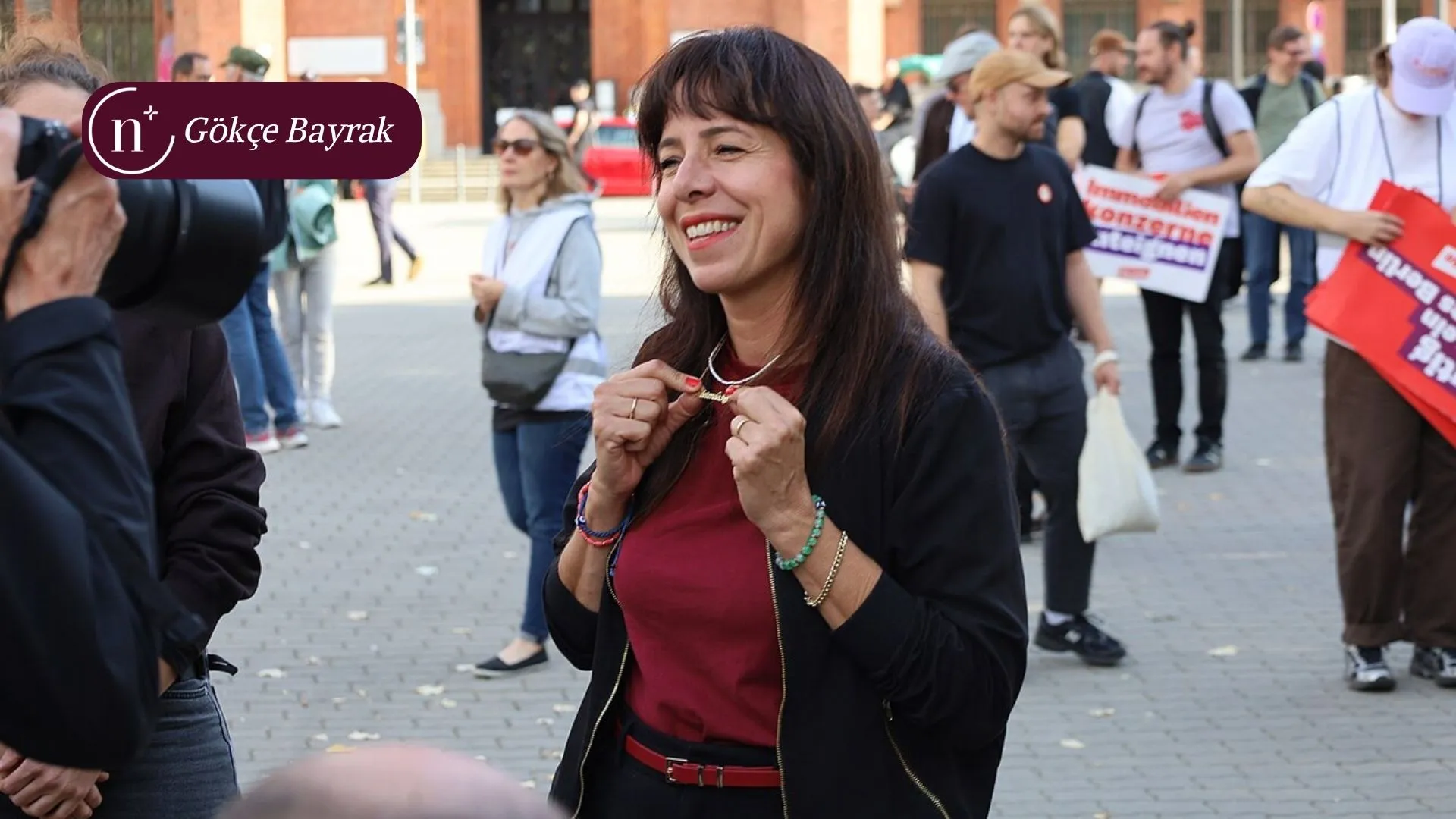
Die Linke (Left Party) candidate Elif Eralp made history in Berlin State Elections, winning 25.7 percent of the vote. With this result, the party has, for the first time in its history, has the chance of putting a governing mayor of immigrant backgrounds in office. In the election dominated by the talk of the far-right AfD’s rise, the victory of the Left Party labeled as the “extreme left” by the public discourse was met with jubilation.
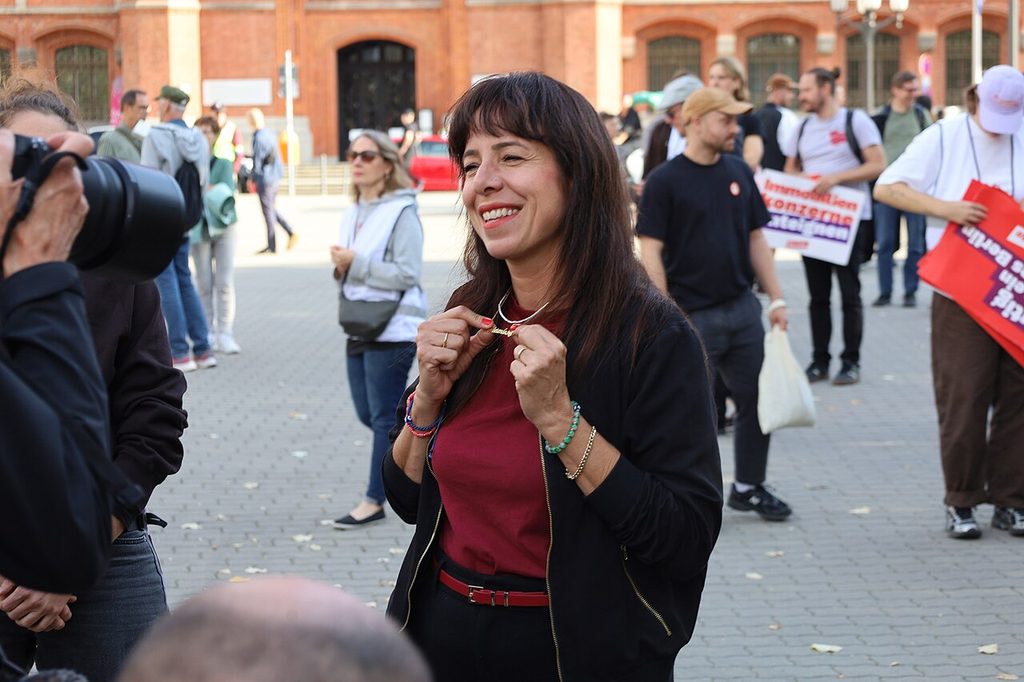
Photo: Wikimedia
Polls closed in Berlin’s state election on September 20, with the Berlin State Electoral Board announcing provisional official results at 3.33 am on September 21. Die Linke’s Elif Eralp more than doubled the party’s 2023 results, lifting its vote share from 12,2 percent to 25,7 percent, and finishing first in Berlin.
The ruling party CDU, which had topped the 2023 election with 28,2 percent, dropped 9,4 points to 18,8 percent, falling to second place on Berlin’s state election. The AfD settled for the third place, but still gained 7,2 more points than the previous Berlin elections.
In the campaign she ran for Berlin, Elif Eralp, politician from Turkiye, focused on social justice policies such as solving the housing crisis through expropriation, making public transportation improvements, and addressing the city’s waste management issue.
Who is Elif Eralp?
She was born in Munich in 1981 after her family settled in Germany as political refugees following the September 12, 1980, coup. Eralp explains that coming from a family of active trade unionists and socialists in Turkey, and growing up as the child of a refugee family, led her to encounter issues of justice, equality, and state violence at a very young age; she says she has always been deeply involved in politics.
At the age of 12, after witnessing the injustices his family had also experienced, he decided to become a human rights lawyer and completed his law degree at the University of Hamburg between 2001 and 2007. After moving to Berlin in 2010, he joined Die Linke (The Left). In 2021, he was elected to the Berlin House of Representatives. She retained her seat in the 2023 elections. Since 2024, she has served as deputy chair of the parliamentary group, and since 2025, as deputy state chair of the party. She was nominated as the lead candidate for the 2026 Berlin state elections.
Eralp, who is married and the mother of two children, says that, like many Berliners, she lives in rented housing. The most talked-about aspect of her campaign in Berlin was her proposal to nationalize large housing companies in response to the housing crisis plaguing Berliners. Elif Eralp—who is often compared to New York’s Democratic Mayor Zohran Mamdani due to her implementation of social justice policies, her background as a member of an immigrant family, and her practice of going door-to-door in the city to listen to voters’ concerns—had already begun to shape the course of the election with her strong showing in polls leading up to the Berlin election. “If a socialist candidate can win in New York, why not in Berlin?” said Eralp, who achieved the victory she had aimed for in this election. She emphasizes the importance of greater political and social participation by this diverse population in Berlin, where more than 40 percent of the residents have an immigrant background.
“Left Party politics in Berlin is stronger”
“On the one hand, Die Linke’s politics is stronger in Berlin. Perhaps the party’s shortcomings seemed more clearly in Saxony-Anhalt. On the other hand, Berlin is a different kind of city, where a different kind of politics is possible. Saxony-Anhalt does not have many big cities; it is a state made up mostly of rural areas. With employment levels also much lower than in Berlin, people’s needs there take a different shape. For example, people do not move to Saxony-Anhalt for work, quite the opposite, a large number of people are leaving. There is no similar infrastructure or employment. What is really needed is something that can give voice to the problems people are struggling with and to more people’s demands and wishes there. What is needed there is more strength and more organizing.”
Die Linke’s policies in Berlin, on de-privatizing housing and tackling the waste collection chaos found more resonance, because Berlin is a large, complex city where good politics occur. It is not made up of small villages, and that difference shapes things on its own. Still, the responsibilities of Die Linke has to be to keep winning ground in these smaller towns and smaller provinces too, to genuinely earn people’s trust. The party needs to offer a stronger systemic alternative to the existing establishment politics. And I think that, for now, we have managed to do that somewhat better in Berlin.
The election results were celebrated with great enthusiasm
In his victory speech, Eralp said, “Starting today, we will change Berlin together and make it a better place.” Expressing his gratitude to the 19,000 members of his party and the voters of Berlin, Eralp noted that history had been made with this election and that voters had given the Left Party the mandate to form a new government.
Eralp, who ran a campaign focused on the socio-economic issues facing the people of Berlin, continued, “I advocate for a social policy—a policy that includes everyone. Our priority now is to make Berlin affordable.” The historic election result was celebrated with great enthusiasm on Sunday night. The celebrations continued with songs by Tarkan and traditional halay dances. Eralp also joined in the celebrations, chanting the slogan “Jin, Jiyan, Azadî.”
Election results: The Left Party won 47 seats
The Left Party came in first with 47 seats. The reason some parties failed to win seats is this: For a party to enter the Berlin State Parliament, it must receive at least 5% of the votes statewide.
Since Berlin is a city-state, voters in this Berlin election are electing the State Parliament. The State Premier of Germany is determined by the new State Parliament, which is formed once the number of representatives in the State Parliament is finalized based on the election results. Since no single party typically exceeds 50 percent of the vote, coalition talks begin, and a coalition government is formed in the Berlin State Parliament once a coalition secures 80 seats—that is, an absolute majority. Currently, for the Left Party to form a government, it must form a coalition with both the Greens and the SPD (Social Democratic Party of Germany).
Although there is currently no information regarding potential coalitions, the SPD’s candidate, Steffen Krach, stated at an event organized by the Berlin Jewish Community before the election that “if anti-Semitic incidents occur, it’s over,” while the Greens’ candidate for mayor, Werner Graf, said he would not join a government that includes anti-Semites or relies on their support.
Meanwhile, Eralp objected to a resolution adopted by his party’s Lower Saxony chapter months before the election, which contained harsh rhetoric directed at Israel. Eralp described the resolution as “wrong,” noting that the text did not sufficiently take into account the October 7 Hamas attack and the Jewish people’s right to live in safety. In statements to the Berliner Zeitung, he emphasized that “Israel’s right to exist and the Jewish people’s right to self-determination” were non-negotiable for him.