
A quantitative analysis of international media coverage of Iranian Kurds between February 28 and March 22, 2026, reveals a pattern that speaks less to increased visibility and more to the nature of that visibility: Kurds were covered more — but largely through the voices of others.
Following the February 28 launch of US-Israeli strikes on Iran, Kurdish political actors entered the international media agenda. The period was further amplified when, on March 5, President Donald Trump told Axios: “If the Kurds want to attack Iran, I think that’s wonderful. I’m totally in favor of it.” That statement turned global attention toward Iranian Kurdish organizations.
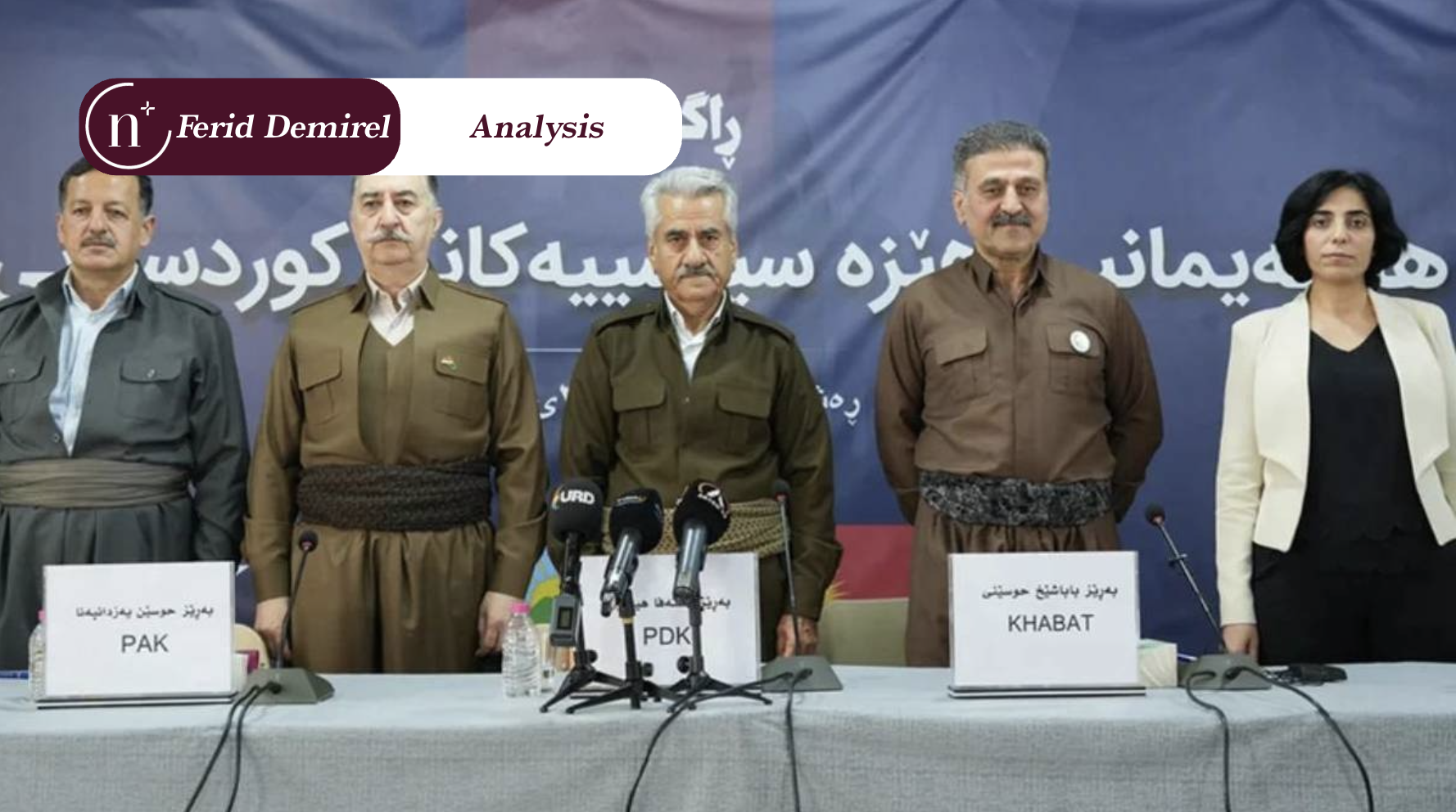
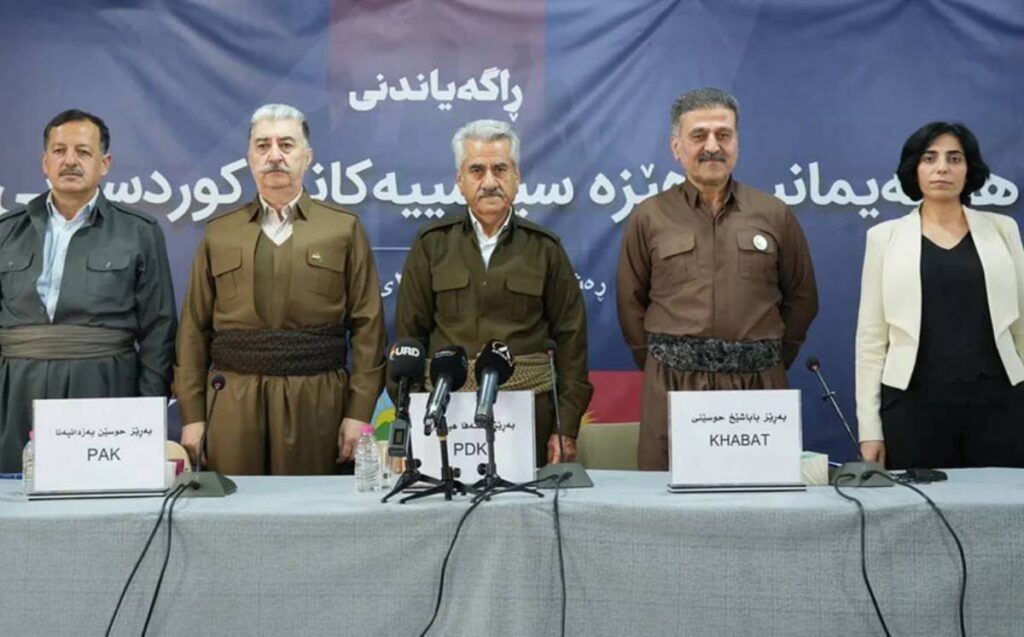
Yet Kurdish groups had already reached an agreement among themselves weeks earlier. The Coalition of Political Forces of Iranian Kurdistan — bringing together PJAK, IKDP, PAK, Komala and Xebat — was formed on February 22, thirteen days before Trump’s remarks. The coalition’s founding drew almost no attention from international mainstream media until Trump spoke. In March, the Komala Party joined, bringing the number of member organizations to six.
Once Trump’s statement focused international attention on the Kurds, coverage surged. Of more than fifty records analyzed, approximately seventy percent were published between March 1 and 8 — the first eight days of the war. Between March 9 and 22, independent Kurdish-focused coverage fell to single digits, with Foreign Policy’s March 17 analysis standing as a near-solitary exception.
The peak came between March 3 and 7. On March 3, CNN was the first to report — citing multiple anonymous sources — that the CIA was working to arm Kurdish forces. That same day, the Wall Street Journal noted that Trump was open to supporting armed militias, with Kurdish forces along the Iran-Iraq border described as holding significant military capacity. Reuters reported, citing three sources, that Iranian Kurdish militias were in discussions with the US about how and where to strike Iranian security forces. On March 5, Bloomberg reported that Israel was working to open the way for Kurdish forces to take positions in northwest Iran, citing a senior Israeli military official. Al Jazeera published a detailed explainer: “Which Kurdish groups is the US rallying to fight Iran?” On March 7, Chatham House published its analysis: “Kurdish groups in Iran face a risky dilemma amid an unclear US endgame.” The Kurdish-focused content published across those five days exceeded the combined total of the two preceding weeks and the two that followed.
Daily news intensity — Iranian Kurds
Feb 28 – Mar 22, 2026 · Estimated distribution based on dataset
Then, on March 7–8, Trump reversed course. Asked about the possibility of Kurds establishing a new autonomous region in Iran and whether they would join the war, he said: “We’re very friendly with the Kurds, but we don’t want to make the war any more complex than it already is. I’ve decided I don’t want the Kurds going in.”
The conditions Kurdish groups themselves had put forward were central to this outcome. According to Axios, one Kurdish opposition official stated: “We cannot move until the skies above us are clear” — a demand for an arrangement comparable to the no-fly zone that enabled Kurdish autonomy in Iraq after 1991. CNN reported that Kurdish groups also sought political guarantees from the Trump administration before committing to action. Komala Secretary-General Abdullah Mohtadi summarized these conditions to Die Zeit: “We will not send our forces to the slaughterhouse.”
On March 4, Kurdish groups issued a joint denial directly contradicting media reports of a ground offensive. PAK stated: “Claims that our forces have crossed into Rojhilat are baseless. We categorically deny these reports — no such movement took place.” PJAK, PDKI and Komala issued similar statements the same day. The coalition’s first joint communiqué, released on March 2, was not a declaration of military action but a political appeal to Iranian armed forces in Kurdish regions: “Separate yourselves from the remnants of the Islamic Republic.” PDKI President Hijri had stated on March 1: “We will continue our struggle until free and democratic elections are held.” The Kurdistan Regional Government’s Interior Ministry also announced that its territory would not be used as a base for operations against neighboring countries. Trump’s reversal on March 7–8 confirmed that the conditions Kurdish groups had set would not be met.
Independence referendum and Rojava: a comparative frame
Two earlier turning points offer context for understanding Kurdish visibility in international media.
Three periods compared
How Kurds appeared in international media — 2017, January 2026, February–March 2026
| Criterion | 2017 Referendum | Jan 2026 Rojava | Feb–Mar 2026 |
|---|---|---|---|
| Visibility level | High | Low | Very high |
| Trigger | Kurdish political demand | Kurdish civilian tragedy | Inclusion in great-power plans |
| Dominant frame | Great-power opposition | Humanitarian crisis | Strategic instrument |
| Subject position | Political actor (shadowed) | Victim | Object / instrument |
| Kurdish voice weight | Limited | Very limited | Limited but increased |
| Civilian dimension | Partly present | Relatively present | Almost absent |
In 2017, the Kurdistan independence referendum drew extensive international coverage — but structured around the near-unanimous opposition of major powers (the US, Russia, the UK, Turkey, Iran) rather than around Kurdish political demands. An academic study published in the British Journal of Middle Eastern Studies documented that in Egyptian online media, the referendum was framed as “a Zionist plan directed by the US and Israel to redraw the region.” That framing was the dominant pattern across regional Arab media in 2017. By 2026, the dynamic had inverted: Israeli support was no longer presented as a threat but as an operational reality — yet Kurds remained objects of great-power planning rather than subjects of their own story.
In January 2026, the Syrian Transitional Government’s attacks on Kurdish neighborhoods in Aleppo — dozens killed, hospitals struck, tens of thousands displaced — drew comparatively limited international coverage. The gap in intensity and framing between that period and February–March 2026 is stark. What it reveals is a pattern: international media interest is triggered not by violence against Kurds, but by Kurdish inclusion in great-power plans.
The comparative picture across three periods: In 2017, Kurds were covered as political actors — but in the shadow of international opposition. In January 2026, as a humanitarian crisis — but with limited attention. In February–March 2026, as a strategic instrument — and with great intensity. Visibility and subject position took different forms in each period.
Coverage by outlet
US media formed the dominant block. CNN produced at least seven separate Kurdish-focused pieces, five of them concentrated between March 3 and 5. Axios published four reports. Reuters and AP each produced one critical exclusive. US media’s Kurdish coverage intensity outpaced the combined output of all other countries.
Israeli media — Haaretz, Times of Israel, Channel 12, i24NEWS, Ynet — formed the second largest block in both volume and substance, though with a markedly different editorial frame.
Coverage by outlet
Estimated Kurdish-focused report count and dominant editorial frame · Feb 28 – Mar 22, 2026
| Block | Outlets | Est. reports | Dominant frame |
|---|---|---|---|
| US | CNN, Axios, Reuters, Bloomberg, WSJ, AP, Fox News, CBS, PBS, WashPost | ~28 | Strategic instrument |
| Israel | Haaretz, Times of Israel, Channel 12, i24NEWS, Ynet | ~15 | Allied force |
| Arab (Eng.) | Al Jazeera Eng., Al Arabiya Eng. | ~6 | Historical betrayal |
| Europe | Die Zeit, InsideOver, BBC WS, France 24, Atlantico | ~5 | Mixed |
| Think tanks | Chatham House, CFR, Atlantic Council, Foreign Policy, FPIF, Soufan | ~8 | Analytical |
| Not reached | FT, Economist, Guardian, Le Monde, NHK, Dawn, SCMP, etc. | — | No access |
In European media, BBC Persian’s Jiyar Gol interview with PJAK leadership — conducted inside tunnels near the border — and BBC World Service’s interview with a PAK fighter were the standout pieces. Die Zeit published an interview with Komala Secretary-General Abdullah Mohtadi; the piece’s reach came largely through citations in Chatham House and Al Arabiya. InsideOver conducted the most direct leader interview on the European continent, speaking with PDKI President Hijri on March 8.
Arabic-language media in this analysis was represented only by Al Jazeera English and Al Arabiya English. The Arabic-language services of both outlets, along with Asharq Al-Awsat, Al-Quds Al-Arabi, Al-Araby Al-Jadeed, BBC Arabic, Sky News Arabia, and Gulf media, fell outside the scope of this study.
Who spoke, who was silenced
When all records in the dataset are coded by source type, approximately fifty percent relied on anonymous US or Israeli officials. CNN’s March 3 report cited “multiple people familiar with the plan”; Axios’s March 5 piece cited two separate US-Israeli officials; Reuters’s March 6 exclusive cited three anonymous sources.
Direct interviews with Kurdish leaders totaled nine over 22 days: Abdullah Mohtadi (CNN, IranWire, Die Zeit, Al Arabiya, Atlantico, Newsweek), PJAK Co-Chair Amir Karimi (CNN, Axios, AFP, Al Arabiya), PJAK Co-Chair Peyman Viyan (Channel 12), Khabat Secretary-General Babasheikh Hosseini (Al Jazeera), IKDP official Muhammed Azizi (Fox News), Komala Central Committee member Koosar Fattahi (CBS), PDKI President Mustafa Hijri (InsideOver, CSM). The distribution is telling: Mohtadi received the most direct coverage, while PJAK generated the most reporting — yet PJAK was most often reported through anonymous sources or US officials rather than its own leadership.
Iranian state media’s terminology passed into mainstream international coverage with almost no critical framing: “separatist terrorist forces.” In Al Jazeera’s March 5 report, Press TV’s characterization — “anti-Iran separatist forces” — and the IRGC statement carried by IRNA were presented side by side, directly and without contextual challenge.
Source breakdown: who spoke in the coverage?
Estimated distribution across all records · Feb 28 – Mar 22, 2026
Thematic focus
Five themes emerge from the dataset.
The US-Israel-Kurdish strategic relationship was the dominant theme, accounting for approximately forty percent of all records. This framing positioned Kurds as objects of the story: coverage focused not on what they were doing, but on what great powers intended to do with them.
Military capacity and ground offensive speculation formed the second major theme — fighter numbers, arms levels, border crossing preparations. The retracted March 4 ground offensive story was this theme’s most concrete and most problematic example.
Historical betrayal and distrust was the third theme, structuring Haaretz’s March 7 analysis, the Chatham House report, the Atlantic Council assessment and France 24’s “pawn” piece.
The predicament of Iraqi Kurds was the fourth theme — the tension between the KRG’s declared neutrality and Iran’s actual strikes.
Kurdish civilian experience and human rights was the most conspicuous absence. Hengaw’s warnings about civilian casualties, strikes in Kurdish cities, women’s organizing — the presence of HPJ received a line or two. HPJ Commander Roken Nereda had not spoken on record to any international outlet before AFP’s March 8 field report.
Disinformation: one story, five outlets
March 4 disinformation chain
The origin, spread and retraction of the “ground offensive launched” story
Initial claim
i24NEWS reported — without footage, citing an unnamed CPFIK official — that PJAK fighters were taking positions in the mountains south of Marivan.
i24NEWS · March 4, 2026
Rapid amplification
Axios and Fox News ran the same story almost simultaneously. Jerusalem Post also reported similar claims citing an unnamed source.
Axios · Fox News · Jerusalem Post · March 4, 2026
Contradictory confirmation
Channel 12 correspondent Barak Ravid first confirmed the report citing a US official, then walked it back the same day: “There are conflicting reports.”
Channel 12 / Barak Ravid · March 4, 2026
Joint denial
PAK, PJAK, PDKI and Komala issued a joint denial the same day. KRG official Aziz Ahmed stated: “Not a single Iraqi Kurd has crossed the border.”
PAK · PJAK · PDKI · Komala · KRG · March 4, 2026
Retraction
Axios and Fox News removed the stories. The retraction did not reach the speed or scale of the original report.
Axios · Fox News · March 4–5, 2026
Five outlets published or amplified the same unverified claim. Reliance on anonymous sources, the absence of direct verification from Kurdish political actors, and the lack of real-time fact-checking mechanisms were the structural causes of this chain.
March 4 stands as this period’s best-documented media failure. i24NEWS reported — without footage and citing an unnamed CPFIK official — that PJAK fighters were taking positions in the mountains south of Marivan. Axios and Fox News ran the same story almost simultaneously. Channel 12 correspondent Barak Ravid first confirmed it citing a US official, then walked it back the same day: “There are conflicting reports.” All Kurdish parties denied it. Five outlets published or amplified the same unverified claim; the retraction did not reach the speed or scale of the original.
Notes

This study was compiled and organized using data gathered by the Claude AI model.

The analysis focused on English-language content and English-language media outlets. This methodological limitation creates several important gaps.

Non-English-language media fell outside the scope of the study. How outlets such as Le Monde, Libération, Le Figaro, Corriere della Sera, El País, NHK, Dawn, South China Morning Post and The Hindu covered — or did not cover — Kurds during this period was not examined.

Arabic-language media was represented in this study only through Al Jazeera English and Al Arabiya English. The Arabic-language services of both outlets, along with Asharq Al-Awsat, Al-Quds Al-Arabi, Al-Araby Al-Jadeed, BBC Arabic, Sky News Arabia and Gulf media, fell outside the scope of this study.

English-language outlets behind paywalls — the Financial Times, The Economist, and certain Haaretz content — could not be fully accessed. For these outlets, the accurate description is "could not be reached," not "did not publish."