Lawyer İdil Arslanbaş, who is following the cases related to the “My Family Is Safe” operations, said that approximately 80 people are in custody across about 20 cases, and that indictments have not yet been prepared in most of them. Lawyer Ezgi Özkan, who is monitoring the cases in Mersin, noted that 22 people are in custody in the city and that prisons are not equipped to meet the needs of LGBTI+’s. According to the attorneys, appeals against the detentions have yielded almost no results.
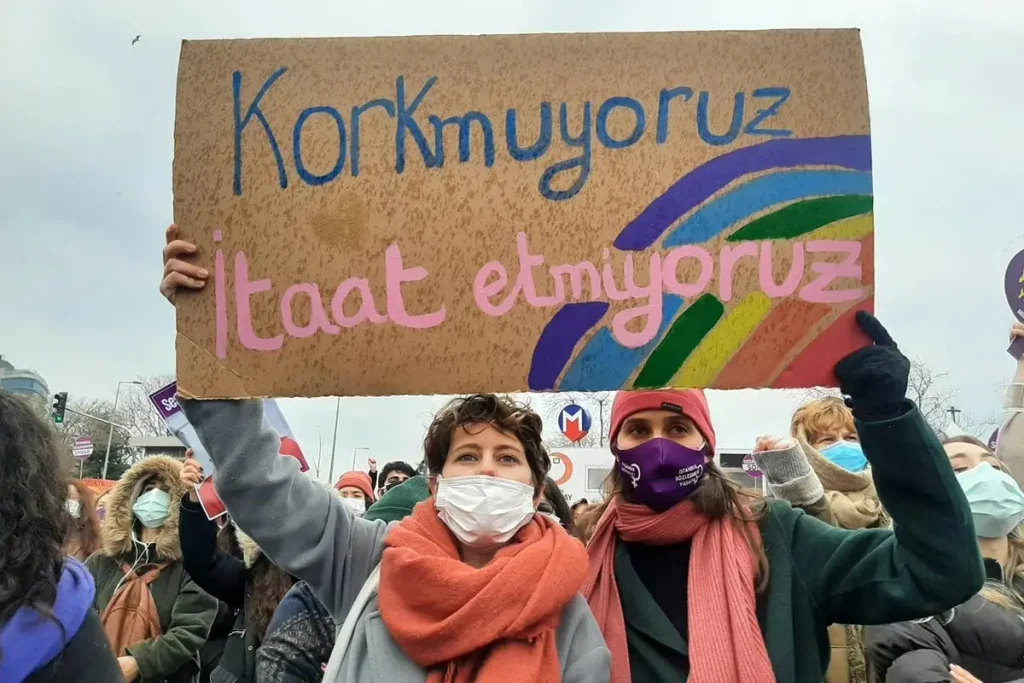
Photo: Eylem Nazlıer / Evrensel
“My Family Is Safe” operations, which began on September 12 with a police raid on Kaos GL in Ankara, continued in 15 provinces under the coordination of the chief prosecutors’ offices in Istanbul, Ankara, Izmir, Aydın, and Mersin. Minister of Justice Akın Gürlek announced that legal proceedings had been initiated against 162 individuals, nine associations, and 13 businesses as part of the operations. Among those detained were trans women, LGBTI+ association leaders, human rights defenders, and a journalist (Tuğba Tekerek).
The investigations are still ongoing. According to the latest information, the Istanbul Chief Public Prosecutor’s Office requested the dissolution of SPoD in its indictment dated November 2. The indictment against the HEVİ LGBTI+ Association also called for its dissolution. In the Kaos GL case, three more people were released on November 11. Lambdaistanbul’s office was also sealed on November 11. Five transgender women on trial in Ankara on obscenity charges were released at their first hearing on November 12; the next hearing is scheduled for December 28.
Two attorneys closely monitoring the cases spoke to Niha+ about the detentions, indictments, prison conditions, and requests to dissolve the associations. Attorney İdil Arslanbaş, one of the attorneys tracking the cases, described the nationwide situation, while Attorney Ezgi Özkan, who is following the case in Mersin, provided an update on the situation in that city.
Attorney İdil Arslanbaş
The number of detainees nationwide is approximately 80.
According to the cases Arslanbaş has been able to track, the distribution by city is as follows:
- In Istanbul, three are detained for being founders of the HEVİ LGBTİ+ Association, and 11 are detained in cases related to venues. A total of 14 people are in detention.
- A total of 15 people are in custody in Ankara. Five were arrested in connection with the Kaos GL case, and 10 were arrested during the second wave of raids.
- Twenty-four people were arrested in Izmir.
- Four people were arrested in Kuşadası.
- Özkan, who is following the case in Mersin, stated that as of today, the number of people in custody stands at 22.
Arslanbaş, describing the release decisions, said the following:
“Five transgender women who were detained on September 12 in Ankara and subsequently arrested were released at their first hearing. Three people were released on bail in the Kaos GL case. Two people were released at their first hearing in the SPoD case in Istanbul.”
Attorney Ezgi Özkan
Two separate cases in Mersin
Özkan said that Mersin has also been affected by the unlawful detentions and arrests carried out under the “My Family Is Safe” campaign. There are two separate investigation files in the city. One involves charges of “violation of the Associations Law” against members of the management and supervisory boards of Mersin 7 Renk and Muamma, while the other involves charges of “obscenity” and “facilitating prostitution” against trans women. According to Özkan, both cases criminalize the very existence of queer people and target the freedom of association.
Özkan, who stated that some of the 22 detainees were being held in Tarsus and others in different provinces, continued:
“In addition to these 22 individuals, six others were released at various stages. Eight others were under judicial supervision prior to their release. There were also suspects for whom no judicial supervision order was issued. The detainees are regularly visited by volunteer lawyers, and reports are compiled during these visits.”
No indictments for most detainees, appeals have been unsuccessful
Arslanbaş stated that there are nearly 20 cases in total, and indictments have not yet been prepared for most of them. Indictments have been prepared for SPoD, HEVİ, Lambdaistanbul, Pozitif Yaşam, Pozitif-iz, and LİSTAG. According to information provided by Arslanbaş, indictments have been prepared for three individuals in the HEVİ LGBTI+ case and the remaining five individuals in the Kaos GL case. However, indictments have not yet been prepared for the 11 people detained in the Istanbul venues case, the 10 people detained in the second wave of arrests in Ankara, the 24 people in Izmir, and the four people in Kuşadası.
Özkan reported that an indictment is expected in the case involving associations in Mersin, that indictments have been prepared for 22 people in another case, and that a date has been set for the first hearing.
According to the lawyers, appeals against the detentions are being filed, but there are very few cases where a favorable outcome has been achieved. Arslanbaş said that following an appeal, one person was released in Izmir and another in Mersin. Özkan also confirmed that in Mersin, a release order was issued for only one person following an appeal. Özkan noted that one detainee was released following a court order, while the others were released by the magistrate’s court based on the prosecutor’s assessment that judicial supervision was sufficient.
“There are no suitable cells for LGBTI+ prisoners”
According to Arslanbaş, problems persist for trans and LGBTI+ prisoners; for example, in many cities, there are no suitable cells for LGBTI+ prisoners. Arslanbaş explained that some of the detainees were sent to other cities, while others were transferred from one prison to another. According to their account, access to healthcare is an issue not only for LGBTI+ prisoners but for all prisoners:
“There have been instances where inmates had to submit dozens of petitions and wait a month just to see a doctor. As far as we’ve been able to track, issues with hormone therapy have been resolved, but I’m not fully aware of the entire process. There were significant difficulties in accessing medication. These problems were only overcome through lawyers’ prolonged and persistent efforts.”
Arslanbaş cited the example of a prisoner who had to wait two months to receive a pair of glasses.
Disciplinary investigations were opened against some prisoners, but no adverse outcomes resulted. Arslanbaş also noted that solitary confinement was being used; as far as they know, the number of people currently in solitary confinement is “either none or very few,” but they said that some prisoners had been held in solitary confinement for long periods. Arslanbaş stated that they had not heard of any bans on visits by lawyers or family members, nor of restrictions on books, but explained that there were also problems with letters. According to them, the number of letters that can be sent weekly is limited, and letters take months to reach their recipients.
Overcrowding in Mersin
Özkan noted that the information gathered during the reporting process is constantly being updated. According to the information shared by Özkan, it was determined that the cells at the Mersin Type E Prison were housing more inmates than their capacity allowed. Inmates living with HIV were placed in single cells and held in isolation. Problems were encountered during the initial distribution of clothing, money transfers, and canteen purchases.
Following their transfer to Tarsus Type T Prison, it was reported that the cells were more spacious. According to Özkan, access to medication and hormones is relatively good, though there have been complaints of interruptions. Holding trans inmates together makes them feel safe and allows them to build solidarity.
Arslanbaş, noting that conditions for LGBTI+ prisoners were already difficult before the operations, summarized the problems arising from the operations as follows:
“In facilities without designated cells for LGBTI+ prisoners, it was unclear where detainees would be placed, and individuals were transferred to different prisons. The increase in the number of people also made access to certain services more difficult.”
They added that as the issue has gained much more public attention, efforts by prison administrations and lawyers to highlight, address, and resolve these problems have increased.
Özkan, meanwhile, stated that the operation has deepened the crisis of fundamental human rights violations for a large number of LGBTI+s across the country.
Özkan, noting that most issues during the process from detention to arrest were resolved through LGBTI+ rights activists and volunteer lawyer solidarity networks, said this process revealed two things:
“Prisons are not equipped to meet the needs of LGBTI+s, and the state’s policies to prevent discrimination are not being implemented.”
Dissolution requests target six organizations, no requests to suspend operations
According to Arslanbaş, there are no requests to suspend operations in any of the cases, and dissolution requests have been filed by the prosecutor’s office only against six organizations in Istanbul:
“Four are LGBTI+ organizations, and two are positive living organizations. The courts have not yet ruled on these requests. No other associations besides these six are facing dissolution requests. Kaos GL is not one of them. Lambdaistanbul’s office, however, has been sealed.”
Arslanbaş noted that the criminal courts of first instance where the cases are being heard do not have the authority to rule on dissolution. He said that even if the prosecutor had made such a request in the indictment and the courts had accepted it, it is unclear how the process would proceed legally. Accordingly, it is also possible that the criminal courts of first instance could rule that they lack the authority to decide on this matter.
The justifications cited against the associations vary from case to case. According to Arslanbaş, however, the fundamental allegation remains the same: that the associations have been in violation of the law since their inception and were established in violation of the constitution and statutes. Arslanbaş noted that this approach criminalizes LGBTI+ activism, as if there were such a crime as “LGBT propaganda.”
In Mersin, according to information shared by Özkan, no closure case has yet been filed against Mersin 7 Renk and Muamma:
“Both associations had undergone periodic inspections prior to the operation, and there were no legal obstacles to their continuing their activities. Despite this, they were inspected once again during the investigation process. The documents requested during the inspection could not be obtained or submitted because the members of the authorized board were in custody.”
Özkan stated that even though no lawsuit seeking closure has been filed, it is very clear that gender identity and sexual orientation are being criminalized and that the freedom of association of LGBTI+s is being violated. Noting that many organizations working on LGBTI+ rights in all provinces where raids took place are at risk of being shut down, Özkan added that the ruling party’s “Year of the Family” policies and its definition of the “ideal family” which reinforces gender inequality, have played a major role in these developments. Özkan said that for this reason, it is essential to continue advocating for “human rights without ‘buts’” and justice for all.
What happened?
Pursuant to Decision No. 2026/9559 of the Istanbul 7th Criminal Court of Peace, on the night of September 12–13, access was blocked to the websites and social media accounts of numerous LGBTI+ organizations, media outlets, student groups, rights advocates, and activists. That same night, raids were carried out on associations, homes, and venues in 15 provinces, primarily in Istanbul, Ankara, Izmir, Mersin, and Kuşadası.
Pursuant to Decision No. 2026/9559 dated September 12, 2026, issued by the Istanbul 7th Criminal Court of Peace, the websites of the Kaos GL Association, the May 17 Association, and the ÜniKuir news site—as well as those of the Pembe Hayat Association, SPoD, the Young LGBT+ Association, Lambda, and the Muamma LGBT+ Association—as well as Velvele.net—had been blocked.
Justice Minister Akın Gürlek announced on his X account that legal proceedings had been initiated against 162 individuals, 9 associations, and 13 businesses as part of the operation. Gürlek added that these operations were carried out within the framework of the “Decade of Family and Population.”
During a police raid on the Kaos GL association and the homes of its members, both the alternate and regular members of the association’s supervisory board were taken into custody. Police also conducted a search of the association’s office and seized digital data and materials.
Two individuals, who were among the founders of SPoD, were arrested on September 16, 2026, as part of the operations. Subsequently, more than 80 people were arrested in several provinces.
The chronology of events during the operations is as follows: