
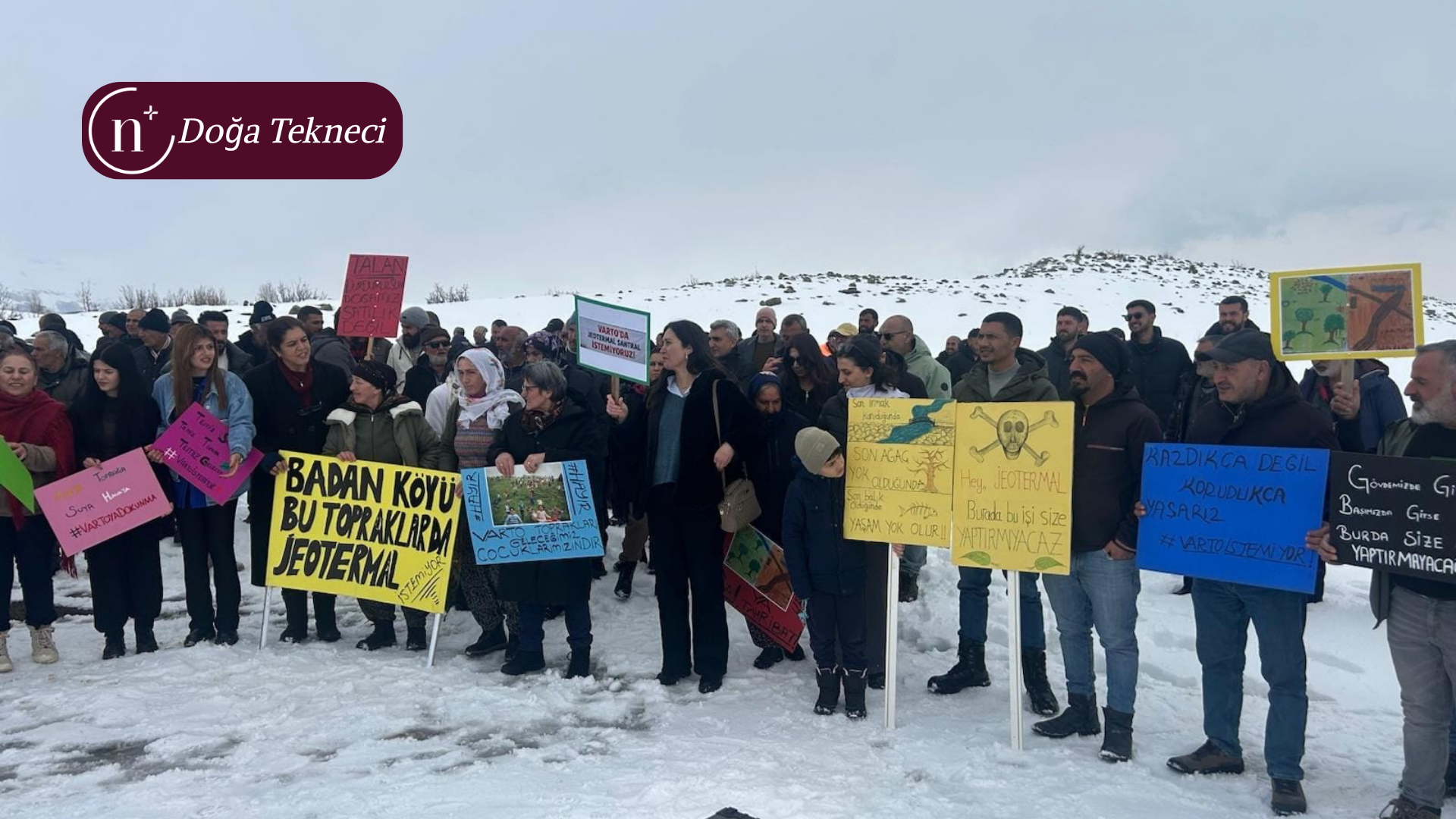
Local residents are protesting the geothermal power plant (GPP) project, which is set to be implemented in an area covering 16 villages and is planned to begin within the boundaries of the village of Xwarik (Çallıdere) in Varto.
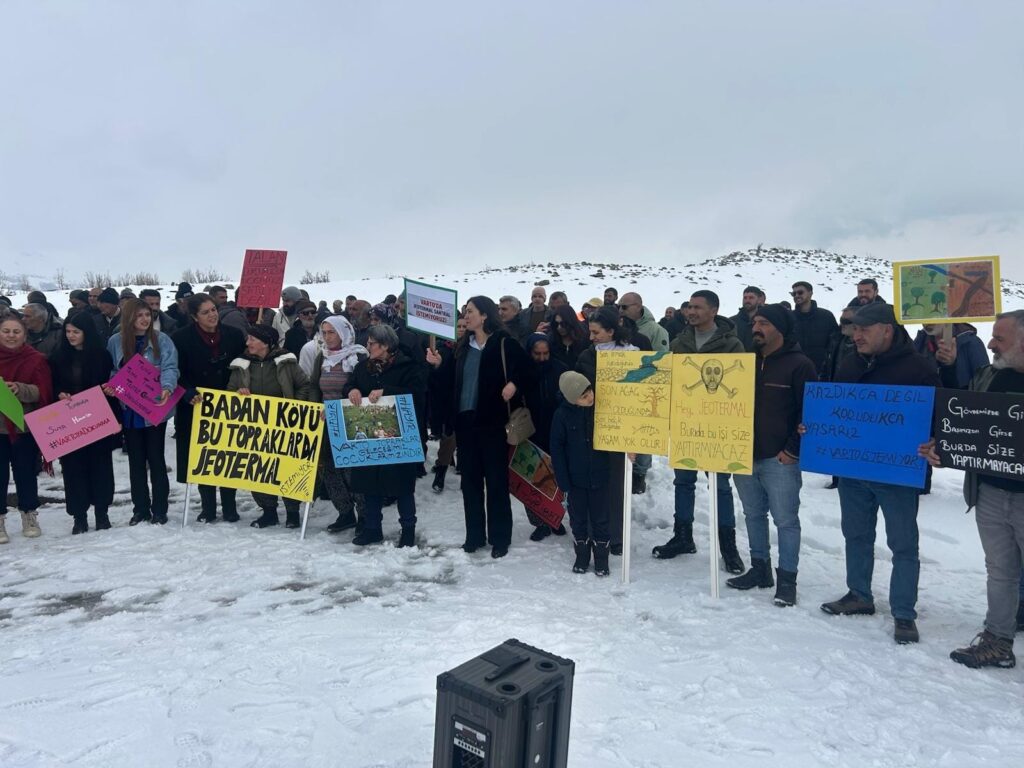
In recent weeks, the Provincial Pasture Commission of the Muş Governor’s Office approved a “drilling project as part of a geothermal resource exploration project” to be carried out by IGNIS H2 Energy Production Inc., which directly affects 16 Kurdish-Alevi villages in Varto (Gimgim). The villagers submitted a petition of objection to the relevant governor’s offices regarding this project. The petitions were rejected by the governor’s offices.
Although geothermal energy is a renewable and sustainable energy source, studies have shown that it causes significant ecological damage due to its environmental impacts. Power plants, which are mostly built in areas with villages and agricultural lands, leave the village communities facing the threat of forced displacement. In many provinces, local residents claim that geothermal power plants (GPP), as well as mines and other energy projects, are causing harm to agricultural and livestock activities, water sources, and living areas.
Local residents are voicing opposition to the GPP project, which will be implemented in an area covering 16 villages and will begin within the boundaries of the village of Xwarik (Çallıdere) in Varto.
Alev Yılmaz from the Varto Ecology Platform and Erdoğan Ödük, co-spokesperson for the Mesopotamia Ecology Movement, spoke to Niha+.
Alev Yılmaz from the Varto Ecology Platform stated that the geothermal power plant project threatens the villages, water sources, animals, and places of worship in the region, declaring, “We will not let Varto be taken over.”
IGNIS H2 Energy Production Inc.
IGNIS H2 Energy Production Inc., an American company that opened a branch in Yedisu, Bingöl in 2023 and operates in the Karlıova (Kanîreş) – Varto region; has obtained search licenses in the villages of Kızılağaç (Aynik), Kaynarpınar (Licik), Kantarkaya (Şorik), Ilıpınar (Çêrmûk), and Kargapazar (Qerxabazar), which are part of Karlıova in Bingöl.
The company states it aims to reach 1 GW of renewable energy capacity by 2030, and plans to conduct operations in the Varto-Karlıova region, where the North Anatolian Fault (KAF) and the East Anatolian Fault (DAF) intersect. Currently, the company aims to begin drilling 10 wells in Varto and Güzelkent, and the work it will carry out within an area of 453,494.83 square meters will cover approximately one-third of Varto.
“Who is this Ignis?”
Yılmaz, who has spoken against the projects of a company called Ignis seeking to operate in Varto, stated that they do not believe the company’s claims of “development”:
“Varto has been handed over to profit-seekers. There’s this company called IGNIS—we can barely even bring ourselves to say its name. What is Ignis? Who are they? Where do they come from? Why are they coming? Is IGNIS just saying, ‘I have nothing better to do, so I’ll go develop this distant, poor town of Varto’? Do you think something like that is possible?”
Yılmaz, noting that nothing the people do not want can be in the public interest, explained how the process began by pointing out that no details regarding the project had been shared with the public:
“IGNIS coming here isn’t new but we’re only hearing about it now. That’s the problem here. No one in the village knows anything about it. It’s a very high-handed situation on our land. These are our living spaces, our livelihoods, but the governor and the district governor are making the decisions. Even the current village head hasn’t been told anything to the people. They’ve spoken with the municipality. It’s claimed that very different things were told to the municipality.”
Yılmaz claimed that company representatives had held meetings with local representatives regarding the project, but the actual plans were being kept secret from the public.
“There is someone working for Ignis. They are meeting with the local bureaucrats, the governor, the district governor and the municipality. There is absolutely no mention of a geothermal power plant. They don’t say ‘We’re going to open up your 16 villages, settlements, and center of faith for profit.’ They say there’s hot water, and we’ll identify it. We’ll build thermal hotels, thermal pools and greenhouses. They say the villagers’ heating needs will be met here.”
“It’s impossible for this hot water to heat us.”
Yılmaz said that the company had made various promises to convince the local people but that they did not believe them:
“We won’t die if we don’t eat tomatoes all winter. They say they’ll heat our homes, but definitely we don’t want that either. We’ll heat ourselves with dung. Besides, we get 2.5 to 3 meters of snow here. There’s no way the hot water they’ll send through those pipes can keep us warm.”
They’ve already destroyed Goşkar Baba
Noting that the planned GPP project isn’t just about building a plant, Alev Yılmaz drew attention to the destruction that has already taken place:
“First, they came to us with the hydroelectric power plant. They plundered Goşkar Baba. They shattered the Goşkar villages and our mountains. They trapped our waters. Now they say they’ll build a geothermal power plant. They use fancy words, but we know it won’t be like that. We’re talking about 16 villages and their hamlets. Within these villages we have places of worship, our sacred sites—everything we hold dear. It’s certainly not limited to just 16 villages. We also know they’re after other mines, not just geothermal ones. Right now, who knows how many projects they have in the works that we’re not even aware of. No one is giving us any real information about this.”
Earthquake-prone region
Yılmaz, who reported that drilling is planned to reach a depth of 2500 meters, emphasized that Varto is an earthquake-prone region and that scientists’ warnings must be taken seriously. Yılmaz also reported that given the area’s status as an earthquake zone, a scientist had told them, “Don’t allow something like this.”
“They will destroy endemic species”
Alev Yılmaz, who stated that three drilling wells are planned to be opened in the village Bağdan, noted that this would disrupt the ecological balance in the region:
“When you go 3 km underground, the earth’s soil and mud will come out. There are substances in this mud. These will harm nature. When we ask, ‘What will you do with these?’ they say they’ll award the contract to local authorities. But the local authorities you’re talking about can’t even provide a shovel when we have a funeral. You’ll take them and dump them in Mengel River. There are red-spotted trout, an endemic species, in the Mengel River. You’ll kill them. You’ll disrupt the ecological balance. Here we have lynxes and chukar partridge. They live freely. We don’t touch them. Because all of these are entrusted to us by Hızır.”
In the Alevi faith, Hızır is regarded as an immortal wisdom figure who helps those in distress and those in need, provides relief from suffering, and symbolizes abundance and prosperity. Typically, during the second week of February, a three-day fast (Tuesday–Thursday) is held, rituals are performed, and lokma (kavut) is shared as a prayer for Hızır’s companionship and assistance.
“I want all the women to stand by my side”
Reminding everyone that the Çepanik Plateau, Gundêmîra, Dadina, and İnalı—all part of Varto—have been devastated by mining operations, Yılmaz stated her opposition to the company’s claims that “we will make you rich.”
Yılmaz concluded her remarks by stating that Varto’s ecology and cultural values must be protected:
“I’m afraid of snakes. I want to be afraid of snakes every day. I don’t want the bears to leave here. I want all women to stand by me as I continue this struggle. I want everyone to hear our voices. When they cut down Goşkar Baba, Grêboxa, Şehîdê Qawax, and Şehîdê Ciran, we’ll have nothing left. Let’s not abandon Varto. This is our village, our homes. If we withdraw our hands from Varto, Hızır will leave us too.”
Ödük: Projects will affect a wide geographical area
Erdoğan Ödük, Co-Spokesperson of the Mesopotamia Ecology Movement, stated that the Muş Ecology Platform has been established, noting that it was formed through the merger of organizations active in the region, such as the Varto Ecology Platform and the Goşkar Ecology Association.
Ödük expressed that the planned projects will affect not only Varto but a wide geographical area:
“Ultimately, this issue is not just Varto’s problem; it is a regional problem. There is currently a situation in the region where a geothermal energy field stretching from Varto to Karlıova and Bingöl Yedisu is being handed over. Last year, we also organized a large-scale protest there, in the Peri Valley.”
Eco-genocide policies have been implemented in the Goşkar Valley for a long time
Ödük emphasized that the eco-genocide policies that have been ongoing for a long time in Muş and the Kurdish regions are not only capital-oriented policies.
“For a long time, it has been claimed that eco-genocide has occurred in this region of Kurdistan during the war, yet even now, both domestic and foreign capital continue to commit eco-genocide in various forms across different areas. This is currently the situation in Varto, Muş. The region has already faced severe ecological destruction due to the Alparslan 1 and 2 dam projects in previous phases. Numerous villages were evacuated. Historical archaeological sites were submerged. Following that, there is another hydroelectric power plant (HES) project in the Goşkar Valley, carried out by Çağlar Elektrik in 2002.”
“Ecological destruction is also triggering migration”
Ödük noted that the exploitation in the Goşkar Valley affects not only nature but also social life, and continued:
“The last remaining water in the region is a spring called Ava Spî. Since the people there follow the Alevi faith, this situation is actually triggering migration in the region. These issues are not merely about ecological destruction; they also bring social problems in their wake.”
Companies are trying to break the resistance
“They told the villagers that a permit would be obtained, but they said it might happen or it might not. These are statements intended to break the resistance. However, it is not possible for an American company to come here, conduct no research, hand over 4 million dollars—which is the minimum cost of drilling—and then just open the well and leave.”
Success will be achieved if the area of resistance is expanded
Explaining that this is not merely a local issue, Ödük outlined the regional solidarity efforts they will carry out together with the people. Noting that village meetings and awareness-raising activities are ongoing in Varto, Ödük said they have also held meetings with members of parliament.
Unity of action in Varto
Emphasizing that the people’s role is decisive in the ecological struggle, Ödük highlighted that the plundering policies implemented in Kurdish provinces are based on more cultural and social factors compared to those in the West.
“The forests of the Black Sea are our too. The forests of India are our forests. But the difference is this: The current situation in the West revolves around a capital-centered dynamic. Here, the issue is not just capital. We saw this clearly with the Alpaslan 1-2 dams. We saw it with the dam planned for the Nerbüş River in Cizre. We saw it in the villages displaced as part of the GAP project. We saw it in the massive Ilısu Dam, in the destruction of Hasankeyf, and in the erasure of cultural memory. This situation is not merely a problem for the peoples living in Kurdistan.”,
Ödük stated that international and local environmental organizations must pay greater attention to the ecological destruction in Kurdish regions.
“We’ve managed to raise our voices for both the forests of the Black Sea region and the Kaz Mountains. Our friends are also working there to protest against the pesticides used in the Çukurova region. This nature is our shared living space. Once it’s gone, neither ideological divisions nor ethnic origins nor cultural distinctions will remain. Therefore, ecology organizations in the West must also approach Kurdistan in this way. In other words, when this place is gone, when it is devastated, they too will suffer the consequences.”
Varto Ecology Platform made press statement
Varto Ecology Platform issued a press statement on March 7, and DEM Party parlamenterian Sümeyye Boz Çakı also expressed her support for the platform members.