
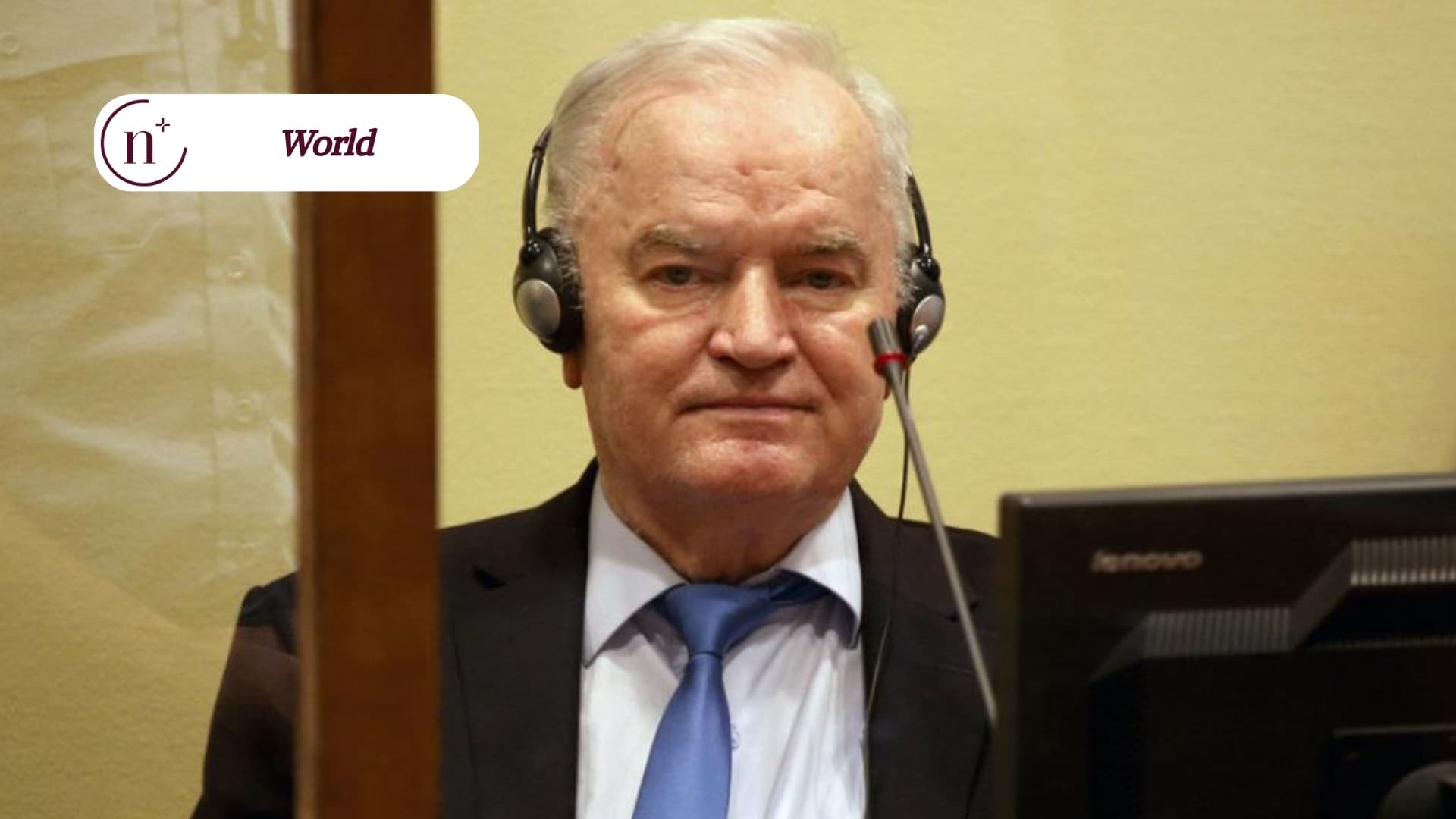
Reactions poured in from many sides following the death of Ratko Mladić, convicted of war crimes committed during the Bosnian War. Serbia’s justice minister said the convicted general would be buried “with the highest state honours.”
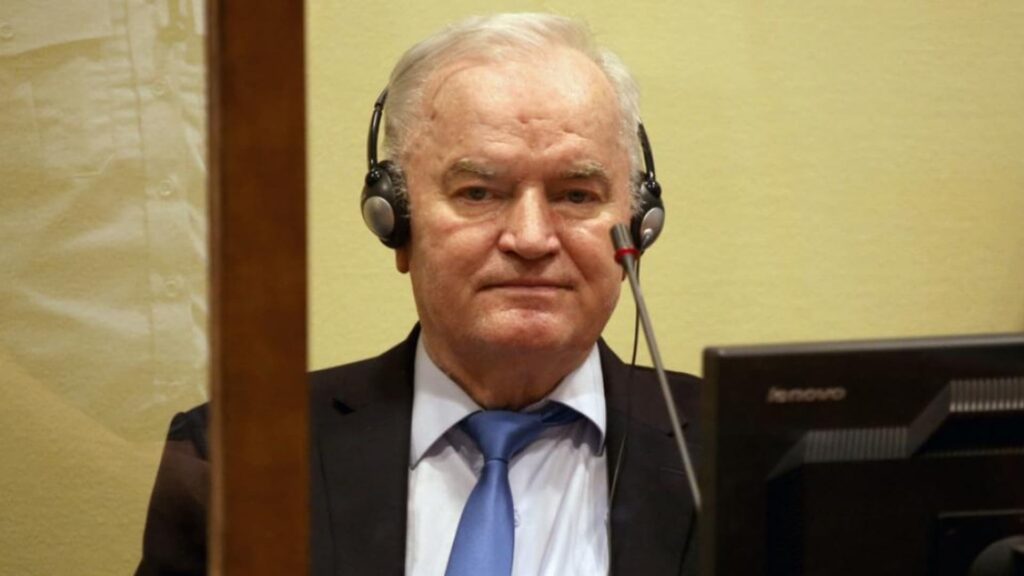
Ratko Mladić, the Bosnian Serb general found responsible for crimes committed during the Bosnian War amid the breakup of Yugoslavia, died on August 27 (yesterday) at the age of 84. Since 2024 he had been held under United Nations (UN) custody in a hospital in The Hague, in the Netherlands.
In 2017 Mladić was found guilty of war crimes and the Srebrenica genocide and sentenced to life in prison by the International Residual Mechanism for Criminal Tribunals (IRMCT), the successor to the International Criminal Tribunal for the former Yugoslavia (ICTY). The sentence was upheld on appeal in 2021.
According to the Serbian press, about a week before Mladić’s death, Serbian President Aleksandar Vučić had asked the Hague court to let Mladić spend his final days in Serbia, citing his deteriorating health, but the request was denied.
News of Mladić’s death was first confirmed late yesterday afternoon by Lidija Pavićević, State Secretary of Serbia’s Ministry of Human and Minority Rights.
Reactions came from many different sides.
Suljagić: His death does not turn a criminal into a historical figure
Part of the statement by Emir Suljagić, head of the Srebrenica Memorial Center, posted on his X account, reads as follows:
Ratko Mladić is dead, and there is not much to say. Nor does that fact change much. It does not bring back the dead. It does not erase mass graves. It does not change verdicts. It does not turn a criminal into a historical figure.
Izetbegović: Mladić will go down in history as a war criminal
Bakir Izetbegović, son of Bosnia and Herzegovina’s first president Alija Izetbegović and chairman of the right-wing Party of Democratic Action (SDA), said on his X account that Mladić would be remembered by history exactly as the final judgment of the Hague tribunal defined him: as a war criminal sentenced to life imprisonment for the gravest crimes committed on European soil since the Second World War.
Hotić: He died in disgrace
Kada Hotić, 82, whose husband and son were killed by Serb forces in 1995, said: “I am grateful to the Tribunal because it sentenced Mladić to life and has not released him. Justice was served on the day he was sentenced to life. He died in disgrace, because he killed so many people.”
Bosnia and Herzegovina’s Justice Minister Zukan Helez, in a statement on his Facebook account, described Mladić as a convicted perpetrator of genocide and one of the most notorious war criminals Europe has seen since the Second World War.
Helez said that death brings no absolution, that mass graves will not be erased, that murdered children and parents will not return, and that all that remains is shame, the verdict, and the bloody trace of the crimes.
Justice minister: He will be buried with the highest state honours
Serbia’s Justice Minister Nenad Vujić announced that Mladić would be buried in Serbia, at a place to be determined by his family, “with the highest state honours”:
“General Mladić is a general and the protocols are known. His role is also known, but whatever belongs to General Mladić will certainly be honoured.”
However, despite the justice minister’s claim, it remains unclear whether a “state funeral” can legally be held for Mladić, who died while serving a life sentence and who, under the law, should have been discharged from military service and stripped of his rank because Article 110 (1/11) of Serbia’s Army Act provides that “unconditional imprisonment of more than one year results, on the day the judgment becomes final, in the termination of service,” and Article 185 (1/3) provides that “the same sentence results, on the day it becomes final, in the loss of rank; along with the rank, all rights tied to the rank are also lost.”
You can access the Serbian Army Act, published in the Official Gazette of the Republic of Serbia under No. 116/2007 and last amended by No. 109/2025 of 4 December 2025, here.
Aleksandar Šapić, mayor of Belgrade and a member of the Serbian Progressive Party (SNS) led by President Vučić, shared a photo of Mladić on his personal Instagram account with the caption “Rest in peace, general. May you have eternal glory and gratitude.”
In a statement on 28 August, President Vučić said, “We have received nothing from The Hague.”
Saying that “they had now seen that The Hague wanted Mladić to die behind bars,” Vučić added, “They did not allow the general to die in Serbia, where he wanted to die. That is uncivilised behaviour, without precedent or justification,” thereby also confirming the Serbian press reports that there had been an intention to bring Mladić to Serbia.
Vučić further stated that Serbian authorities would help arrange a dignified burial for Mladić in Serbia if his family requested it. However, he made no comment on the justice minister’s claim that Mladić would be buried “with the highest state honours.”
In addition, the President of Montenegro’s parliament, Andrija Mandić, posted on his official X account that he had conveyed his condolences to Mladić’s son.
Commemorated at football matches
At the match yesterday at 8:00 p.m. in which Serbia’s Red Star football club (FK Crvena Zvezda) lost 5-1 away to Czechia’s Viktoria Plzeň in the second leg of the UEFA Europa League play-off round, a banner reading “General, eternal glory and gratitude” in tribute to Mladić was unfurled by Red Star’s supporters’ group Delije and shared from the club’s official X account.
Željko Ražnatović, known as Arkan, the mafia and terrace leader who founded the Delije supporters’ group, was also one of the influential figures of the era of Yugoslavia’s breakup and the Bosnian War. Arkan, who also headed the Serb paramilitary force known as the Serb Volunteer Guards or “Arkan’s Tigers,” was indicted by the ICTY for crimes against humanity after the war. He was assassinated in January 2000.
Before the match yesterday at 9:30 p.m. in which Borac, the football club from Banja Luka, the capital of Republika Srpska (one of Bosnia and Herzegovina’s two entities), beat Iceland’s representative Vikingur 3-1 in the second leg of the UEFA Conference League play-off, applause rose from the stands when it was announced in the stadium that Mladić had died. A song praising Mladić was also sung, and a banner was unfurled reading “The earthly is a small kingdom; the heavenly is forever and ever. Eternal glory to the greatest defender of the Serbian people.*”
* The words on the banner draw on the defeat of the Serbian kingdom at the First Battle of Kosovo in 1389. According to legend, on the night before the battle, Serbian Prince Lazar was visited in a dream by an angel of God and asked to choose between an earthly kingdom and a heavenly one. Lazar, who chose the heavenly kingdom, lost the battle and died on the battlefield.
According to an 28 August report by The Athletic, the sports section of The New York Times, UEFA announced that it had opened disciplinary proceedings against Red Star on three separate counts. These counts include “racist and/or discriminatory behaviour”, “transmitting a message that is not fit for a sports event” and “improper conduct of the team.”
Following the match, the Srebrenica Memorial Center had contacted UEFA to state that the banners that were unfurled “cannot be reduced to the behaviour of fans.”
The statement of the Srebrenica Memorial Center includes the following:
“A club that consciously uses its official communication channels to spread messages glorifying a man legally convicted of genocide cannot reduce such behavior to the behavior of fans.
This is no longer just a question of the fans, but of the club’s institutional relationship to the values on which UEFA bases European football.”
UN Secretary-General: I stand in solidarity with the victims
UN Secretary-General António Guterres, in a statement through his spokesperson Stéphane Dujarric, said he stands in solidarity with the victims, survivors and their families who suffered the crimes for which Mr. Mladić was found guilty.
Stating that the facts conclusively established by the judicial findings form part of the historical record, Guterres reiterated his call on all those in positions of power to refrain from denying the seriousness of the crimes that have been adjudicated.
Guterres also said he strongly condemns any denial of the Srebrenica genocide as a historical event, and any actions that glorify those convicted of war crimes, crimes against humanity and genocide by international courts.
Dodik: This is a murder
Milorad Dodik, chairman of Republika Srpska’s Alliance of Independent Social Democrats (SNSD), former president of Republika Srpska, one of the leading figures of Serb nationalism in Bosnia and Herzegovina, and currently banned from politics, said of Mladić’s death: “It is a murder. He was respected by the Serbian people. As a commander he stood to defend Serbs.”
Šešelj: Mladić fought against villains
The far-right convicted war criminal Vojislav Šešelj* said of Mladić: “Mladić fought against those villains for a long time; they expected his death two or three years ago, but he did not give up… They killed him.”
* Vojislav Šešelj is the founder of the far-right Serbian Radical Party (SRS). Indicted by the ICTY in January 2003 over war crimes and crimes against humanity committed in Croatia and Bosnia and Herzegovina during the breakup of Yugoslavia, Šešelj went to The Hague and surrendered in February 2003 after a judge confirmed the charges. He remained in ICTY custody for 11 years and 9 months. In 2014 he was allowed to return to Serbia for cancer treatment. Later also a member of parliament, Šešelj was acquitted in 2016, but the acquittal was overturned on appeal in 2018. Šešelj, however, did not return to prison.
Russia: Mladić’s right to health was violated
Russia’s Ministry of Foreign Affairs made a statement via Facebook, and the Russian Embassy in Belgrade via its X account, regarding Mladić’s death.
The Russian Foreign Ministry said: “The Russian side has consistently pointed out that Mladić’s trial in The Hague and the conditions of his imprisonment were accompanied by disregard for his basic rights, including the right to health and adequate medical care.” The Russian Embassy in Belgrade, for its part, offered “Its sincere condolences to Mladić’s family and loved ones on the passing of General Ratko Mladić.”
Who was Ratko Mladić?
Ratko Mladić was born in 1942 in the village of Božanovići in Bosnia and Herzegovina and rose to the rank of general in the Yugoslav People’s Army. With the outbreak of the Bosnian War, he became the commander-in-chief of the newly formed Bosnian Serb army (Vojska Republike Srpske-VRS). He was among the most senior military figures responsible for the army’s actions, including the nearly four-year siege of Sarajevo and the genocide at Srebrenica. After the war he spent years in hiding as a fugitive and was captured only in May 2011 in Serbia, then handed over to The Hague.
In 2017, Mladić was found guilty by the ICTY of the Srebrenica genocide, crimes against humanity, and violations of the laws of war, and sentenced to life imprisonment. The sentence was upheld on appeal in 2021. While serving his sentence, Mladić died on 27 August 2026 in a hospital under UN custody in The Hague, following long-standing health problems.