

Poets Deniz Erkaradağ and Ceren Avşar discussed how queer identity intersects with poetry, the imagery in queer poetry, how the Turkish language creates space for this kind of writing, and the censorship practices they encountered in publishing.

“[…] poetry is not a luxury. It is a vital necessity of our existence. It forms the quality of the light within which we predicate our hopes and dreams toward survival and change, first made into language, then into idea, then into more tangible action.“
-Audre Lorde
As Black lesbian feminist poet Audre Lorde reminds us, poetry is a way of “naming the nameless.” Queer poetry, in this respect, takes on an additional unique burden: to describe an “invisible” experience in a world constructed by the language in which it seeks to exist, while simultaneously challenging the normative boundaries of that language.
The roots of queer poetry in Turkey go back further than commonly believed. From the veiled themes of male desire explored in Divan literature, to Enderunlu Fazıl’s “Defter-i Aşk” (Book of Love) which was confiscated centuries ago, to the poems of Arkadaş Z. Özger, and to the often invisible framework that has grown around organizations like Kaos GL and Lambdaistanbul today, queer poetry has been almost entirely absent from the “mainstream” part of literary history and has had to be gathered from archives, oral history, or independent sources.
Speaking to Niha+, poets Ceren Avşar and Deniz Erkaradağ stated that poetry is not a theme or a subject, but rather a space where language is re-constructed, a space of images and perspectives. Avşar and Erkaradağ discussed both the unexpected freedoms inherent in the genderless nature of the Turkish language and the reality of censorship that still persists at the levels of publishing, distribution, and public visibility.
“Queer poetry is also political”
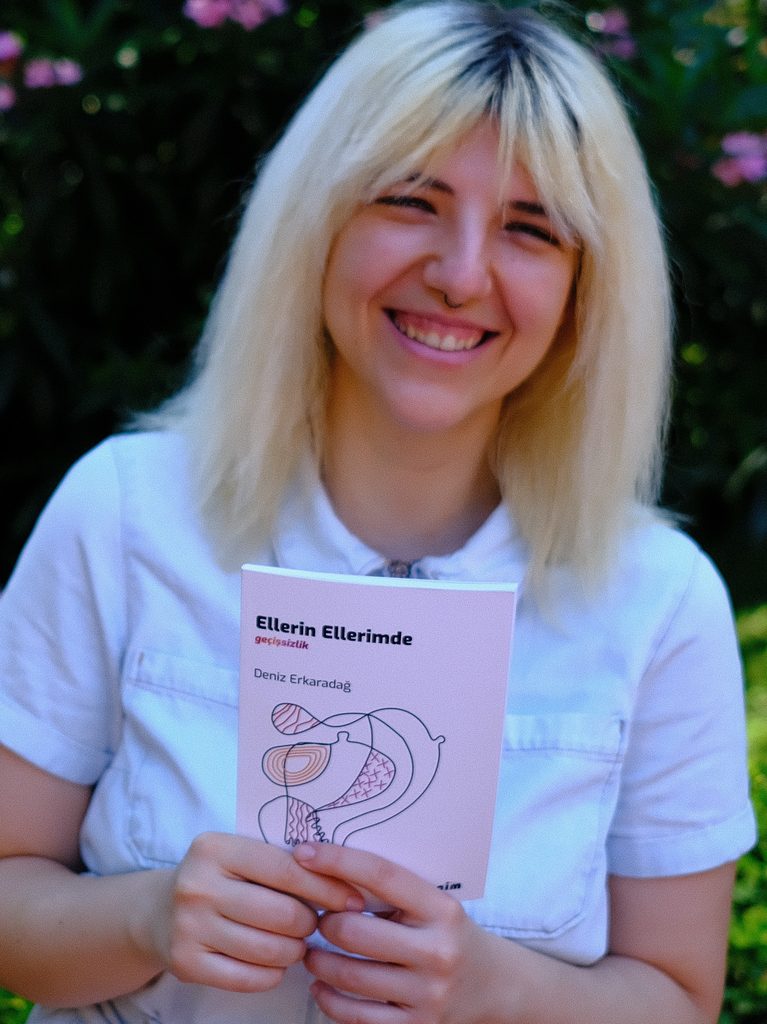
Deniz Erkaradağ
In Turkey, the category of “political poetry” has long excluded LGBTQ+ identities. Poet Deniz Erkaradağ explained this situation by saying, “There is a field called political poetry, and this field does not include LGBTQ+ identities in any way. When you talk about queer poetry, you encounter something like ‘that’s bourgeois poetry, it’s not political anyway.'” Stating that this distinction does not reflect the truth, Erkaradağ emphasized that both her poetry and queer poetry are political, saying, “My poetry is definitely political, and queer poetry is also political. It’s impossible for me not to reflect this in my writing.”
Ceren Avşar, speaking from a similar perspective, argues that for her, queer identity is not a theme added later to poetry, but a constitutive space at the center of her existence and, consequently, her language. Bringing Judith Butler’s idea of performativity from Gender Trouble to poetry, Avşar explains that language itself is given through the language of power and norms, and that she re-bends, distorts, and reconstructs this while writing. Referring to Michel Foucault’s History of Sexuality, she defines writing poetry as a practice of “counter-discourse” against the discourse produced by power.
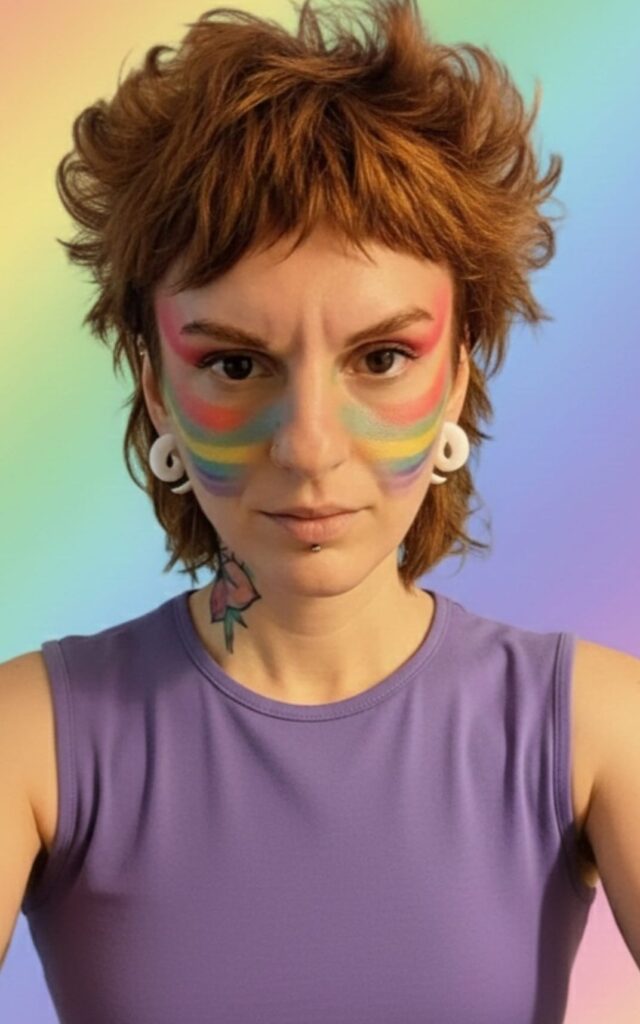
Ceren Avşar
Writing in a language without gender
Erkaradağ, interpreting the contributions of Turkish to poetry from a gender perspective, stated that she does not find Turkish “poor” in this regard and that it does not experience a language barrier in terms of identity or gender expression. Erkaradağ also emphasized that some theoretical concepts in academia (for example, “queer” or “gender”) may be controversial.
According to Avşar, who stated that the absence of masculine or feminine suffixes in Turkish opens up a space of freedom in the context of gender and queer existence, Turkish is a direct “opportunity” in this sense. She explained that in many languages, the subject is confined to a binary gender regime from the very first step, while Turkish offers “a neutral playground where ambiguity and fluidity prevail.”
Avşar also relates this to her own experience with dyslexia:
“As someone living with dyslexia, learning another language, penetrating its structure, and being able to write in it is extremely difficult, even impossible, for me. Therefore, the production, the refuge, and the entire universe of expression have become, in a way, necessary to be drawn to a single center: Turkish. However, this situation has transformed my connection with Turkish into an extremely deep and layered relationship. My inability to find resonance in other languages has led me to delve deeper into the veins, flexibilities, and hidden spaces of this single language I can master.
The genderless nature of Turkish makes it easier for me to transcend the sexist boundaries of power and norms within this monolingual universe. I may be limited by the boundaries of a specific language; however, thanks to the timeless and genderless flexibility offered by Turkish, I can create an infinite world of imagery within those boundaries.”
“Queer poetry exists to disrupt mainstream showcases”
Erkaradağ, evaluating the censorship mechanisms targeting queer poetry, stated that they don’t write queer poetry invisibly, saying, “It’s so obvious that it’s being banned.” Erkaradağ also claimed that Kitapyurdu has deliberately started excluding queer books from its catalog, and that they can’t get into chains like D&R.
Therefore, she said, relying on independent publications and digital or independent distribution networks has become a necessity for queer poetry. “There’s a big difference between a bookstore receiving hundreds of copies of a book and boutique publishing houses trying to sell them individually,” she added.
Erkaradağ’s account isn’t just about one experience; there are hundreds of similar examples. The Turkish Publishers Association, PEN Turkey, and the Turkish Writers’ Union have repeatedly issued joint condemnations against the “obscene publications” mechanism, which operates under the Ministry of Family and Social Services and is used by the Board for the Protection of Minors from Obscene Publications. LGBT+ themed books have been repeatedly removed from digital sales platforms through this mechanism. One of the best-known examples is the Heartstopper series, removed from D&R due to its queer content. Sales of the book were halted in 2021 on the grounds that it was “of a nature that would have a harmful effect on the morality of those under 18.”
He explained that censorship manifests itself as either a “conservative state of ignoring that renders queer existence invisible” or a “fetishizing approach that views queer existence as a marketable ‘marginality'”:
“Sometimes censorship doesn’t manifest as the refusal to publish the text; it appears as an aesthetic intervention in editorial processes under the guise of ‘making the language more universal’ or ‘finding the image too direct.’ Fetishization, on the other hand, tends to perceive queer poetry not through the poetic power of the text itself, but solely through the label it carries, as an ‘interesting’ or ‘political appeal.’
It’s no coincidence that queer poetry establishes its own free space through independent publications, fanzines, and alternative platforms, in opposition to this restrictive, sterilizing, or meta-transforming structure of the mainstream, because queer poetry doesn’t need the approval of the mainstream or the showcases it creates to gain acceptance. On the contrary, it exists precisely to disrupt those showcases and boundaries.”
Erkaradağ also stated that fetishization can particularly manifest in “liberal and capitalized” forms of the queer movement, emphasizing that in the current climate of intense pressure on the LGBT+ movement (police intervention in Pride Marches, closure of associations, detention of volunteers), one should not speak of such a “fetish” atmosphere, but rather of a direct threat and a need for solidarity.
Arkadaş Z. Özger
Born in Bursa in 1948, Arkadaş Z. Özger (pseudonym) graduated from the Faculty of Political Sciences, Department of Press and Broadcasting at Ankara University. During a police raid on the Faculty of Political Sciences dormitory on January 24, 1971, and subsequent detention, Arkadaş was subjected to torture and suffered severe head injuries. In 1973, at the age of 25, he was found severely wounded on Meşrutiyet Street in Ankara. While the official cause of death was a brain hemorrhage, some believe that Arkadaş bore the marks of an attack stemming from his identity. His book, which he intended to title “The Tragedy of a Beardless Boy,” was only published under the same title in 2014, decades after his death.
Erkaradağ stated that Arkadaş is still not fully recognized for his queer identity, and that a state of “inability to accept” this identity persists, sometimes ignored or rejected by former leftist circles.
Whose voice is heard?
Avşar stated that, “no matter how hard she tries to be brave in her writings or public presence, the dark reality of the geography she lives inevitably imposes self-censorship on her.” Avşar described this self-censorship not as a “retreat,” but as “a survival reflex constantly clashing with a heavy sense of responsibility growing within her”:
“For every woman and LGBTQ+ person whose life has been taken and whose voice has been silenced, writing, speaking, and existing is no longer a personal choice for me, but an unavoidable duty. Therefore, despite the human anxiety and internal obstacles I experience, I see being visible as a necessity. It is our duty to be the voice of those who have been murdered, ignored, and targeted because of their identity and existence, to carry their cries into words and images. Pushing the suffocating boundaries of self-censorship again and again, saying ‘we are here’ at all costs, and being able to exist in the public sphere without compromising our own truth is our greatest responsibility towards those we have lost.”
Erkaradağ, however, underlined another point. Erkaradağ, commenting on the inequality within the queer literature field itself, stated that a “gay male poet” can have the chance to be visible in the mainstream, appear on television, and even become “mainstream” to some extent, but queer female poets who refuse to enter the male-dominated environment cannot achieve the same visibility in Turkey.
Images of identity in poetry
Both poets explained that they wove their identities into imagery in their poetry.
Erkaradağ stated that she did not use a recurring, fixed symbol in her poetry, but occasionally incorporated fantastic elements from her reading of fantasy/science fiction, while for Avşar, the central image was “the house.”
Avşar took Bachelard’s idea of the house as “the dwelling place of the soul” and, moving beyond a heteronormative, fixed structure, defined it as “a house with bendable walls, doors open to uncertainty, constantly being rebuilt.” She also defined the motifs accompanying this image—body, water, shell, shadow, echo, and threshold—as parts of the same fluid existence.
Poems from each poet: “Parla” and “Anneannem öldü”
Erkaradağ shared her poem titled “Parla,” stating that her own experiences found political meaning in the poem and that it carries a fantastic theme.
Parla
ürkütücü söylemsel, dönüştürücü bir an
Sihirbaz büyülendiğinde Tek Boynuzlu At nasıl lanetlenir
ruhaniliğime asla karşı konulamaz, komplona inandığın gibi
bu gece son denemen olacak
bu kahramanca taç, garip, ben ufuk
vizyonunu genişlet biraz,
bıçak bulundu !
devlerle dost karahindiba
Krallıklar örgüye döndüğünde
yaprakların ruhu mu satılan yoksa Ejderhalar mı?
sorgularsanız Goblininiz çıkar
biri bu hikâyeleri anlatacak, kırmızı elma pembe değil
aşağıda halsiz titreme
ezici çoğunluk çiçek kocasının altında
ben postu korurum, genellikle barış daha derindir
görev değil ama korkunç bir şekilde, düşen çığlığı bilir
onların öpüşmesi yarığa geliyor
dramatik inançlar, felaket aroması
bu büyüleyici kar
şarkı söylemek geriye dönük
günahlarım büyülendi.
Avşar shared her poem titled “Anneannem öldü,” expressing its meaning for her as follows:
“This poem is not just a lament for my grandmother, but a story of one woman helping another, of that unyielding female solidarity where even absence transforms into presence. It is the poem of all women whose grandmothers have died, who hear their mothers’ silence, who understand through their aunts’ eyes, who touch their sisters’ wounds, because we are women wounded by the paper cut of the past, but who have given birth to our own language, our own refuge, and our own truth from that wound. My grandmother died, but she is always present because the secret knowledge she whispered continues to live on in these lines and everywhere we look into each other’s eyes. I always say, woman is woman’s homeland.”
Anneannem öldü
Bunun ne demek olduğunu
anneannesi ölen kadınlar anlar
Bana bi şeyler anlatırdı
anneannem gizli gizli
Gizli gizli anlatırdı
çünkü erkek doğmamıştı
ve bizim topraklarımızda
kadınların bi şeyler bilmesi ayıptı
Bizim dışımızdaki bütün sülale eşrafı erkekti sanki
sanki bilgiye bi biz vakıftık
Anneannem bana bilgiyi aramanın
bilginin kendisinden daha önemli olduğunu anlattı
Öldükten sonra da bana bi şeyler anlattı anneannem
Mezar taşına yazdı
ben taştan okudum
yokluğun doldurulabildiğini
gözün geleceği görebildiğini
geçmişin kağıt kesiği olduğunu
erkekleri anlayamamayı
anlamayı başka şeyleri
kadınları sevmeyi
aşk üzerine konuşulmaması gerektiğini
konuşunca porçöz görmüş kireç gibi cozurdayıp
yok olacağını anlattı
Kuzuların kuru üzüm sevdiğini
Sinamekinin bağırsaklara iyi geldiğini
Seçmeyi en güzel karpuzu
Nevresimi ütülü gibi katlamayı
Resimde zıt renklerin bir arada kullanılması gerektiğini
Anneannem anlatmadı kendini
nerede doğduğunu nerede öldüğünü neden öldüğünü
Anneannem bi vardı bi yoktu
Benim anneannem öldü
bunun ne demek olduğunu
anneannesi ölen
kadınlar anlar
Hep vardı anneannem öldü ama hep vardı
bunda tuhaf bi yan vardı