

Hacer Foggo, founder of the Deep Poverty Network (Derin Yoksulluk Ağı), who responded to the Constitutional Court’s annulment of the provision allowing a divorced spouse to claim poverty alimony “indefinitely” on grounds of unconstitutionality, reminded the public that single mothers living in deep poverty are already working in irregular and uninsured jobs.
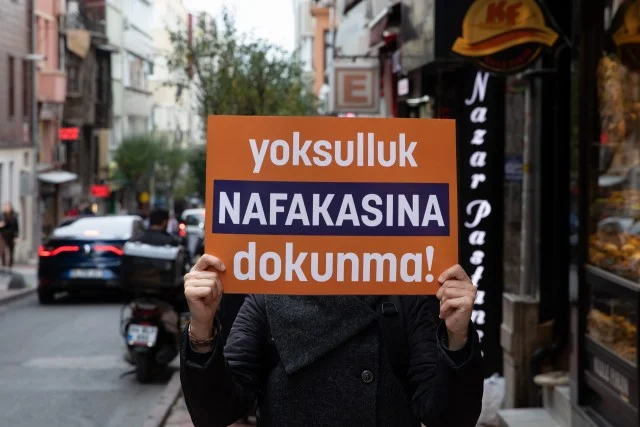
The Constitutional Court (CC) in Turkey annulled the provision in Article 175 of the Civil Code allowing a divorced spouse to claim poverty alimony “indefinitely,” ruling it unconstitutional. The CC General Assembly decided to grant the Grand National Assembly of Turkey nine months to enact the necessary legislation.
The Antalya 12th Family Court had applied to the Constitutional Court in 2025 seeking the annulment of the phrase “indefinitely” in the provision on poverty alimony under Article 175 of Turkish Civil Code No. 4721. The high court issued this ruling upon the application of the local court.
Following the annulment ruling, it was reported in the press that the draft on the AKP’s table plans to take the duration of marriage as the basis. Accordingly, those married for 3 years would receive alimony for 5 years, those married for 5 years for 7 years, and those married for 10 years for 12 years.
Hacer Foggo, founder of the Deep Poverty Network (DPN), who shared her assessment with Niha+, underlined the hunger, debt, school dropout, and housing risks that emerge in households when alimony is cut or not paid.
Hacer Foggo: “Alimony is insufficient but vital support”

Foggo emphasized how vital alimony is for women and stated that the public perception created, that “women receive alimony in high amounts” does not correspond to the reality in the field:
“A significant portion of the single mothers living in deep poverty whom we support in the field, particularly those working in daily precarious jobs, either receive very low amounts of alimony or cannot regularly collect the alimony that has been ruled. The 2024 Poverty Alimony Monitoring Report of the Women’s Solidarity Foundation also shows that, among the files examined, the average poverty alimony was 1,179.40 TL. It is impossible for this amount to suffice for a woman living alone. What we see in the field is this: alimony is not a welfare tool for women — it is a support that is most often vital yet insufficient for rent, bills, food, children’s school meals, transportation, medicine, fuel, and a safe life. Women living in deep poverty are already trying to survive through daily, irregular, and precarious work.”
The 2019 “Poverty Alimony Research” report of the Women’s Solidarity Foundation had recorded that only 20.7 percent of alimony rulings were paid by those obligated to pay, while 50.7 percent were never paid at all.
The foundation’s 2024 “Poverty Alimony Research” report stated that while the proportion of men with no income was 7 percent, the proportion of women with no income was 47 percent. Accordingly, while 80 percent of men work at or above the minimum wage, this figure stands at only 46 percent for women.
“The structural inequalities women face are being ignored”
Responding to the argument that making alimony time-limited is justified with the claim “Women should work too” which has been asserted in public debate, Foggo stated that this argument ignores the structural inequalities women face. Foggo said that single mothers living in deep poverty are already working, such as going to do daily cleaning, doing piecework, working in irregular and uninsured jobs, and underlined that these are not jobs that provide regular income, social security, or a dignified life.
Reminding that one of the biggest obstacles to women’s participation in the workforce is the burden of care, Foggo said: “If there are no free and accessible nurseries, if a woman cannot find a safe place to leave her child, it becomes practically impossible for her to work with a fixed income. Many women shoulder child care, school follow-up, hospital processes, housework, and the responsibility of livelihood entirely on their own. Ignoring these conditions means not knowing the conditions of deep poverty.”
“It becomes harder for women to escape violence”
According to Foggo, when alimony ends, a woman who has not yet established her economic independence faces even deeper poverty. Saying “For a woman who cannot find a free nursery to leave her child and cannot access regular and secure employment, the cutting of alimony means being unable to cover basic living expenses,” Foggo explained that this would place women in a more precarious and unhealthy situation:
“This situation may force women to accept lower-waged, uninsured, long-hour and unhealthy jobs. For some women, it may also increase the pressure to return to a home where they experience violence or to endure a violent relationship. Because the decision to divorce is not only a legal one, it is also an economic one. If a woman cannot find answers to the questions ‘where will I stay with my child, how will I pay the rent, how will I feed my child,’ it also becomes harder for her to escape violence.”
“Alimony also affects the child’s life”
Foggo, who stated that alimony directly affects not only the conditions of women but also those of children, argued that a decrease in a mother’s income produces consequences in every area, from a child’s nutrition to education, from access to health to housing.
Foggo emphasized that the removal of alimony security is one of the factors that could increase child labor, school dropout, malnutrition, and the risks of child marriage, and gave the following example: “In the field, we see that children drop out of school because their bus fare cannot be covered, that school meals cannot be prepared, that children are forced to look after younger siblings at home or work to bring income to the household.”
She said that such a decision should be addressed not only under the heading of alimony but together with women’s poverty, child poverty, care labor, and the right to escape violence:
“In our view, its effects in the field must be urgently monitored. At the same time, free and accessible nurseries must be expanded, regular social support must be provided to single mothers, secure employment opportunities must be increased, and effective public mechanisms must be operated in cases where alimony cannot be collected. Limiting alimony rights with a time limit without establishing social policies that will reduce women’s poverty is unacceptable. From our perspective, touching the right to alimony means touching the right to life of women and children living in deep poverty.”
DPN: “For single mothers, alimony is vital”
The Deep Poverty Network’s statement on the annulment of indefinite alimony is as follows:
Touching the Right to Alimony Means Touching Women’s and Children’s Right to Life
The Constitutional Court’s annulment of the phrase “indefinitely” concerning poverty alimony under Article 175 of the Turkish Civil Code is not merely a technical legal debate. This ruling cannot be evaluated independently of the living conditions of women in Turkey, particularly single mothers living in deep poverty, working in daily and precarious jobs.
Poverty alimony is not an unconditional, unlimited, and automatic privilege as it is presented to the public. It is subject to conditions such as not being at serious fault, falling into poverty due to divorce, and the continuation of need. When the need disappears, alimony can already be revoked. Despite this, presenting the right to alimony as a “lifelong burden” renders invisible the unpaid care labor women undertake within marriage, the impoverishment following divorce, and the economic conditions of escaping male violence. The Women’s Solidarity Foundation’s 2024 Poverty Alimony Monitoring Report shows that alimony amounts are not as high as publicly claimed, that the average poverty alimony in the files examined was 1,179.40 TL, and that a significant portion of ruled alimony cannot be collected. What we at the Deep Poverty Network see in the field is this: for single mothers, alimony is not a welfare tool, it is most often a vital threshold for rent, bills, food, school meals, transportation, wood, coal, medicine, and a “safe” life.
Single mothers living in deep poverty are on the one hand, shouldering the care of their children entirely on their own, while on the other hand trying to provide for the household through daily, irregular, low-wage, and precarious work. Single-parent households have no secure job, no regular income, and no free childcare support to safely leave their children. For this reason, limiting alimony with a time frame will, particularly for single mothers, produce the following consequences:
It will deepen the poverty of women and children. For a mother working in daily jobs, income is something that must be found anew each day; if there is no work that day, there is hunger, if the child is sick and there is no medicine. Limiting alimony will deepen poverty.
“Some days I don’t eat myself so my children can eat more. But how well can they be nourished on pasta? Some days there’s nothing at all, we all have to go hungry.”
It will make escaping violence harder. One of the biggest obstacles to women making the decision to divorce is economic insecurity. A woman who wants to leave a home where she experiences violence will be forced to think about where she will stay with her child, how she will pay the rent, how she will feed her child — and will continue to “endure” the violence.
“Due to the problems with my ex-husband, my life is still in danger. I can’t leave the house out of fear that he will kill me or harm my children. My son quit school and is doing daily work.”
It will leave the burden of care entirely on women’s shoulders. Child care, school follow-up, hospitals, housework, and livelihood are left simultaneously to the single mother’s responsibility. While free and accessible nurseries are not widespread, while flexible and secure employment is not provided, limiting the right to alimony will confine women to the home.
“Every day I work daily jobs too, I can’t even spend proper time with my children out of exhaustion. My eldest son left school, he’s looking after his younger siblings at home.”
It will strip children of their right to education, nutrition, and health. The alimony debate concerns not only the living conditions of women but of children too. The impoverishment of a single mother may mean a child dropping out of school, being malnourished, and being unable to access health services. “I couldn’t give my high school freshman son his bus fare, I had to pull him out of school.”
It will worsen the housing crisis. In single-parent households, rent, bills, and basic household expenses are among the most acute dimensions of poverty. Limiting the right to alimony will push women and their children into unsafe, unhealthy living conditions. “I can’t make ends meet — should I pack the child a meal every day, or pay my rent?”
It will allow economic violence to persist after divorce. Non-payment, delay of alimony, and forcing women to renounce alimony are forms of economic violence. It will make it easier for men who exercise economic violence to escape responsibility. Women will be forced to accept lower-waged, uninsured, long-hour, and unhealthy jobs.
“No matter how much I work it’s not enough. The employer always delays it. I can’t raise my voice. I have to live counting every penny… Believe me, I can’t even afford pads.”
Without developing social policies to reduce women’s poverty, without expanding free nurseries, without providing secure employment, without implementing equal pay for equal work, and without bringing care labor into life, limiting the right to alimony is unacceptable. The fact that in practice it is mostly women who benefit from this right stems from gender inequality. Poverty alimony is not a privilege granted to women — it is a social protection mechanism for the party that falls into poverty after divorce, and it is insufficient.
No regulation that ignores women’s poverty is just.
No policy that leaves the burden of childcare on the shoulders of single mothers is compatible with the principle of the social state.
No decision that weakens the economic security of women who want to escape violence can be considered independently of the right to life.
Touching the right to alimony means touching the lives of women and children living in deep poverty. We do not accept any regulation that will condemn women to poverty, violence, confinement to the home, and relationships of dependency.
Deep Poverty Network