

Ecmel Deniz, a member of the Hormon Hakkım Collective, states that the anti-LGBTQ+ provisions proposed in the 12th Judicial Package are not a health policy but an attempt to assert power over bodies. They note that the draft in question targets not only the rights of LGBTQ+ individuals but also “everyone’s right to health, bodily autonomy, freedom of expression, and the democratic sphere.”
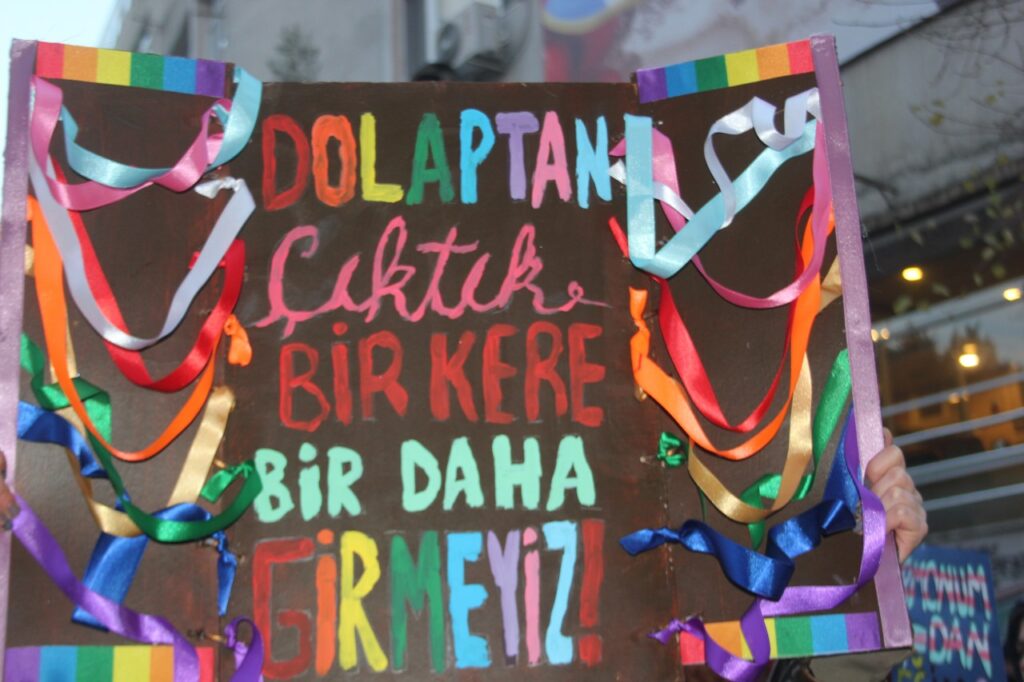
Anti-LGBTQ+ legislation is back on the agenda in the Grand National Assembly of Turkey (TBMM). Provisions that were withdrawn from the 10th and 11th Judicial Packages, which passed through parliament in previous year, due to public pressure have now been included in the 12th Judicial Package.
According to behind-the-scenes information obtained by KaosGL.org, a briefing note regarding the 12th Judicial Package was sent to senior Adalet ve Kalkınma Partisi (AKP / Justice and Development Party) lawmakers. It has been learned that the package, expected to be submitted to the TBMM in June, contains provisions targeting the LGBTQ+ community and raising the age of access to gender-affirming surgery for trans individuals to 25.
Ecmel Deniz, a member of the Hormon Hakkım Kolektifi (Hormone Rights Collective), assessed for Niha+ these proposed regulations, expected to be included in the 12th Judicial Package.
Ecmel: “The right to health cannot be governed by the threat of punishment”
According to Ecmel, this draft law constitutes an overt policy of hatred that targets trans people’s autonomy over their bodies, the trust-based relationship they establish with healthcare providers, their access to healthcare, and their most fundamental spheres of existence.
Recalling that the government has long sought to portray LGBTQ+ individuals as a “threat to the family,” “a threat to children,” “a threat to society,” and “a threat to public morality,” Ecmel stated that this policy has transformed trans people’s access to healthcare from a matter of rights into an issue of security, morality, and punishment:
“The right to health cannot be governed by the threat of punishment. A person’s access to hormones, surgery, psychosocial support, or any other health service related to the gender affirmation process cannot be criminalized. This draft law aims to make trans people’s lives manageable, controllable, and punishable. The government is saying, ‘I decide what happens to your body, and if your doctor supports you, I’ll punish both of you.’ This is not health policy; it is an attempt to assert power over our bodies. That is why when we say ‘My Right to Hormones,’ we are not merely talking about access to a medication. We are talking about the right to make decisions about our own bodies, the right to access safe healthcare, the right to speak with a doctor without fear, and the right not to be treated as a criminal because of our identity.”
“They’re afraid of our power to organize”
Ecmel, noting that many rights would be violated if this bill passes through parliament, said that access to healthcare which is already difficult for trans people, would become even harder, and those seeking healthcare would be pushed toward more precarious and unregulated avenues:
“If the law is passed, the resulting human rights violations will be multifaceted. The right to health will be violated. Because people will not be able to safely access the services they need. The right to privacy will be violated. Because a person’s body, identity, health information, and life will be turned into objects of state surveillance. The right to equality will be violated. Because access to the same health services is surrounded by penalties and specific barriers when it comes to trans people. Freedom of expression and association will be violated. It fuels hatred in society. It sends the message to people that ‘these individuals are already guilty, already dangerous, already targets.’ This leads to more discrimination and violence on the streets, in schools, at home, in hospitals, at workplaces, and on social media.”
Emphasizing that the purpose of the proposed regulations is not merely to regulate a few medical procedures, but also to prevent trans people from trusting the healthcare system, doctors from acting in accordance with professional ethics, and institutions from opening their doors to trans clients, Ecmel stated that these draft laws were written based on the questions: “How can LGBTQ+ people become less visible, make fewer demands, and feel more afraid?”
Ecmel said, “Because they fear our organizational power; the LGBTQ+ movement is a movement that has managed to form a strong opposition bloc despite all this oppression”
“The government says, ‘We decide what happens to the body‘”
They stated that the government is pursuing its efforts to isolate the LGBTQ+ community, silence doctors, intimidate families, polarize society, and portray the struggle for rights as criminal in four distinct ways:
“First, it masks social crises with the rhetoric of a ‘moral crisis.’ While real issues like the economic crisis, poverty, the housing crisis, the collapse of the healthcare system, the lack of a future for young people, and the violence faced by women and children are out in the open, the LGBTQ+ community is presented as an artificial threat. In this way, the public’s anger is diverted from real problems and directed toward a vulnerable group.
Second, a uniform lifestyle is being imposed under the guise of the “family.” Strengthening the family truly means reducing poverty, preventing violence, supporting care work, ensuring children’s safety, and making it possible for everyone to live equally and with dignity. But the government uses the family not as a support mechanism, but as a tool to keep society in line. By portraying LGBTQ+ individuals as a threat to the family, the government both fuels a politics of hatred and imposes a “acceptable citizen,” “acceptable body,” “acceptable gender,” and “acceptable relationship” on society.
Third, a message is being sent to the entire society through trans bodies. It says, “We, not you, decide what happens to the body.” This message is not directed solely at trans people; it is aimed at women, young people, those living with HIV, people with disabilities, children, and everyone in need of healthcare. The government seeks to control society by controlling bodies.
Fourth, they are trying to criminalize advocacy. This draft targets not only the healthcare processes of trans people but also the visibility, organization, solidarity, and advocacy of the LGBTQ+ community. Because those in power know that people are more easily intimidated when left alone; but when there is solidarity, information, and organized resistance, these repressive policies fail.”
Ecmel, noting that the provisions in the draft legislation have concrete consequences for trans people, such as being turned away from hospitals, being unable to access hormones, struggling to find a doctor, facing humiliation, being forced to accept misinformation, becoming isolated due to family pressure, and being unable to make decisions about their own bodies, stressed the importance of making trans people’s real-life experiences visible.
“This issue cannot be left solely on the shoulders of trans people”
Stating that this law directly targets the right to one’s own body, Ecmel underscored that a person’s ability to make decisions about their own body is not a favor granted by the state. According to Ecmel, the government threatens not only trans people but everyone’s bodies by asserting, “Your body does not belong to you; it can only exist within the boundaries drawn by the state”:
“Once the government begins punishing people’s decisions regarding their bodies under vague justifications like ‘public morality,’ ‘family,’ or ‘protection of society,’ this threat does not stop at trans people. “Today, trans people’s right to hormone therapy is under attack; tomorrow, abortion, birth control, HIV treatment, young people’s access to healthcare, psychiatric support, reproductive health, or other bodily autonomy decisions could be targeted using the same logic. That is why this struggle is not just a struggle for trans people. It is, in fact, a struggle over the question, ‘Who gets to decide about my body?’”
Ecmel, who stated that it is not just the rights of LGBTQ+ individuals but everyone’s rights to health, bodily autonomy, freedom of expression, and the democratic sphere that are under attack, said, “This issue cannot be brushed aside by saying, ‘LGBT+ organizations will make a statement anyway.’” Ecmel listed what each sector must do as follows:
“Medical associations must declare: Medicine cannot be practiced under the threat of punishment. Political power and the threat of imprisonment cannot be introduced into the patient-doctor relationship.
Bar associations must state: Existence cannot be criminalized. Privacy, bodily integrity, equality, and freedom of expression cannot be eliminated through moralistic criminal provisions.
Women’s organizations, feminists, and those working in reproductive health must state: Attacks on bodily autonomy are not separate from one another. The logic targeting trans people’s right to hormones is the same as the logic regulating abortion, birth control, sexual health, and reproductive health.
Unions and professional organizations must state: This law also concerns the labor sector. Because the professional autonomy of healthcare workers, the safety of LGBTQ+ workers, the prohibition of discrimination in the workplace, and everyone’s right to a life of dignity are all part of this attack.
Human rights organizations and political parties must state the following: This draft law must not be brought before Parliament under any circumstances; if it is, it must be opposed through all democratic means. Because hate laws cannot be made “reasonable” through debate. One’s very existence is not up for negotiation.”
Stating that merely making a statement would not be enough and that support must be provided in many areas, Ecmel said: “Legal preparations must be made, informative materials in the field of health must be produced, solidarity hotlines for physicians and healthcare workers must be established, and secure channels where young trans individuals and families can access accurate information must be strengthened. Media language must be monitored, and rapid response mechanisms against hate speech must be set up. Local governments, counseling centers, non-governmental organizations, and professional chambers must work together.”
“We are not alone. Our pride cannot be packaged!”
Emphasizing that this hate law must be completely withdrawn without being added to any judicial package, Ecmel said: “We do not accept our lives being narrowed down a bit more, our bodies being monitored by the state, and our access to healthcare being criminalized with every new package.”
Concluding their words, Ecmel stated that one of the most important things in this process is to counter fear with solidarity:
“With these laws, the government is not only producing a threat of punishment, but also sending the message: ‘You are alone, no one will defend you, your doctor will be afraid, and your organization will be silenced.’ Our response to this must be collective, loud, and clear: We are not alone. We will not give up on each other. Our pride cannot be packaged. No to the hate law in the 12th Judicial Package! Our bodies belong to us. We will not give up on our right to health, our right to hormones, and our right to life.”
What had happened?
After the government declared 2025 as the “Year of the Family,” regulations directly targeting LGBTQ+ individuals in the drafts of the 10th and 11th Judicial Packages, which were expected to be submitted to the Grand National Assembly of Turkey, came to the agenda.
The 10th Judicial Package was approved by the assembly Justice Commission in June 2025. Following this, the 11th Judicial Package was submitted to the assembly on November 27, 2025, and approved on December 25, 2025.
According to the articles in these drafts submitted last year:
- Under the scope of “indecent acts,” crimes of promotion or encouragement regarding LGBTQ+ individuals could be punished with imprisonment from one to three years.
- Marriage and wedding ceremonies of same-sex individuals would also be punished with imprisonment.
- Additionally, contents featuring LGBTQ+ individuals could be penalized or removed from broadcast by the Radio and Television Supreme Council (RTÜK).
One of the most critical regulations that stood out was raising the age for gender affirmation surgery for trans individuals from 18 to 25, and tightening the conditions for obtaining medical reports by exposing the relevant physicians to imprisonment and fines. For the gender transition process, the age limit was to be raised from 21 to 25.
However, public backlash created by LGBTQ+ organizations, feminists, and rights-oriented institutions prevented the articles in this draft from passing through parliament. This year, similar articles are back on the agenda.