
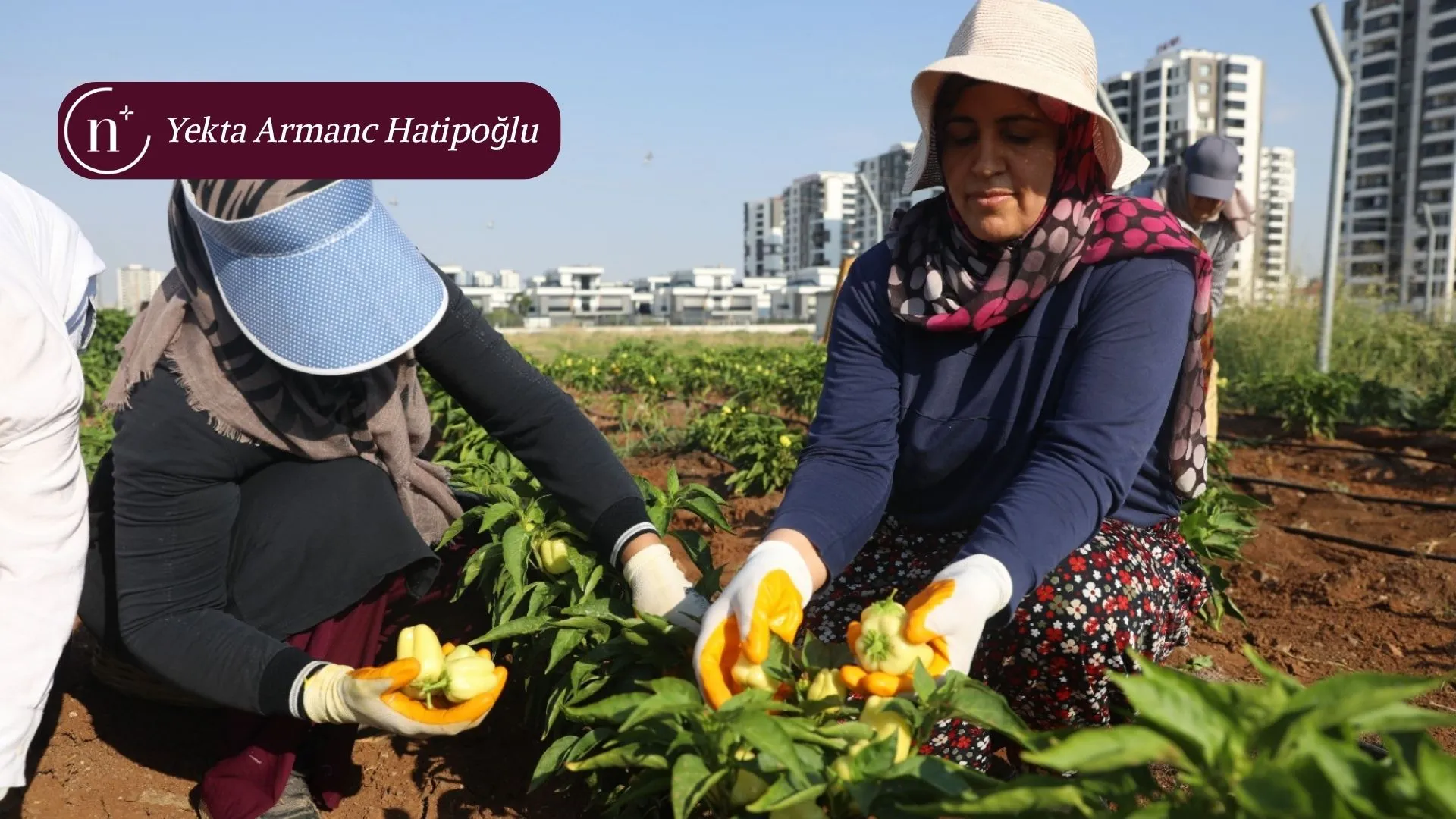
The first harvest has taken place at the Women’s Commune Urban Gardens, launched by the municipality in Diyarbakır. Zozan Halil Müslüm, one of the women growing produce in the gardens, and Özden Gürbüz Sümer, Head of the Diyarbakır Metropolitan Municipality’s Department of Women’s Policies, spoke about their experiences.
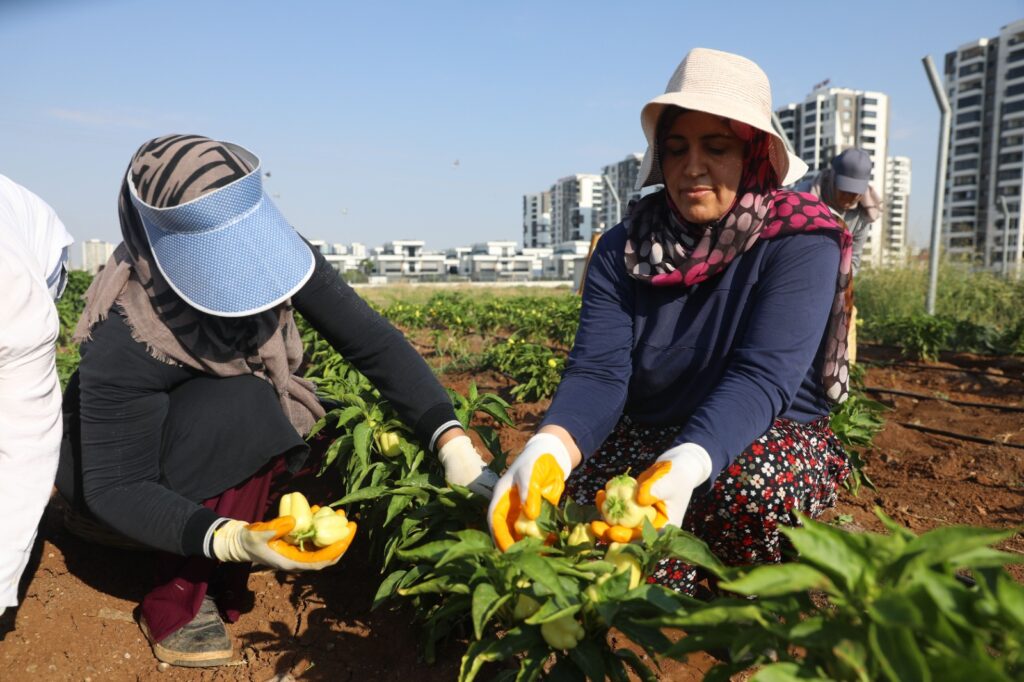
Photos: Diyarbakır Metropolitan Municipality
The first harvest at the Women’s Commune Urban Gardens, launched by Diyarbakır Metropolitan Municipality, took place last week. Women gathered the vegetables and plants they had grown.
Established under the leadership of the Directorate for Strengthening the Women’s Economy, which operates within the Department of Women’s Policies, the gardens aim to strengthen the women’s economy, preserve local seed varieties, and promote ecological production.
The gardens are located on the grounds of the Directorate of Rural Services, in the Talaytepe neighborhood of Kayapınar district.
We spoke with Zozan Halil Müslüm, one of the women growing produce in the gardens, and Özden Gürbüz Sümer, Head of the Department of Women’s Policies, about the Women’s Commune Urban Gardens.
“The city of women needs to grow stronger”
Zozan Halil Müslüm began by saying: “I learned about the Women’s Life Centers and the support offered there. I saw that it wasn’t just about the garden — there were also activities like sports and self-defense. As I got to know the other women, I came to feel that the city of women, and our presence as women, needed to come forward and grow stronger. That’s why I joined the Women’s Commune Urban Garden.”
Müslüm said that together they had planted peppers, eggplants, tomatoes, cucumbers, gherkins, and okra, as well as “medicinal plants” such as thyme, lavender, mint, and rosemary. She said that as women, they were meeting their vegetable needs in a natural and fresh way, and that they took the produce home with them.
“We pickle it, we dry it, and we use it fresh in our cooking. We’re also able to make products like oils and creams from the medicinal plants,” said Müslüm, adding that what happens in the gardens isn’t just about growing and harvesting produce.
“At the same time, we’re learning to respect each other’s ideas and decisions, and to make decisions together. As women, we’re strengthening our own will. Because we’re learning, together, how to live communally. Society has drifted away from its own essence, and people have become increasingly individualistic. As women, we’ll do whatever it takes to help society return to its essence.”
Müslüm closed by saying that opening spaces like this one is essential, that she feels lucky to be part of such a project, and that she always wants to be involved in this kind of work.
“We’re building a shared space of production”
Özden Gürbüz Sümer, Head of the Department of Women’s Policies, said that as a local government with a democratic and women’s-liberationist perspective, they do not see the city merely as a collection of buildings, roads, and the services tied to them. How the city is governed, how it is reproduced, where its food comes from, and women’s place within that process of production all matter to them as well. Sümer said the Women’s Commune Urban Garden is part of that broader approach:
“We wanted to create a space where women could rebuild their relationship with the land, with production, and with their own labor. What matters to us here isn’t just growing vegetables. It’s creating a space where shared production, shared decision-making, and shared distribution are possible.”
Sümer said the garden does not operate through individual plots — the space is held in common, and production is carried out collectively. She explained that women work together at every stage, from planting to tending to harvesting, and make decisions about production together as well:
“We’re building a model where no individual woman owns a particular plot or a particular crop — where what’s produced is treated as collective output. Because of that, the garden itself becomes a space where the experience of producing and deciding together actually happens.”
Sümer said the priority is for what’s grown to go first toward meeting the needs of the women and their households, and that preparations are also underway to set up a market space where any surplus, or produce the women wish to sell, can be offered. “This way, women will be able to sell what they’ve grown directly, in this space. The goal here is to create a setting where women can determine the value of their own produce themselves, and actually be compensated for their labor,” she said.
“We don’t approach production here with individual profit at the center. Our priority is sustaining collective production and making sure the value it generates feeds back into further production. At the same time, it matters that there’s a space where women can choose, of their own will, to sell any surplus they produce. So we want to do both — preserve the ethic of shared production and distribution, while also creating opportunities for women to benefit economically from what they grow.”
“Women must be directly involved in production”
Sümer said their aim is to create a space where women don’t just take part in production, but have a say at every stage of it.
“Especially in agriculture, women are present as labor — in the fields, or in processing the crop — but they’re almost entirely absent from decision-making, from selling the product, and from earning income directly from it. In other words, there’s a very serious exploitation of women’s labor happening in this sector. Making women’s labor visible matters in that sense, but we’re not limiting ourselves to that. We want women directly involved in production knowledge, in the land itself, and in the economic process. With that perspective, in the commune urban garden, women are learning agricultural technique on one hand, while experiencing commune economics — both in theory and in practice — on the other. They’re also taking part in collective training workshops that build awareness around gender equality, as a way of strengthening themselves individually.”
“We’ll keep developing our commune work”
Asked what the process of running the garden has shown them, Sümer said:
“The process has shown us that women have a genuine, strong interest in producing collectively. As they worked together in the garden, we saw women sharing their own experience and production knowledge with one another. That’s why we don’t see the garden as a finished project, we see it as a space we keep developing through producing and experiencing it together.”
She said that as coverage of the garden has spread, they’ve begun receiving a great deal of interest and response from people living in the city — including people who want to join the work, come see the garden, or buy the natural produce being grown there.
Sümer said they see this interest as significant, because it points to a strong, existing appetite in the city for local production and natural food. She said they plan to open the space to visitors before long, so that residents can see the garden firsthand, learn about the production process, and witness the women’s experience of collective production up close.
Sümer said the seedlings planted in the gardens are grown from local seed varieties prepared by the Metropolitan Municipality’s Directorate of Rural Services, meaning that protecting local seed stock and bringing it back into production has been part of the garden’s process from the very beginning.
She closed with the following:
“What we’ve learned from the garden will feed directly into our future work. In fact, the production work we run at our Women’s Life Centers already follows this same approach. We have textile production groups, a medicinal and aromatic plants production group, and epoxy and recycling production groups. In all of these, we run things the same way — women producing together, deciding together on the production process, and evaluating what comes out of it through a shared, collective understanding. The garden is this same approach applied to a different field of production. Going forward, we’ll keep developing commune-based work built on women’s own labor and knowledge, grounded in shared production and shared distribution.”