TPAO has taken a 15% stake in the BP vehicle redeveloping Kirkuk. According to The National Context, it marks Turkey’s return to a geography where a century ago it held only a royalty right; yet the share structure keeps Ankara’s seat well short of a steering wheel.
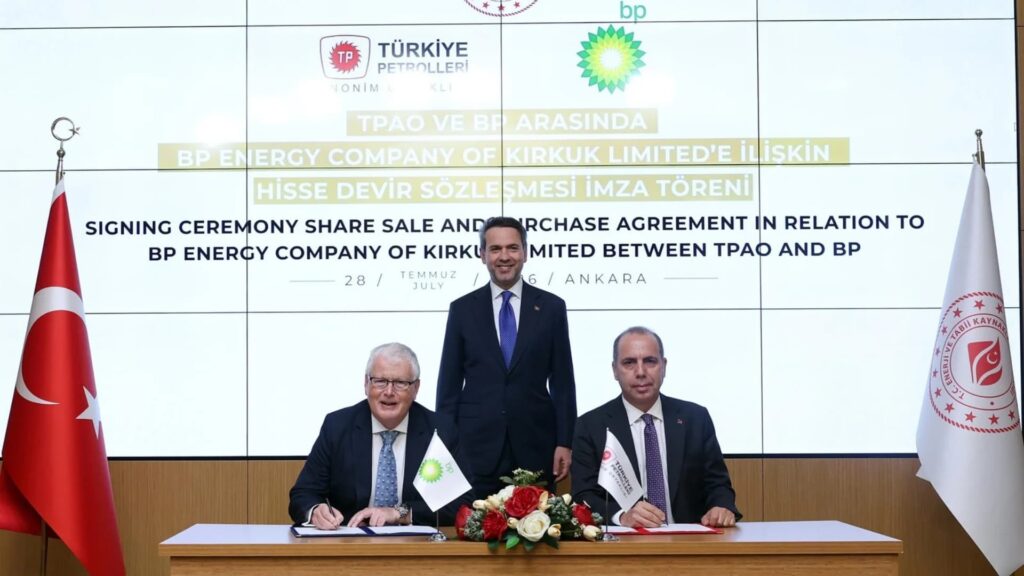
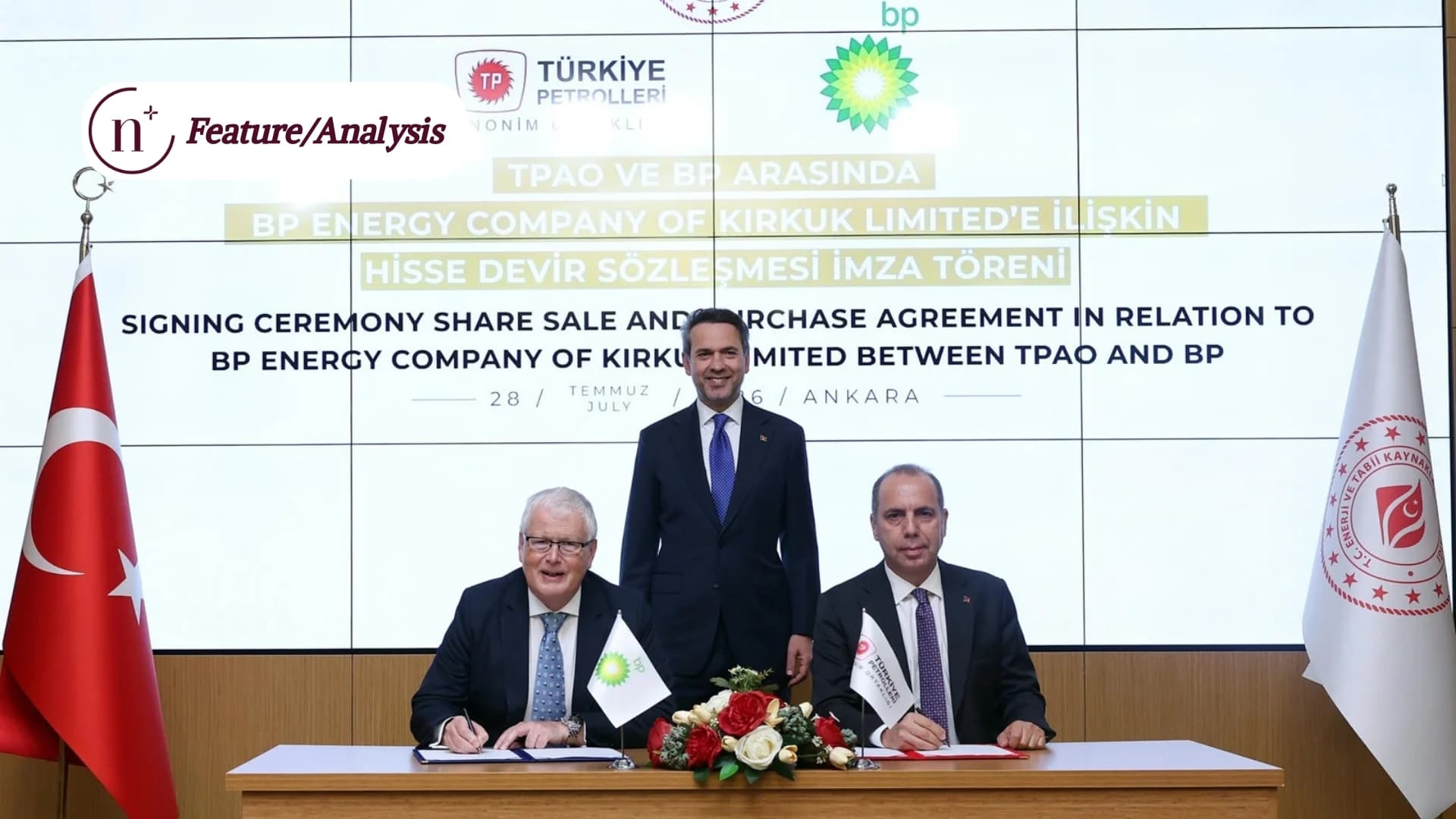
Turkey’s state oil company TPAO has acquired a 15% stake in BP Energy Company of Kirkuk Limited, the contractor vehicle for the redevelopment of the Kirkuk oil complex. An analysis published by The National Context describes this as the clearest commercial sign yet of Ankara’s return to a geography where it last held a formal economic interest a century ago.
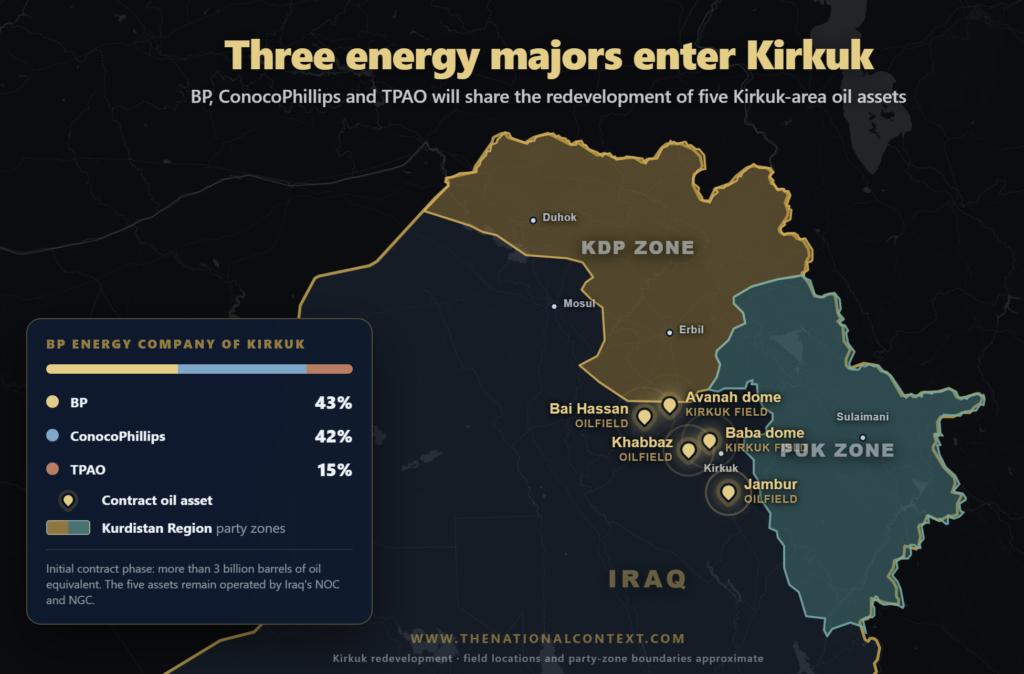
The agreement was signed in Ankara by TPAO general manager Cem Erdem and BP upstream business development vice president Andrew McAuslan, in the presence of energy minister Alparslan Bayraktar, ahead of talks between President Recep Tayyip Erdoğan and Iraqi Prime Minister Ali al-Zaidi. It follows ConocoPhillips’s agreement earlier in the month to take a 42% interest in the same vehicle, concluded during al-Zaidi’s visit to Washington, and leaves BP with the remaining 43% and majority control.
The National Context states that the contract area covers the Baba and Avanah domes of the Kirkuk field together with Bai Hassan, Jambur and Khabbaz, with an initial gross recoverable resource above three billion barrels of oil equivalent. The transaction does not alter the contract framework: the fields remain Iraqi state property, North Oil Company and North Gas Company retain their operating roles, and the partners will book production and reserves according to the terms of the development and production contract. The signing came a day after the Iraq–Turkey crude oil pipeline agreement expired, with both governments stating that they now want a comprehensive energy cooperation agreement in its place.
Back to 1926
To measure the return, The National Context reaches back to the one earlier moment Turkey had money riding on this ground. Back then, the analysis notes, it wasn’t a business stake at all but a consolation prize for territory it had given up. The 1926 Ankara Treaty had Turkey accept the Brussels Line, which placed the old Mosul vilayet on the Iraqi side of the border. In exchange, Ankara was promised 10% of the oil royalties owed to the Iraqi government over a 25-year window, with a fallback option to trade the whole stream for a single £500,000 cheque. Crucially, that 10% bit only into royalties (not production, not exports, not profits) and it bought Turkey no piece of the Turkish Petroleum Company, an outfit the analysis describes as Turkish in name and nothing else.
The cash didn’t even start moving until Baba Gurgur was discovered. The first payment landed in 1931: Iraq collected somewhere around £400,000 in royalties and passed roughly £40,000 up to Ankara, a figure that had climbed to about £223,000 by 1939. Turkish budget records show the 10% payments still running through 1952, with one last, smaller sum in 1954, which makes the frequently repeated claim that Turkey just cashed out for £500,000 either wrong or only half the tale. The math also limits how much the entitlement was ever worth: 10% of royalties, themselves only a sliver of gross sales, left Ankara with something nearer 1% of what the oil was really worth. Lord Curzon’s instinct that the territory mattered was vindicated within a year of the settlement, when Kirkuk turned out to hold one of the largest fields in the world.
Zoom out, the analysis suggests, and the real backdrop is the regional economy that the post-1918 lines carved up. It leans on Sarah Shields’s work on nineteenth-century Mosul, which shows a city whose merchant class looked outward along old, dense regional ties (toward Aleppo, Baghdad, Damascus and the Anatolian interior) rather than toward Europe or Istanbul, with only a small share of trade by value ever leaving that orbit. Aleppo connected the interior to Mediterranean shipping through Alexandretta, and the Baghdad Railway was an unfinished attempt to bind Anatolia, northern Syria and Mesopotamia through modern infrastructure. Kirkuk didn’t enter its oil age until 1927 so, the piece argues, today’s petroleum arrangements are being draped over a map that trade, caravans and railways had already knitted together long before.
The Fulcrum Doctrine
The National Context files the TPAO stake under what it calls the Fulcrum Doctrine: a setup in which Washington calls the strategic shots across Iraq, Syria and Turkey but hands the actual work to regional players, using energy and infrastructure as the levers.
The diplomatic architecture, it argues, tells the same story. Tom Barrack serves simultaneously as US ambassador in Ankara and as special envoy for Syria and for Iraq, and he described the three countries on taking the expanded role as the strategic fulcrum on which regional stability rests, requiring a single consistent American point of contact. Syria and Iraq were bolted onto the portfolio of the ambassador resident in Turkey, not the other way round, which makes Ankara the administrative hub of Washington’s northern Middle East. The economic side lines up with the diplomacy. June’s US–Iraq joint statement backed reviving the Kirkuk–Baniyas line out to the Mediterranean, and the Iraq–Syria pipeline deal inked in Washington this month puts a US-led consortium in charge of the engineering and the financing. The point of both the northern and western corridors, the piece says, is the same: to loosen Iraq’s reliance on the Strait of Hormuz.
Inside that frame, the analysis reads the Kirkuk line-up as a neatly parcelled set of jobs. Washington holds the strategic umbrella; the American and British firms bring the capital and the corporate machinery; Turkey brings the ground, the pipes and the regional access; and Iraq keeps the sovereignty and owns the oil. The 85% that BP and ConocoPhillips split between them also sets the hard ceiling on how far Turkey can go. TPAO gets a seat, the piece argues, because Turkish soil, ports and pipelines make Ankara the northern gateway nobody can route around. Yet, the share math is built so that a seat never becomes a steering wheel. That fits its longer-running case that Turkish leverage in the region runs through corridors, host geography and rights of approval, not through owning the outcome.
1926 against 2026
The analysis suggests that the comparison with 1926 should be handled with the same precision. A royalty cut and a block of company equity are different legal instruments, so reading “10% to 15%” as a straight upgrade misses the point. The jump means nothing in pure financial terms. According to The National Context, what actually repeats is the structure: In 1926, a bargain drawn up in London turned a Turkish land claim into a short-lived royalty trickle from outside the operating company, while later American pressure bought US firms a permanent 23.75% inside it.
In 2026, the same three ingredients (a Turkish state interest, British oil capital and Kirkuk crude) are stirred back into one vehicle, with BP presents the project as a return to the field its predecessor helped discover at Baba Gurgur. The one thing that’s genuinely moved, the piece concludes, is where Turkey stands in relation to the consortium: in 1926 it took a slice of Baghdad’s royalties from the outside, in 2026 it holds shares inside the contractor within an arrangement that remains Anglo-American in design and Iraqi in sovereignty. The borders drawn after 1918 are unchanged, while the energy, security and commercial systems that cross them increasingly operate as one connected space, with Turkey positioned as its northern hub.