
Twelve years have passed since ISIS, after capturing Mosul on August 3, 2014, turned its attention to Sinjar (Shingal), massacring thousands of Yazidis and abducting Yazidi women and children. According to data from May 4, 2026, 3,595 Yazidis abducted by ISIS have been rescued, while the fate of approximately 2,500 remains unknown.
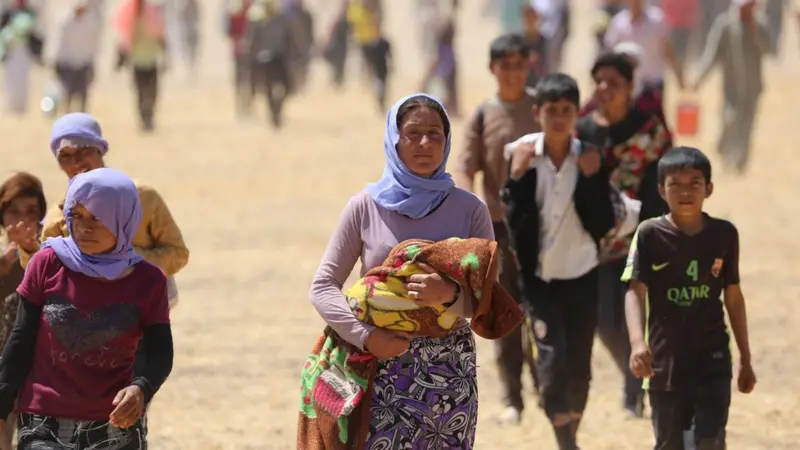
It has been 12 years since the Islamic State of Iraq and Syria (ISIS) attacked Shingal, home to approximately 550,000 Yazidis, on August 3, 2014. Thousands of civilians were executed on the spot, tens of thousands were displaced, and Yazidi women and girls were abducted and raped. The Yazidis, who had endured 72 massacres by 2014, describe ISIS’s 2014 attacks and massacres against them as the “73rd ferman.”
Yazidis who fled the region following the attack sought refuge in camps in many areas, including Turkey, Syria, and the Kurdistan Regional Government of Iraq. According to a report by Rûdaw, approximately 2,500 homes have been built so far at the foot of Mount Sinjar (Shingal) for Yazidis who wish to build their homes there rather than in the valley. Although tens of thousands of Yazidis have returned to Shingal and the surrounding area, many still continue to live in camps far from their homeland.
12-Year Toll
According to official data from the Office for Rescuing Abducted Yazidis, the fate of 2,500 out of 6,417 Yazidis abducted in Shingal by ISIS remains unknown.
6,417
Total Abducted Yazidis
3,595
Rescued from Captivity
~2,500
Fate Still Unknown
Current Status of the 6,417 Abducted Individuals
Documents related to the Yazidis are kept on file in the archives of the United Nations (UN) ISIS Crimes Investigation Team (UNITAD)—established by United Nations Security Council Resolution 2379—as well as in the archives of the Ministry of the Interior of the Kurdistan Regional Government of Iraq and the Office for the Rescue of Those Abducted by ISIS.
In the Yazidi faith, the term “ferman” is used to describe the waves of massacres and forced displacement they have faced throughout history, effectively serving as a “death warrant.” The Yazidis say that, up until 2014, they had been subjected to similar persecution and massacres 72 times throughout history. For this reason, ISIS’s August 2014 attack on Shingal is referred to in various sources—and in the words of the Yazidis—as the “73rd Ferman.”
The Shingal Defense Forces
On June 10, 2014, ISIS seized Mosul without encountering any resistance. Having reinforced itself with military supplies left behind by the Iraqi army, it targeted the villages south of Mount Sinjar—where the Yazidis lived—on the night of August 3 of the same year. During the attack, thousands of Yazidis were killed, and women and children were taken captive and sold in slave markets; according to current data, 93 mass graves have been identified in Shingal and the surrounding area to date.
To rescue the hundreds of thousands of Yazidis trapped on Mount Sinjar as a result of ISIS’s attacks, members of the People’s Defense Forces (HPG) went to the region to fight, leading to the rescue of many Yazidis. Tens of thousands of Yazidis were able to escape thanks to a corridor opened by a 12-member HPG unit, after days of fighting, HPG fighters repelled ISIS and succeeded in evacuating the Yazidis to northern and eastern Syria.
The YBŞ (Yekîneyên Berxwedana Şengalê / Şengal Resistance Units) was founded by Yazidi youth within the same month after they were resettled in safe zones. During the Campaign to Liberate Shingal, women within the YBŞ announced at a conference in 2015 that they had organized themselves under the name YPJ-Şengal (Yekîneyên Parastina Jin ê Şengalê / Shingal Women’s Protection Units) to empower themselves.
Yazidis remaining in camps in Turkey
According to a report titled “Access to Services for Yazidis Living in Mardin and Batman,” published by the Hayata Destek Association in May 2020, 22,062 Yazidis sought refuge in Turkey between August and October 2014; following the continuation of ISIS attacks, this number exceeded 30,000. The report’s data indicates that the Yazidis settled either with relatives in Şırnak (5,675 people), Batman (2,857 people), Diyarbakır (5,360 people), Siirt (1,686 people), and Mardin (5,471 people), or in camps established by municipalities.
Following the appointment of a trustee to the Diyarbakır Municipality in 2016 and the subsequent closure of the camp in December 2016, some Yazidis returned to Shingal or Iraq, while others went to Germany, as a result, there are currently only a small number of Yazidis in Turkey.
The European Parliament had called it “genocide”
The European Parliament was the first to recognize ISIS’s attacks on the Yazidis as genocide in February 2016. UNITAD, established by a UN Security Council resolution, explicitly determined that the crimes committed in Shingal constitute the most serious international crimes, including genocide. Nearly 20 countries, including the United States, Ireland, Canada, Luxembourg, the Netherlands, Belgium, Germany, Switzerland, Armenia, the United Kingdom, and Portugal, have recognized the Yazidi genocide.
However, the “73rd ferman” has not yet been recognized as genocide by any international criminal court.
The Çilê Havînê festival before the attack
In the Yazidi faith, the 40-day fasting period that begins on June 25 ends on August 1. During this period, which is regarded as a symbol of patience, spiritual purification, and gratitude, the Yazidis devote themselves to worship by abstaining from food and drink from dawn until sunset during the hottest days of the year. This fasting period is known as Çilê Havînê (Summer Fast) in the Yazidi calendar. Another 40-day fasting period is Çilê Zivistanê (Winter Fast), observed during the winter months.
The festival celebrated on August 2, following the end of Çilê Havînê, was held just one day before August 3, 2014—the day ISIS launched its attack on Shingal.