
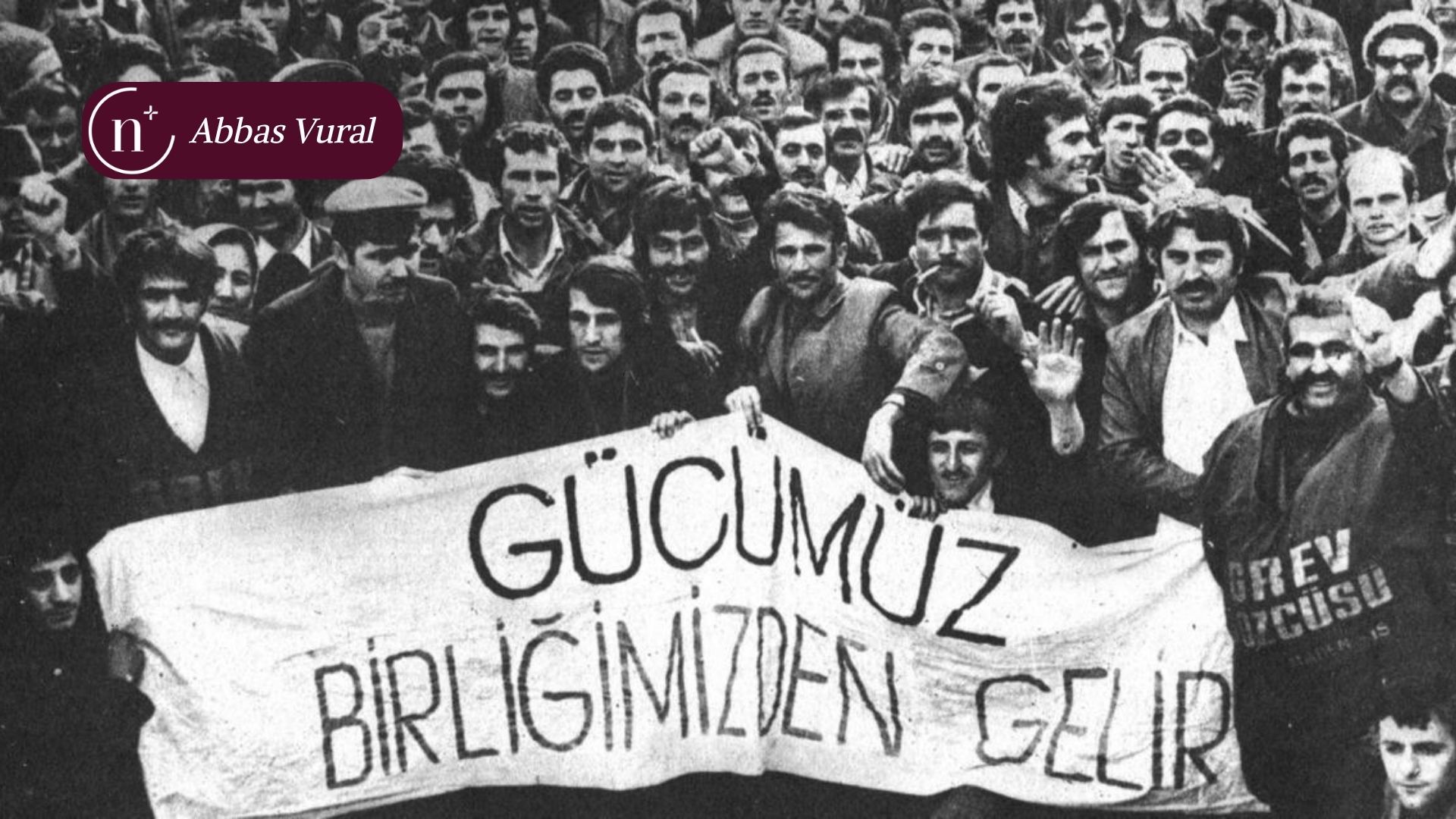
On June 15-16, 1970, nearly a hundred thousand workers took to the streets against regulations targeting union rights. Despite 56 years having passed, we have compiled a day-by-day account of the events, which remain one of the greatest resistance movements in Turkish working-class history.
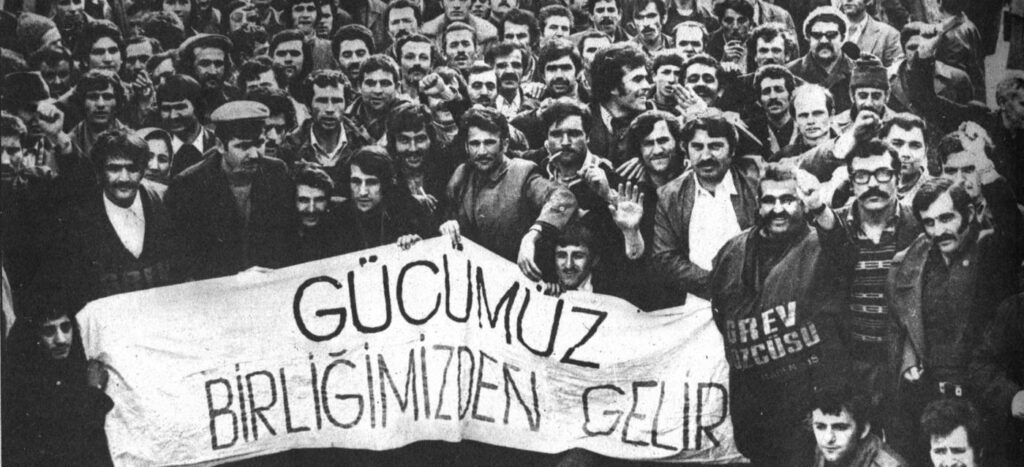
Today marks the 56th anniversary of the June 15-16 resistance, one of the largest worker actions in Turkish history.
The June 15-16 resistance, the subject of numerous books, films, documentaries, and research, has maintained its status as one of the greatest actions of the Turkish working class for over half a century. The memory of these actions, in which nearly one hundred thousand workers from companies such as Türk Demir Döküm, Sungurlar, Derby, Elektrometal, Rabak, Auer, Çelik Endüstrisi, Mutlu Akü, Vinileks, Otosan, Arçelik, and Vita took to the streets, still needs to be preserved 56 years later.
On the 56th anniversary of the June 15-16 resistance, which began as a protest against the Justice Party government’s planned changes to the trade union law but transformed into a much more radical and widespread movement, we discussed the state of labor struggles and trade union rights in Turkey with Prof. Dr. Aziz Çelik, Assoc. Dr. Hakan Koçak, Özkan Atar, General President of the United Metal Workers Union, and labor historian Zafer Aydın.
A bill proposing amendments to Trade Unions Act No. 274 and Collective Bargaining, Strike and Lockout Act No. 275 was passed in the Grand National Assembly with the votes of all parties except the Turkish Workers’ Party (TİP) — including the Justice Party and the CHP. The bill’s primary aim was to halt the flow of workers from Türk-İş to DİSK. It introduced a requirement that a union must have enrolled as members at least one-third (1/3) of the insured workers employed in the sector in which it operates in order to function nationwide. A similar one-third representation threshold was also set for confederations.
Under the legislation, which had completed its parliamentary process, salaried state personnel such as orderlies, janitors, and cleaning workers would be classified as workers and permitted to form unions; a minimum of three years’ employment in the sector would be required to establish a union; withdrawal from union membership would be processed through a notary; union general assemblies would convene every three years rather than two; and unions’ investment permissions for funds would be subject to confederation approval.
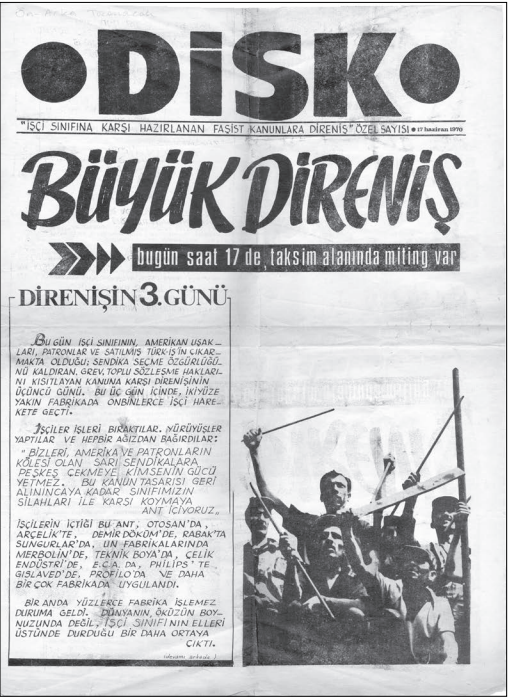
On the grounds that the bill would eliminate freedom of union choice, workplace representatives of unions affiliated with the Confederation of Revolutionary Trade Unions (DİSK) in Ankara, İzmir, Kocaeli, and Sakarya convened a joint meeting and resolved to take action until the bill was withdrawn.
Tensions that had been building on factory floors for years spilled into the streets as between 75,000 and 100,000 workers marched toward various points across Istanbul. Although the protests were led by DİSK, large numbers of Türk-İş members also joined the marches in class solidarity, rejecting the stance taken by the parties they had previously supported. By the evening of the first day, the Council of Ministers declared 60 days of martial law.
- Asian Side: A march column departing from Kartal advanced along the Ankara Highway (E-5). With workers from Otosan and DMO in Göztepe joining, along with groups from Beykoz and Paşabahçe, an enormous crowd formed and moved toward Üsküdar and Kadıköy.
- European Side: Marches were held along the Bakırköy–Topkapı–Sağmalcılar route. The Istanbul–Ankara highway was closed to traffic.
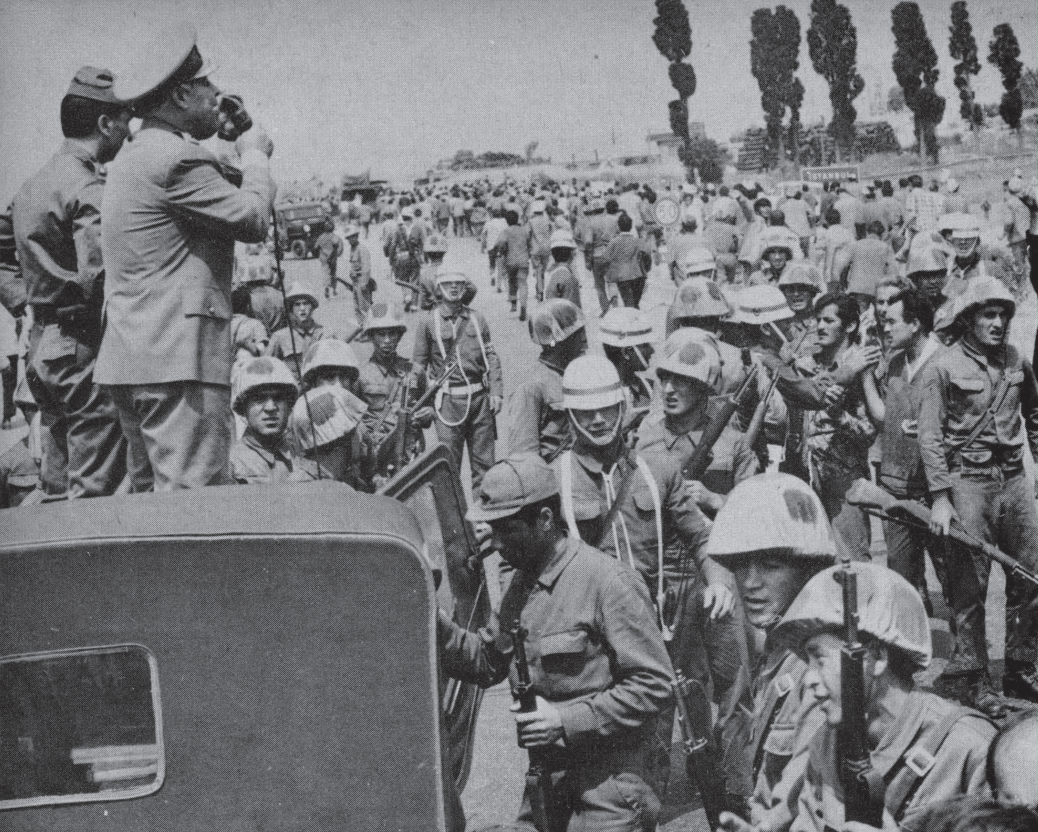
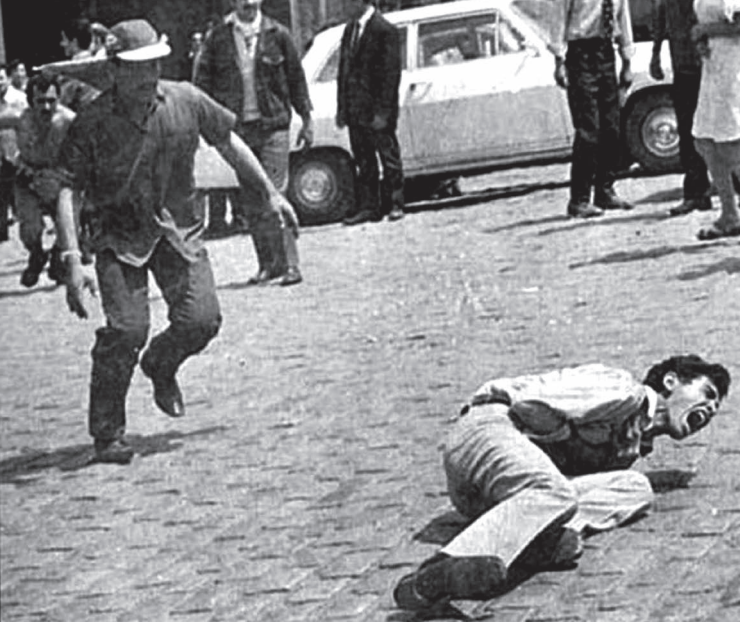
The workers’ protests continued in full force. A march that began in Gebze merged with workers from Kartal and reached Kadıköy Ferry Square along Bağdat Avenue. On the European side, columns advancing from outside Topkapı descended via Aksaray to Sultanahmet, Cağaloğlu, and the front of the Governor’s Office, and from there to Eminönü. Actions also took place in Ankara, Adana, Bursa, and İzmir.
- Opening of the Bridges: The Istanbul Governorship opened the Galata and Unkapanı bridges to traffic in order to prevent the Asian and European columns of the movement (or passage to the Beyoğlu side) from converging.
- Casualties: As a result of police fire and clashes in Kadıköy, workers Yaşar Yıldırım (Mutlu Akü), Mustafa Bayram (Vinleks), and Mehmet Gıdak (Cevizli Tekel), along with shopkeeper Doğukan Dere and police officer Yusuf Kahraman, lost their lives.
- Martial Law and DİSK’s Stance: Martial law was declared in Istanbul and in the Merkez and Gebze districts of Kocaeli. DİSK General President Kemal Türkler, in a message read on the radio, warned workers against provocations and called on them not to step outside the constitutional framework.
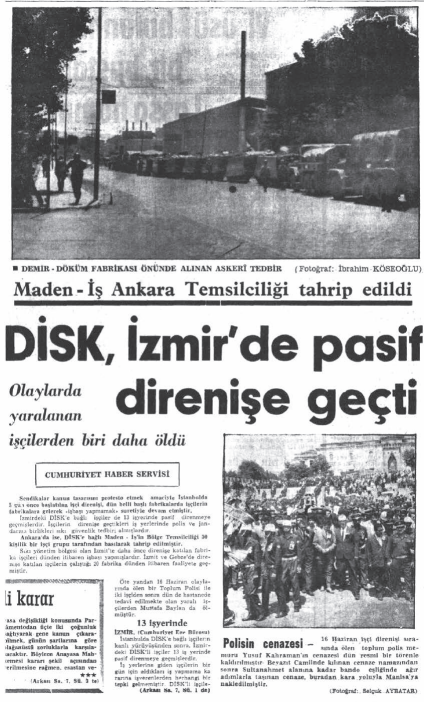
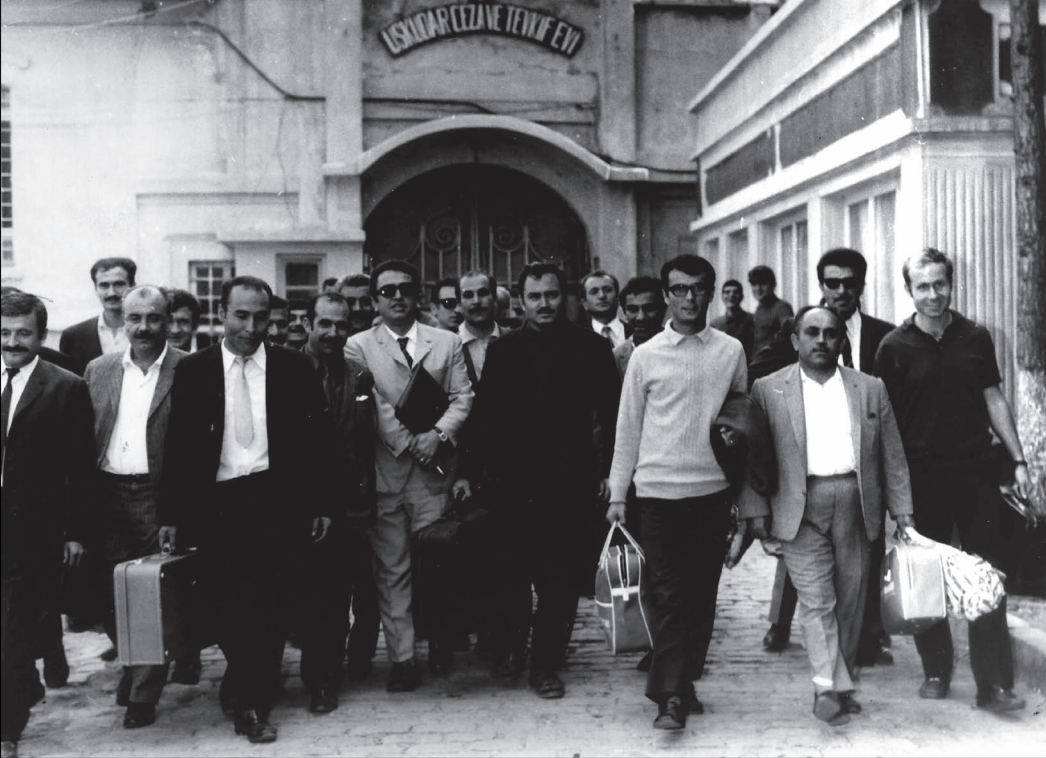
The Martial Law Command detained 23 union officials — including DİSK General President Kemal Türkler and Secretary General Kemal Sülker — on charges of instigating and inciting the events. These individuals were tried by the Martial Law Military Court on the grave charge of “attempting to alter, transform, and abolish the Constitution.” In addition, close to a hundred workers were taken into custody during the events, and a curfew was imposed from 21:00 onward.
In İzmir, where martial law had not been declared, workers at certain workplaces affiliated with Lastik-İş, Maden-İş, and Gıda-İş also walked off the job in solidarity with the resistance.
Through Communiqué No. 13 of the Martial Law Command, the exercise of the right to strike was banned; a separate communiqué made collective bargaining negotiations subject to official authorization.
The printing and distribution of Maden-İş Gazetesi, the publication of the Maden-İş Union affiliated with DİSK, was banned.
Military units entered the İzsal strike zone, where a strike had begun prior to the events and was still ongoing. Martial law officials issued an order to open fire on anyone approaching within 25 metres of the military units.
In the aftermath of the June 15–16 events, 5,090 workers who had participated in the protests were dismissed and blacklisted. The targeted dismissal of workers silenced the labor movement in the Marmara region for a long time to come. Meanwhile, the bill amending Act No. 274 — following the suppression of the protests — received its final parliamentary approval on July 29, 1970, as Law No. 1317.
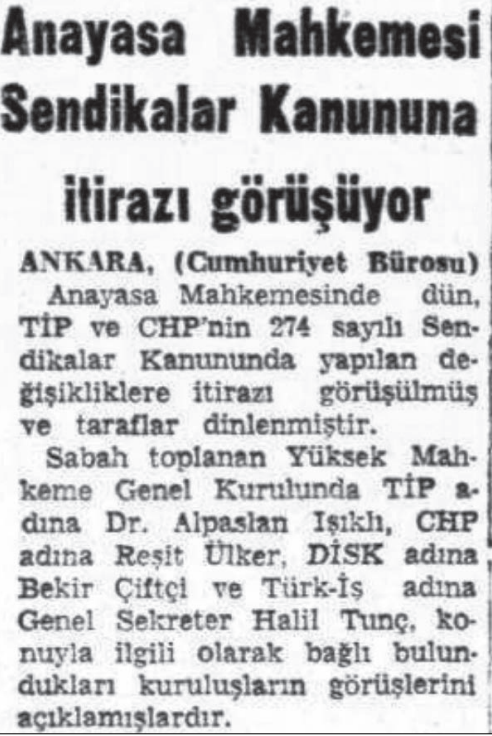
Law No. 1317 was published in the Official Gazette and entered into force. On the same day, a petition prepared on behalf of the Turkish Workers’ Party (TİP) by Prof. Dr. Alpaslan Işıklı was formally submitted to the Constitutional Court (AYM) to have the law annulled.
Shortly after TİP’s application, the Republican People’s Party — under the leadership of Secretary General Bülent Ecevit and party leader İsmet İnönü — filed a separate application with the Constitutional Court seeking the annulment of the law. (The Court later consolidated these cases and examined them under case number 1970/47.)
The Turkish Armed Forces issued a memorandum citing street conflicts and economic instability, forcing the incumbent government to resign and effectively seizing control of the administration.
The Constitutional Court’s ruling of February 9, 1972 was published in the Official Gazette and entered into force. The Court annulled the majority of the amendments in their entirety, on the grounds that they were “contrary to the constitutional principles of the right to form trade unions and the right to strike.”