
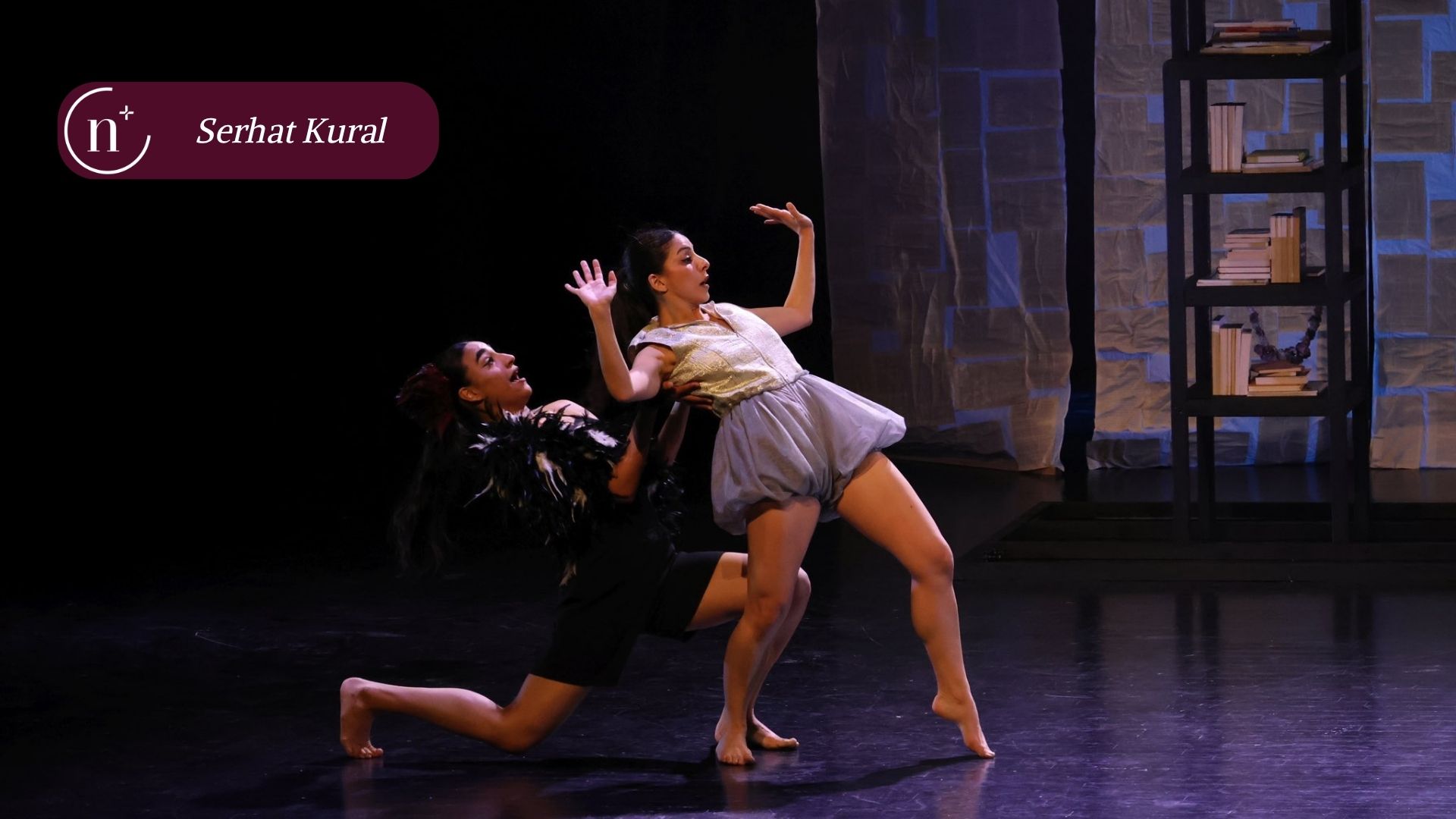
Palestinian dance artist Shaden Abu Elasal, whose dance group, Shaden Dance Company, presented a performance titled “Feathers” at the 11th Amed International Theatre Festival, expressed that she was deeply moved by the Kurdish people’s commitment to their culture. Abu Elasal noted that in her works, she does not merely copy reality but generates something new from it.
The theme of this year’s 11th Amed International Theatre Festival, held in Diyarbakır, was set as “Dialogue for Peace.” Led by the Metropolitan City Theatre, which continues its work under the auspices of the municipality, the festival opened with a reception on April 22nd.
During the ten-day festival, which runs until May 2nd, numerous plays and dance performances by theatre troupes from 19 countries will meet the audience. Various panels and workshops related to theatre will also be organized.
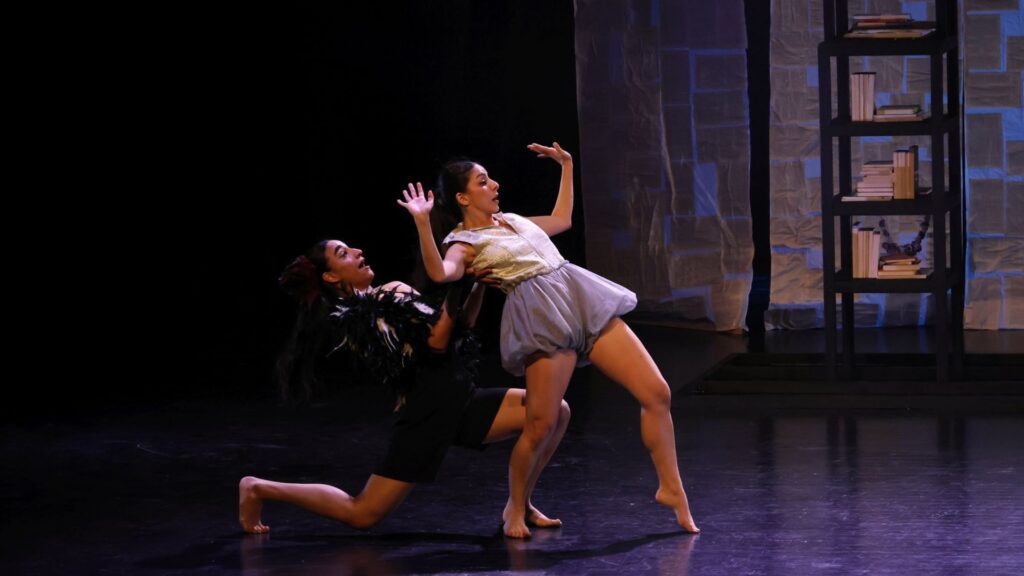
Alongside participants from countries such as Sudan, Ukraine, Syria, and the Kurdistan Region, the Shaden Dance Company from Palestine is among the groups and artists attending the festival. The team’s project, “Feathers,” met with the audience on April 25th at the Çand Amed Grand Hall.
The performance was introduced in the promotional bulletin with the following words: “When our consciousness forms, we realize that we do not know how free we truly are or whether we can ever escape the clutches of power. Feathers explores how power shapes our identity, influences our perception of beauty and goodness, and how it can drive a human being from love to hate. In Feathers, four beings come together and intertwine in scenes that reveal the complexity of human interaction and the forces of power shaping their lives. This is embodied in a love story between two beings—one dominant, the other submissive. The submissive being does not realize what they are.”
Dance and music artist Serhat Kural spoke with the founder of the ensemble, Shaden Abu Elasal, for Niha+ about this dance performance, the experience of being a female dancer in Palestine, and the festival itself.
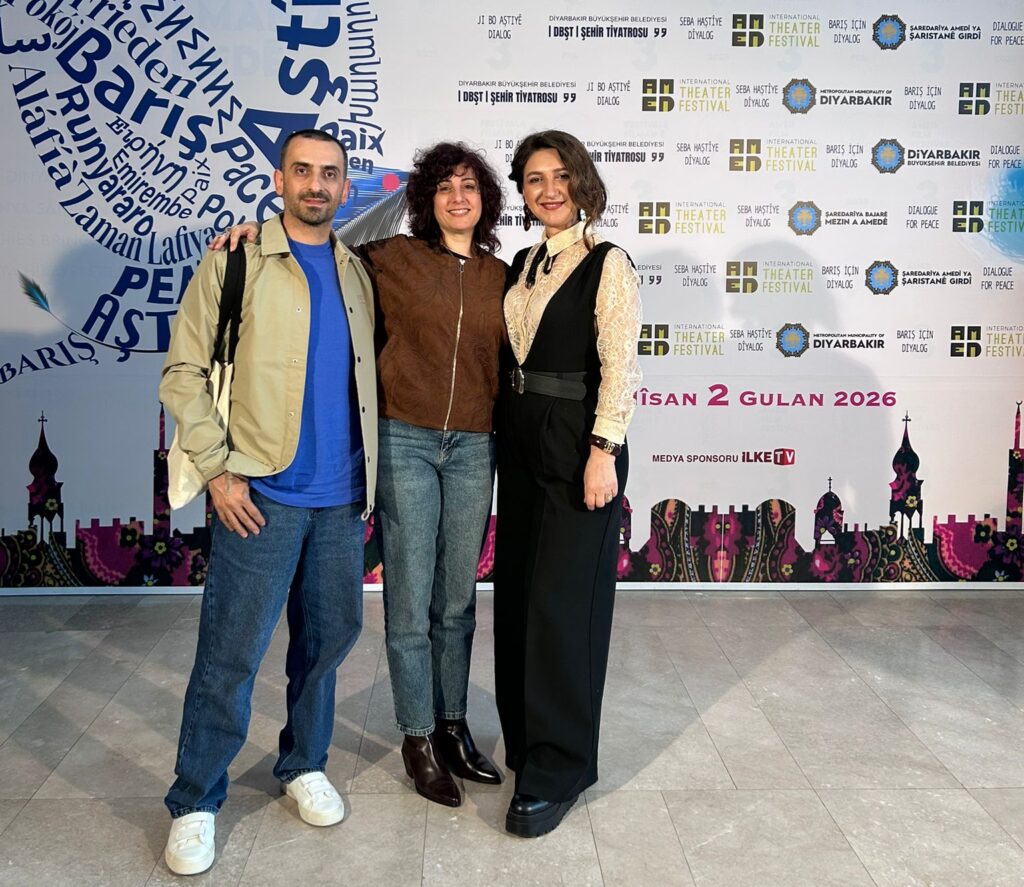
Serhat Kural, Shaden Abu Elasal, Rugeş Kırıcı
Hello Ms. Shaden. Welcome to Amed. Welcome to our International Theatre Festival as a Palestinian choreographer and dancer. First of all, I want to ask: Who is Shaden Abu Al-Assal, and what is the Shaden Dance Company? Could you tell us a bit about yourself?
First, I’m happy to be here and thank you, Serhat, for this interview. I am Shaden Abu Al-Assal. I was born in Nazareth, in the north of Palestine. I finished my degree in Dance at the Academy of Music and Dance in Jerusalem. Then I came back to Nazareth and I started establishing projects and programs around dancing—educational programs. Besides that, I started doing my own creations as an independent choreographer. So, there was one path of education, focusing on dance, ballet, and contemporary dance, and the other line was developing myself as a choreographer. In 2016, I established a dance group for ballet and contemporary dance in Nazareth for ages 14 to 18, and we used dance as a tool for understanding ourselves and understanding the world and our complicated reality. So, besides the technique, we searched the body as a tool for education. In 2019, I established the Shaden Dance Company. After I did many projects as a dancer and created and performed my own dance works, I decided that I would now be only a choreographer and create not on stage, but behind it. I started this in 2019, and there are dancers from Palestine, Palestinian dancers, and also dancers from all over the world.
Could you explain your identity, as a dancer in Palestine and also as a woman? What kind of journey have you had regarding this?
In a society that has been under oppression for many years since the Nakba of 1948, as a third generation of the Nakba, as a Palestinian living in a very “hot” place… it’s a very hard, complicated, and difficult situation. It’s like everyday suffering. So I want to say that the values that I embrace as a woman and as a human being created who I am. I also came from a family that was very active politically and socially. So the meaning of justice, the meaning of equality, and the meaning of respect for humanity were really powerful parts of who I am. Since I was a child, I was asking myself many questions about the world that we are living in, about myself, about what I can do in this situation, and what my influence is. Can I make my voice louder than it is, seeing the suffering of the Palestinians through all these years?
I can understand this very well because our story is more or less the same as Kurdish dancers. When I met you and your group, and when I watched your performance, a part of me was really happy. Another part of me was so sensitive because even when I listened to your panel, you said you created choreography about how power can affect the body. A lot of pieces are also about this, because balance is really changeable and we don’t have to take our decisions for it to be more free. And that’s why I can understand you very, very much. I want to ask about your piece; what did you want to tell us about it? Can you tell us a bit about your project?
Yes, it’s a combination of who I am, how I was created in this reality as a person, and also how I am a revolutionary in my life. Usually, in anything, I look for something different, new, something that is unique. So, in my art, I don’t want to be a victim—not in reality and not in my art. I want to look for this combination of having a message for the world and being an artist that is looking for something new. I don’t want the authority to decide how my art is going to be. So I am very, very sensitive about not wanting to copy reality. I’m taking reality and digging and creating something new. My biggest happiness is when I enter the studio and start searching, and in one moment something is created—something different, something that I haven’t seen before. This astonishment that I have from art makes me feel powerful, and this power makes me survive in this place. I feel my power when I create. I feel my power when I create as I want to create, not as they want me to create. It’s a combination between who I am as a woman and a human being, and who I am as an artist. I hope that you understand me.
Exactly, I understand very much. Do you think you are giving courage to women who live in Palestine as an artist?
I don’t know. I know that I’m giving…
Sorry, I want to open this topic; maybe it can help you. I watched two videos about your pieces. They were so affecting. I saw many women dancers inside, and I think you have many women dancers. You create something and they find an opportunity to do something with you. I have to say you are like a choreographer, but at the same time, a leader as a woman. That’s why I ask this.
I find it hard to talk about it because it’s hard to talk about myself as a leader. I can say that I can affect people around me in a positive way so that they can do something that wasn’t done before. If they have the tools, if they insist, if they believe in themselves and if they work hard, I think that maybe I am an example of that. Because as an Arab woman, I was the first one to study in the Academy of Dance. At that time, the words “contemporary dance” were not common in our society. But I took this step because I wanted to do that. And coming back and creating things there… my performances are not “shows” shaped in a beautiful way. My performance is different; it’s not superficial. And I insist on that. I also succeeded in creating a very good school at a very high level, technically and artistically. So, I think that these students—women that I taught and who dance in this group—maybe, and I hope, see the world differently than how society wanted us to see it. I’m happy that some of them continued dancing and they are finding their own ways now as choreographers. I hope that I had a positive effect on them.
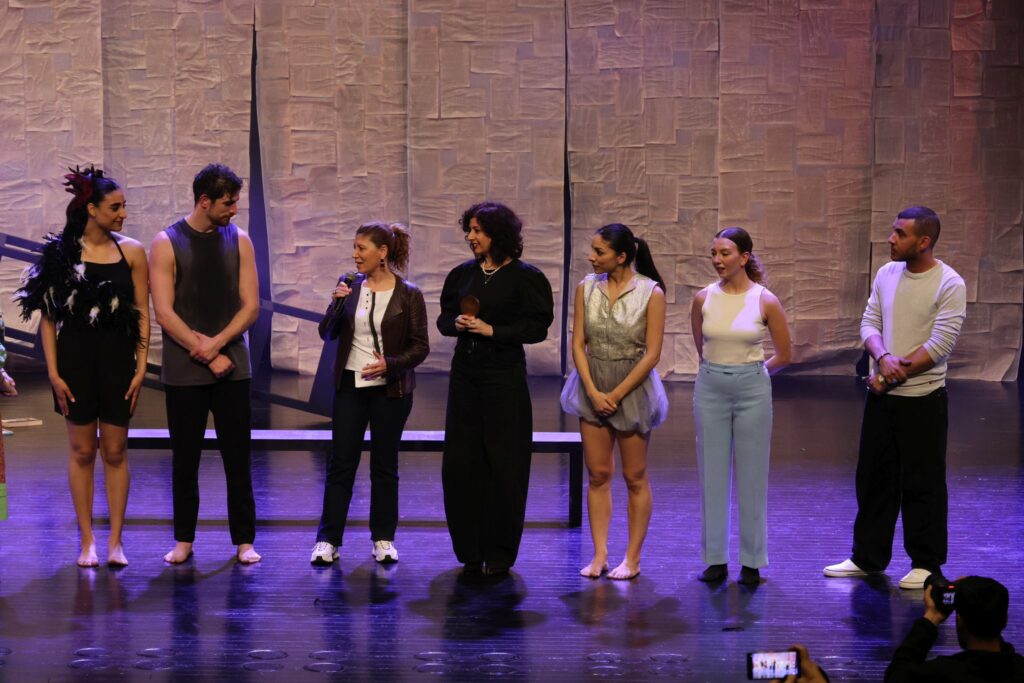
I’m pretty sure you’re going to be an example for these women. I want to talk about your experience in Amed. What do you feel about Amed and about your performance? How did the audience criticize your piece? Could you share a bit of this experience with us?
First of all, the idea of this festival is really powerful and important, both in its panels and performances. Because there is always an attention to shut our mouths. In this festival, they give people who are under oppression the power to stand and to express themselves with all the beauty that this place has. The people are so kind, so generous. I’ve been to many festivals, but being in a festival that a woman is directing… I should say that it’s different. It has its own spirit. I really admire this community, the Kurdish people, for their commitment to their culture and their insistence on expressing themselves through art. They don’t lose their culture. I saw the opening and I said, “Wow.” Yes, I see people here and how connected they are to each other. The position of the woman as mayor is something unique. I think it’s something that I can learn from.
My last question. Deeply, I want to say I have really high respect for the Palestinian community. We are always with you. I know there is a condition that is so difficult. But as I said to you, we are a bit similar. And I hope Palestine is going to be free soon. How do you relate to the audience in Palestine as a contemporary dancer?
I must say, as I said before, that it is new in Nazareth and in the north of Palestine, and also in the West Bank. But people are curious. People come to our performances and they ask questions. Even though sometimes they say, “we don’t understand,” what is good is that we talk to people. There’s a dialogue about it. I must say that the last work, Feathers, because it has a clearer drama and characters, the audience interacts with it more than my previous work, which was more abstract. So I think these kinds of works make the people closer to you. I think sometimes they are afraid of these kinds of performances because they don’t have the tools to analyze them. But when you come to them and you talk and explain, and you say it’s okay, you can take it however you want, people feel comfortable. When they feel comfortable, their imagination works. So I’m happy that we have an audience for this. It is not huge, but there’s an audience that is growing more and more.
Exactly. I understand very much because we are in the same process. We are doing the same way for us to be more understandable for the audience. But another part of us wants to be more abstract. I don’t want to say this is our destiny, but we need a balance to be closer to the audience.
Exactly. And I think it’s so important not to be “above” the audience. Because our work is going on stage, and without this audience, there is no meaning for us. This combination between being loyal to yourself as an artist and staying loyal to your audience… we have to find this balance without giving up our artistic vision.
Thank you very much Shaden.
Spas Serhat.