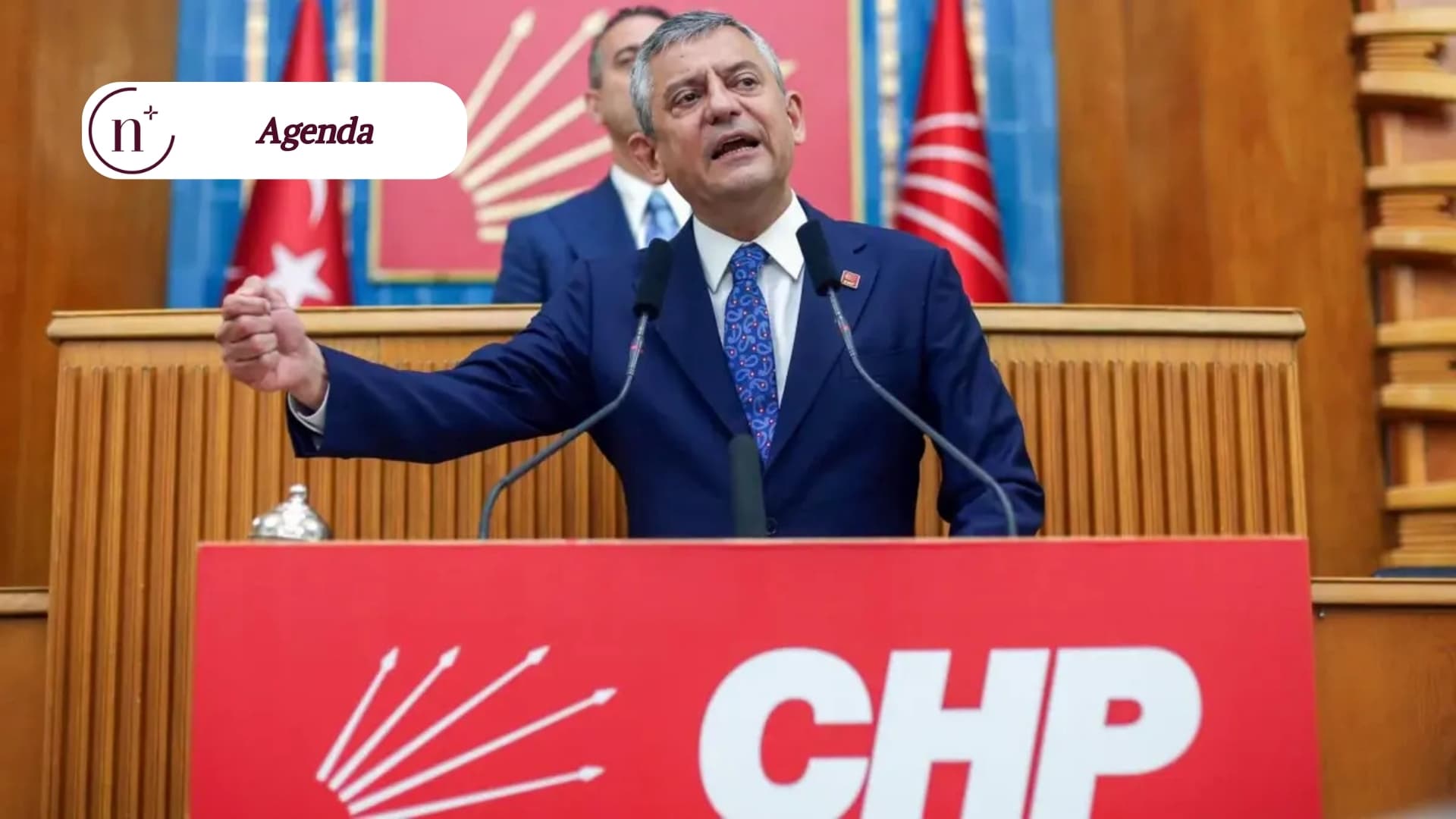
The ALO 153 Solution Center of the Istanbul Metropolitan Municipality (İBB), which previously provided services in Turkish, English, and Arabic, has added the Kurmancî dialect of Kurdish as of today.
The Istanbul Metropolitan Municipality has added the Kurmancî dialect of Kurdish to its multilingual service offerings.
The ALO 153 Solution Center, which operates under the Istanbul Metropolitan Municipality’s Directorate of Public Relations, previously provided services in Turkish, English, and Arabic. As of today, the Kurmancî dialect of Kurdish has been added to the ALO 153 Solution Center.
With this new initiative, Kurdish speakers will also be able to access municipal services in their native language through the call center, where tens of thousands of people each day can submit requests, suggestions, and complaints without having to visit a municipal office.
Previously discussed in the Municipality Council
The implementation of this initiative had been brought up multiple times in the Istanbul Metropolitan Municipality Council.
There had been calls for this initiative to be expanded and implemented across all departments so that Kurds living in Istanbul could rise their concerns and complaints in their native language.
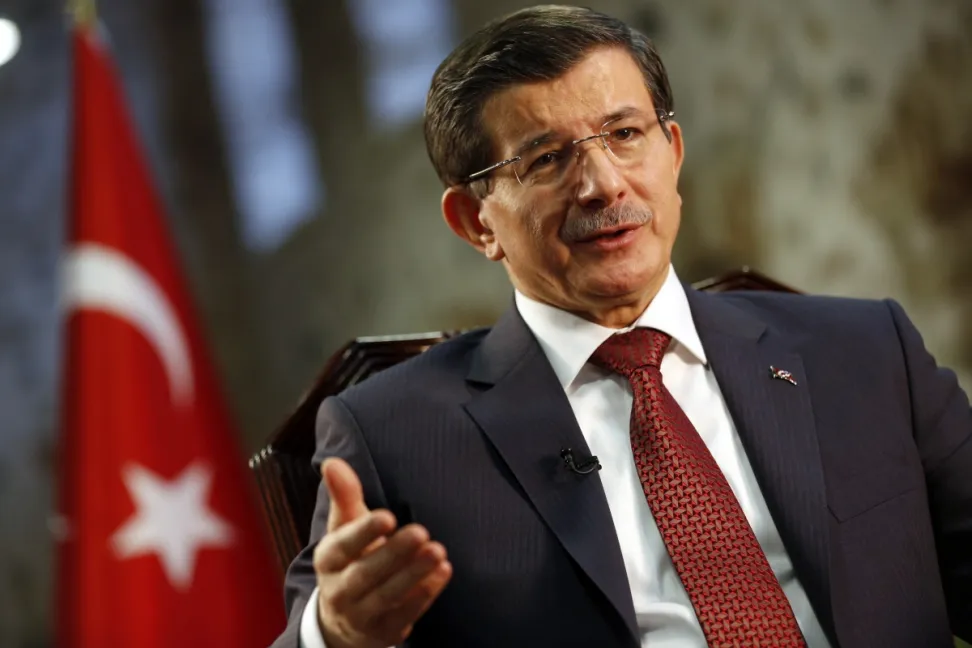
Beginning his public career as an academic, Ahmet Davutoğlu went on to serve as a foreign policy adviser, Minister of Foreign Affairs, and Prime Minister, becoming one of the key political actors during some of the most critical turning points in Türkiye’s recent history.
Photo: Social media
One of the most influential figures in Türkiye’s politics over the past two decades, Ahmet Davutoğlu has announced his retirement from active politics. His political career—from academia to the prime ministership—has been marked by dramatic shifts in foreign policy, widespread human rights violations during curfew periods, urban destruction documented in civil society reports, and controversial security policies that have become part of the country’s political history through his own public statements.
As the chief architect of the Justice and Development Party’s (AKP) foreign policy, Davutoğlu entered the highest levels of government. His political legacy remains closely associated with some of the deepest crises in Türkiye’s domestic and foreign policy.
Former Turkish Prime Minister and Future Party (Gelecek Partisi) leader Ahmet Davutoğlu announced that he is withdrawing from politics and that his party will cease its political activities.
In a written statement, Davutoğlu said that in 2021 they had sought to establish an alliance among three conservative parties in response to an electoral system that effectively made political alliances necessary. After those efforts failed, he said they joined an alliance that balanced the main opposition party “to prevent the dangers of revanchism arising from polarization and to create common ground for social reconciliation.”
He continued:
“After the 2023 elections, we made every possible sacrifice—including our party’s name—in order to ensure that alternative conservative politics would be represented in the Grand National Assembly of Türkiye as a parliamentary group and would emerge as a strong political alternative for the future. We first formed a parliamentary group together with the Felicity Party (Saadet Partisi), and later under the name New Path Party (Yeni Yol Partisi). From the very beginning, we worked to transform this parliamentary group into a single party by first uniting internally and then, if possible, incorporating other conservative parties as well. Where a merger proved impossible, we sought to establish an organic alliance. Unfortunately, these efforts also failed.”
Davutoğlu argued that “the widespread erosion of political ethics and the transfer of members of parliament regardless of party affiliation have made it increasingly difficult to build a strong political alternative and have weakened our parties’ standing in the eyes of society.”
He continued: “At the point we have reached today, we see that the political system in general—and party politics in particular—has reached a profound impasse. On the one hand, power has become increasingly monopolized; on the other, fragmentation has rendered alternative political forces ineffective. The corruption that began at the highest levels of politics has spread, regardless of party affiliation, to political cadres, civil society organizations, and ultimately every layer of society. The existing political mechanisms have largely exhausted their capacity for self-correction.”
Davutoğlu announced his decision to withdraw from party politics and terminate the Future Party’s political activities with the following words:
“In light of these assessments, and following consultations with our party’s authorized bodies and the colleagues who have carried the Future Party to this day, we have decided to withdraw from party politics and end the political activities of the Future Party in order not to become part of the contaminated political climate. This is not a decision of surrender. It is a decision to establish moral distance. It is not an abandonment of politics, but rather a call for everyone to rethink politics.”
From academia to the center of power
Born in 1959 in the Taşkent district of Konya Province, Ahmet Davutoğlu pursued an academic career in international relations.
Known for his work on international relations, strategy, and foreign policy, Davutoğlu developed an approach arguing that Türkiye should make more effective use of its historical and geographical position in international affairs. This vision was most clearly articulated in his influential book Strategic Depth.
Following the Justice and Development Party’s (AKP) rise to power in 2002, Davutoğlu entered government as Prime Minister Recep Tayyip Erdoğan’s chief foreign policy adviser.
In 2009, he was appointed Minister of Foreign Affairs, giving him the opportunity to translate his academic ideas directly into state policy.
During this period, Türkiye’s foreign policy came to be defined by the doctrine of “Zero problems with neighbors.”
From “Zero problems with neighbors” to regional intervention
At the heart of Davutoğlu’s foreign policy vision was the idea that Türkiye should strengthen its relations with neighboring countries and act as a stabilizing regional power.
During the period when relations with Syria improved, Ankara and Damascus significantly expanded their economic and diplomatic ties. However, the popular uprising that began in Syria in 2011 and rapidly evolved into a civil war became the greatest test of this policy. Türkiye soon adopted a much more confrontational stance toward the government of Bashar al-Assad.
The government’s direct involvement in Syria’s internal affairs—guided by the symbolic slogan of the time, “We will pray at the Umayyad Mosque”—marked one of the most controversial turning points in Turkish foreign policy. During this period, the political, logistical, and military support provided to armed opposition groups in Syria effectively made Türkiye a direct party to the conflict.
Security policies and controversial statements
As the Syrian civil war deepened, ISIS emerged as one of the region’s most significant security threats. Türkiye came under both domestic and international criticism over border security, the movement of foreign fighters, and ISIS’s presence within the country.
Some of the statements Davutoğlu made during this period became the subject of intense public debate regarding the state’s approach to ISIS and the limits of its security policies.
While assessing the organization’s rapid territorial expansion in the Middle East, Davutoğlu said that “ISIS may be seen as a radical, terrorist organization, but (…) the situation there reflects earlier grievances and anger that have produced a broad reaction across a wide front.” Although he did not literally describe ISIS members as “angry young men,” these remarks were widely summarized and remembered by the public under that characterization.
Another statement that drew widespread attention came after the 10 October 2015 Ankara Train Station Massacre. Speaking during a television interview, Davutoğlu said:
“We have a list of suicide bombers currently in Türkiye. However, under the rule of law, we cannot arrest them before they carry out an attack.”
The statement, which was widely paraphrased in public discourse as “We cannot arrest suicide bombers before they blow themselves up,” triggered intense criticism, particularly in the aftermath of the Ankara Train Station Massacre.
From the peace process to renewed armed conflict
One of the defining turning points of Ahmet Davutoğlu’s tenure as prime minister was the collapse of the Kurdish peace process and the resumption of armed conflict.
The Peace Process, which began in 2013, entered a new phase with the Dolmabahçe Declaration in 2015. However, escalating violence during the summer of 2015 led to extensive security operations across predominantly Kurdish cities.
During the clashes in Sur, Cizre, Nusaybin, and several other districts, numerous civilians lost their lives, residential areas were heavily damaged, and thousands of people were displaced. As prime minister, Davutoğlu was one of the government’s highest-ranking political officials responsible for the security policies implemented during this period.
Human rights organizations criticized the government’s handling of the curfews, the protection of civilians, forced displacement, and the large-scale destruction of urban areas.
The Civilian Toll of Curfews
Field reports and data compilations by civil society organizations—the Human Rights Foundation of Türkiye (TİHV) and the Human Rights Association (İHD)—clearly documented the devastating impact of the operations on the civilian population:
Civilian Deaths
321
According to the Human Rights Foundation of Türkiye (TİHV), at least 321 civilians lost their lives during the period when curfews were most extensively imposed, between 16 August 2015 and 16 August 2016.
Scope of the Curfews
369 Times
Curfews were imposed 369 times between 2015 and 2019 across 11 provinces and 51 districts. In some locations they lasted for weeks or even months, including uninterrupted curfews exceeding 100 days in Diyarbakır’s Sur district.
Forced Displacement and Destruction
~500,000
Approximate number of people who were forcibly displaced. Urban neighborhoods and historic city centers were devastated during clashes involving the use of heavy weaponry.
Violations of Fundamental Rights
1.5 Million+
More than 1.5 million people living in areas under curfew faced restricted access to water, food, and healthcare. The rights to life, education, health, and housing were systematically violated.
Sur and the “Toledo” remark
One of the areas most severely affected by the clashes was the historic Sur district of Diyarbakır, renowned for its rich cultural heritage and centuries-old urban fabric.
The destruction of Sur and the subsequent reconstruction projects became the subject of extensive public debate.
Among the most controversial statements of the period was Davutoğlu’s pledge:
“We will turn Sur into Toledo.”
The remark sparked criticism from many who argued that it reflected an approach prioritizing urban redevelopment over preserving the district’s historical and cultural identity.
The Ankara Train Station Massacre
The attack targeting a peace rally outside Ankara’s main railway station on 10 October 2015 became one of the deadliest terrorist attacks in Türkiye’s history.
More than one hundred people were killed and hundreds more were injured.
In the aftermath of the massacre, public debate extended beyond the perpetrators themselves to include questions surrounding intelligence failures, security shortcomings, and the state’s obligation to protect the right to life.
Following the attack, Davutoğlu stated:
“We conducted polling after the terrorist attack in Ankara, and there is an upward trend in our support.”
Like his earlier remarks concerning ISIS, this statement provoked widespread public criticism.
In later years, responding to criticism directed at him, Davutoğlu argued that he had never personally used the phrase “angry young men” to describe ISIS. He also maintained that his comments regarding suicide bombers and post-attack polling had been taken out of context and distorted as part of a campaign to discredit him.
Academics for peace
Davutoğlu’s term as prime minister was also marked by intense debate over freedom of expression, press freedom, and academic freedom.
The appointment of government trustees to media outlets, legal proceedings against journalists, and investigations targeting academics drew criticism regarding Türkiye’s democratic standards.
Following the publication of the Academics for Peace declaration titled “We Will Not Be a Party to This Crime” in 2016, criminal and administrative investigations were launched against its signatories.
In subsequent years, the Constitutional Court of Türkiye ruled in several cases that the proceedings against some of the signatory academics had violated their right to freedom of expression.
The period reignited broader debates over how the balance should be drawn between state security policies and fundamental freedoms, particularly freedom of expression and academic independence.
Departure from power
Davutoğlu stepped down as Chairman of the Justice and Development Party (AKP) and Prime Minister in 2016. His departure was widely viewed as more than a routine leadership change; it marked a significant political turning point that reflected shifting power dynamics within the ruling party.
One of the defining episodes of this process was the publication of the document that became known as the “Pelican Brief” (Pelikan Bildirisi), an anonymous manifesto sharply criticizing Davutoğlu and widely regarded as a catalyst for his resignation.
In the years that followed, Davutoğlu increasingly advocated for the rule of law, judicial independence, stronger democratic institutions, and the restoration of institutional checks and balances.
However, this new political stance continued to be evaluated in light of the policies implemented during the years in which he had served in government.
A new party
In 2019, Davutoğlu founded the Future Party (Gelecek Partisi).
The party presented itself as an alternative conservative political movement, emphasizing the rule of law, the separation of powers, judicial independence, and the strengthening of democratic institutions.
Despite these ambitions, the Future Party struggled to establish itself as a major political force. In later years, Davutoğlu sought cooperation with other conservative opposition parties, ultimately participating in parliamentary alliances in an effort to consolidate an alternative political bloc.
Following the 2023 general elections, these efforts resulted in the formation of a parliamentary group first with the Felicity Party (Saadet Partisi) and later under the banner of the New Path Party (Yeni Yol Partisi). Nevertheless, attempts to unite the conservative opposition under a single political organization ultimately proved unsuccessful.
A contested political legacy
Ahmet Davutoğlu’s political career is closely associated with one of the most transformative and contentious periods in Türkiye’s recent history.
As the principal architect of the AKP’s foreign policy, he played a central role in shaping Türkiye’s regional strategy through the doctrine of “Strategic depth” and the policy of “Zero problems with neighbors.” Yet the outbreak of the Syrian civil war, Ankara’s direct involvement in the conflict, and the subsequent deterioration of regional relations fundamentally altered that vision.
His tenure as prime minister also coincided with the collapse of the Kurdish peace process, prolonged curfews and security operations in predominantly Kurdish cities, the Ankara Train Station Massacre, and widespread debates over human rights, freedom of expression, and democratic governance.
While Davutoğlu has consistently argued that some of his most controversial statements were taken out of context and that his later political agenda sought to strengthen democratic institutions and the rule of law, critics continue to hold him politically responsible for many of the policies implemented during his years in office.
With his announcement that he is withdrawing from politics and bringing the Future Party’s political activities to an end, Davutoğlu closes a chapter that remains one of the most debated in contemporary Turkish political history.
The Ahmet Davutoğlu Era: Key Turning Points
2002
Entered government as Chief Foreign Policy Adviser.
2009
Appointed Minister of Foreign Affairs, and the “Zero Problems with Neighbors” policy was officially introduced.
2011
With the outbreak of the Syrian civil war, Türkiye adopted an “open-door” policy at the border and embraced a more interventionist approach toward the Syrian government.
Summer 2015
The Peace Process collapsed. Extensive curfews and military operations began across predominantly Kurdish cities.
10 October 2015
The Ankara Train Station Massacre, the deadliest terrorist attack in Türkiye’s history, took place.
Early 2016
Following the publication of the “We Will Not Be a Party to This Crime” declaration, investigations and dismissals targeting the Academics for Peace began.
May 2016
Following the process associated with the “Pelican Brief,” he was sidelined from the center of power and stepped down as Prime Minister and AKP Chairman.
2019
Founded the Future Party (Gelecek Partisi), launching a new political movement.
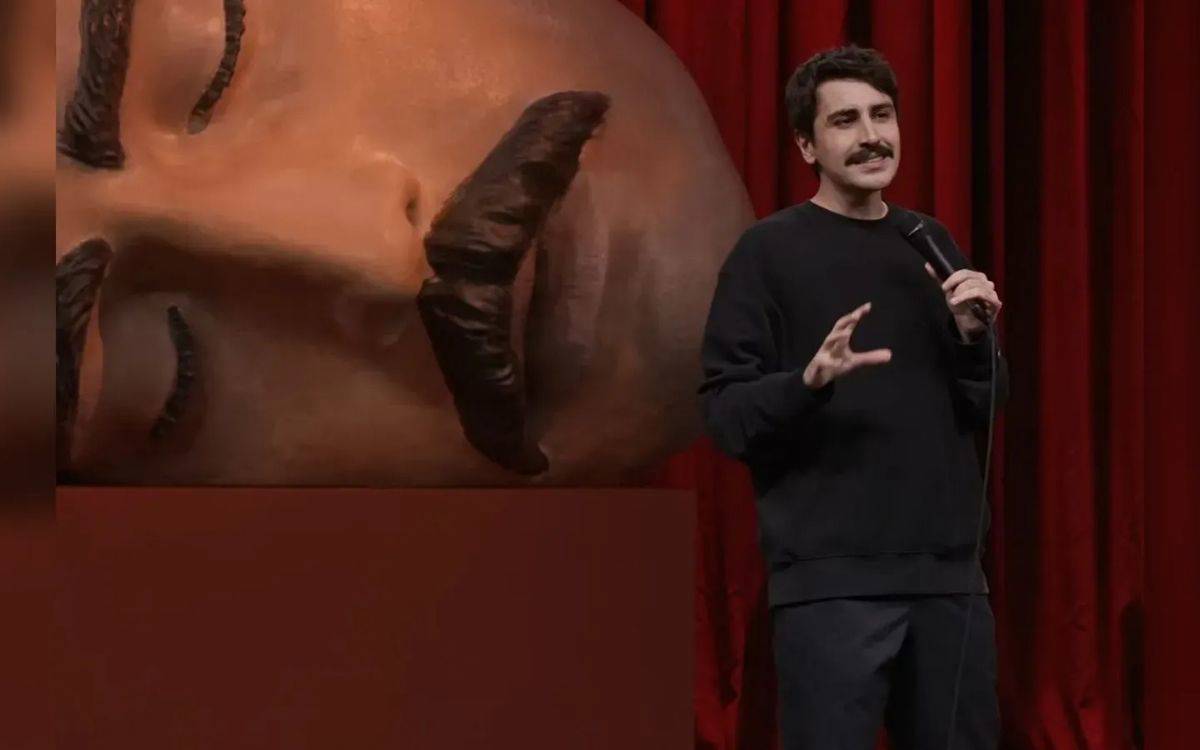
According to research conducted by KONDA, 41 percent of society finds the arrest of comedian Deniz Göktaş “wrong,” while 34 percent said they find it “right.”
In its July 2026 Barometer, KONDA included the case of comedian Deniz Göktaş, who was arrested on July 3 on charges of “inciting the public to hatred and hostility.”
In the study conducted on July 11–12 with 1,895 people, interviewees were asked whether they agreed with the statement, “I find Göktaş’s arrest right.”
While 22 percent of the participants stated they found Göktaş’s arrest “definitely wrong,” 19 percent said they found it “wrong.”
Fifteen percent of the interviewees answered “definitely right” and 19 percent answered “right.”
Survey participants were also asked about the statement, “Anything can be the subject of humor.” Only 16 percent of the interviewees said “I agree” with this statement.
Additionally, the research included analyses of which party participants would prefer to vote for if an election were held today, whom they want to govern Türkiye, potential Presidential election scenarios between President Recep Tayyip Erdoğan and detained Istanbul Metropolitan Municipality (İBB) Mayor Ekrem İmamoğlu, as well as between Erdoğan and Özgür Özel, and an analysis of Erdoğan’s report card grade.
What had happened?
Göktaş was investigated on allegations of “insulting the President” and “degrading religious values” due to statements he used in his stand-up show titled “Ölü Deniz” (The Dead Sea), which was published on YouTube on June 24. Detained at Istanbul Airport on July 2, Göktaş was arrested the following day and sent to the Çorlu Karatepe High-Security Penal Execution Institution in Tekirdağ.
The family of 17-year-old E.K., who was injured when an armored vehicle struck her in the Yüksekova district of Hakkari, said that police had approached people known as “tribal elders” in an effort to get them to withdraw their complaint. Deaths and injuries caused by armored vehicles continue to pose a risk to children in the region.
Photo: Yüksekova Halkın Sesi Journal
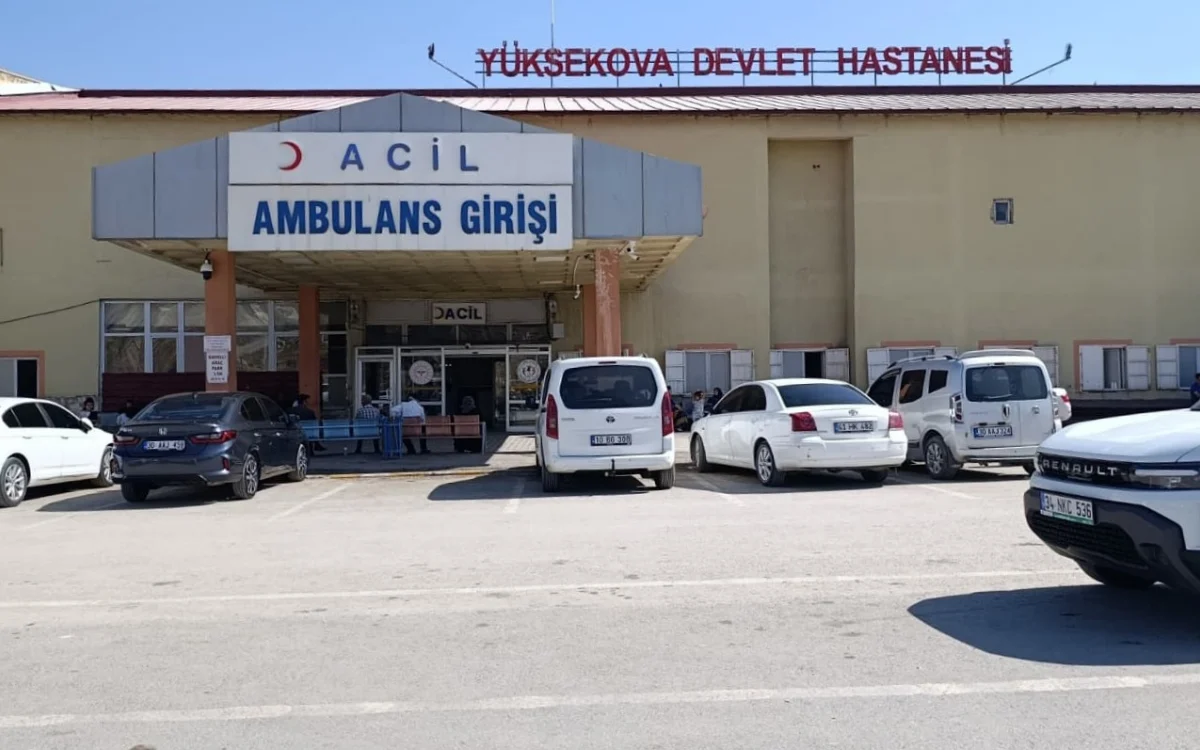
E.K., 17, who was injured on July 24 when an armored vehicle struck him in the Güngör neighborhood of Hakkari’s Yüksekova district, is receiving treatment at Yüksekova State Hospital. Examinations found two fractures in E.K.’s right leg, and she is expected to undergo surgery. The course of his condition remains uncertain for now.
While the investigation into the incident continues, the family has not been given any official notification as to whether any judicial or administrative proceedings have been initiated against the police officers who were driving the vehicle.
“When I heard my daughter’s scream, the vehicle had already thrown her to the ground”
In a statement to Mezopotamya News Agency (MA), E.K.’s mother, Vesile Kına, described how, as she was walking with her daughter, the armored vehicle came speeding toward them at an intersection. Kına said that while she was able to step up onto the pavement, her daughter could not get away, describing the moment with the words: “The road was narrow, but even so the vehicle was coming very fast.”
Kına pointed out that armored vehicles are frequently driven at high speed in the neighborhood, and stressed that this was a safety problem concerning not only her own family but the entire neighborhood.
Family: We were asked to withdraw the complaint
Vesile Kına claimed that after the incident, police approached them and asked them to withdraw the complaint. She said that she had been told “we will do everything we can,” but she would not give up her demand for justice. Kına stated that they wanted the camera footage to be examined and the incident to be brought to light in all its aspects:
“Let the camera footage be examined, let the incident be uncovered in all its aspects. I will defend my daughter’s rights and I will not withdraw my complaint.”
E.K.’s father, Lokman Kına, meanwhile, claimed that the police officers who hit his daughter were trying to have the complaint withdrawn through people known as “tribal elders” who are influential in the region. Recalling that his daughter had previously undergone surgery on her arm twice and that her mother has MS, Kına called for an effective investigation into those responsible: “It happened to us today; tomorrow it could happen to another family.”
A situation that has persisted in the region for years
According to the Diyarbakır Bar Association’s report titled “Violations of Children’s Rights Stemming from Armored Vehicles, Mines and Conflict/War Remnants,” covering the 2011-2021 period, 22 children lost their lives and 27 children were injured in accidents caused by armored vehicles over that ten-year span. The report listed Şırnak, Diyarbakır, Hakkari and Mardin as the provinces where armored-vehicle-related injuries were most concentrated. Hakkari, where E.K. was injured, is also on this list.
The annual rights-violations reports of the Human Rights Association (İHD) also show that this situation remains current. Deaths and injuries caused by armored vehicles continue to be recorded as an ongoing risk to children in the region.
The Kurdish word game “Peyv Link,” which contains more than 200,000 words, is waiting for Kurdish language enthusiasts on Google Play.
The digital word game “Peyv Link,” created as the Kurdish version of the famous game Scrabble, is available for players on the Google Play platform.
The game includes more than 200,000 Kurdish words and their meanings in its dictionary. Users can play either against artificial intelligence (AI) or compete against other players online.
A great workout for the Kurdish mind
Peyv Link is not just a word game; it also serves as a mental exercise to strengthen memory and develop mother-tongue awareness. The connections made between Kurdish words systematically expand players’ vocabularies and keep their minds active.
Users who want to install the game on their mobile devices can search for “Peyv” or “Peyv Link” on Google Play to download it.
Iranian forces attacked Erbil, the capital of the Kurdistan Region of Iraq, this morning with more than 5 drones and missiles. As a result, 8 Peshmerga were killed and many people were injured. Iran also attacked Kuwait, Bahrain, and Syria.
Photo: Rûdaw
The United States (USA) and Israel declared war on Iran on February 28, 2026, and began attacks. In response to the attacks by the US and Israel, Iran also attacked US bases in Gulf countries and the Kurdistan Region of Iraq, and Iran continues these attacks to this day.
On the first day of the attacks, many high-ranking Iranian officials were killed, including Iran’s Supreme Leader Ali Khamenei. The United States named its attacks against Iran “Operation Historical Fury,” and Israel named its attacks “Operation Lion’s Roar.” Iran also launched retaliatory attacks under the name “Operation True Promise-4.”
Since February 28, the start of the U.S. and Israel’s war with Iran, hundreds of attacks have been carried out against the Kurdistan Region before the ceasefire.
On April 8, 2026, U.S. President Donald Trump announced that they had accepted a two-week ceasefire with Iran on the condition that the Strait of Hormuz be completely reopened.
Also, despite the ceasefire being announced, Iran has not stopped its attacks against the Kurds in any way. From February 28, 2026, until the ceasefire on April 8, Iran and its affiliated organizations attacked the Iraqi Kurdistan Region with more than 700 drones and missiles. After the ceasefire, Iran continued its attacks against the Kurdistan Region.
There are dead and wounded
According to RojNews this morning, Iran attacked the border of Hewlêr, the capital of the Kurdistan Region, with more than 5 drones and missiles. The attack was also intercepted by the air defense system.
According to reports, explosions were also heard near the border of the city of Halabja this morning. The official cause has not been confirmed, but it is said that the attack was carried out by a drone.
Also, according to Rudaw news this morning, bases of Eastern Kurdish parties on the Rêzgûz border in Sulaimaniyah were attacked with drones, and a fire broke out.
An official of the Revolutionary Association of the Workers of Kurdistan in Iran announced that they have had dead and wounded from this morning’s attacks on one of their bases in the Sulaymaniyah province.
A member of the Central Committee of the Revolutionary Association of the Workers of Iranian Kurdistan spoke to Rudaw about the drone and missile attacks on their camps, saying:
“Our main headquarters in Zirgiwêzeleya, Silêmaniye, was bombed with 6 missiles and caught fire. According to initial information, we have at least 8 martyrs, and it is likely that this number will increase. There are also a number of wounded, but due to the ongoing fire, the details are not yet clear.”
Iran also attacked Kuwait, Bahrain, and Syria
The Kuwaiti Army released a statement on its official X account regarding the Iranian attacks on their country, saying:
“Kuwait’s air defense is now responding to hostile missile and drone attacks resulting from Iranian aggression.”
In Bahrain, citizens were urged to take shelter Bahrain’s Ministry of Interior announced that warning sirens have been activated in the country. The ministry urged citizens to quickly go to shelters and safe places to protect their lives. Iranian state media confirmed that their country’s military had targeted an airbase in Bahrain that housed American aircraft and helicopters.
Tehran also claimed that the attack was “in response to the enemy’s hostile actions against the country’s urban infrastructure and innocent people.”
Syria
The Iranian Revolutionary Guard announced that in response to the attack in the city of Bampur in Iran’s Sistan and Baluchestan province, they targeted an American military base in Syria.
The Iranian Revolutionary Guard Corps issued a statement on the attack on the Tenef military base.
According to the statement, many American soldiers were killed in the attack. The statement indicated that they “suddenly” attacked the headquarters of the American special operations command in the Tanf region of Syria.
According to the statement, the attack was carried out in retaliation for an American attack on an army military base in the city of Bampur in Sistan and Baluchestan, in which 7 soldiers were killed.
The Public Relations Department of the Iranian Revolutionary Guard Corps announced that in addition to destroying a radar system and several helicopters, a large number of American soldiers were also killed in the attack.
The CHP’s elected leadership has asked Ankara Civil Court of Peace to appoint a three-member convening committee that would take the party to an extraordinary congress.
Özgür Özel, Photo: Agos
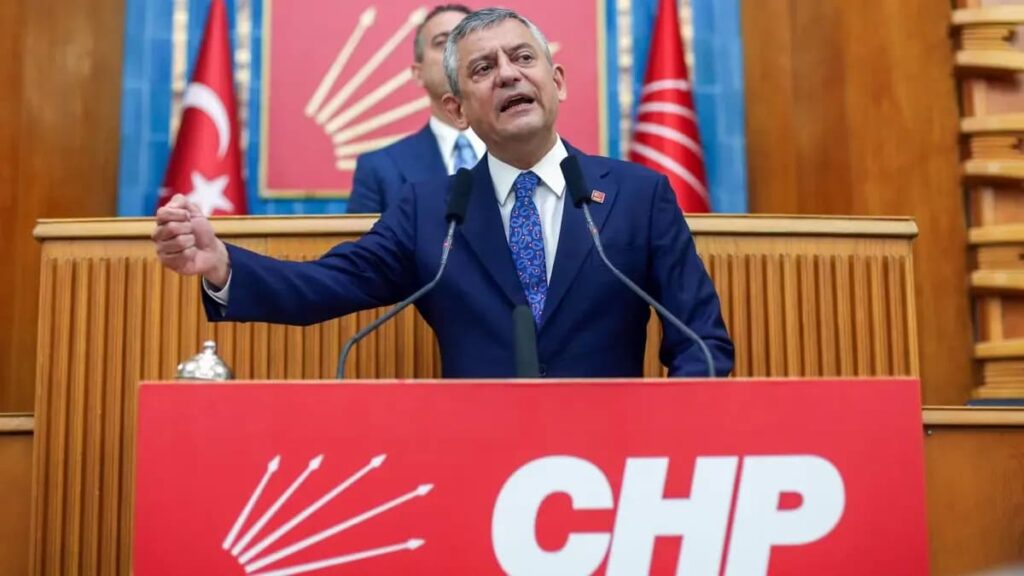
The leadership of Özgür Özel, the elected chair of the Republican People’s Party (CHP), filed a petition with the Ankara Civil Court of Peace on Tuesday (14 July), seeking to convene an extraordinary party congress. In its application, the Özel leadership requested that a three-member convening committee be appointed to call the congress.
According to an information note released after the filing, the process dates back to June. A total of 833 congress delegates submitted a joint, notarised petition for an extraordinary congress, citing the need to “restore democratic legitimacy within the party and convene the congress, the party’s highest decision-making body.” The figure represents more than two-thirds of the congress’s full membership.
The signatures were gathered within the 15-day period stipulated by the CHP’s charter and delivered to the party headquarters on 17 June 2026. As no congress has been called since, the Özel camp argues that the delegates’ collective will has been left without effect.
“Not a matter for the leadership’s discretion”
The case rests on Article 75 of the Civil Code, which allows a civil court judge to authorise three members to convene a general assembly if the executive body fails to do so, upon application by any member. The petition asks that three congress delegates, whose names are to be disclosed at a later stage, be tasked with calling the extraordinary congress.
The information note also cited rulings by the Constitutional Court and the Court of Cassation, arguing that once a sufficient number of delegates demand a congress, the matter is not left to the leadership’s discretion and that this demand is legally binding on the party’s executive. The stated purpose of the case is to enable the 833 delegates to exercise the rights granted to them under the law and the party charter, to uphold democratic functioning within the party, and to secure the convening of the congress.
Emre: “Committee’s sole task will be to convene the congress“
CHP spokesperson Zeynel Emre outlined the limits of the committee’s powers in remarks on Monday (13 July). According to Emre, the three-member convening committee will be tasked solely with calling the congress and will not be able to authorise any spending or carry out any administrative action beyond salary payments.
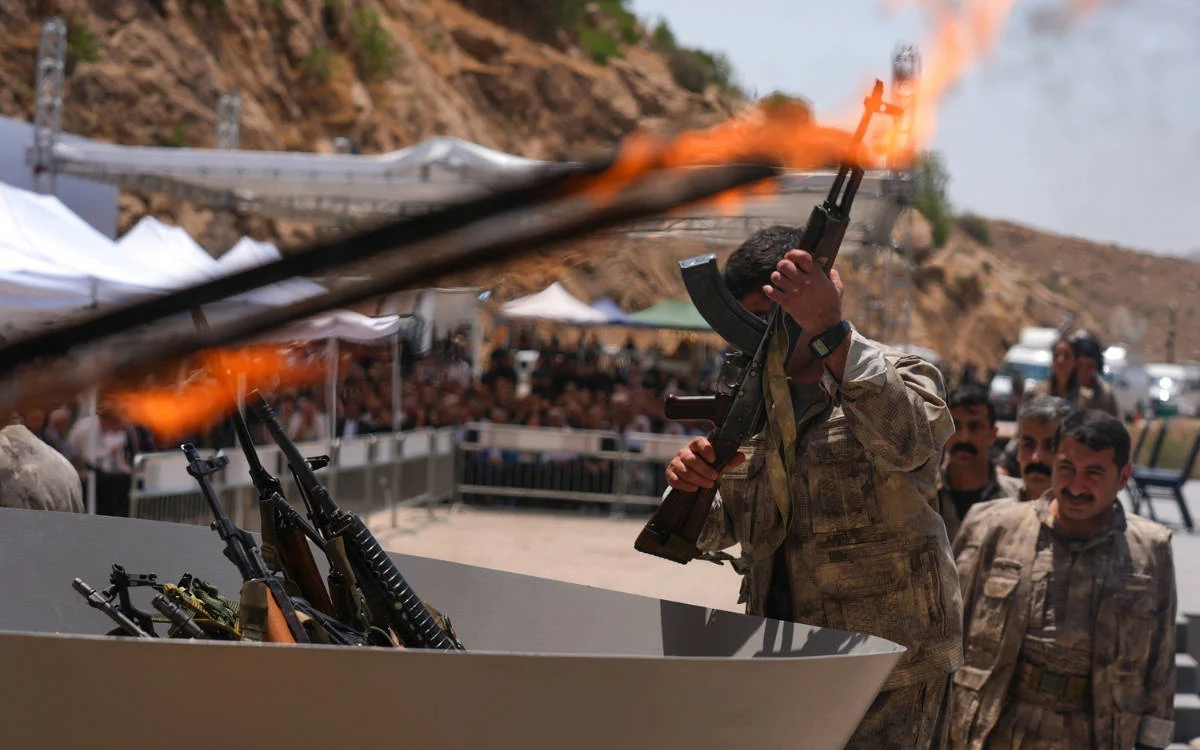
A full year has passed since the historic weapons-burning ceremony held on July 11, 2025 at Casene Cave in Sulaymaniyah, attended by 30 PKK members, which symbolically ended nearly 50 years of armed struggle. We have compiled the behind-the-scenes story of that iconic moment—launched at Abdullah Öcalan’s call and hailed by MHP Leader Devlet Bahçeli as “of extraordinary importance”—along with the testimonies of those who witnessed the ceremony and all the political reverberations of the process up to today.
From the PKK’s July 11, 2025 weapons-burning ceremony, Photo: Yeni Yaşam newspaper
“The PKK’s founding leadership has kept its word and recognized global and regional threats in time. Days of extraordinary importance are being experienced for Turkey and the region.”
These words belong to MHP Chairman Devlet Bahçeli, who made this statement immediately after PKK guerrillas, who had dissolved themselves, burned their weapons in a symbolic ceremony on July 11, 2025 at Casene Cave, located within the borders of the city of Sulaymaniyah in the Kurdistan Region of Iraq.
The weapons-burning ceremony, which produced iconic images of 30 PKK guerrillas, together with the assessments made by both Bahçeli and President Erdoğan, as well as the ceremony’s international repercussions, led to the formation of expectations regarding the advancement of the process following the ceremony.
At the call of PKK founding leader Abdullah Öcalan, at the “weapons-laying-down” ceremony held in Sulaymaniyah, under the Kurdistan Regional Government of Iraq, a total of 30 guerrillas—15 women and 15 men, including KCK Executive Council Co-Chair Besê Hozat—burned and destroyed their weapons.
With this step, the PKK demonstrated that it had ended its roughly 50-year armed struggle through a symbolic weapons-laying-down ceremony.
Around 150 people attended the ceremony, including politicians, intellectuals, rights defenders, and journalists. The delegation included DEM Party Co-Chairs Tülay Hatimoğulları and Tuncer Bakırhan, DBP Co-Chairs Çiğdem Kılıçgün Uçar and Keskin Bayındır, ÖHD Co-Chairs Ekin Yeter and Serhat Çakmak, members of the Peace Mothers Assembly, and DEM Party MPs.
While the delegation was taken to the site where the weapons-laying-down ceremony would take place, around 200 journalists watched the ceremony on a screen set up in the Dukan district of Sulaymaniyah.
The PKK guerrillas, who called themselves the “Peace and Democratic Society Group,” issued a statement saying: “From now on, in order to carry forward our struggle for freedom, democracy and socialism through democratic politics and legal means, and on the basis of the enactment of democratic integration laws, we are destroying our weapons of our own free will.”
The same statement also included the following: “As a step of goodwill and determination for the practical success of the Peace and Democratic Society process, and in order to carry forward our struggle for freedom, democracy and socialism from now on through democratic politics and legal means, and on the basis of the enactment of democratic integration laws, we are destroying our weapons of our own free will in your presence. We hope that this step we have taken will be auspicious for our entire people—women and youth above all—for the peoples of Turkey and the Middle East, and for all of humanity, and that it will bring peace and freedom.”
Niha+ Special Assessment
Ruken Ay Adın
DEMOS Research Collective
“The Peace and Democratic Society Group took the most important step in the peace process, announced to have begun in October 2024: in a ceremony carried out by thirty guerrillas, fifteen of them women, they demonstrated—before more than one hundred fifty people—that they were giving up their weapons and their determination to continue their struggle through democratic politics. One of the institutions taking part was DEMOS, and I was there.”
“I still find myself looking at length at the photographs from that day; each time, I feel anew how priceless, how important a moment it was for everyone present, everyone working for peace, everyone who wants peace.”
“Today marks the first anniversary of that ceremony, of that decision. And as we hand this year over, neither those who burned their weapons at the ceremony are among us, nor have the conditions demanded for them to be able to be among us been met. I say this not from a place of pessimism or impatience, but because it points to the process’s lack of transparency.”
“The disarmament ceremony in Sulaymaniyah was not an isolated event; it was the outcome of a series of thresholds spanning months. At its 12th Congress, held on May 5-7, 2025, the PKK had announced that it was dissolving its organizational structure and ending its method of armed struggle. The weapons-burning ceremony on July 11 was the first concrete expression of that decision on the ground. In October, the PKK carried the process a step further by announcing the withdrawal of all its forces from Turkey.”
“A parallel institutionalization took place on the state side as well: on August 5, 2025, the National Solidarity, Fraternity and Democracy Commission was established within the Turkish Grand National Assembly. The Commission held a total of 21 meetings up to February 18, 2026; heard from 137 individuals and institutions; and shared its final report, adopted by qualified majority, with the public in February. This constitutes the official record of the process.”
“There is a concrete and undeniable gain on the ground: deaths resulting from armed conflict have come to a near-total halt. For a society that has lived through the cost of a conflict spanning decades, this is a threshold that cannot be dismissed.”
“We will certainly go on counting the years since the ceremony, but for this first anniversary, here is what I put on the table: Lasting peace is not merely a matter of confirmation bound to the calendar of the security bureaucracy; it is a matter of social peace, one that extends beyond the security-focused framework and includes all segments of society. In the second year, we will continue to insist on this.”
Reactions to the ceremony
Following the ceremony, Turkish state and government officials as well as Kurdish officials made statements on the significance of the step taken. Pervin Buldan, a member of DEM Party’s İmralı delegation and Deputy Speaker of the Turkish Grand National Assembly, called President Recep Tayyip Erdoğan by phone after the ceremony to thank him. Buldan thanked Erdoğan and MHP Chairman Devlet Bahçeli for their contributions to the process and expressed satisfaction that the process was continuing with the burning of the weapons.
That same day, Erdoğan also held a phone call with MHP Chairman Devlet Bahçeli. Bahçeli expressed to Erdoğan his satisfaction that a group of PKK members had destroyed their weapons.
In a post on social media, President Erdoğan said: “I hope that the important step taken today on the path toward our goal of a Turkey free of terrorism will lead to good outcomes. On this path we are walking for the security of our country, the peace of our nation, and the establishment of lasting peace in our region, may Almighty God grant us the achievement of our goals.”
According to information obtained by ANKA News Agency, MHP leader Devlet Bahçeli also called Buldan by phone to congratulate her. In a statement to ANKA News Agency, Buldan said Bahçeli told her regarding today’s weapons-laying-down ceremony: “Both your effort and your contribution are considerable, so I wanted to thank you. And I also say, ‘may it be auspicious.'”
Who said what about the historic step?
The Government Front
“I hope that the important step taken today on the path toward our goal of a Turkey free of terrorism will lead to good outcomes.”
Recep Tayyip ErdoğanPresident
“These positive developments, which bring solace to hearts, are a turning point… The bad memories will be left behind, and the architect of the new century will be the Turkish nation.”
Devlet BahçeliMHP Chairman
Kurdish Politics
“While the world moves toward armament and the Middle East lives through war, we are burning our weapons. We want to free the peoples from weapons.”
Cemil BayıkKCK Executive Council Co-Chair
“The peoples will be the winners. Equality, democracy and peace will be the winners. We will defend this process with dignity, patience and persistence.”
Tuncer BakırhanDEM Party Co-Chair
Opposition and Regional Reverberations
“We hope that this step will be the beginning of an era in which weapons fall silent for good. The process must be managed under the roof of Parliament.”
Özgür ÖzelCHP Chairman
“Now is the time to heal the wounds and open a new page based on peace and coexistence in North Kurdistan and Turkey.”
Bafel TalabaniPUK Leader
Other Statements on the Process, in Brief
Numan Kurtulmuş– Speaker of the Turkish Grand National Assembly
“The process is proceeding as planned. Everything is proceeding in good faith. I invite everyone to support the process.”
Selahattin Demirtaş– Former HDP Co-Chair (Post shared from his account, featuring a photo of Sırrı Süreyya Önder)
“‘There is no losing side in peace,’ our dear Sırrı Süreyya used to say. Yes, today we have reaped the first fruit of the efforts into which you too poured your heart. There was no losing side, and there will be none.”
Hakan Fidan– Minister of Foreign Affairs
“A very important and gratifying step has been taken toward the goal of a Turkey free of terrorism. We will remain vigilant until the KCK, with all its components, ceases to be a threat.”
Ali Yerlikaya– Minister of Interior
“From now on, it is words, not weapons, that will speak. Hope, not fear, will grow. We are witnessing a historic day on the path toward a Turkey free of terrorism.”
Yılmaz Tunç– Minister of Justice
“A Turkey freed from the scourge of terrorism will now spend its energy on stability, development and prosperity.”
Ömer Çelik– AKP Spokesperson
“Reaching the goal of a ‘Turkey free of terrorism’ will free our country from the burden of terrorism and enable our surrounding region to reach the goal of becoming a ‘region free of terrorism.'”
Ali Babacan– DEVA Party Chairman
“I hope it will be auspicious for our country and that it will help bring about lasting peace and stability. We will continue to follow the process with cautious optimism.”
Ahmet Davutoğlu– Future Party Chairman
Stating that the weapons-burning ceremony was “not an end but a beginning,” he noted that there were still very important stages yet to be passed.
Iraqi Presidency Press Office
“This step sheds light on the future, creating opportunities for peace and coexistence in the region. It is important that this process be legally guaranteed so that all parties may benefit from it.”
Senior Turkish State Officials– Anonymous statements made to Reuters
The weapons-burning ceremony was described as an “irreversible turning point” in the process, with the next steps said to involve efforts toward the “legal reintegration of PKK members into society.”
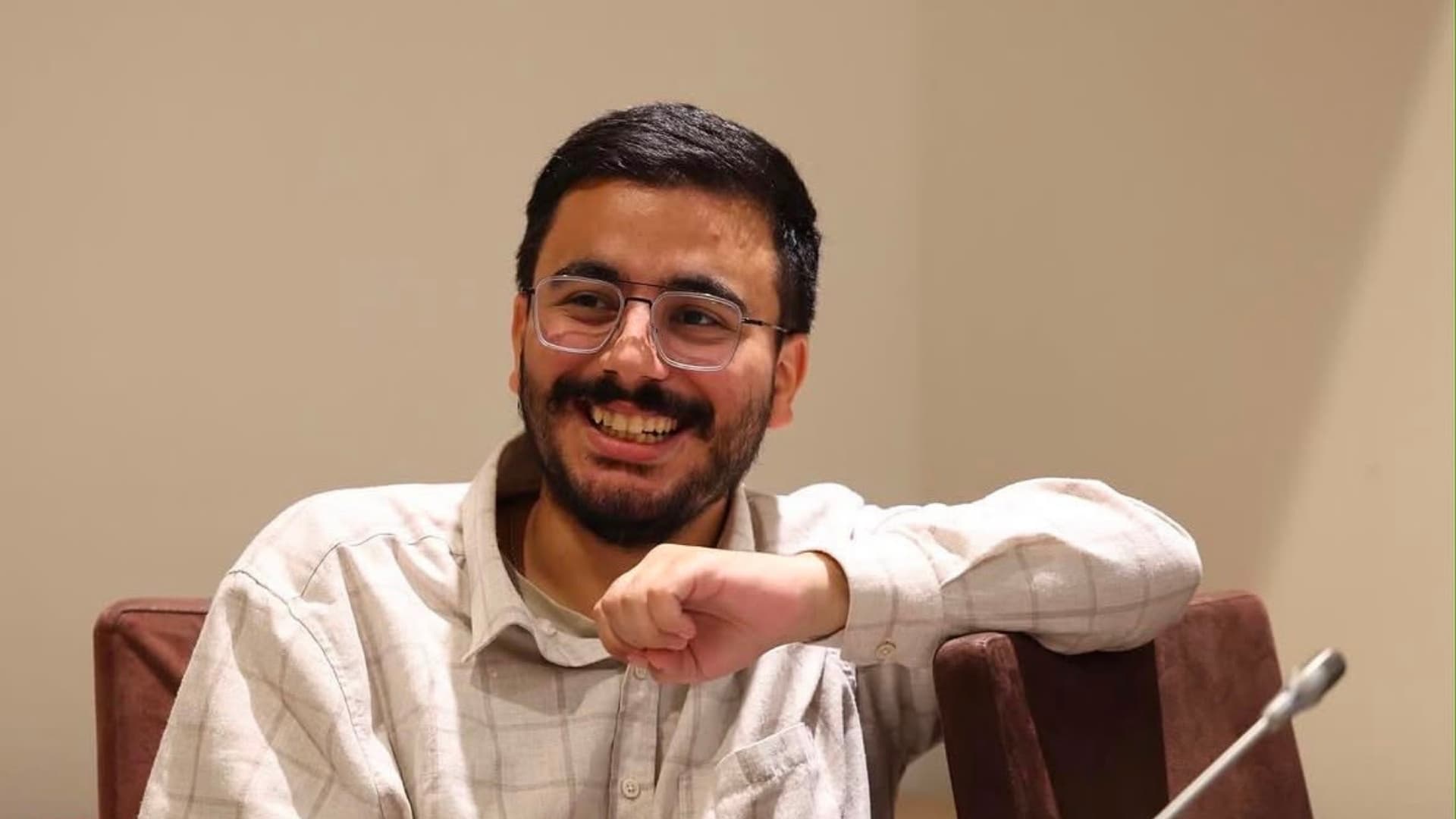
Niha+ reporter Abbas Vural, who was detained following a raid on his residence in Kocaeli ahead of the NATO Summit, was brought to the Kocaeli Courthouse today after four days in police custody. Following his statement to the prosecutor, Vural was referred to court with a request for judicial control. The court released Vural under judicial supervision, imposing an international travel ban.
Abbas Vural
Niha+ reporter Abbas Vural, who was detained on July 5 following a raid on his residence in Kocaeli ahead of the NATO Summit, was referred to court with a request for judicial control after his interrogation by the prosecutor.
Following a four-day period in police custody, Vural gave his statement at the Kocaeli Police Department yesterday and was transferred to the Kocaeli Courthouse today.
After his statement to the prosecutor, Vural was referred to the court with a request for judicial supervision. Lawyer Elif Yetigen reported that Vural was interrogated on alleged charges of “membership in an illegal organization,”“making propaganda for an illegal organization,” and “inciting the public to hatred and hostility.”
Following his testimony in court, Abbas Vural was released under judicial control with an international travel ban. Vural will be required to report to a designated police station to provide his signature every 15 days.
What Happened?
Abbas Vural was detained on July 5 following a raid on his residence in Kocaeli. According to reports, special operations teams and Anti-Terror Branch (TEM) police broke down the door of Vural’s residence on the morning of July 5. Waking the household members with physical assault, the police forced Vural and those with him to the ground, handcuffing them behind their backs. After confiscating phones and computers and obtaining the passwords for the electronic devices, the police conducted identity checks on the residents and detained them after allowing them to change their clothes.
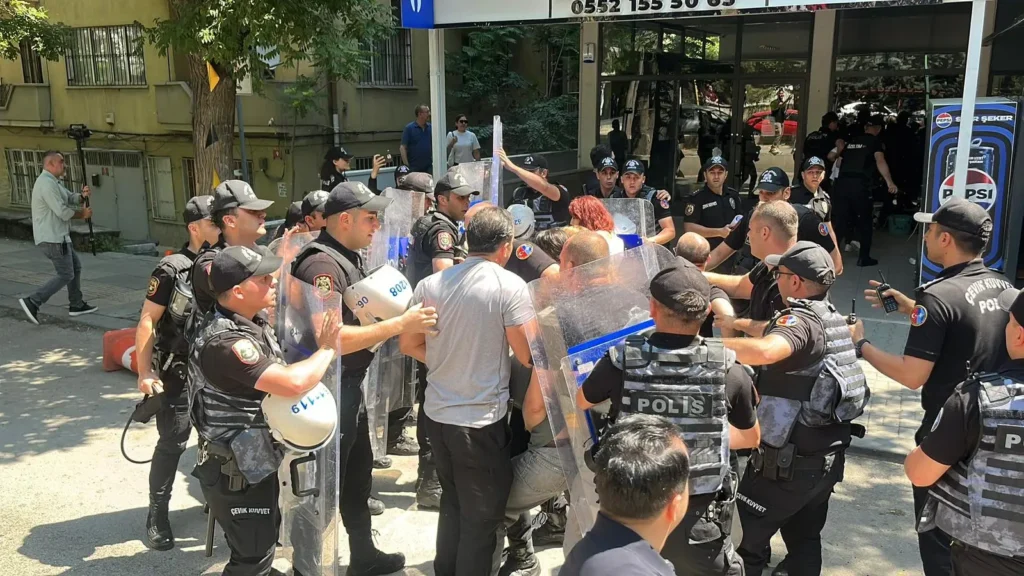
Police intervened against people who had gathered at Kurtuluş Park in Ankara in response to a call by the “No to NATO Coordination,” detaining a large number of people, including representatives of political organizations.
Photo: Emre Orman
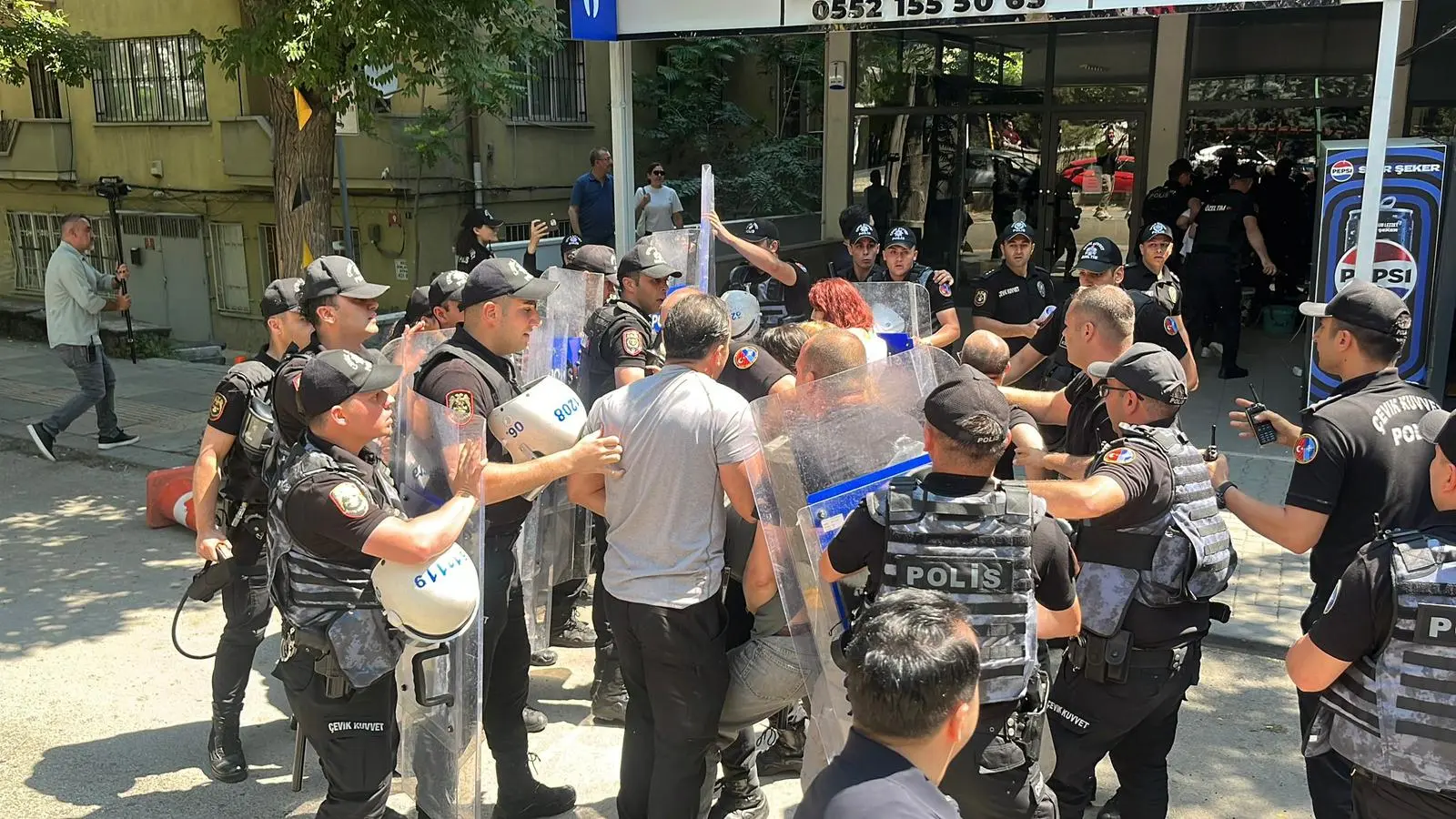
On the first day of the 36th NATO Summit, held in Ankara on July 7–8, police intervened in a protest planned for Kurtuluş Park in Ankara at the call of the “No to NATO Coordination.”
Members of the Peoples’ Equality and Democracy Party (DEM Party) MPs Kezban Konukçu and Perihan Koca, Labor Party (EMEP) MPs İskender Bayhan and Sevda Karaca, Workers’ Party of Turkey (TİP) Chair and MP Erkan Baş, and People’s Houses Chair Sevinç Hocaoğulları were among a group that was surrounded by police around 11 a.m.
The groups under siege frequently chanted slogans such as “Murderer NATO, collaborator AKP,” “NATO get out, this country is ours,” and “Imperialists, collaborators, don’t forget the 6th Fleet.”
According to a post on the Ankara branch of the Association of Contemporary Lawyers (ÇHD)’s X account, 22 TİP students attempting to march toward Kurtuluş Park and approximately 75 people in Dikmen were detained “under torture and ill-treatment.” In addition, numerous individuals—including Halkevleri President Sevinç Hocaoğulları, Ece Ünsal, and ÇHD member Şevval Sarı—were also detained. According to the post by the ÇHD Ankara Branch, nearly 100 people were detained during today’s protests.
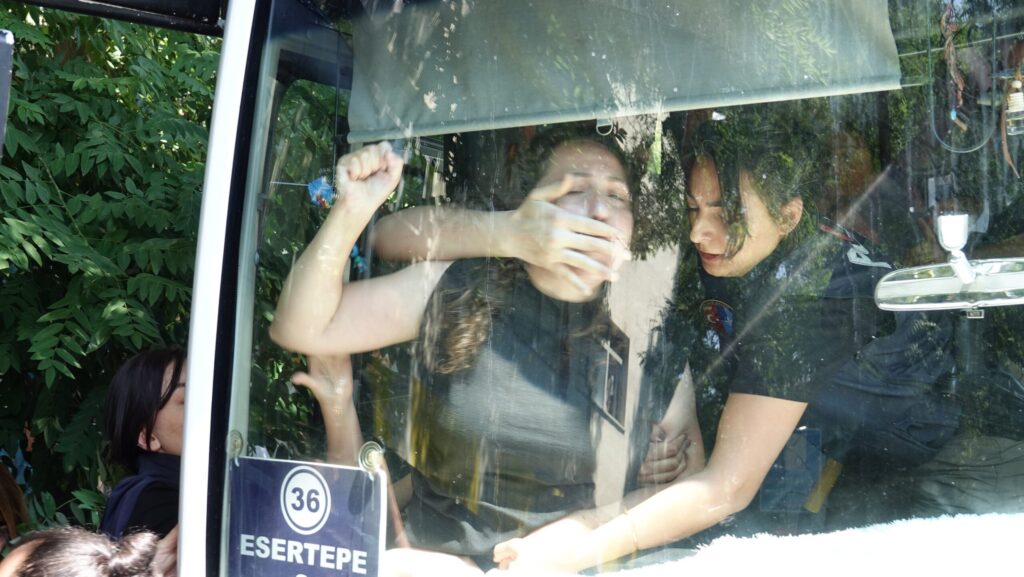
Police, who also intervened in the march held on Dikmen Street, detained Halkevleri Chairperson Sevinç Hocaoğulları, Halkevleri Secretary-General Özgür Ersoy, Legal Secretary Döndü Kurşunoğlu, and Central Executive Committee (MYK) member Nebiye Merttürk, subjecting them to the torture of being handcuffed behind their backs. Footage showed police in the detention vehicle attempting to silence Nebiye Merttürk, a member of Halkevleri’s Central Executive Committee (MYK), by squeezing her mouth and throat.
Nebiye Merttürk, Photo: Emre Orman
Kezban Konukçu, spokesperson for the Socialist Solidarity Platform (SODAP) and DEM Party Member of Parliament, stated in a statement following the police intervention: “Right now, at the meeting point where we gathered to go to Kurtuluş Park, they are detaining people one by one right beside us. They are beating and torturing them. We gathered to say, ‘NATO, get out—this country is ours.’ NATO is a war organization. We will not allow NATO supporters to have a foothold in this country.”
Interference with media workers
Police also intervened against media workers who were covering the protests and filming the detentions.
Erkan Baş, General Chairman of the Workers’ Party of Turkey, noted that Ankara has been under siege for days, stating, “They are detaining and arresting our friends, but they cannot silence the voices opposing imperialism, NATO, and its local collaborators in this country. “Today, we have shown once again that these voices cannot be silenced,” he said. Baş also noted that the police intervened not only against the demonstrators but also against the press covering the protests.
What had happened?
Ahead of the 36th NATO Summit to be held in Ankara on July 7–8, all forms of press statements, marches, sit-ins, setting up booths, distributing leaflets, hanging posters and banners, and hunger strikes were banned throughout the city from June 28 to July 10 by order of the governor’s office.
As part of summit preparations, Ankara’s main roads, diplomatic transit routes, and accommodation areas were closed off. Transportation and access to many areas were restricted around Beştepe, Söğütözü, Anadolu Boulevard, Mevlana Boulevard, Dumlupınar Boulevard, Atatürk Boulevard, and Ankara Boulevard.
Ahead of the NATO Summit, during house raids that continued across Turkey from late June until the day of the summit, a large number of people—including academics, lawyers, students, union members, and political party representatives—were detained. Among those detained was Niha+ reporter Abbas Vural. Of those detained in late June, 236 were subsequently arrested.