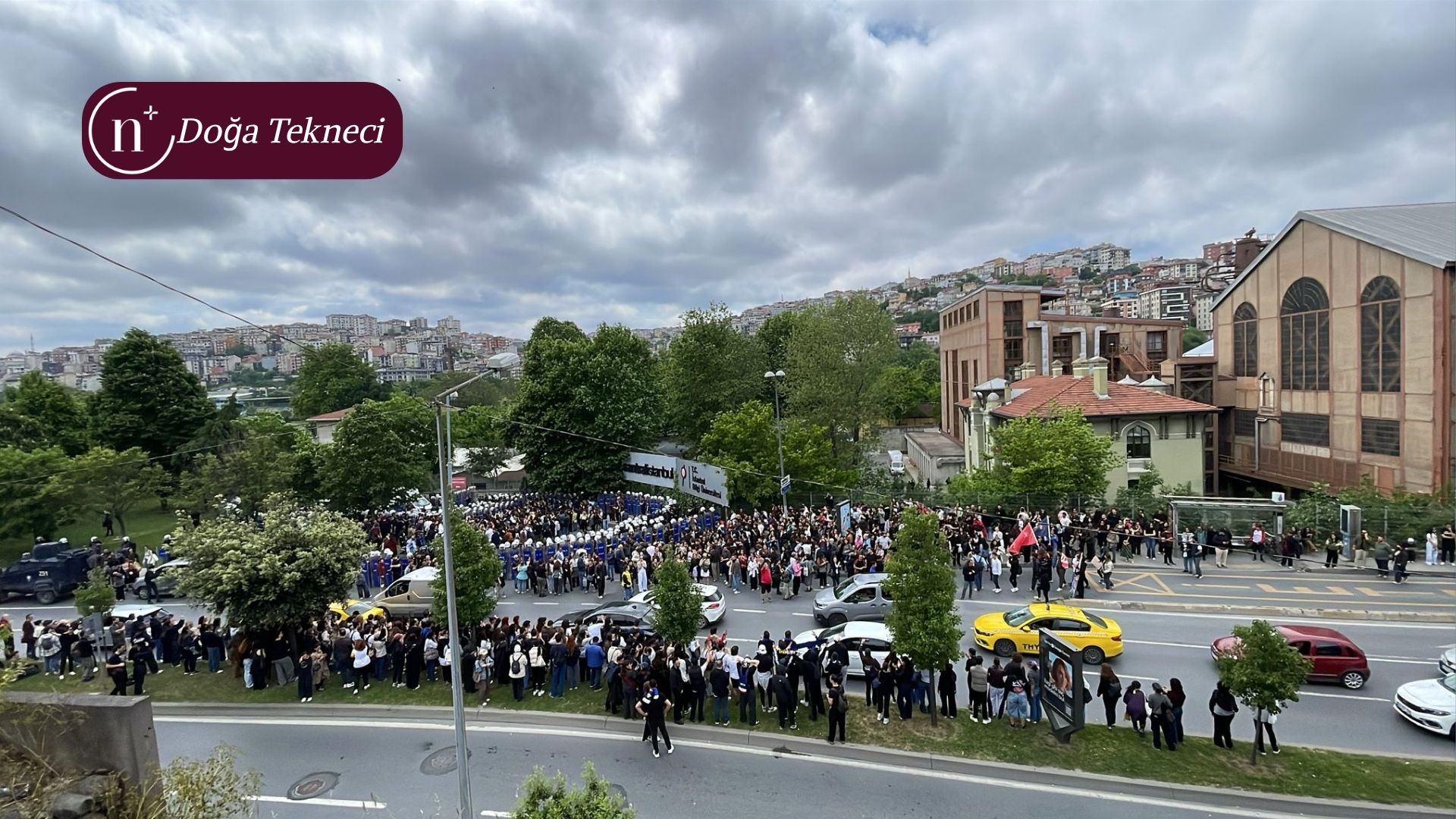
As at least 1,500 employees and at least 20,000 students at Istanbul Bilgi University demand the reversal of the university’s closure decision, reports indicate that no one is being allowed onto campus and that students remaining inside have been forced to leave. H. Işık, a research assistant at the university, said, “It is unacceptable to tell so many people overnight, ‘Do whatever you want.’”
Following the publication of a decision in the Official Gazette on the night of May 22 ordering the closure of Istanbul Bilgi University without any prior notification to students, academics, or staff, protests began on campus. In a statement made around midnight yesterday, Rector Ege Yazgan announced that no students, academics, or food supplies would be allowed to enter the campus.
As protests continue into their third day, students and academics report an increased presence of riot police and plainclothes officers around the university. Police officers and private security personnel are reportedly preventing students and staff from entering or leaving the campus.
Despite these restrictions, students outside the campus threw food and snacks over the fences to those remaining inside.
Students attempting to enter the university through the historic gate were met with a riot police blockade, while students inside the campus reported being forcibly removed from the university. Police were also alleged to have used pepper spray against students. Several students were reportedly detained.
H. Işık, a research assistant at Istanbul Bilgi University, spoke to Niha+ about the closure decision and the developments that followed on campus.
“We expect the decision to be reversed and a statement from the Council of Higher Education”
Işık, who works as a research assistant in the Department of Sociology at Istanbul Bilgi University, emphasized that their primary and most urgent demand is the immediate reversal of the closure decision. He stated that administrative and technical staff, as well as academic personnel, have been left in a state of uncertainty and described the situation as follows:
“As academics and members of the teachers’ union, our first demand is the reversal of the decision. We also urgently expect a statement from the Council of Higher Education (YÖK). What will happen to the staff and academic personnel? We also expect an explanation regarding the future of more than 1,500 cleaning workers, security personnel, and administrative employees.”
Işık stated that access to and from the campus had come under the control of police and private security forces following the closure decision, drawing attention to the heavy security presence around the university:
“There was an incredible number of plainclothes police officers on campus—far too many. It is the same now; they outnumber the students and academics inside.”
“Education at foundation universities should be public”
Addressing precarious working conditions at foundation universities and the commercialization of education, Işık argued that the sudden closure has caused serious hardship for both students and employees:
“For students, this amounts to a complete violation of their right to education. We already know that foundation universities are places that produce a great deal of insecurity. As academics working at foundation universities, we have long been experiencing the commercialization of education, which affects both knowledge production and academic freedom. As unions, we demand the publicization of education and of foundation universities as well.”
“It is unacceptable to tell people overnight, ‘Do whatever you want’”
Criticizing the decision for being implemented without any prior notice, Işık said that thousands of people had been left in a vulnerable position overnight:
“On the other hand, there has been no information whatsoever about what approximately 400 to 500 academic staff members are supposed to do. These are not the first attacks we have faced, but shutting down the university in this manner and effectively telling 1,500 employees and 20,000 students overnight, ‘Do whatever you want,’ is unacceptable.”
Following the police intervention against students, students and staff gathered around 5:00 p.m. and appealed to passing drivers with a banner reading, “Honk for Bilgi.”
The sit-in protest organized by students and staff in front of the university remains ongoing.
What happened?
According to information shared by Bilgi University Student Solidarity on social media, after the closure decision was published in the Official Gazette on May 22, both the Council of Higher Education (YÖK) and the university administration issued statements early in the morning claiming that no one would suffer any hardship. However, shortly afterward, employees’ meal cards and private health insurance coverage were cancelled.
Students gathered at the university at 2:00 p.m. the same day to protest the decision. Although entrances were blocked with barricades and the historic gate was locked, students inside the campus, together with union members and alumni outside, enabled people to enter the university. Protesters marched to the rectorate building, delivered press statements, and launched an indefinite sit-in.
Following a series of forums, students decided to spend the following two nights on campus.
After negotiations with the rectorate, agreements were reportedly reached to provide accommodation for students staying on campus, allow the establishment of an activity tent, permit the entry and exit of food and water, prevent the removal of students from campus, and continue in-person education after the Eid holiday.
While the second day of protests unfolded in a similar manner, the number of riot police units and detention vehicles in the university parking lot increased significantly toward the evening. As of midnight, Rector Ege Yazgan announced that the campus would effectively be shut down. Students, academics, and alumni were banned from entering, while food and water supplies from outside were also prohibited, and these measures began to be enforced. In response, students continued their vigil.