
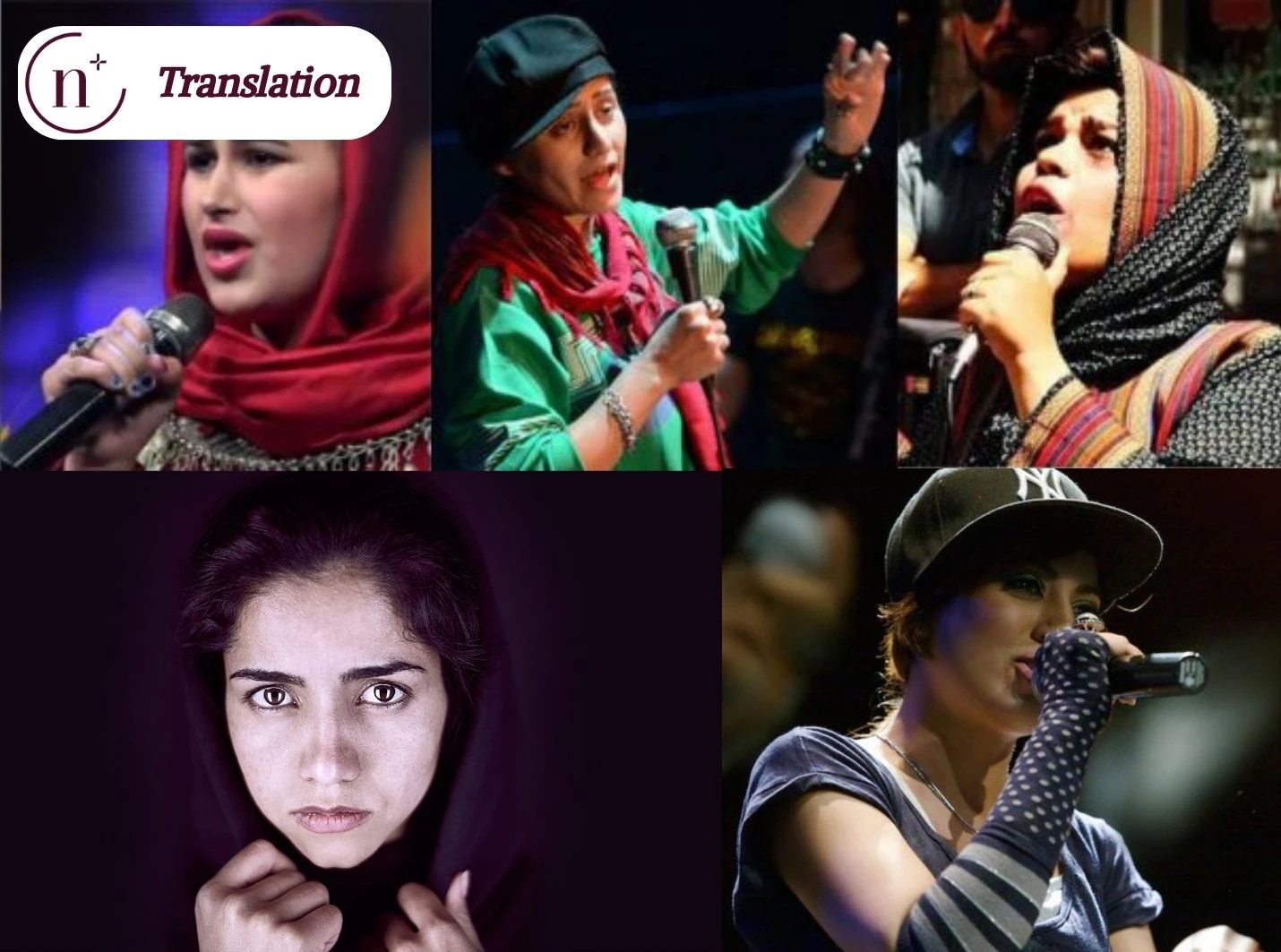
We have translated a report by AWNA (Afghanistan Women’s News Agency) featuring five Afghan female rappers who are raising their voices against misogynistic policies in Afghanistan.
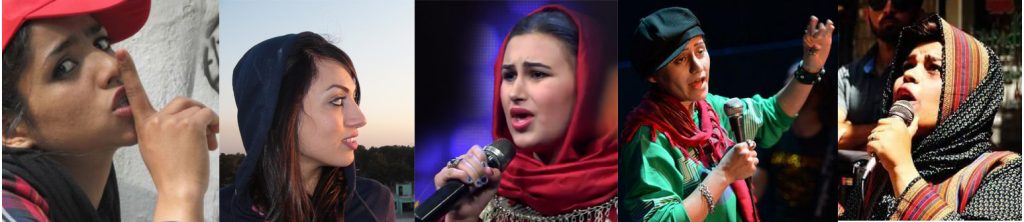
Five female rappers in Afghanistan. Respectively: Sonita Alizadeh, Paradise Sorouri, Ziba Hamidi, Sosan Firoz, and Elina Afghan. Photo: AWNA
The policies of the Taliban administration in Afghanistan restrict women’s right to education, legitimize violence against women, and directly impact their lives through mandatory dress codes and limitations on freedom of movement. Women’s voices are being suppressed not only in physical spaces but also in cultural and artistic production.
Amid this climate of repression, in an Afghan society where male dominance prevails and women are subjected to various forms of violence and pressure, these young women are breaking the silence by raising their voices and expressing their protests through rap music. Most of the people believes that rap music is exclusively for men due to its harsh tone and the movements involved, and they do not consider this style appropriate for young women.
Nevertheless, young women like Sonita Alizadeh, Ziba Hamidi, Elina Afghan, Sosan Firoz, and Paradise Sorouri are successfully using this musical style to voice the unspoken words in defense of women’s rights.
Sonita Alizadeh
Sonita Alizadeh was born in 1996 in the city of Herat, Afghanistan. She spent several years as a refugee in Iran’s Alborz Province. She began composing music, playing the guitar, and singing in 2011 (1391 in the Islamic calendar). In 2014, she stood out among 166 rap artists to win a $1,000 prize. After winning this award, with the support of a charity and a scholarship she received, she was able to continue her education in the Utah, USA.
The themes of the rap songs she performs include Afghanistan, politics, discrimination against Afghan refugees in Iran, and the challenges faced by Afghan women, young girls, and children within Afghanistan’s traditional societal structure.
Ziba Hamidi
Ziba Hamidi was born in 1997 in Karachi, Pakistan. She spent over a decade as a refugee in Iran, where she completed her education. During her time in Iran, she took nearly six months of music training.
Ziba uses rap music to express the pain and sorrow experienced by her people.
Elina Afghan
Elina, who goes by the surname “Afghan,” was born in Mazar-i-Sharif. The 21-year-old artist is a graduate of the Faculty of Law and Political Science at Kabul University. Elina, who has been making rap music for over four years, views the genre as a tool for protest. The artist, who has a total of 15 songs, has performed numerous street shows to voice her concerns and became the first Afghan girl to participate in an art festival held in India in 2016.
The main themes she addresses in her rap songs include: violence against women, orphaned children, street children, street vendors, women’s rights, advocacy, and women’s quest for justice.
Violence against women, orphaned children, street children, and street vendors, as well as women’s rights, advocacy, and human rights activism, are among the topics she addresses in her rap songs. Elina has gained fame for her songs “Woman,” “I’m Not a Prostitute,” “Love,” and “Afghan Girl.”
Soosan Firooz
Soosan Firooz is known as Afghanistan’s first female rap artist. She is a controversial and influential figure who challenges social norms and the traditional roles of Afghan women.
Firooz was born in Afghanistan. Her family fled the country in 1990 and lived in a refugee camp in Iran for seven years during the Afghan Civil War. She then spent three years as a refugee in Pakistan with her family. After the collapse of the Taliban regime, her family returned to Afghanistan and settled in Kandahar in 2003, where her father found work. Soosan initially worked as a carpet weaver alongside her siblings. In 2011, she began her acting career with small local roles, then moved to Kabul and, with her father Abdülgaffar Firooz’s permission, started pursuing rap music.
Firooz, who caught the attention of Afghan musician Farid Rastagar, performs rap songs in the Dari language. Her first single, “Our Neighbors” (Hemsayegan-e Ma), released in 2012, addresses the harsh conditions faced by Afghan refugees; the song was composed by Rastagar based on verses by the poet Sohrab Sirat. Another of her songs, “Nakıs-ül Akl” (The Foolish One), refers to a phrase used in Afghanistan to belittle women.
Firooz lives with her family north of Kabul. She has repeatedly faced acid attacks, kidnappings, and even death threats. Her mother, who works on humanitarian aid projects in southern Afghanistan, has also been threatened with death. Her father, who works for the electricity department, accompanies her to studios and on TV shows, serving as both her manager and her bodyguard.
Paradise Sorouri
Paradise Sorouri is a 24-year-old Afghan singer born in Isfahan, Iran. At the age of 17, she moved to Herat, her father’s hometown, and later relocated to Tajikistan with her husband, Diverse. As the first female Afghan rapper, she released a rap song titled “Feryad-e Zen” (The Woman’s Cry). Through this song she voices the suffering, oppression, and struggles of Afghan women; her work has generated significant buzz on social media, particularly on YouTube and Facebook.
Another of her artistic works is “Nalestan” (Land of Lament), which addresses violence against women in Afghanistan.
The lines in the intro of Paradise’s song, which have drawn the attention of many people, especially women’s rights organizations and activists, are as follows:
“My voice is always filled with pain; it’s not the Arctic, but the air is so cold. I wanted to run, but they shot my waist; I wanted to think, but they shot my head. In the name of Islam, they burned my face; for revenge, they cut off my nose. They poured acid on my hands and body; they sold me, because I am just a woman…”
These striking words serve as a summary of Paradise’s struggle and the severe human rights violations faced by women in Afghanistan.
Resource: AWNA