Kurdish, which was excluded from education, publishing, place names, and public life in Syria for decades, is entering the state’s official education system for the first time in the country’s modern history. Under a regulation announced by the interim Damascus administration on 28 August, Kurdish will be taught for three hours a week in public and private schools in areas with large Kurdish populations, while one additional hour will be allocated to social and cultural activities. The decision marks a new phase in the language repression that has accompanied denaturalisation, Arabisation, and prohibition policies since the 1960s.
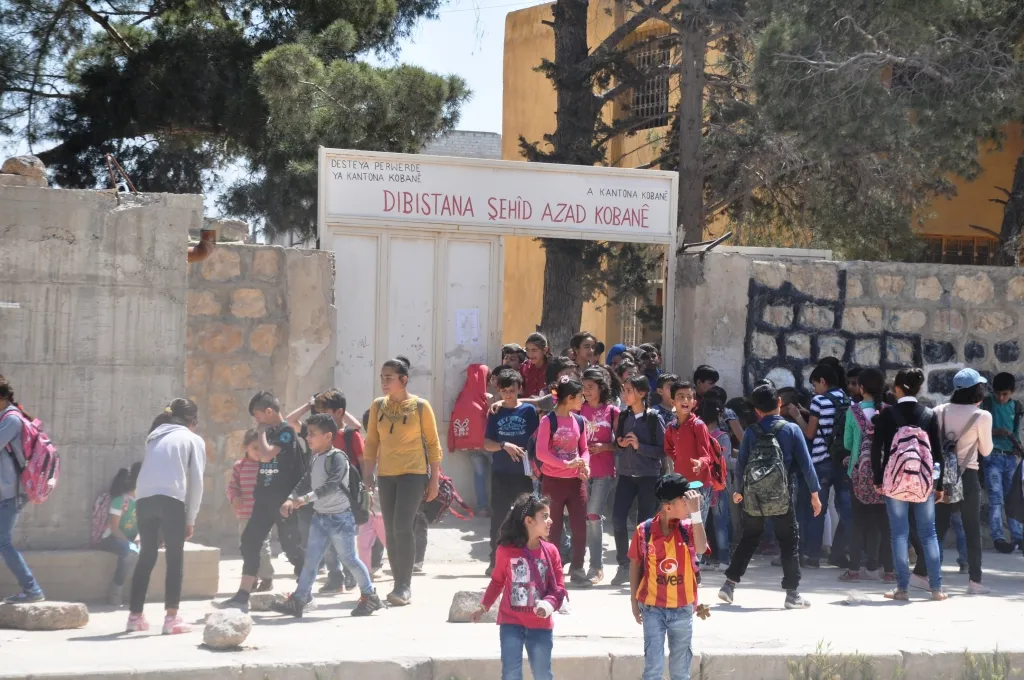
Rojava, Foto: ANHA
Under a decision issued on 28 August 2026 by Muhammad Abd al-Rahman, the Education Minister of the interim Damascus administration, Kurdish was added to the curricula of public and private schools in Kurdish-populated areas as a national language.
Under the decision, an average of three class hours per week will be allocated to Kurdish lessons. One hour per week will also be set aside for Kurdish social and cultural activities.
The decision states that Kurdish will be regarded as one of the core subjects and that students’ grades in the subject will count toward their overall academic average.
The Syrian Ministry of Education also set out the qualifications required of teachers who will teach Kurdish.
Teachers must be university graduates or graduates of teacher-training institutes, with specialisation in Kurdish.
Where necessary, high-school graduates proficient in Kurdish will also be allowed to teach.
Prospective teachers will be required to take written and oral examinations to demonstrate their proficiency in Kurdish.
Kurdish, now incorporated into the education system for the first time in modern Syrian history, had previously been banned by various laws and administrative decisions. Apart from the limited relaxation during the French Mandate period, the ban persisted until the present day.
However, policies toward Kurdish in Syria were not limited to excluding a language from education or public life. Language policy was implemented alongside measures concerning citizenship, place names, personal names, cultural activities, publishing, education, and demographic engineering. Kurdish-language repression in Syria can therefore be seen as part of a broader state policy intended to reduce the public visibility of Kurdish identity and define the country around a single Arab national identity.
Kerim Yıldız’s 2005 study, The Kurds in Syria: The Forgotten People, notes that Syria’s Kurdish population was long estimated at between 1.5 and 2 million, concentrated especially around al-Hasakah, Afrin, Kobani, and Damascus. According to the book, rather than recognising Kurds as an indigenous ethnic or national community of Syria, the state often viewed them as migrants from Turkey or as a security threat. This approach formed the core ideological framework used to legitimise restrictions on the public and educational use of Kurdish.
1920–1946: The French Mandate period
After the First World War, Syria came under French mandate rule. In order to contain Arab nationalism, the French administration pursued a “divide and rule” policy that allowed different communities a degree of local autonomy and space for organisation.
During this period, Kurds, along with some other communities, enjoyed a relatively broader sphere of cultural activity. Kurdish intellectuals and political circles were able to form organisations, while Kurdish publishing and cultural activities became more visible. Hawar, the journal published by Celadet Ali Bedirxan between 1932 and 1943, played an important role in developing a Latin alphabet-based writing system for Kurmanji Kurdish. The journal is considered one of the most significant products of Kurdish cultural life in Syria.
Nevertheless, when France withdrew from Syria in 1946, it left behind no lasting constitutional or legal arrangements guaranteeing Kurdish cultural and linguistic rights. The relative freedom of the mandate era therefore did not evolve into a sustainable rights framework after independence.
1946–1958: The rise of Arab nationalism
After Syria gained independence in 1946, its political system increasingly took shape around Arab nationalism. While the state’s official identity was defined through the idea of “Arab Syria,” the distinct ethnic and linguistic identities of Kurds, Armenians, Syriacs, and other communities were relegated to a secondary position in public life.
Kurdish was not yet banned with the same intensity in every sphere. However, education, state institutions, and official communication were conducted in Arabic. There was no public policy for teaching Kurdish in schools, and Kurdish publishing came under increasingly tight control.
The formation of the United Arab Republic by Syria and Egypt in 1958 reinforced centralist and Arab nationalist policies. According to Kerim Yıldız, during Gamal Abdel Nasser’s rule, Kurds were associated with accusations of “treason” and “separatism”; Kurdish was banned, Kurdish publications were confiscated, and pressure on Kurdish music intensified.
Human-rights reports also indicate that the prohibition of Kurdish publications became clearly institutionalised from 1958 onward. According to these reports, the distribution and publication of Kurdish-language material were banned, and Kurdish was prevented from being used as a language of instruction in schools and universities.
1962: Denaturalisation
One of the most significant turning points in the Kurdish question in Syria was the special census conducted in al-Hasakah Province in 1962.
Decree No. 93 of 23 August 1962 ordered a special census in al-Hasakah. It was carried out in a single day, on 5 October 1962. The government said the purpose was to identify “foreign infiltrators” and regularise population records. However, according to Human Rights Watch, the process was conducted largely arbitrarily. Members of the same family were assigned different statuses, and many Kurds born in Syria were stripped of citizenship.
Kurds were divided into those who retained Syrian citizenship, those classified as ajanib—meaning “foreigners”—and maktumin, or “unregistered” people who were not entered into any official records.
Human Rights Watch reported that around 120,000 Kurds were deprived of citizenship as a result of the 1962 census, while later reports suggested that the figure was tens of thousands higher. A 1996 Human Rights Watch report stated that the government had stripped 142,465 people of citizenship or classified them as foreigners, while Kurdish sources cited higher figures.
Denaturalisation was not a direct language ban. Yet it severely affected the social conditions underpinning Kurdish language and identity. People deprived of citizenship faced difficulties accessing education and public services; lost opportunities to work in public institutions or hold state positions; could not obtain travel documents or passports; encountered problems with property ownership, marriage, and birth registration; and were unable to secure their children’s status.
For this reason, the policy also indirectly weakened the transmission of Kurdish from one generation to the next. Communities whose access to education, official records, and state institutions was restricted could no longer use their language at a public or institutional level.
1963–1970: The Ba’ath regime
When the Ba’ath Party came to power in 1963, the Arab nationalist conception of the state became more systematic. Syria’s political, educational, and administrative institutions were reorganised around Arab national identity.
A 1963 report by Muhammad Talab Hilal, then responsible for internal security in al-Hasakah, is regarded as one of the key documents revealing the state’s approach to the Kurdish population. It proposed removing Kurds from the region, denying them education, restricting their employment opportunities, relocating Arab settlers to the area, and preventing people who did not speak Arabic from voting or holding public office.
These proposals show that policies toward Kurdish were not viewed merely as a cultural matter. For the state, language was treated as a vehicle of Kurdish identity and therefore as a political threat. Speaking Kurdish or carrying out Kurdish cultural activities was frequently associated with allegations of “separatism” or of harming “national unity.”
Reports published in 1967 stated that references to Kurds had been removed from school geography textbooks. Kurdish presence in Syria’s history and geography was thus rendered invisible in the educational curriculum.
1970–1976: The Arab Belt Project
After Hafez al-Assad came to power in 1970, demographic and administrative policies directed at Kurdish regions continued.
From 1973 onward, the project known as the “Arab Belt” or “Arab Cord” was implemented along the borders with Turkey and Iraq in al-Hasakah Province. Human Rights Watch reported that the project extended along a strip approximately 10–15 kilometres wide and 375 kilometres long. Arab families were settled on Kurdish-inhabited land, some Kurdish land was confiscated, and new settlement centres were established.
A report submitted to United Nations human-rights mechanisms states that Kurdish-owned agricultural land in al-Hasakah was expropriated in 1973 and that the Ba’ath Party administration established 41 settlement centres.
The Arab Belt Project affected language in three ways: Kurdish place names were replaced with Arabic names; Kurds’ historical and geographical ties to their land were erased from official records; and efforts were made to reduce the concentration of Kurdish-speaking populations in border areas.
Although the Syrian government announced that the project had ended in 1976, the settlements that had been established were not dismantled, and a substantial number of displaced Kurds were unable to return to their land.
1977: Kurdish place names changed
From the mid-1970s onward, the Arabisation of Kurdish village and town names accelerated.
Instruction No. 15801 of May 1977 ordered the replacement of numerous Kurdish place names in the Afrin region with Arabic ones. During this period, Kobani became Ayn al-Arab.
Place names are not merely administrative labels. They carry communities’ historical memory, relationship with geography, and collective identity. Changing them thus meant not only removing Kurdish from public life but also officially erasing the historical connection between Kurdish communities and the regions where they lived.
The 1980s: Restrictions on public use
During the 1980s, bans on Kurdish began to be enforced through more explicit administrative decisions.
According to information submitted in United Nations documents, the al-Hasakah Governorate banned the use of Kurdish in workplaces through Decision No. 1012/S/25 of 11 November 1986. Another decision, No. 1865/S/25, issued on 13 March 1989, reaffirmed the prohibition on speaking Kurdish and also banned songs in languages other than Arabic at weddings and holiday celebrations.
According to Kerim Yıldız, the 1986 decision also prevented the use of Kurdish in workplaces, cinemas, and cafés. Kurdish was thus suppressed not only in educational institutions but also in a range of public spaces in everyday life.
A secret decree reportedly issued in 1982 again banned the use of Kurdish as a language of instruction in schools and universities, as well as its use and teaching in official institutions. The implementation of this decision made the institutional transmission of Kurdish almost impossible.
As a result, Kurdish children could not receive education in their mother tongue. Kurdish literacy instruction remained outside formal educational institutions, and some families were forced to organise classes at home or in secret to teach their children Kurdish.
The 1990s: Bans on names and publishing
During the 1990s, bans on Kurdish expanded to personal names, business names, and publishing.
From 1992 onward, it became more difficult to give children Kurdish names in al-Hasakah. According to Kurdish sources, instructions from the Ministry of Interior required approval from security authorities for non-Arabic names. This practice particularly targeted Kurdish names.
Intervening in a child’s name showed that language policy had extended into family and private life. The state also controlled how a child’s identity would be expressed in official records.
In 1994, al-Hasakah Governor Subhi Harb ordered businesses bearing Kurdish names to change their names into Arabic within one week. Local authorities were instructed not to issue licences to Kurdish-named shops, hotels, and restaurants. Existing businesses could be closed or their owners subjected to legal action. Human Rights Watch reported seeing Arabic, Armenian, and Russian signs in Syria in 1995, but no Kurdish signs.
The printing, distribution, and import of Kurdish books and magazines were largely prevented. Publishers and printing houses risked punishment under broad and vague pretexts such as “national security,” “national unity,” or “public order.”
Those who wanted to publish in Kurdish sometimes had to print their work in neighbouring countries such as Lebanon and smuggle it into Syria. The 2002 arrest of Ibrahim Nasan for distributing Kurdish cultural and educational materials is one example showing that this policy continued into the 2000s.
2000–2010: Continued restrictions
Although Bashar al-Assad’s rise to power created expectations of reform in some circles, the state’s basic policy toward Kurdish did not change.
Kurdish was not recognised as an official language. Kurds were not allowed to open private language schools or institutions providing education in Kurdish. While Armenian, Syriac, and Circassian communities were able to establish linguistic and cultural institutions to a limited extent, no comparable space was opened for Kurds.
Kurdish-speaking teachers were prevented from using Kurdish at school. Pressure on Kurdish publications continued. Kurdish music, cultural gatherings, and Newroz celebrations were subject to security monitoring.
The events that began in Qamishli in 2004 again demonstrated that the Kurdish question was handled through the state’s security-centred approach. Kurdish activists, journalists, and people involved in cultural activities were detained after the events. Kurdish publishing, cultural expression, and political organising were often treated together as suspected “separatist activity.”
Reports submitted to the United Nations stated that the Syrian government used investigations, detention, restrictions on movement, and criminal charges to prevent Kurds from speaking their mother tongue. The same report noted that Kurdish use was not officially recognised and that the administrative decisions of 1986 and 1989 remained in force.
The situation after 2011
The outbreak of war in Syria in 2011 brought a de facto change in the status of Kurdish. As the Syrian government’s control over the north and northeast weakened, Kurdish political and military structures took control of certain areas.
From 2012 onward, the Autonomous Administration of North and East Syria began using Kurdish in education and public life. Kurdish was included in the education system alongside Arabic and Syriac. In some regions, children received instruction in their mother tongue in the early years, with other languages added to the curriculum in later grades.
This development represented a significant break from the Arabic-centred education policy maintained by Syria’s central government for decades. However, diplomas and educational documents issued under this system were not fully recognised in the rest of Syria or internationally. This created difficulties for Kurdish-educated students seeking admission to university and official recognition of their qualifications.
Meanwhile, after Afrin came under the control of Turkey-backed forces in 2018, Kurdish education and public use faced a new source of pressure. Reports stated that the region’s curriculum was reorganised around Turkish and Arabic and that Kurdish’s place in education was weakened. Thus, in the post-war period, pressure on Kurdish ceased to be concentrated in one centre; policies of different actors in different regions became decisive.
2026: Kurdish becomes a national language
The year 2026 marked a significant change in the legal status of Kurdish in Syria.
According to a SANA report of 26 August 2026, Decree No. 13, issued by Ahmed al-Sharaa, head of the interim Damascus administration, on 16 January 2026, defined Kurds as an integral and inseparable part of the Syrian people and recognised Kurdish as a “national language.” The decree permitted Kurdish to be taught in public and private schools in areas with substantial Kurdish populations.
Under the Ministry of Education’s decision of 28 August, Kurdish will be taught in schools beginning in the 2026–2027 academic year.
It was not a policy about language alone
This historical trajectory shows that language policy in Syria cannot be considered in isolation. The banning or suppression of Kurdish was implemented alongside denaturalisation, forced displacement, land confiscation, the changing of place names, the rejection of Kurdish names, and the control of publishing.
In other words, the state regarded Kurdish not simply as a “foreign language,” but as an element carrying Kurds’ collective identity and political demands. For this reason, speaking, writing, teaching, or making Kurdish visible in public was often transformed from a cultural activity into a matter of security.
A long process of prohibition
The history of Kurdish in Syria is as much a history of prohibitions and repression as it is a history of preserving the language within families, in clandestine lessons, at cultural gatherings, and in the diaspora. The limited cultural freedom of the French Mandate period was curtailed by Arab nationalist state policies after independence. The 1962 census weakened the social and institutional transmission of the language by stripping a significant section of the Kurdish population of citizenship. The Arab Belt Project of the 1970s deepened this policy through changing place names and demographic interventions. From the 1980s through the 2000s, restrictions continued on the use of Kurdish in education, workplaces, publishing, and personal and business names.
After 2011, a new period began for Kurdish education and administrative use in northeast Syria. Yet this development did not become a common legal framework across the country. The recognition of Kurdish as a national language in 2026 and its introduction as a school subject are viewed as a significant break with the former policy of denial. Whether this will develop into a lasting rights framework will depend on whether use of Kurdish in universities and public institutions is guaranteed, and on how the legacy of denaturalisation is addressed.
From Prohibition to the Curriculum: Kurdish Returns to Public Life in Syria
The interim Damascus administration’s decision of 28 August 2026 adds Kurdish to the curricula of public and private schools in Kurdish-populated areas as a national language. The move is seen as the beginning of a new era for a language excluded from education, publishing, and public life for decades.
01 / What is at the centre of the decision?
The new regulation does not treat Kurdish merely as an elective or symbolic activity. Kurdish grades will count toward students’ overall academic average, and the language is defined as one of the core subjects. Teacher selection will also require Kurdish specialisation and written and oral proficiency examinations.
For the first time in modern Syrian history, Kurdish is becoming part of the official education system.
Apart from the limited cultural freedom of the French Mandate period, Kurdish was largely excluded from education and public life under post-independence state policies.
Teaching requirement / Specialisation
Teachers of Kurdish must be university graduates or graduates of teacher-training institutes, with specialisation in Kurdish.
Where necessary / Temporary solution
When qualified teachers are unavailable, high-school graduates proficient in Kurdish may also be permitted to teach.
02 / Before the decision: Four historical thresholds
Rather than a conventional timeline, this section focuses on four periods that shaped Kurdish’s public status: limited cultural space, state-led exclusion, the spread of bans into daily life, and the de facto education system that emerged after the war began.
Limited cultural space under the Mandate
During the French Mandate, Kurdish intellectuals had a relatively broader space for organisation and publishing. Celadet Ali Bedirxan’s Hawar journal, published from 1932 to 1943, helped develop a Latin alphabet-based writing system for Kurmanji.
Arab nationalism and exclusion
After independence, the state’s official identity was built around Arabness. The 1962 al-Hasakah census stripped thousands of Kurds of citizenship; from 1973, the Arab Belt Project was implemented and Kurdish place names were Arabised.
Bans spread into everyday life
Kurdish use was restricted in schools, workplaces, publishing, and cultural events. Kurdish names, signs, books, and music faced administrative oversight, bans, and the risk of criminal penalties.
From de facto education to official status
After 2011, Kurdish entered the education system in northeast Syria alongside Arabic and Syriac. The model was not recognised nationally, but the 2026 decision makes Kurdish part of the central education system for the first time.
03 / It was more than a ban on a language
Language policy was part of a broader system designed to limit the public visibility of Kurdish identity.
Repression of Kurdish in Syria was not only about the language used in textbooks or government offices. Denaturalisation, displacement, changes to place names, rejection of personal names, control of publishing, and restrictions on cultural activities were interconnected policies. In this framework, speaking, writing, or teaching Kurdish was often treated not as a cultural right but as an issue of security and “separatism.”
Barrier to mother-tongue education
Kurdish was not a language of instruction in state schools for decades, and private Kurdish educational institutions could not be opened.
Loss of citizenship
The 1962 census produced statelessness that limited tens of thousands of Kurds’ access to education and public services.
Spatial memory
Changing Kurdish village and town names erased the language’s traces in geography from official records.
Pressure on publishing and culture
Books, magazines, music, and cultural activities were restricted through censorship, confiscation, and the threat of investigation.
The 2026 decision is a historic threshold, but it does not mean that language equality has been achieved.
Bringing Kurdish into the education system is a clear break with the former policy of open prohibition and denial. Yet the decision does not grant Kurdish official-language status equal to Arabic, and it limits implementation to Kurdish-populated areas. Its durability will depend on teacher and curriculum capacity, the possibility of using Kurdish in universities and public institutions, and how the consequences of past citizenship exclusion are addressed.
Sources
- Kerim Yıldız, The Kurds in Syria: The Forgotten People
- Human Rights Watch, Syria: The Silenced Kurds
- Kurdish Initiative for Syria, Persecution and Discrimination against Kurdish Citizens in Syria
- Syrians for Truth and Justice, How the 1962 Census Destroyed Stateless Kurds’ Lives and Identities
- Syrians for Truth and Justice, Curricula in Afrin: Between “Turkification” and Restrictions on the Kurdish Language
- North Press Agency, Multi-language Curriculum in Northeast Syria Lacks Official Recognition
- Syrian Arab News Agency (SANA)
- Kurdistan24