
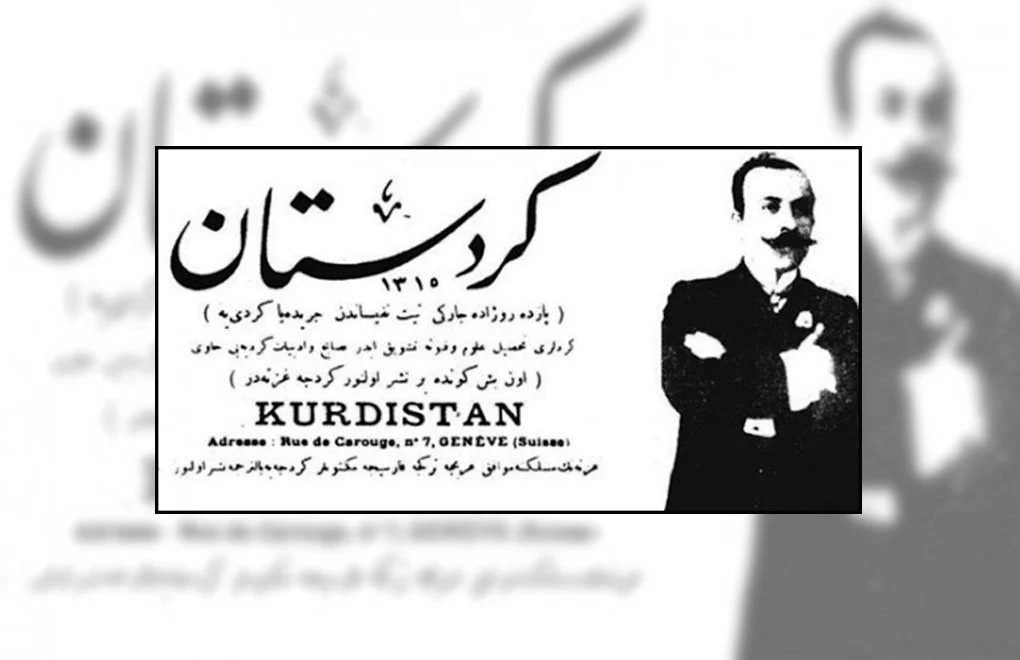
128 years ago, Mîqdat Mîdhad Bedirxan lit the torch of Kurdish journalism by publishing the Kurdistan newspaper in Cairo, Egypt. Despite all hardships, torture, murders, and exiles, this tradition continues.
From its inception, Kurdish journalism has been more than just an information tool; it has served as a mirror of national identity, an arena for linguistic struggle, and a political platform for a stateless nation. In all four parts of Kurdistan, every publication has simultaneously represented the press, resistance, and cultural memory. The character of this journalism distinguishes it from many other forms of media and makes it a vital source for political and cultural research.
From Kurdistan to Rojî Kurd, Jiyan, Hawar, Ronahî, Rojname, Welat, Azadiya Welat, and many others, Kurdish journalism continues its journey despite hardships, torture, assassinations, and exiles.
History of Kurdish Journalism (1898–2026)
I. EARLY PERIOD: CAIRO and EXILE (1898–1908)
Kurdistan — The First Kurdish Newspaper
On April 22, 1898, Mîqdad Midhat Bedirxan published the first Kurdish newspaper, Kurdistan, in Cairo.
Printing locations: Cairo (1–5), Geneva (6–19), Cairo again (20–23), London (24), Southern England (25–29), Geneva (30–31).
II. THE ISTANBUL PERIOD (1908–1918)
Rojî Kurd and Hetawî Kurd (1913–1914)
On June 6, 1913, the Hêvî association published the magazine Rojî Kurd. Following its closure, it continued under the name Hetawî Kurd.
Jîn and Kurdistan (1916–1918)
In 1916, Süreyya Bedirxan published the Turkish-language weekly Jîn (Life) in Istanbul, advocating for Kurdish independence. This publication is entirely distinct from Pîremêrd’s Jîn newspaper in Sulaymaniyah.
III. THE SOUTH AND THE SOVIETS (1919–1932)
Pêşkewtin and Sulaymaniyah
The first newspaper published within the Kurdistan region itself, Pêşkewtin (1920–1922), was released in Sulaymaniyah. Later, Jiyan (1926), edited by Pîremêrd, became the symbol of this era.
Riya Teze (1930–) — Voice of Soviet Kurdistan
It began publication in Yerevan on March 25, 1930, serving as the Kurdish organ of the Communist Party of Armenia.
IV. THE HAWAR ERA (1932–1943)
Celadet Alî Bedirxan and Hawar Magazine
In May 15, 1932, Hawar was published in Damascus. Celadet implemented the Latin-based Kurdish alphabet through this magazine, which remains the standard today.
Principal Writers: Celadet and Kamûran Bedirxan, Rewşen Bedirxan, Cegerxwîn, Osman Sebrî.
V. THE REPUBLIC OF MAHABAD (1945–1946)
Kurdistan Newspaper
Established in Mahabad on January 11, 1946. Although the Republic of Mahabad lasted only 11 months, it held a special place in Kurdish media history as a period of institutional statehood.
VI. & VII. THE FREE PRESS TRADITION (1990–2016)
Özgür Gündem and Apê Musa
On May 30, 1992, Özgür Gündem began publication. The Kurdish intellectual Musa Anter (Apê Musa) was assassinated in Diyarbakır on September 20, 1992.
Bombing of Buildings (1994)
On the night of December 2-3, 1994, the headquarters of the Özgür Ülke newspaper were bombed. Ersin Yıldız lost his life.
| Newspaper Name | Year | Status |
|---|---|---|
| Özgür Gündem | 1992 | Closed (1994) |
| Özgür Ülke | 1994 | Bombed |
| Azadiya Welat | 2006 | Closed (2016) |
VIII. THE ROLE OF WOMEN
Gurbetelli Ersöz (1965–1997)
The first female editor-in-chief of a daily newspaper in Turkey (Özgür Gündem). October 8th is celebrated as Kurdish Women Journalists Day.
Modern Institutions: JINNEWS and JIN TV (The first all-female satellite channel, 2018).
IX. THE SATELLITE REVOLUTION: MED TV
MED TV (1995–1999)
The first Kurdish satellite channel. It began broadcasting in March 1995, representing a media revolution for Kurds and a turning point for language standardization.
X. CONCLUSION AND HISTORICAL CHRONOLOGY
Historical Milestones
| Date | Event |
|---|---|
| 1898 | Kurdistan, Cairo (First Newspaper) |
| 1932 | Hawar, Damascus (Alphabet Revolution) |
| 1946 | Kurdistan, Mahabad |
| 1995 | MED TV, Europe (First Satellite TV) |
| 2018 | JIN TV |
Kurdish journalism is a 128-year tradition of resistance, stretching from exile to the digital age.
I. Kurdistan, the first Kurdish hewspaper
On April 22, 1898, Mîqdad Midhat Bedirxan (1858–1915), son of Bedirxan Pasha of Botan, published the first Kurdish newspaper under the name Kurdistan in Cairo. Under the shadow of Ottoman censorship, it was printed abroad in Geneva, London, and Folkestone, with a total of 31 issues released. The final issue was published in 1902.
In the first issue, Mîqdad Midhat Bedirxan stated his purpose with these words:
“Each time, I will talk to the Kurds a little about the benefits of reading and science. Through reading and science, one understands everything. Our Kurds are not as educated as other nations. Therefore, they are unaware of the world’s situation.”
The printing locations were as follows: Cairo (1–5), Geneva (6–19), Cairo again (20–23), London (24), Southern England (25–29), and Geneva (30–31). His brother, Abdurrahman Bey, took over the responsibility of publication in the later periods.
Kurdistan was not merely a source of information but an ideological platform. By establishing Kurdish as a medium for intellectual expression and resistance, it laid the foundation for the century to come.
II. The Istanbul period (1908–1918)
Rojî Kurd and Hetawî Kurd (1913–1914)
On July 27, 1912, the Kurdish Student Association Hêvî (Hope) was founded in Istanbul. On June 6, 1913, the association published the magazine Rojî Kurd (Kurdish Day). It was shut down by the government after four issues. During the same period, Yekbûn (1913, 3 issues) was published. On October 24, 1913, the magazine changed its name to Hetawî Kurd. It was essentially the same publication, continuing under a different name. The etymology of the names is interesting: Roj in Kurmanji and Hetaw in Sorani both mean “Sun.”
Jîn and Kurdistan (1916–1918)
In 1916, Süreyya Bedirxan published the Turkish-language weekly Jîn (Life) in Istanbul, which demanded Kurdish independence. Between 1917 and 1918, he published the weekly Kurdistan. It is important to clarify: this Istanbul-based Jîn was in Turkish and was entirely different from the Jîn newspaper published by Pîremêrd in Sulaymaniyah.
III. The South and the Soviets (1919–1932)
Pêşkewtin and Sulaymaniyah
The first Kurdish newspaper published within the geography of Kurdistan itself, Pêşkewtin (Progress), was released in Sulaymaniyah between 1920 and 1922 under British administration. 118 issues were printed. This was followed by a series of publications:
- Bangê Kurdistan (1922, 14 issues)
- Rojî Kurdistan (1922–1923, 15 issues)
- Jiyanewe (1924–1926, 56 issues)
- Jiyan (1926–1938, 556+ issues, under the editorship of Pîremêrd)
- Zarî Kurmancî (1926–1932, Rawanduz, 30 issues)
Pîremêrd and Jiyan-Jîn: Born in Sulaymaniyah, Tewfîq Mehmûd Hemze, known by his pen name Pîremêrd (1867 – June 19, 1950), became the editor-in-chief of Jiyan in 1926 and its manager in 1932. In 1938, he changed the name of Jiyan to Jîn and continued publishing it until his death on June 19, 1950. He also founded the first private Kurdish school, Qutabxaney Zanistî.
Riya Teze (1930–) – The Voice of Soviet Kurdistan
On March 25, 1930, it began publication in Yerevan using the Marogulov and Shamilov alphabet. It was the Kurdish organ of the Communist Party of Armenia. Initially managed by three Armenian Kurdologists (Kevork Paris, Hrachya Kochar, and Harutyun Mkrtchyan), the Kurdish Kurmanji scholar Cerdoy Gênco became the editor-in-chief in 1934. It was suspended during the Stalin era but resumed in 1955 with a Cyrillic alphabet. Mîroyê Esed (1919–2008) managed the newspaper until 1989.
IV. The Hawar era (1932–1943)
Celadet Alî Bedirxan and Hawar Magazine
After being exiled from Turkey, Celadet Alî Bedirxan published Hawar in Damascus on May 15, 1932. A total of 57 issues were released between 1932-1935 and 1941-1943.
Hawar holds special significance as the first media outlet published in Kurmanji Kurdish. For this reason, May 15 has been celebrated as Kurdish Language Day since 2006.
Celadet created a Latin-based alphabet for Northern Kurmanji, known as the “Hawar Alphabet” or “Bedirxan Alphabet,” which remains the standard today. Its purpose was: “Hawar is the voice of science. Science is for a person to know themselves; knowing oneself opens the path to freedom and happiness.”
Key writers: Celadet and Kamûran Bedirxan, Rewşen Bedirxan, Qedrî Can, Cegerxwîn, Osman Sebrî, Nûredîn Zaza, Ekrem Cemîl Paşa, Ahmed Namî.
Roja Nû and Stêr were published in Beirut by Kamûran Bedirxan. Nûdem (1992–2001, Stockholm, 40 issues, edited by Firat Cewerî) was referred to as the “Second Hawar.”
Rewşen Bedirxan
In a field largely dominated by men, Rewşen Bedirxan took her place as an active writer among the contributors of Hawar. She stands as a pioneering example.
V. The Kurdish Republic of Mahabad (1945–1946)
On January 11, 1946, during the brief existence of the Republic of Mahabad, the newspaper Kurdistan was established as the first Kurdish newspaper of the region, releasing a total of 113 issues. Alongside it, the literary magazine Kurdistan (16 issues) was also published.
When the Iranian army entered Mahabad on December 15, 1946, the Kurdish printing press was closed, Kurdish education was banned, and all Kurdish books, including school textbooks, were burned. Qazi Muhammad was executed on March 31, 1947. The Republic of Mahabad lived for only 11 months but secured a unique place in Kurdish media history.
VI. The South (1950–1990)
South Kurdistan
Between 1950 and 1963, numerous publications emerged in Baghdad and Sulaymaniyah:
- Hîwa (1957–1963, Baghdad, 36 issues)
- Xebat (1959–1961, Baghdad, 462 issues)
- Ray Gel (1959–1962, Kirkuk, 34 issues)
- Azadî (1959–1961, Rawanduz, 56 issues)
After 1968 and the Baathist occupation, the Kurdish press came under intense pressure. The Enfal and Halabja chemical attacks in 1988 signaled a period of extreme suppression for Kurdish media.
Diaspora
From the 1970s onwards, Kurdish media shifted its center to Europe (Germany, Sweden, France, Belgium). These publications were mostly party-affiliated and primarily political in content.
“Rojname” Newspaper (May 8, 1991)
In the early 90s, when the ban on the Kurdish language was slightly relaxed, Kurdish intellectuals and journalists sought to step into daily news reporting. This newspaper is recognized as the first trial of a daily newspaper based on “Kurdish Reality” in the history of Northern Kurdistan and Turkey after a long silence. Rojname was only able to print one issue. On the very day it was released, it was confiscated and banned by the State Security Court (DGM).
VII. The northern free press (1992–2016)
Özgür Gündem (1992–1994)
On May 30, 1992, under the leadership of Ragıp Duran, Özgür Gündem began publication, reaching a circulation of 60,000. During Ocak Işık Yurtçu’s tenure, circulation reached 100,000.
Systematic Murders (1990–1995):
Between 1990 and 1995, dozens of journalists, mostly from the Kurdish free press, were killed. Within this historical context, 76 victims are remembered as “martyrs of the free press.”
The Assassination of Apê Musa, September 20, 1992
Musa Anter (1920 – September 20, 1992) was born in the village of Zivinge, Nusaybin, Mardin. Known as “Apê Musa,” he was a prominent Kurdish writer and intellectual; he wrote for Özgür Gündem, Yeni Ülke, and Welat. He had been prosecuted in the “Trial of the 49s” for Kurdish propaganda. On September 20, 1992, he was murdered in an ambush in Diyarbakır. His murder remained a “perpetrator unknown” case. In 2008, the European Court of Human Rights convicted Turkey.
The Bombing of Buildings, December 2–3, 1994
Özgür Gündem was closed on April 14, 1994. Two weeks later, Özgür Ülke was launched. On the night of December 2–3, 1994, the technical center in Kadırga, Istanbul, the Çağaloğlu bureau, and the Ankara bureau were bombed simultaneously. Transport coordinator Ersin Yıldız lost his life, and more than 20 employees were injured.
Chronology (1992–2016):
| Name | Start | Outcome |
| Özgür Gündem | 1992 | Closed on April 14, 1994 |
| Özgür Ülke | 1994 | Bombed on Dec 2–3, 1994 |
| Gündem | 1995 | Closed |
| Ülke | 1996 | Closed |
| Özgür Gündem (New) | 2011 | Closed in August 2016 |
Welat and Azadiya Welat
Launched as a weekly in Istanbul on February 22, 1992, it was the first Kurdish-language newspaper in Turkey after the 1991 ban was lifted. In 1996, it became Azadiya Welat. In 2003, it moved its headquarters to Diyarbakır, and in 2006, it became a daily newspaper. It was closed on August 8, 2018, by a statutory decree (KHK) under the State of Emergency.
VIII. The role of women
Rewşen Bedirxan
She was an active writer in the Hawar ekol and served as a pioneering example in the early periods of the Kurdish press.
Gurbetelli Ersöz (1965–1997)
A chemist born in Elazığ/Palu. She was arrested in 1990 for political activities and spent two years in prison. On April 23, 1993, she began working at Özgür Gündem and became the editor-in-chief, making her the first female editor-in-chief of a daily newspaper in Turkey, not just in Kurdish media. On December 10, 1993, the newspaper building was besieged; Ersöz was detained along with 17 colleagues. After being held for 13 days, she was sent to Sağmalcılar Prison. At the trial, the prosecutor sought 15 years; Harold Pinter, Noam Chomsky, and the CPJ supported her. She was sentenced to 3 years and 9 months and released in June 1994. Since she was not allowed to work as a journalist, she joined the PKK in 1995. She lost her life in a clash on October 8, 1997. October 8 is celebrated as Kurdish Women Journalists Day.
Jinha, Jinnews, and Jin TV
JINHA began its operations as the Women’s News Agency. It was closed by the Turkish state in 2016 and subsequently continued as JINNEWS. On March 8, 2018, on International Women’s Day, JIN TV began broadcasting as the first satellite channel with an all-female staff.
IX. The Satellite revolution: MED TV and beyond (1995–2010)
MED TV (1995–1999)
In 1994, it received a license from the UK Independent Television Commission (ITC) and began test broadcasts in March 1995. It was the first Kurdish satellite channel and represented a media revolution for Kurds during a period of extreme state pressure. In the West, satellite dishes were in every Kurdish home, and dozens of families would gather in the evenings to listen to the news in their own language. At the request of the Turkish state, MED TV‘s license was revoked on April 23, 1999. Following this:
- Medya TV was launched but closed by French authorities.
- Roj TV (2003, Denmark) was closed.
- Nûçe TV, Stêrk TV, and others were launched in succession.
European News Agencies
The first Kurdish news agency, Dam, was founded in Germany in 2000, later becoming the Mesopotamia News Agency (MHA) in Frankfurt. After MHA was closed by German police, the Firat News Agency (ANF) was founded in Belgium in 2005.
X. Rojava (2011–2019)
On January 21, 2014, the Democratic Autonomous Administration was announced in Qamishlo on the anniversary of the Mahabad Republic. That same year, when ISIS attacked Sinjar, Kurdish journalism played a key role in bringing the voice of the Yazidi community to the world. During the siege of Kobanê, the Dengê Kobanî radio became the voice of the resistance.
XI. Principal figures
The Bedirxan Family
| Name | Life | Contribution |
| Mîqdad Midhat Bedirxan | 1858–1915 | Kurdistan (1898) — Founder |
| Süreyya Bedirxan | 1883–1938 | Jîn (1916), Kurdistan (1918) |
| Jeladet Alî Bedirxan | 1893–1951 | Hawar (1932–1943), Alphabet |
| Kamûran Bedirxan | 1895–1978 | Roja Nû, Stêr (Beirut) |
| Rewşen Bedirxan | — | Writer of the Hawar ekol |
Pîremêrd (1867–1950)
Real name: Tewfîq b. Mehmûd Hemze. Born in the Gwêje neighborhood of Sulaymaniyah. He was a poet, writer, and journalist. He became the editor-in-chief of Jiyan in 1926 and its manager in 1932. In 1938, he renamed Jiyan to Jîn. He founded the first private Kurdish school, Qutabxaney Zanistî. He passed away in Sulaymaniyah on June 19, 1950.
Musa Anter — Apê Musa (1920–1992)
Born in the village of Zivinge, Nusaybin, Mardin. He was convicted in the “Trial of the 49s.” He wrote for Özgür Gündem and Yeni Ülke. He was killed by JÎTEM in Diyarbakır on September 20, 1992.
XII. Hardships and obstacles
Systematic Bans
In Turkey, publishing in Kurdish was explicitly banned from 1924 to 1991. Subsequently, Kurdish journalists were prosecuted under Article 8 of the Anti-Terror Law and later Article 314.
The 2016 Mass Shutdowns
During the State of Emergency (2016–2018), via Decree Laws (KHK):
- Azadiya Welat was closed (August 2016)
- JINHA was closed (2016)
- IMC TV was closed (2016)Dozens of journalists were arrested and sentenced.
XIII. The digital age (2010–2026)
Digital media brought three major changes:
- Proliferated: Social media, websites, and Kurdish podcasts increased.
- Weakened: The financial model of print media collapsed; many newspapers closed.
- Renewed: ANHA, ANF, Rudaw, Kurdistan 24 developed a global Kurdish digital media model, though most remain affiliated with political parties or governments.
Conclusion
| Date | Event |
| April 22, 1898 | Kurdistan, Cairo — Mîqdad Midhat Bedirxan |
| June 6, 1913 | Rojî Kurd, Istanbul |
| March 25, 1930 | Riya Teze, Yerevan |
| May 15, 1932 | Hawar, Damascus — Jeladet Alî Bedirxan |
| January 11, 1946 | Kurdistan, Mahabad — Republic of Mahabad |
| May 30, 1992 | Özgür Gündem, Istanbul |
| February 22, 1992 | Welat, Istanbul |
| September 20, 1992 | Assassination of Apê Musa |
| Dec 2–3, 1994 | Bombing of Özgür Ülke |
| March 1995 | MED TV — First Satellite TV |
| October 8, 1997 | Assassination of Gurbetelli Ersöz |
| March 8, 2018 | JIN TV |
| 2026 | The journey continues |
Kurdish journalism has faced oppression and obstacles for over 128 years. From Cairo to digital platforms, from exile to war, and from the Bedirxan family to the generation of Jinnews and Jin TV, this tradition endures.
*Infographics prepared with Gemini and ChatGPT.