
Academics for Peace declared that in the 10 years since being expelled from public service under State of Emergency Decree-Laws (OHAL KHK), 385 of their applications were rejected, 189 lawsuits were dismissed and 173 were ruled in the applicants’ favor. Out of hundreds of applications, only 18 of the scholars were granted to be reinstated to their posts.
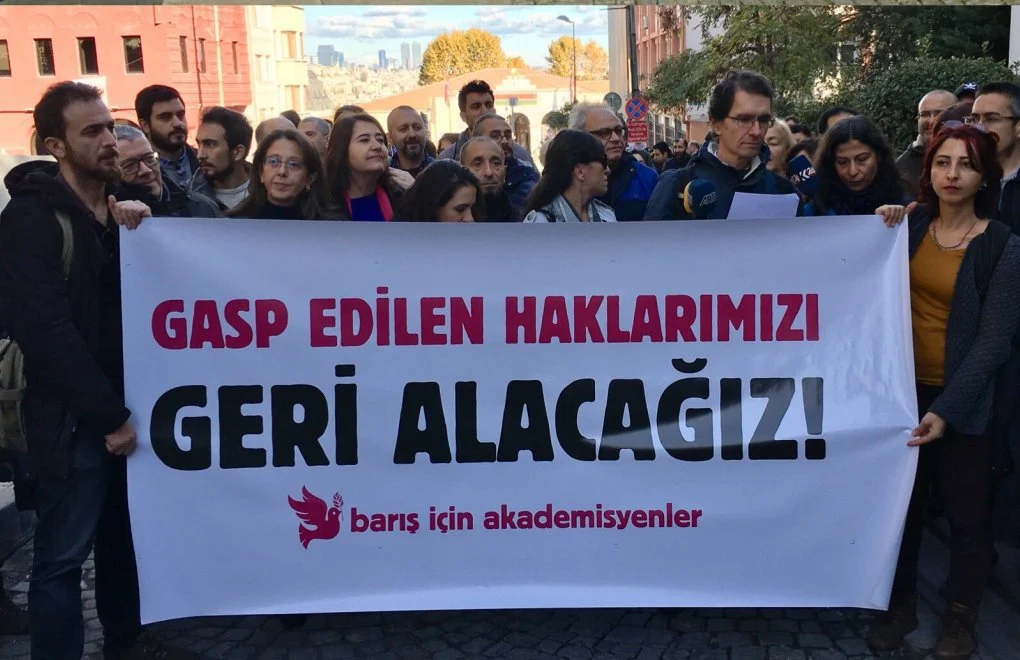
The Academics for Peace, who were dismissed under the State of Emergency Decree-Law after issuing a “Statement forPeace,” released a declaration detailing the events that have unfolded since the first expulsions ruled a decade ago.
Through the announcement on their social media account, the Academics for Peace shared statistical data covering the periodfrom 2016 to 2026. According to this data, 10 State of Emergency Decree-Laws issued between 2016 and 2018,resulted in the expulsion of 406 academics, and 385 of the applications made to the Inquiry Commission on State of Emergency Measures (OHAL İşlemleri İnceleme Komisyonu) were rejected.
The commission, established in 2017, did not finish announcing its rejection decisions until the end of 2021. Only after this date could applications be filed with the courts. Emphasizing this barrier, Academics for Peace stated, “Access to justice was blocked for nearly 5 years.”
189 Rejections from the Administrative Courts
Alongside the data on the administrative courts and regional administrative courts, the announcement provided information regarding the Council of State (Danıştay) and Constitutional Court (Anayasa Mahkemesi).
Accordingly, of the lawsuits brought before the administrative courts, 189 resulted in rejection while 173 were accepted. As for the regional administrative courts, the appeals in 124 cases resulted either in the acceptance of the appeal or the reversal of the decision, both against the applicant.
In contrast, 147 of the cases concluded with a reversal or an acceptance in favor of the applicant, while no decision was reached in 91 cases.
As for the 5th Chamber of the Council of State (Danıştay 5.Daire), where the cases of the Academics for Peace were brought, 18 cases resulted in a favorable upholding decision, finalizing their reinstatement to office. In 4 cases, an unfavorable upholding decision was issued, leading them to be brought before the Constitutional Court. In one case, an unfavorable reversal decision was issued; since this ruling differed from the regional administrative court’s judgment, the case is currently being reconsidered by the regionaladministrative court (BİM).
In an additional 29 cases, the process resulted in favorable reversal. However, as the rulings differ from the Regional Administrative Court’s decisions, they are being re-evaluated by the regional court. In 9 of the cases, the regional administrative court insisted on its original decision to accept the appeal against the applicant. The cases were subsequently brought before the Plenary Session of Administrative Law Chambers of the Council of State (Danıştay İdari Dava Daireleri Kurulu).
Meanwhile, 219 cases remain pending without a decision.
4 Cases are currently before the Constitutional Court
The 4 cases brought before the Constitutional Court by the Academics for Peace are currently being heard. 9 case files are pending before the Plenary Session of Administrative Law Chambers of the Council of State.
Background
The 406 academics who signed the declaration titled “We will not be a party to this crime!” on January 11, 2016, were expelled under Decree-Laws signed by then-President Recep Tayyip Erdoğan on September 1, 2016. In addition, 822 of the signatory academics stood trial before the Heavy Penal Court.
Although the Heavy Penal Court issued acquittals, ruling that the petition fell under freedom of expression, the Academics for Peace were still not reinstated to their posts. This was because, regarding the applications the scholars had pending before the European Court of Human Rights during this period, it was ruled that “domestic remedies must first be exhausted.”
Following the coup attempt on July 15, 2016, the State of Emergency (OHAL) Commission was established to handle all case files related to the Academics for Peace and the Gülenmovement. This commission issued rejection decisionsregarding the reinstatement of nearly all Academics for Peace. Because it took until 2021 for the commission to announce these rejection decisions, the academics’ access to a higher court was delayed by approximately 5 years.
As a result, the Regional Administrative Court proceedingsbegan in 2019. The legal process, which has now spanned nearly 10 years, is still ongoing.
As of June 2023, it was reported that numerous Academics for Peace, who had been dismissed under the decree-laws, were still not reinstated by universities, despite court rulings ordering their return to work.
According to the report regularly published by the Academics for Peace, while some courts rule in favor of the actions for annulment filed for their reinstatement, others might reject.
Furthermore, scholars of every level are being subjected to renewed security clearances, which include everything from screening social media accounts to reviewing memberships in foundations, associations, and similar organizations. As a result,the reinstatement processes take even longer, progressively restricting the academics’ active and critical production of knowledge.