Mazlum Özdemir, one of the coordinators of Kurdish Monitoring, divides demands regarding the Kurdish language under two heading directed at the state and at Kurdish society: “Demands directed at the state can quite clearly be formulated as the removal of all legal and practical barriers placed before the Kurdish language in the public sphere.”
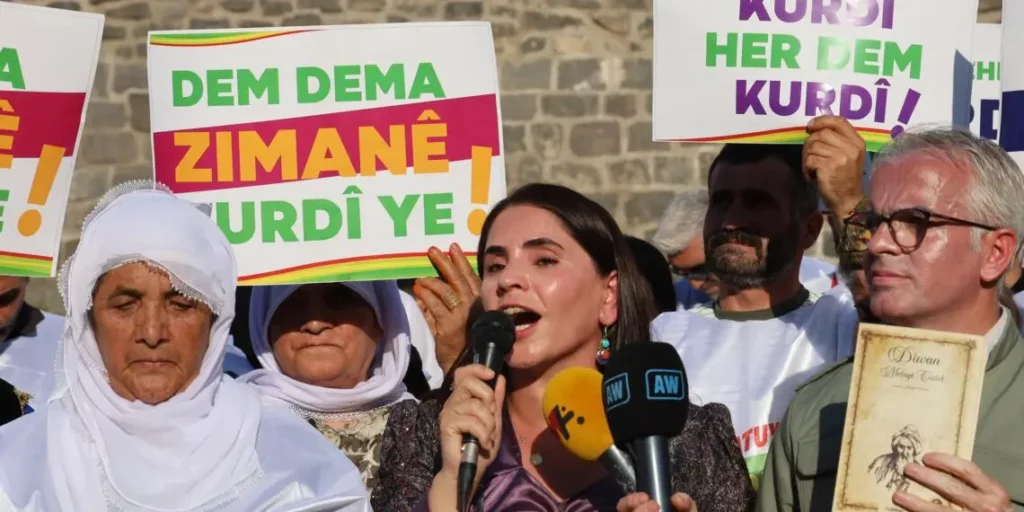
Mazlum Özdemir, one of the coordinators of the Kurdish Monitoring platform, which is established in 2024 to track bans and restrictions on the use of Kurdish in the public sphere, spoke about the assimilation policies that have persisted in Turkey since the founding of the Republic, as well as the initiative’s goals. Özdemir said that the state structure shaped around Turkish national identity has systematically disregarded Kurds and the Kurdish language, and that they therefore view all violations as a serious matter that must be documented.
Kurdish Monitoring, launched in 2024 by a group of journalists, records the pressures exerted against the Kurdish language. Noting that the assimilation policy applied since the founding of the Republic has targeted Kurds, Özdemir says: “In order to institutionalize the Republic of Turkey’s structure, which was built upon the Turkish ethnic nation, all other ethnic, religious, and cultural identities were disregarded, subjected to assimilation, and exposed to massacre. Kurds and the Kurdish language received their share of this as well.” In this context, Özdemir recalls that the Law on the Maintenance of Order and other laws enacted during the Republican era denied the very existence of Kurds and banned Kurdish from the public sphere, adding: “The aim was to assimilate and eliminate Kurdish, just like all other languages spoken on these lands.”
This policy effectively continues to this day
Mazlum Özdemir emphasizes that despite some legal adjustments made after the 1990s, the use of Kurdish remains banned: “Starting from the 1990s, certain legal regulations were made and some of the barriers before Kurdish were lifted — but both legally and in physical, practical terms, the use of Kurdish in Turkey is banned. People are attacked and killed for speaking Kurdish in the street. Artists and attendees are detained and arrested for singing Kurdish songs at weddings. Kurdish-language concerts are banned by governors or mayors. The ‘right of mothers to speak Kurdish with their children in prison,’ which President Erdoğan has repeatedly claimed to have lifted and boasted about, is still banned. Kurdish publications cannot enter prisons; books written in Kurdish are blocked by prison administrations and cannot be sent outside.”
We aimed to make systematic repression visible
Describing how the initiative came about, Özdemir says: “We want the barriers to the use of Kurdish in Turkey to become visible, and to show that a systematic policy of obstruction is being applied.” He notes that while this situation is known to the public, it is often forgotten amid the intensity of the daily news agenda: “In the chaos of the day, these things often remain as stories we read and move past. Yet this is a serious violation against a language, and they need to be brought together in a systematic way — because the obstruction itself is systematic. It is not isolated or sporadic. These barriers and bans arise as the result of a policy and an ideological approach.”
Stating that they currently share their reports with the public and the media, Özdemir adds that they will also share them with national and international institutions: “The issue has an international dimension as much as a national one. Turkey is a country that has for years sought to become a member of the European Union and has undertaken certain efforts toward that goal. It is important to present, in the form of systematic reports, how a country seeking membership in the Union approaches human rights and language rights.”
Mazlum Özdemir emphasizes that they collect their data entirely from open sources: “News published in conventional media and social media, along with statements and reports released by civil society organizations, make up our sources.” However, he adds that the pressures faced by the Kurdish language are far greater than what appears in these outlets: “We also know from our daily experience that the reactions shown to people speaking Kurdish among themselves on the street or on the phone, or speaking Kurdish at school, at the grocery store, or at the hospital, are very rarely reflected anywhere. There are barriers and pressures that arise from covert racism.” Despite this, Özdemir notes that their physical and technical infrastructure remains limited, saying they currently document violations under only four main headings: “We report violations in the areas of media, prisons, public space, and culture and arts.”
The state spread assimilation through all public instruments
Describing the tools of assimilation policy, Özdemir argues that the state denied the Kurdish language through schools, media, and academia. “The Republic’s assimilation policy was shaped around the premise that Kurdish did not exist — and when that could no longer be sustained, around the premise that it was not a language. Once that became the policy, its instruments had to be set in motion. Schools became an important tool for banning Kurdish from the public sphere. Media emerges as another instrument. And these have now merged with today’s digital technology,” he says.
He goes on to describe how this process operated:
“Schools, media, academia, and all other instruments spent years propagandizing this and putting this policy into practice. Kurdish was prevented from becoming a language of education; children who spoke Kurdish at home were unable to speak it at school, and when they did, they faced systematic pressure from teachers. Teachers would assign one student among their peers the task of finding out whether children were speaking Kurdish at home — and when that student heard or saw children speaking Kurdish at home, they would report it to the teacher, causing those other children to be punished and beaten.”
Özdemir notes that this mechanism of repression was also sustained through the media: “Universities and the publications they produced spent years propagandizing that Kurds do not exist and that Kurdish is not a language. The media was used as a platform through which these policies were reproduced and disseminated.”
The warning of ‘self-assimilation’
According to Özdemir, despite all these pressures, Kurdish resisted assimilation for many years. However, he says that in recent times the concept of “self-assimilation” has also entered the conversation. “Particularly over the last 20 years, Kurds have begun using the concept of self-assimilation almost as much as assimilation itself,” he says. He explains the reason as follows: “For many years, Kurdish put up serious resistance to assimilation. Yet, particularly over the last 20 years — though it existed before as well — Kurds have begun using the concept of self-assimilation almost as frequently as assimilation. Because for some time now, certain voices have been suggesting that assimilation has been ‘successful,’ and it is acknowledged that self-assimilation is also being observed on a significant scale.”
Noting that even in villages, parents speaking Turkish with their children illustrates the extent of self-assimilation, Özdemir says: “When there is no Kurdish-language education in schools, when Kurdish television and digital media are banned and blocked, and when extra effort is made to ensure Turkish-language media reaches everywhere in response — it should come as no surprise that such an outcome would follow.”
Demands: To the state and to society
Mazlum Özdemir groups the demands regarding the Kurdish language under two headings: those directed at the state and those directed at Kurdish society. He lists the responsibilities that fall to the state as follows:
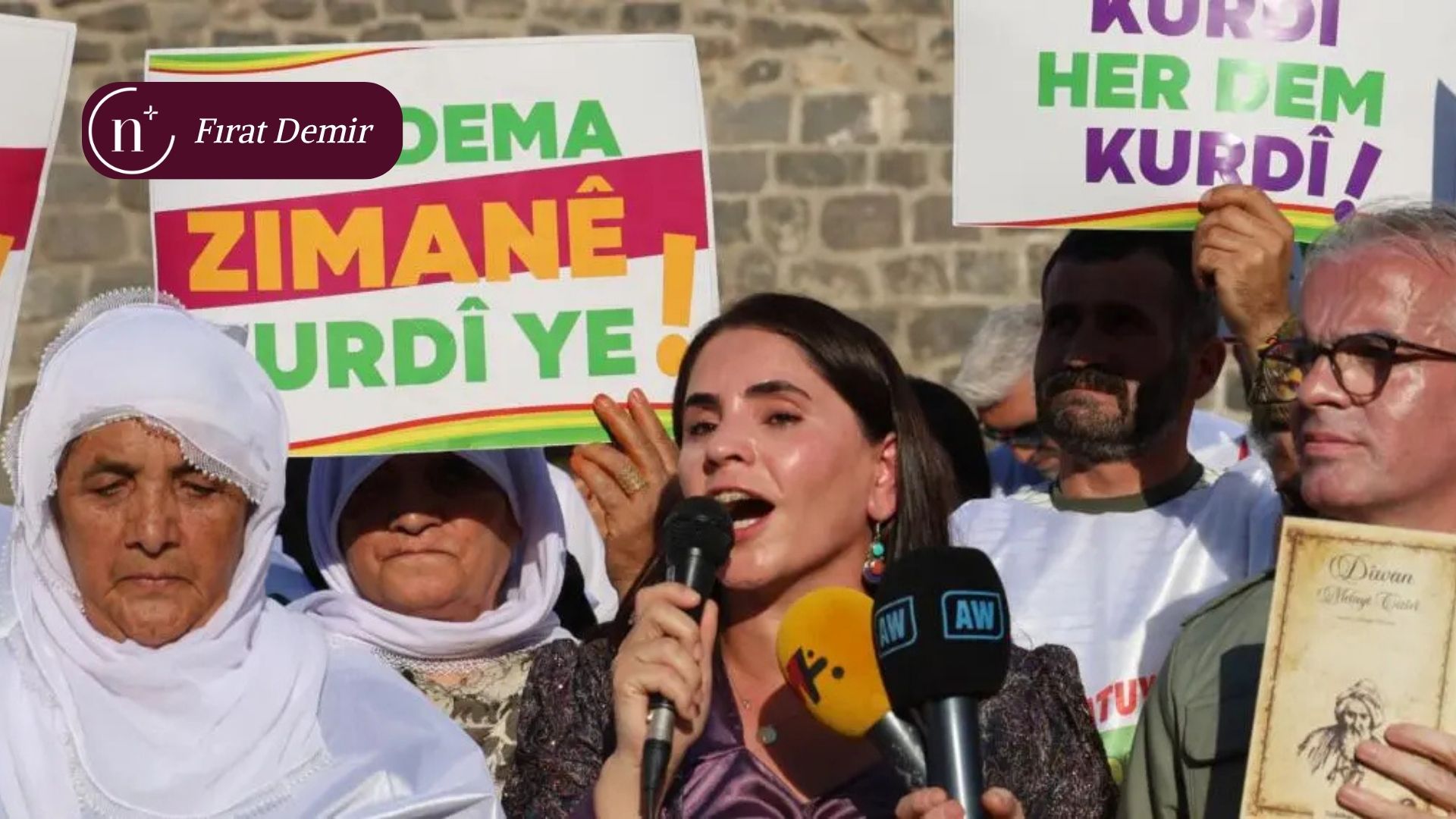
“Demands directed at the state can quite clearly be formulated as the removal of all legal and practical barriers placed before the Kurdish language in the public sphere. That is: Kurdish must become a language of education and be present at all levels of schooling; official space must be opened for Kurdish in all public institutions and organizations; barriers before Kurdish-language media must be eliminated; and the obstruction of cultural and artistic activities must come to an end. In short, all barriers must be removed and active encouragement must be provided so that Kurdish is officially recognized, becomes widespread, and can be learned and taught.”
He also draws attention to the responsibilities of Kurdish society and politics: “In parallel with these steps, Kurds themselves must use Kurdish in every area of their daily and public lives and resist assimilation as they have in the past. As for Kurdish politics — beyond reminding the state of its duties and responsibilities on this matter, it must also be criticized for not using Kurdish more within its own internal mechanisms, and public pressure must be built to push it toward taking steps in that direction. Because while the state bears responsibility for assimilation, Kurdish society and the political movement bear responsibility for self-assimilation.”