In her solo exhibition “neither carnation nor frog,” Banu Cennetoğlu invites us to think about fatherhood, rights, boundaries, loss, and power.
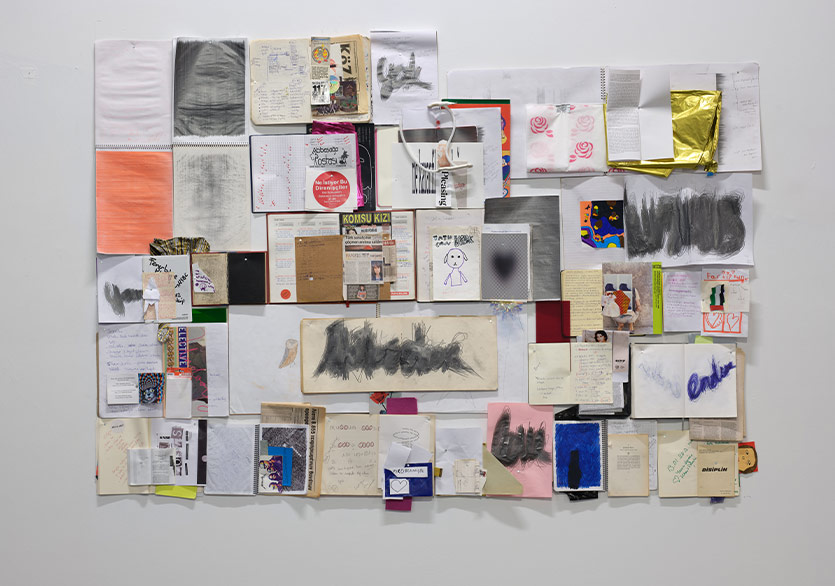
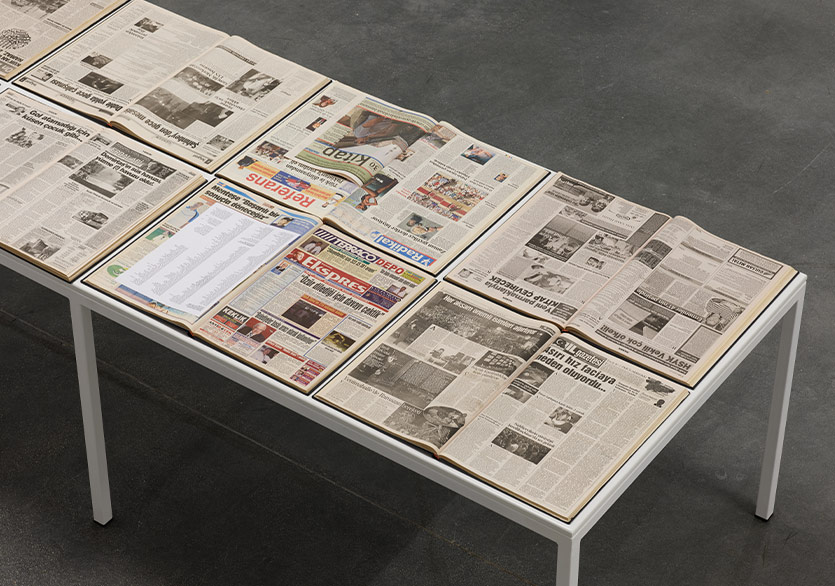
Artist Banu Cennetoğlu’s solo exhibition “ne karanfil ne kurbağa” (neither carnation nor frog) was shown in Bursa at İMALAT-HANE between October 25, 2025 and January 20, 2026, curated by Yavuz Parlar. It is now viewable online at https://nknk-erika.imalat-hane.com.
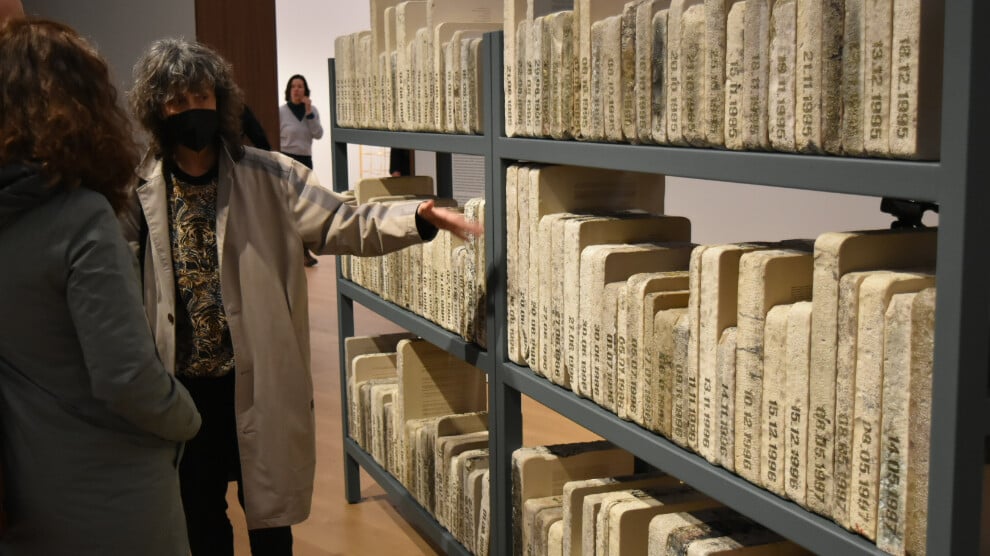
Cennetoğlu is known for her long, research-based projects rooted in personal and collective memory. In a previous work, she engraved the book “Yüreğimi Dağlara Nakşettim” which is based on the diaries of Gurbetelli Ersöz, Turkey’s first female editor-in-chief, onto 145 limestone tablets. In this new exhibition, she looks at three connected ideas: power, reputation, and denial.
Banu Cennetoğlu’s work is rooted in long, careful research and draws on both personal and shared memory. Her practice often focuses on how knowledge is produced, organized, and circulated. In this exhibition, she thinks through ideas of fatherhood, rights, boundaries, loss, and power — alongside the slipperiness of both speaking and making promises. The exhibition was curated by Yavuz Parlar. The emails, arguments, and personal outpourings that Cennetoğlu and Parlar exchanged during their collaboration didn’t just shape the exhibition, they also became a companion publication called nknk-erika.
The exhibition itself didn’t come together through a typical curatorial process. Instead, it grew naturally out of the back-and-forth between the two. It started as a digital exchange, messages sent without any fixed goal in mind. Once they decided to just begin, a simple rhythm took over: each day, one would send something to the other, and the other would respond.
“The personal is also political”
In the exhibition, the figure of the father — and everything connected to it — serves as a research space that stretches from personal experience to collective memory, and from there to apologies that can never quite be made.
The exhibition also helps us remember the grief and pain carried by children who lost their fathers, fathers killed in the struggle against the system, against what might be called the “state as father”: a power and authority that defines and enforces the rules.
In a conversation with Sina Ergün, Cennetoğlu describes the exhibition like this:
“Starting from a personal place, I’d describe it roughly as a state of being haunted. Setting aside fathers and forms of fatherhood that have managed to be different, for me, fatherhood is, both personally and socially, a way of existing that is self-satisfied, certain of itself, arrogant, and apparently without doubt about the unwritten rules it considers absolute truth.
And to keep that certainty going, three things are essential: power, reputation, and denial. A structure that loves, protects and spreads these things, that punishes those who object, wants to ‘correct’ them, and feels entitled to cross other people’s boundaries, all while claiming it’s for their own good.”
Looking at fathers and children who have experienced loss in the Kurdish conflict
Viewing the exhibition and reading the conversation afterward brings to mind the enormous cost of grief carried by fathers who lost their children — and children who witnessed their fathers’ deaths — in the struggle against political violence in Kurdistan. This cost, for any hope of peace, democracy, and living together, is immense and raw. These losses leave an indescribable pain and emptiness, felt most deeply within families and close communities.
The long-term effects of this pain and absence don’t stay private. They become part of how children who lived through it see and remember the world, and through them, part of society itself. When past suffering goes unaddressed, when those responsible are never held accountable, the sense of justice fades. And with it, so does mutual trust and the hope of sharing a future together.
Looking again at Kurdish fathers and children who have experienced such loss should be understood as an act of rebuilding memory. On one hand, it means examining the fractures in the father-child relationship through a political and social lens. On the other, it means listening to the memories of children who lost their fathers to state forces — memories filled with absence, grief, and pain. This can be read either as a wound that never fully heals, or as a genuine act of resistance.
It is also worth remembering that these children are now the adults of today and tomorrow people who carry and keep reproducing an emotional memory tied to a specific period of history.
Looking at the roots of the Kurdish conflict through the inner lives of children who were left carrying the consequences of what their fathers went through will also shed light on how these collective experiences keep being reproduced inside individual lives.
As the poet Hasan Hüseyin Korkmazgil wrote – and as this exhibition reminds us – fatherhood, where the personal is as social as the social is personal, is “neither carnation nor frog.”
About Banu Cennetoğlu
Banu Cennetoğlu works across disciplines, using archival methods to question how memory is shaped, and how knowledge is produced, shared, and consumed. Her solo exhibitions have been shown at institutions including Kunsthal Charlottenborg, Copenhagen (2025); Sylvia Kouvali, Athens (2024); K21 Ständehaus, Kunstsammlung Nordrhein-Westfalen, Düsseldorf (2019); Sculpture Center, New York (2019); Chisenhale Gallery, London (2018); Bonner Kunstverein (2015); Salonul de proiecte, Bucharest (2013); and Kunsthalle Basel (2011). She has participated in numerous group exhibitions and biennials in Berlin, Istanbul, Liverpool, Gwangju, Athens, and Venice, as well as Manifesta 8 in Murcia, documenta 14 in Athens/Kassel, and the 58th Carnegie International in Pittsburgh. Cennetoğlu is the founder of BAS, an artist-run initiative in Istanbul focused on artist books and printed matter, and serves as an advisor at the Rijksakademie in Amsterdam. She lives and works in Istanbul.