
Archeological excavations at the ancient city of Syedra in Antalya uncover a mosaic figure, with the inscription “Haters gonna hate”.
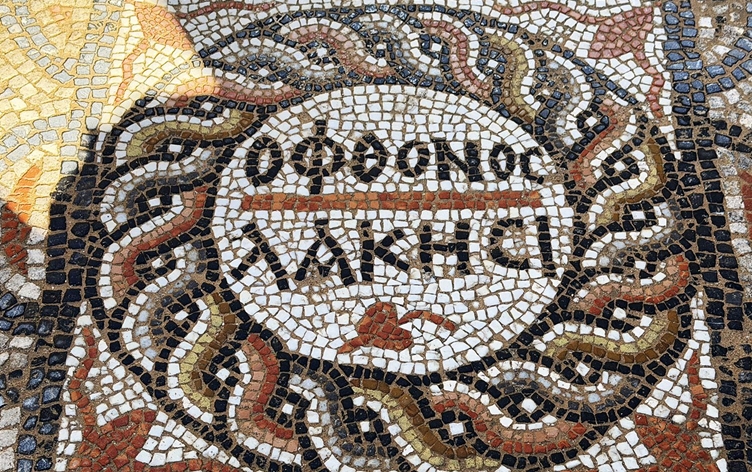
During archaeological excavations at the ancient city of Syedra in the Alanya district of Antalya, Turkey; a mosaic estimated approximately 15 square meters -believed to have been created between the 4th and 6th centuries A.D. and with the inscription “let the jealous burst”, roughly equivalent to “haters gonna hate”- had been discovered.
Excavations are being carried out under the Culture and Tourism Ministry’s Heritage for the Future Project, led by Associate Professor Ertuğ Ergürer.
Excavation Director Assoc. Prof. Dr. Ertuğ Ergürer told an Anadolu Agency (AA) journalist that they had made an important discovery during excavation work being carried out in one of the city’s largest residential structures, which dates back approximately 3,000 years.
The ancient city of Syedra, whose history dates back to the 9th century B.C., is located in the Alanya district of Antalya Province, Turkey, and is known to have been home to numerous empires.
Turkish phrase “Let the jealous burst” is on the mosaic
Noting that what makes the approximately 15-square-meter mosaic unique is the presence of two writings on it, “In the central part of the mosaic, there is an expression meaning something like ‘use it well.’ In the entrance door section of the room, there is a second inscription within a circular border. This inscription also has a somewhat metaphorical meaning. The first word in the inscription means ‘jealousy’ or ‘the jealous one,’ while the second word means ‘cracking’ or ‘bursting.’ It corresponds to the expression ‘may the jealous one burst,’ which we still use (in Turkish) today. Coming across such an expression in the entrance section of a structure built approximately 1,500 years ago was a huge surprise for us.” said Ergürer.
Ergürer explained the AA, that the northern section of the triple building has entrances to the second and third floors, “The structure, which has numerous rooms and a central courtyard in the middle, was in use from the 2nd to the 7th century A.D. During this period, the owners changed, new spaces were added, additional floors were built, and some sections were closed off. In later periods, the entrance area and the upper part of this mosaic-covered section were enclosed. The fact that the mosaic was covered has ensured that it has survived to the present day in such good condition,” he said.
Ergürer noted that they believe the construction to be one of Syedra’s significant residential structures and that excavation and restoration work will continue at certain points of the structure.
The archaeologists aim to uncover new evidence regarding daily life during the late Roman Empire and the early Byzantine period.